

The previous article used two tools of formal logic, modus ponens and modus tollens, to argue that life’s coded architecture points to intelligence rather than to unguided chemistry. That is where many design arguments stop. Intelligence, mind, something. The conclusion is left vague, which makes it easier to defend but also less interesting.
The vagueness is not necessary. The same two tools, applied carefully, take the argument further. Not all the way to the full content of Christian theology. But further than most people expect, and into territory that overlaps substantially with what is commonly called God.
The move is straightforward. Once you have concluded that some intelligence is the best explanation for life’s coding, you can ask what kind of intelligence it would have to be. The answer is not any old mind will do. The cause has to fit the effect.
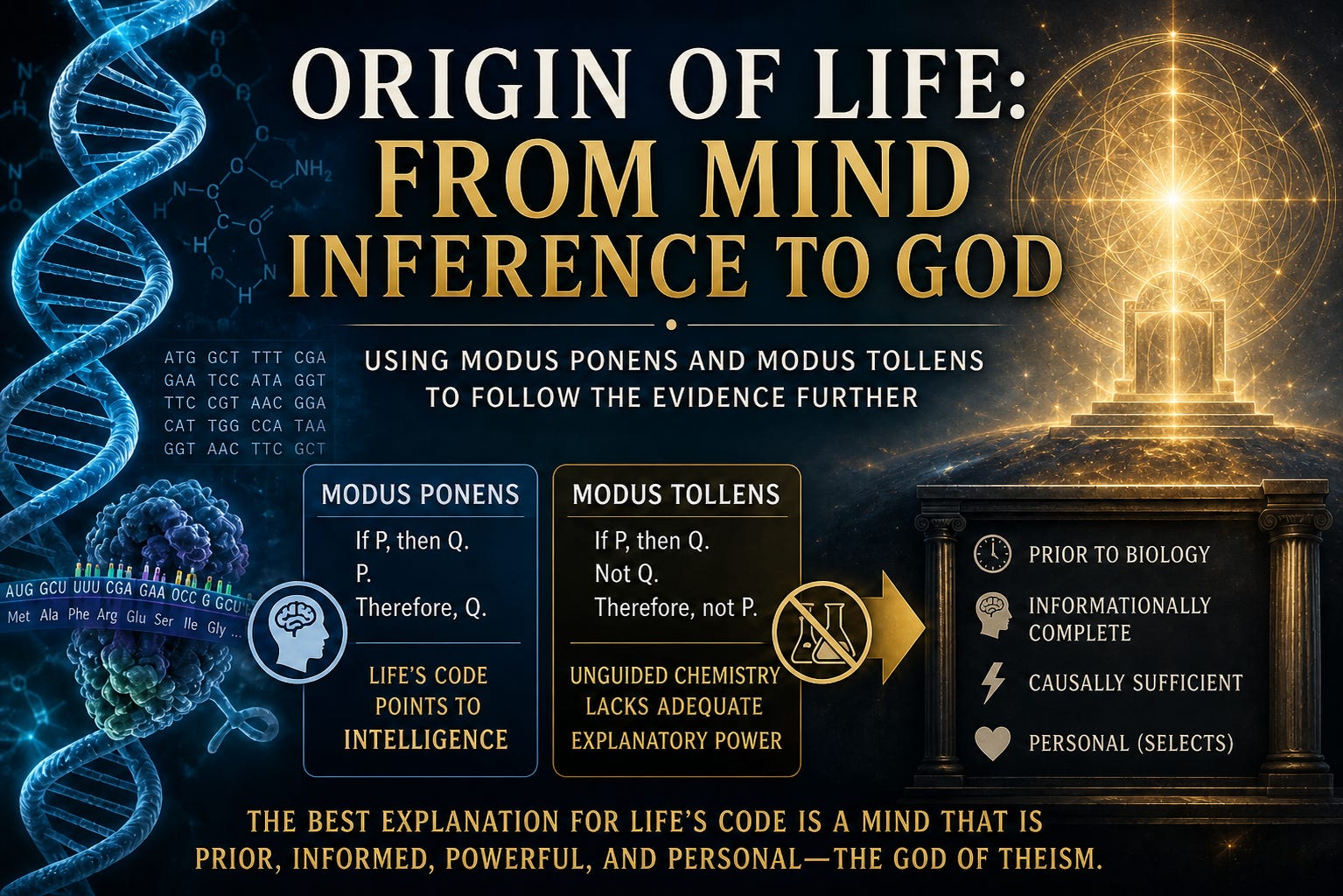
Start with what the effect requires.
Life’s coding system is prior to life itself. The translation machinery, the symbolic mapping, the rules that govern how sequences become proteins, all of it has to be in place before biology as we know it can run. A code that decodes itself into existence is not a code. It is magic, and we are trying to avoid magic.
So plug that into modus ponens.
If life’s coding system is the best explanation for biology, and that coding system is prior to biology, then its cause must be prior to biology. Life’s coding system is prior to biology. Therefore, its cause is prior to biology.
That single step removes a large family of candidates. The cause cannot itself be a biological organism. It cannot be a product of evolution, since evolution presupposes the very coding system whose origin is in question. Whatever mind we are talking about, it is not a mind of the kind we are familiar with from the natural world. It exists, or operates, on the far side of the system it explains.
This is not yet God. It is, however, the elimination of every materialist proposal that locates intelligence somewhere downstream of life. Aliens seeded earth, panspermia, simulated universes run by evolved civilizations, all of these merely push the question back. Where did their coding come from? The regress has to terminate somewhere, and wherever it terminates, the cause is prior to coded life as such.
Next property. The cause must possess the information before the system exists.
This sounds trivial but it is not. To originate a code is to specify, in advance, the mapping between signs and outcomes. Codons map to amino acids in a way that is not dictated by chemistry. The mapping is, in the technical sense, arbitrary. Other mappings are possible. The one we have was selected from a large possibility space.
Selection from a possibility space is the signature of mind. Not pattern-matching, not blind iteration, but the holding-in-view of alternatives and the picking of one. Whatever produced life’s code had the relevant information available to it before any biology existed to embody that information. Mind with content, not mind as a side-effect of brains.
Modus ponens again.
If originating a code requires possessing its content prior to its instantiation, and life’s code was originated, then its cause possessed the content prior to instantiation. Life’s code was originated. Therefore, its cause possessed the content prior to instantiation.
Now apply modus tollens to the rival.
If unguided physical processes are sufficient to specify a code’s content, they should demonstrate the capacity to hold informational content prior to any physical substrate. Unguided physical processes do not hold informational content prior to physical substrates. They are physical substrates. Therefore, unguided physical processes are not sufficient to specify a code’s content.
The rival fails. The remaining candidate is something that holds content without depending on a physical substrate to do so. That is a property classical theism has always attributed to God. It is not the whole of the doctrine, but it is a real and substantial overlap.
Third property. The cause must be sufficient to instantiate what it specifies.
A mind that knows how a code should run is not yet a cause. Causation requires power adequate to the outcome. To bring about life’s coding system is to bring about a system whose informational and chemical complexity vastly exceeds anything human engineering has matched. Even modest synthetic biology efforts succeed only by piggybacking on existing biological machinery. Origin-of-life is a different problem. It requires producing the whole apparatus from non-coded inputs.
Whatever did this had causal power on a different order from anything in our normal experience. Not infinite, perhaps, by the strict philosophical sense of that term. But certainly sufficient to instantiate, from outside the system, an architecture that the system itself could not produce.
This is the third overlap with classical theism. A cause that is prior to the natural order, holds informational content independently of physical substrate, and exercises causal power adequate to bring the natural order into being. Three properties, all converging on the same profile.
Fourth property, and the one that completes the convergence. The cause selected.
The genetic code is one of many possible mappings. Other codon assignments would work in principle. The actual code shows error-minimizing structure that random alternatives almost never match. The estimates have only gotten steeper as the analyses have gotten more refined. Freeland and Hurst found that roughly one in a million randomly generated codes outperforms the natural one when realistic mistranslation biases are included (The Genetic Code is One in a Million, Journal of Molecular Evolution 47, 1998, pp. 238–248). Gilis, Massar, Cerf, and Rooman, using a completely independent cost function based on protein folding stability, estimated the figure at roughly one in a hundred million, with later refinements pushing toward one in a billion (Optimality of the Genetic Code with Respect to Protein Stability and Amino-Acid Frequencies, Genome Biology 2:11, 2001). Two independent measures, two independent cost functions, both pointing in the same direction. The code is not just non-random. It is non-random by orders of magnitude that grow as the analysis gets sharper.
There is an ongoing technical debate about whether this optimization is best explained by direct selection or by partial optimization from a frozen accident in a rugged fitness landscape (Koonin and Novozhilov, IUBMB Life 61:99–111, 2009). That debate is real and worth tracking. But notice what neither side disputes. The mapping is not chemically forced. It was selected, in the literal sense that one mapping out of an enormous possibility space became the actual one, and its position in that space is statistically extraordinary. Whether that selection was performed by Darwinian fitness pressure, by some pre-biotic dynamic still unknown, or by something else entirely, selection from a possibility space is the signature of mind. Impersonal forces do not weigh options. They do not navigate landscapes. They do not arrive at one-in-a-billion outcomes by accident, and when they appear to, the working assumption in every other domain of inquiry is that we are missing something.
Selection is the act of a personal agent. Not necessarily a person in the human sense, but an agent with the capacity for choice, evaluation, and intent. Impersonal forces do not select in this way. Gravity does not weigh options. Thermodynamics does not prefer outcomes. Whatever picked the actual mapping out of the possibility space exercised something that functions like will.
So the cause is prior, informationally rich, causally adequate, and personal. At this point we are no longer talking about intelligence in the bare abstract. We are talking about a being with mind, will, knowledge, and power, operating outside the natural order it brought into being.
That is not the full content of Christian theology. It does not by itself give you the Trinity, or the Incarnation, or the moral law in its fullness, or any specific revelation. Those come from somewhere else, and they require their own arguments.
But it is, recognizably, what people have meant for thousands of years when they used the word God.
The honest objection is the same one raised against the first article. This is just God of the gaps. You are inferring a designer from your ignorance of how nature could have done it.
The answer is the same. The argument does not run on ignorance. It runs on positive knowledge of what kind of cause produces what kind of effect. Codes come from minds. Codes that exist prior to physical substrates require minds that hold content independently of physical substrates. Codes that are selected from possibility spaces require agents that select. None of this is a gap in scientific knowledge. It is the application of well-attested causal patterns to a well-described explanandum.
The gap, if there is one, is in the rival account. Unguided chemistry has not shown how non-coded matter becomes coded matter. That is the bill that remains unpaid. Until it is paid, the better explanation runs through mind, and the kind of mind in view bears a striking resemblance to what theism has always described.
Two tools, applied twice. The first application argued from biology to intelligence. The second argues from intelligence to the kind of intelligence the effect requires. Prior. Informationally complete. Causally sufficient. Personal.
Each step is a modus ponens or a modus tollens. The premises are open to inspection. The form is valid. The conclusion is not the whole of Christian doctrine, but it converges on the central figure of that doctrine in a way that is hard to wave off as coincidence.
The textbook used the word code without apology. Follow what that word implies, all the way down, and you do not arrive at some vague intelligence. You arrive at a profile most people already have a name for.