

Most arguments fall apart not because the conclusion is wrong, but because the structure is sloppy. People assert things, pile on examples, and hope the weight carries the day. It rarely does.
Formal logic is a remedy. It gives you a small set of moves that, used carefully, force clarity. Two of those moves are worth knowing by name, because once you see them you start noticing them everywhere.
They are called modus ponens and modus tollens.
The names are Latin and sound intimidating. The ideas are not.
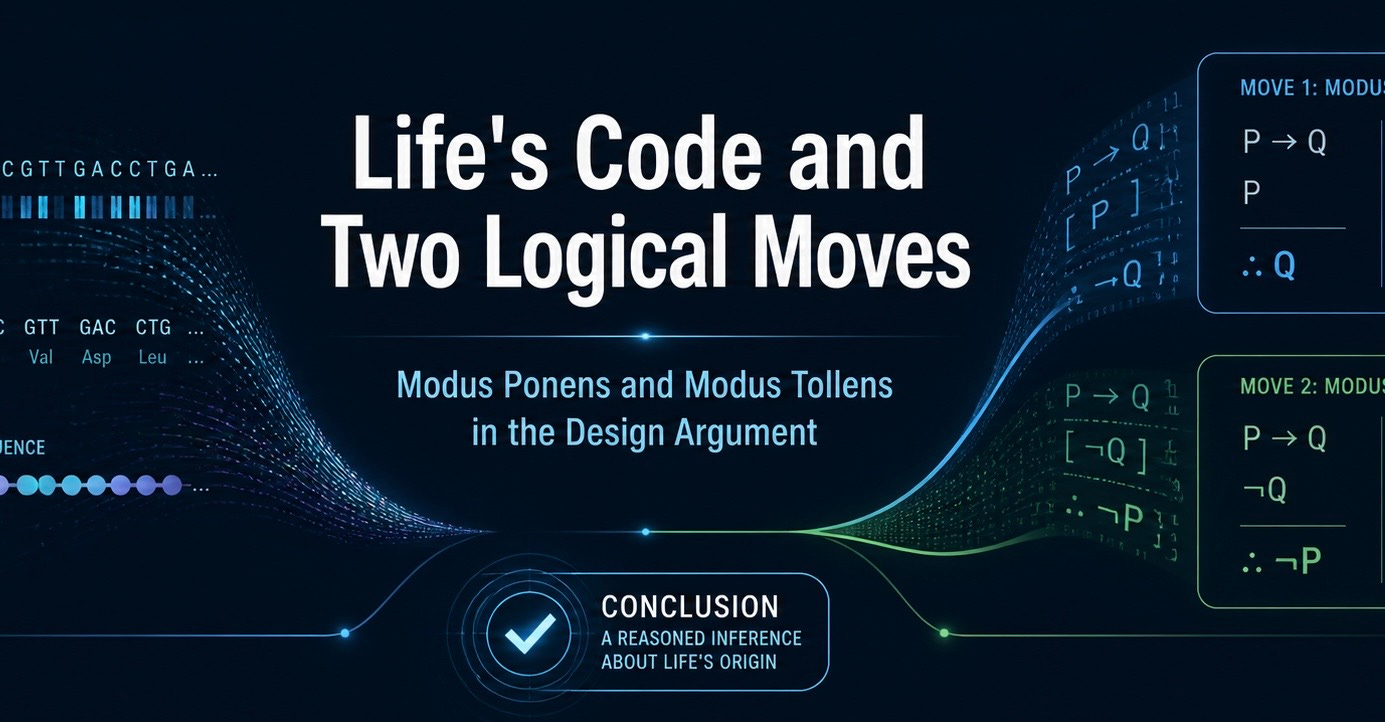
Modus ponens is the affirming move. It runs like this.
If P, then Q. P is true. Therefore, Q is true.
A homely example. If it is raining, the street is wet. It is raining. Therefore the street is wet. The structure is so natural we barely notice we are using it. But notice what the form requires. You need a conditional, you need to confirm the front half, and the back half follows necessarily. No wiggle room. If the premises are true, the conclusion cannot be false.
Modus tollens is the denying move. It runs like this.
If P, then Q. Q is false. Therefore, P is false.
Same rain example. If it is raining, the street is wet. The street is not wet. Therefore it is not raining. Again the structure is forced. If the conditional holds and the back half fails, the front half has to fail too.
These two moves are the workhorses of careful argument. Ponens affirms forward. Tollens denies backward. Between them, they handle most of what rigorous reasoning actually does.
Now watch what happens when you point them at one of the oldest debates in philosophy.
The design argument has been around for a long time, and most popular versions of it are bad. The bad version goes something like life is complicated, complicated things need a designer, therefore life has a designer. That argument deserves the dismissal it usually receives. Complexity by itself proves nothing. Snowflakes are complex. Hurricanes are complex. Crystals can be exquisitely ordered. None of that requires a mind.
A better version of the argument starts somewhere more specific. Not complexity, but coding.
Open a biology textbook and you will find the word code used without apology. DNA carries sequences. Those sequences are read by cellular machinery. Three-letter units called codons map onto amino acids. Amino acids get assembled into proteins. The mapping is rule-governed. The reading is functional. The output does work.
This is not chemistry behaving like chemistry. This is chemistry carrying instructions. A symbolic system, with an arbitrary mapping between signs and outputs, governed by rules, interpreted by a reader, producing a function. The letters on this page are that kind of system. Morse is that kind of system. The instructions inside a cell are that kind of system.
Every code we have ever traced to its source has come from a mind. That is not a philosophical claim. It is an observation about causal history. Languages, alphabets, software, signaling protocols, sheet music, traffic systems. The pattern is uniform. Symbolic-functional coding has one known cause, and that cause is intelligence.
Now plug that into modus ponens.
If a system contains symbolic-functional coding, intelligence is the best explanation for it. Life contains symbolic-functional coding. Therefore, intelligence is the best explanation for life’s coding system.
The form is clean. The first premise is supported by uniform causal experience. The second is supported by molecular biology. The conclusion follows.
This is the positive case. It is not an argument from ignorance. It is not we don’t know how nature could do it, so God did it. It is we do know what produces codes, and it is always mind. That is a different kind of claim, and it is much harder to dismiss.
The counter-move is predictable. Someone will object that unguided material processes, given enough time, can produce coding systems without any intelligence involved. Chemistry alone, the story goes, is sufficient.
Fine. Take that seriously and run modus tollens on it.
If unguided material processes are sufficient to produce symbolic-functional coding, then they should demonstrate causal adequacy. They should show how non-coded chemistry becomes coded chemistry, without smuggling in pre-existing information, pre-existing machinery, or selection pressures that already presuppose function.
That demonstration has not been produced. Not in the laboratory. Not in simulation. Not in any proposed mechanism that survives scrutiny once you trace its assumptions. Many origin-of-life scenarios quietly assume what they need to explain. They posit a replicator, or a ribozyme, or a metabolic network, but the symbolic mapping between sequence and function is treated as if it could just appear. The hard part is hand-waved.
So the second half of the conditional fails. And modus tollens delivers the conclusion.
If unguided processes were sufficient, they would demonstrate causal adequacy. They have not demonstrated causal adequacy. Therefore, unguided processes are not presently sufficient.
Notice what this conclusion does not say. It does not say unguided processes are impossible in principle. It says something more modest. The bill is unpaid. The case has not been made.
Put the two arguments together and the dialectic (truth-seeking through ordered opposition) is straightforward. Modus ponens delivers the positive case: coding points to mind. Modus tollens denies the rival: unguided chemistry has not produced an account of coding’s origin. Between them, the better explanation on the available evidence is intelligence.
This is what formal logic is for. Not to win debates by intimidation, but to make the structure of an argument visible, so that strengths and weaknesses can be examined honestly. Ponens shows you what follows when premises hold. Tollens shows you what fails when consequences do not. Once you see the moves, you can apply them anywhere. Politics. Science. Theology. Your own reasoning.
The textbook used the word code without apology. State out loud what that word actually implies, run the implication through the two forms above, and the argument writes itself.