

Young Creation vs. Old Creation is usually framed as a dispute over time: thousands of years versus billions. I think the deeper issue is initialization.
Consider a thought experiment. Imagine scientists living inside a sophisticated virtual world. They measure erosion, tree growth, stellar processes, genetics, and every other observable regularity. From those measurements they reconstruct millions or billions of years of history. But what if some of the states they are measuring were already present when the simulation was initialized? Their measurements could be correct, their models mathematically sound, and their reconstructed history still wrong.
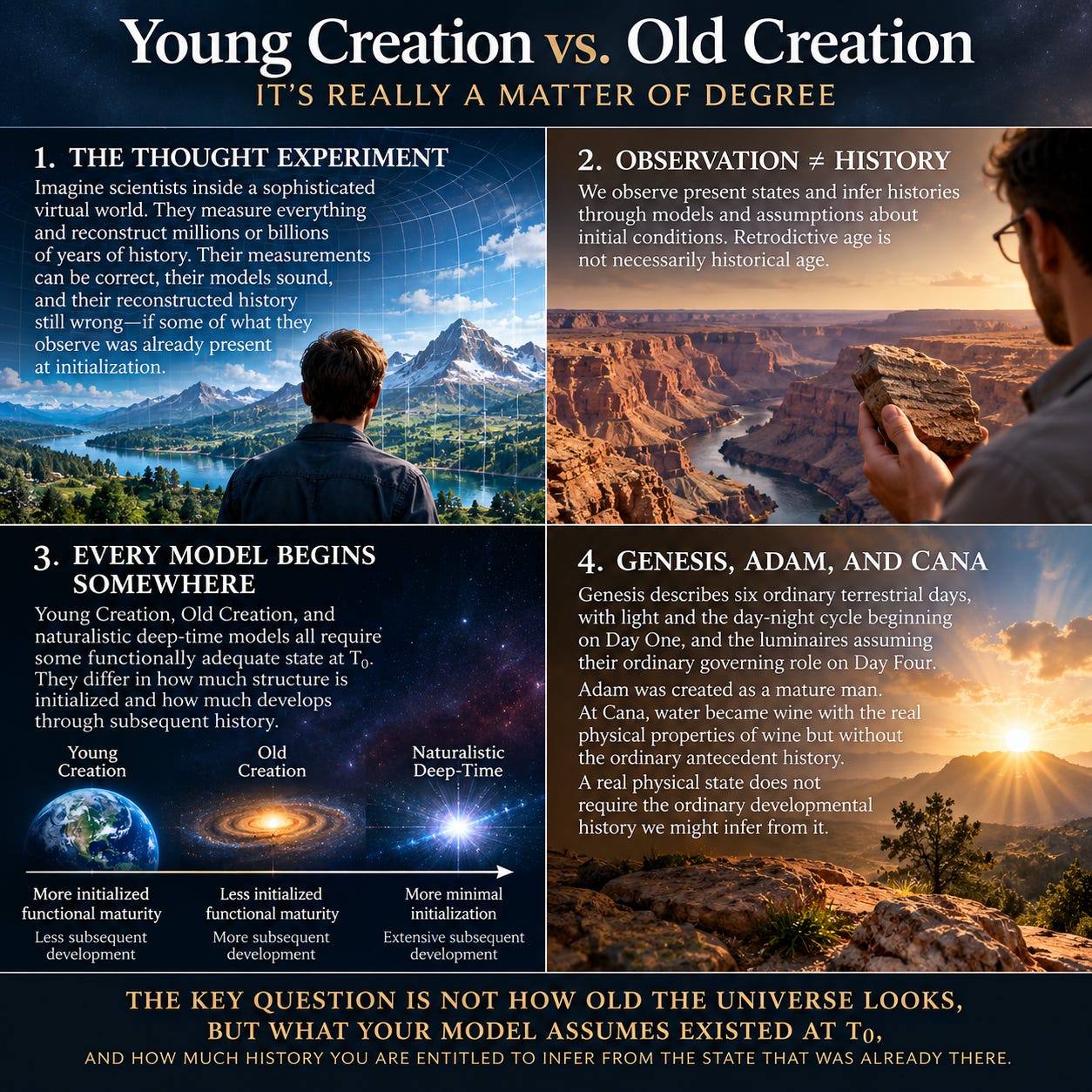
That exposes a crucial distinction: retrodictive age is not necessarily historical age. We observe states. We infer histories through models and assumptions about initial conditions.
Christians already recognize this with Adam. Five minutes after his creation, a physician could have observed a mature adult body and reasonably inferred decades of ordinary development. The observations would be real. The inferred developmental history would not.
The same issue applies more broadly. Young Creation, Old Creation, and even naturalistic deep-time models all require some functionally adequate state at T₀. They differ in how much structure is initialized and how much explanatory work is assigned to subsequent development.
I also explore why this helps make sense of Genesis itself: six ordinary terrestrial days, light and the day-night cycle beginning on Day One, the luminaries assuming their ordinary governing role on Day Four, and Cana as another biblical example of a real physical state that did not possess the ordinary antecedent history we might infer from it.
The key question is not simply, “How old does the universe look?”
It is: What does your model assume existed at T₀, and how much history are you entitled to infer from the state that was already there?