

We live in an age that increasingly speaks about the human person as though we were essentially biological computers.
Your brain processes information. Your memories are stored there. Your personality emerges from neural activity. Damage the brain, and cognition can change. Eventually the brain dies, and therefore, we are told, you cease to exist.
There is an important observation buried in that argument.
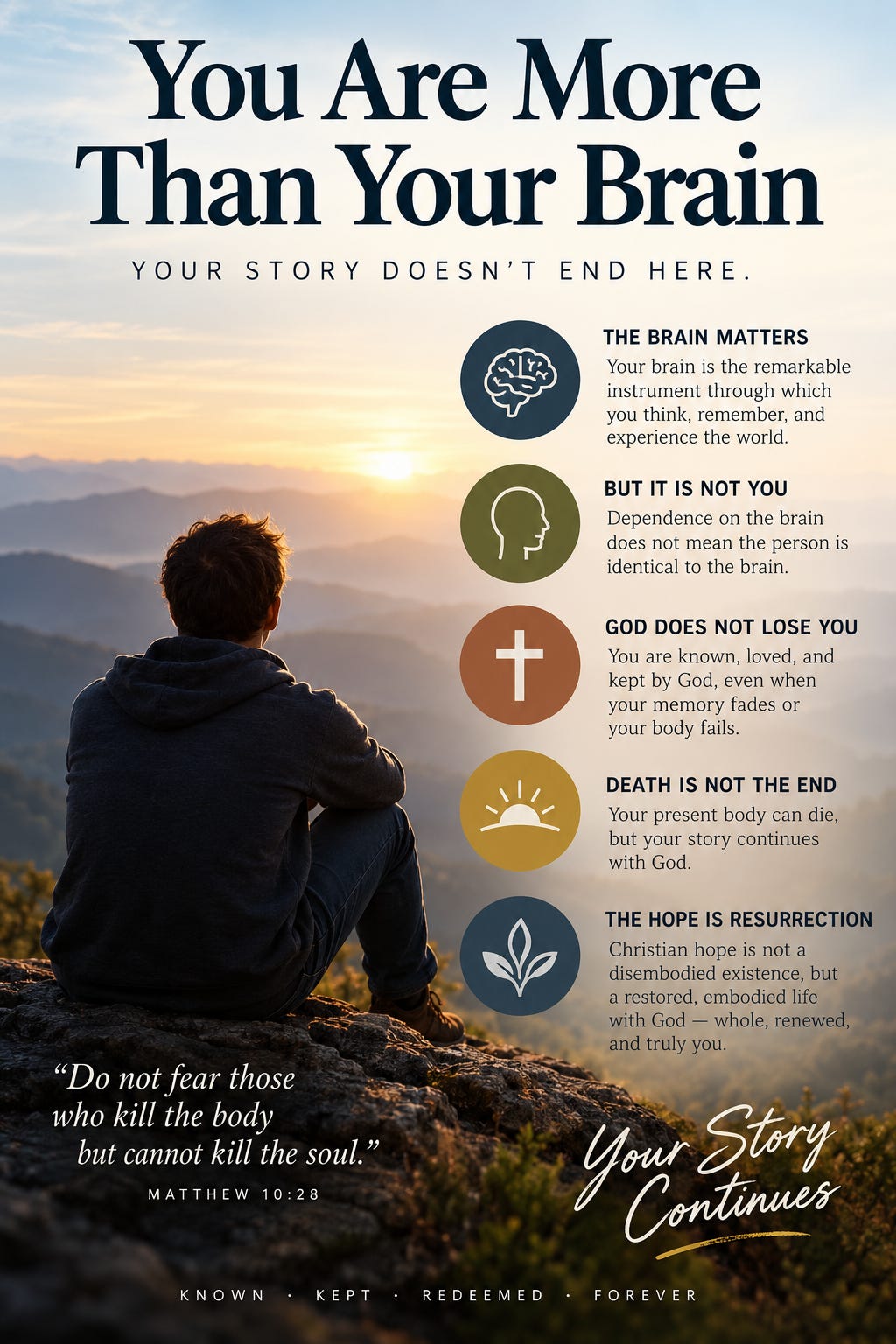
Our brains matter enormously.
But the conclusion does not necessarily follow from the observation.
Consider an analogy from computing.
Software normally requires hardware through which to operate. If I damage the hardware badly enough, the software may no longer execute properly. Corrupt memory, damage a processor, or destroy a storage device, and what I observe on the screen can change dramatically.
Yet none of this establishes that the software is the hardware.
The hardware is the physical substrate through which the software presently operates.
The analogy is imperfect, as all analogies are. Human beings are not computers, minds are not computer programs, and brains are not merely interchangeable processors.
But the distinction is useful.
Your Brain Matters. But Is Your Brain You?
Christianity gives us good reason to distinguish the brain, the mind, and the person.
The brain is unquestionably involved in how we think, remember, perceive, communicate, and interact with the physical world. Brain injury can change someone’s behavior. Dementia can devastate memory. Neurological disease can profoundly affect someone’s ability to communicate.
Christians have no reason to deny any of that.
The deeper question is different:
Does dependence upon the brain during embodied life prove that the person is identical to the brain?
It does not.
That conclusion requires an additional metaphysical assumption.
If damaging a computer prevents a program from functioning properly on that computer, we would never conclude from that observation alone that the program and the computer were the same thing.
Likewise, observing correlations between brain states and mental states tells us something extraordinarily important about how human beings presently function.
It does not, by itself, answer the question of what a human being ultimately is.
And this distinction becomes profoundly pastoral when the brain begins to fail.
When Someone You Love Seems to Disappear
Anyone who has watched Alzheimer’s disease, dementia, traumatic brain injury, stroke, or another neurological disorder affect someone they love understands the terrible question underneath all the medical questions:
Are they still in there?
The Christian answer is grounded in something stronger than our ability to observe them.
Yes.
Their ability to express themselves through their damaged body may be profoundly diminished. Their memories may become inaccessible to us. Their personality may appear altered. They may eventually stop recognizing the people they have loved for decades.
But their identity before God does not depend upon their ability to demonstrate that identity to us.
The person you love is not reducible to the performance of his or her nervous system.
That matters.
It means human dignity does not diminish with cognitive capacity.
It means a person with advanced dementia has not become less human.
It means the severely disabled person is not a lesser person.
It means consciousness, intelligence, memory, productivity, and communicative ability are terrible measures of human worth.
And it means death itself does not finally erase the person.
God Does Not Lose You
Jesus said:
“And do not fear those who kill the body but cannot kill the soul.”
Matthew 10:28, ESV
Whatever else we must say about Christian anthropology, Jesus clearly distinguishes bodily death from the complete destruction of the person.
Paul similarly writes of being “away from the body and at home with the Lord” (2 Corinthians 5:8, ESV).
That gives Christianity an extraordinary account of personal continuity.
Your present brain can die.
Your body can return to dust.
Yet God does not lose track of you.
This is important because Christian hope does not depend upon some indestructible biological component surviving death. Neither does it require imagining a tiny ghost hiding somewhere inside the skull.
The continuity of the Christian person ultimately rests in God.
He knows you completely.
He created you.
He sustains you.
He has promised life beyond the death of the present body.
And therefore the Christian can say something remarkable at the graveside:
Death has destroyed the present physical habitation. It has not destroyed the person whom God has promised to raise.
Christianity Does Not End With a Disembodied Soul
Here the computer analogy reaches its limit.
Christian hope is not that our “software” finally escapes defective biological hardware and lives forever in some spiritual cloud.
The biblical hope is resurrection.
Paul devotes an entire chapter to this in 1 Corinthians 15. The body is buried perishable and raised imperishable. It is buried in weakness and raised in power (1 Corinthians 15:42–44).
God does not discard embodiment.
He redeems it.
Christianity therefore takes the body far more seriously than a simplistic “ghost in the machine” account would suggest. Human beings were created as embodied creatures, and our final state is embodied.
There is continuity across death.
There is also transformation.
The child of God who dies is not ultimately destined to remain separated from the body. God promises resurrection.
When Memory Fails
This gives Christians a particularly powerful way to think about dementia.
Imagine a husband sitting beside his wife after sixty years of marriage.
She no longer knows his name.
Perhaps she no longer knows her own.
From our perspective, something precious appears to have disappeared.
But the Christian can hold her hand knowing something she may no longer be capable of knowing herself:
God remembers her.
Her identity does not depend upon her damaged brain successfully retrieving sixty years of memories.
Her dignity does not depend upon passing a cognitive examination.
Her relationship to God does not depend upon her ability to explain that relationship coherently today.
The Shepherd does not forget His sheep when the sheep can no longer remember the Shepherd.
Jesus said of His people:
“I give them eternal life, and they will never perish, and no one will snatch them out of my hand.”
John 10:28, ESV
That promise does not contain an exception for neurological disease.
And When My Own Brain Fails?
Eventually this becomes personal.
Perhaps slowly.
Perhaps suddenly.
Unless Christ returns first, every Christian presently reading these words will experience the failure of the biological system through which he or she presently encounters the world.
Eyes fail.
Hearing fades.
Memories become less reliable.
Bodies weaken.
Brains die.
Christian hope does not require pretending otherwise.
It allows us to look directly at biological death and say that biology does not have the final word about personal existence.
Paul’s language is astonishing:
“It is sown a natural body; it is raised a spiritual body.”
1 Corinthians 15:44, ESV
The God who called creation into existence does not face an information-recovery problem at the resurrection.
He does not need an intact brain in the grave to remember who you were.
He does not need functioning neurons to reconstruct your memories.
He does not need preserved DNA to determine your identity.
He knows you.
And the promise of resurrection means that the person He raises will not merely be someone remarkably similar to you.
It will be you.
Whole.
Embodied.
Restored.
Alive.
That is why Christians can grieve deeply without grieving as those who have no hope (1 Thessalonians 4:13).
The brain is precious.
The body is precious.
Death is real.
But neither your brain nor death itself gets the final word about who you are.
God does.
And He has promised resurrection.