

A world-picture has two related but distinct layers. The first is a worldview: an account of what reality fundamentally is, and of what must be true if there is to be actuality, intelligibility, information, causation, and rational knowledge. The second is a world model: an account of how this observable universe came to occupy its present state. They intersect. They are not the same inference.
The common error is to treat them as one thing. Either metaphysics is asked to mint a chronology, or a chronology is asked to serve as a metaphysics. Another error, no less common, is to pretend they can be sealed off from one another—as if physics had no ground, and theology had no world. What follows is an attempt to keep the coupling without the collapse.
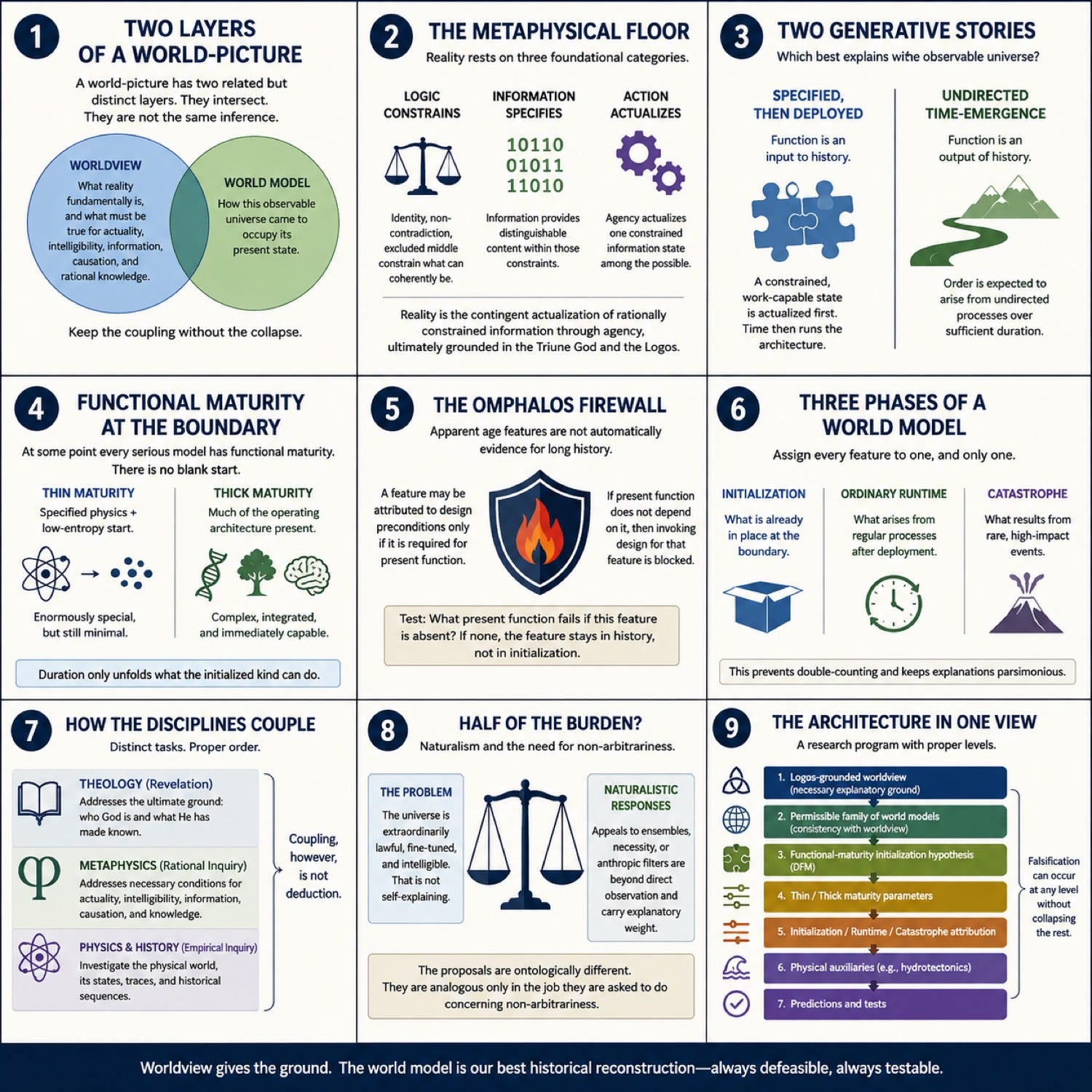
Figure. The architecture in nine panels. Worldview gives the ground. The world model is a defeasible historical reconstruction.
I. The metaphysical floor
Logic is not a convention invented by human beings. Identity, non-contradiction, and excluded middle express constraints upon coherent actuality. Physical theories already presuppose them. Any physical explanation of logic must itself employ logical inference, and therefore cannot provide a non-circular ultimate grounding for logic. Logical order is ontologically prior to any particular physical description.
Actual reality also consists of distinguishable states. Particles have properties. Fields have values. Biological systems encode, transmit, and execute information. Minds distinguish propositions from one another. Reality therefore has structured informational content. Logic constrains the states that can coherently obtain. Information supplies distinguishable content within those constraints. Neither category alone explains why one possible state is actual.
A coherent informational possibility is still only possible. Something must account for actuality. Hence three foundational categories: logic constrains; information specifies; action actualizes. Once a physical causal order exists, later states may arise through the powers and regularities instantiated in that order. The metaphysical question lies beneath physics: why there is an actual causal order with these particular possibilities, constraints, and powers at all.
I identify that ground with the personal, necessary Triune God, and particularly with the biblical Logos. “In the beginning was the Word” is not only devotion. It identifies rationality and personal agency with the source of created existence. The intelligibility of the universe then reflects the nature of its source. Human minds can investigate the world because mind and world participate in a common rational order. Human reasoning is finite and fallible. It nevertheless has genuine reach because reality itself is rationally ordered.
Reality is the contingent actualization of rationally constrained information through agency, ultimately grounded in the personal, necessary Triune God and the Logos.
That sentence is a worldview. It does not, by itself, tell us the age of the Earth, the history of biological diversification, or the physical history of the cosmos. Those are additional questions. They require additional evidence. That boundary matters.
II. Two generative stories
Origins inference begins with the possibility of intentional creation. It does not simply deduce a physical history from the existence of God. The question is comparative: what model best explains the observable state of the universe?
Operational science investigates regularities in the presently accessible world. That success belongs to investigators with very different metaphysical commitments. Historical reconstruction adds another step. Suppose the ordinary evolution of a system is Sₜ₊₁ = F_L(Sₜ). Confidence that F_L describes present dynamics does not entail that every antecedent state was generated only by repeated applications of F_L. That is a historical hypothesis.
The alternative is that the universe entered ordinary physical history through an initialization boundary: S₀ = G(Φ, L, B), a first state instantiated according to functional requirements, constraints, and boundary conditions. After that boundary, ordinary regularities govern. The initialization itself need not be recoverable merely by reversing those regularities.
Call the two stories by their generative kind.
The first is specified, then deployed. Function is an input to history. A world is actualized already as a constrained, work-capable regime. Time after deployment runs the architecture. It does not have to invent it.
The second is undirected time-emergence. Function is an output of history. Order is a late product of lawful transitions, stochasticity, selection, and duration. Time is not a cause, but it is the interval in which causes must do all the specifying work.
These are not “science versus religion.” They are two accounts of how a non-arbitrary world got here.
III. The world is not arbitrary
The datum is not that there is a world. It is that the world is tightly constrained rather than a heap. Lawfulness is only the first layer. There is also a narrow possibility space: constants, laws, and initial entropy sit in an island that permits durable structure. There is functional packaging: nuclear stability, stellar lifetimes, water, carbon chemistry, digital genetic systems, energy gradients, a planet in range. And there is intelligibility. The package is not merely stable. It is compressible into mathematics and usable by reason.
Undirected emergence is not surprised by lawfulness. A law-governed process is still directed by law. “Undirected” never meant “unpatterned.” It meant “not aimed at a finished architecture.” The live issue is the rest. Those features are not generic consequences of there being transitions. They are consequences of which transitions exist and which starting point they were given.
If the generative story is specification then deployment, non-arbitrariness is an input. One does not first get a blank manifold and then luck into a working stack. One deploys a stack that was already a stack. If the generative story is undirected emergence, non-arbitrariness has to be recovered—from chance, from selection, from duration, or from a brute law. In present practice it is mostly taken as scenery. That is borrowed capital: the naturalistic reconstruction occupies a world that looks like the expected output of specification, then denies that specification was an input.
The borrowing is specific. Law is used as given, not as prize. A traversable possibility space is used as the stage on which emergence happens, not as what emergence explains. Information in the right form—stable, copyable, causal—is often assumed after it exists. Function-talk is used because the objects are target-shaped, then the aiming is removed from the ontology. Theoretical reason is used as if it tracked the structure of things far beyond local survival. None of that convicts a person of secret theism for using modus ponens. It does convict a picture that consumes a prepared world and will not put the preparation on its books.
IV. Functional maturity is not a date
At some point every serious model has functional maturity. The phrase does not mean only a recent finished biosphere. It means that some ordered, usable state is an input. There is no blank start.
A usable cosmos needs, at minimum, laws and constants in a narrow island, a very special initial thermodynamic condition, enough homogeneity for structure and enough irregularity for galaxies, and a possibility space in which stable complexity can persist. That is already maturity of a kind: not a rainforest at the first moment, but a regime in which rainforests are not physically forbidden. Low entropy is the cleanest case. Time does not create the gradient. The gradient is why time as we use it can do work.
So both models have an initialization boundary. One side hides it under “initial conditions.” The other names it as specification. The honest comparison is not maturity versus no maturity. It is thin maturity versus thick maturity.
Thin maturity: the first state is a specified physics plus a specified low-entropy start. After that, almost all visible function is an output of ordinary dynamics. Thick maturity: the first state already contains much of the operating architecture, and later dynamics maintain and vary what was already a going concern. Those are degrees on one axis. A highly ordered primordial regime is functional maturity of the physical kind. A living world at first human-relevant time is functional maturity of the ecological kind. One can reject the second and still be on the specified side of the real distinction: the operating possibility was not an accident of duration. It was instantiated.
What does not exist is the picture often sold as naturalism’s default: generic slop, plus duration, plus the architecture appearing as a free byproduct of the clock. Duration only unfolds what the initialized kind can do.
V. Preconditions, not a painted past
If initialization is allowed to write arbitrary histories into the first state—starlight from untraveled paths, decay chains that never ran, genomes that look copied from unborn ancestors, only so that an observer will infer a long past—then the hypothesis explains nothing. That is Omphalos. It is not this model.
The right term is designed precondition. A feature is there because the system cannot run without that kind of state, not because a story was planted to fool an observer. Light already on the way is a precondition of a usable sky. A thermal and isotopic budget in the crust is a precondition of a living planet. A star already on the main sequence, with metals already available, is a precondition of chemistry. Soil, aquifers, a redox gradient, an atmosphere out of equilibrium, food webs already closed: those are preconditions of a biosphere that is on.
The rule that keeps the word honest is simple. A precondition must answer: what present function fails if this feature is absent? If the system cannot operate as intended, it is a precondition. If the only work the feature does is to keep an observer from noticing that the past was short, it is not a precondition. It is an accommodation to the observer.
The contrast, then, is not real history versus forged history. It is runtime residue versus operating requirements. Some objects fall cleanly. A worldwide ordered fossil succession, with first and last appearances and nested morphology, does not fall cleanly unless the present function it serves can be named without saying “so the world looks old.”
VI. A catastrophe is not Omphalos
A further auxiliary belongs to the model I take the biblical narrative to constrain: a catastrophic hydrotectonic flood. That is not appearance of age. Omphalos says the archive was instantiated already looking used. A flood says a large part of the archive was made after deployment, by a real process, under real physics, in a short interval. Creation and Flood are distinct acts. Features should be assigned to initialization, ordinary runtime, or the catastrophe—and only one of those.
The Bible offers a theological-historical picture: a world specified and actualized by God; a first world that is a going concern; a later watery judgment treated as a real event. It does not offer the physical engine. “Fountains of the great deep” names sources of water in the story’s language. It does not specify crustal reservoirs or a particular tectonic coupling. Those are models of the Flood. They may be good or bad. They are not verses.
An auxiliary is allowed. It is also where models get expensive. Water plus tectonics is a real coupling at smaller scales. A global hydrotectonic pulse is the claim that the coupling ran at planetary amplitude once. Then it owes a budget of energy and mass, a prediction of facies, an order of rocks, an account of what it does to isotopes, magnetism, and fossils, and a picture of the world after the water stops. Scope is a virtue only when the same mechanism that explains a megasequence does not need a new knob for each reef, paleosol, and reversal sequence.
If the flood is doing real work, preconditions should shrink. If one still needs a painted history and a flood that also makes history, the model is paying twice for the same traces.
VII. Theology, metaphysics, physics
The mistake is not coupling these three. The mistake would be asserting that they can be decoupled as sealed boxes. Physics already sits on metaphysical bets: that there is a stable world, that constraints obtain tomorrow, that mathematical form maps onto that world, that a mind can track what it did not make. Those bets are not laboratory results. They are conditions for laboratory results. Theology, if it concerns the same God and the same world, is not a side essay. If the world is created by speech, initial conditions and function are what creation looks like in another register.
Coupling, however, is not deduction. Theology can bind the kind of world: created, good, judged, intelligible. It cannot mint the equation of state of the deep, the openness of an isotopic system, or the exact thickness of the first state. Metaphysics can say that some initialized, constrained, information-bearing state is required. It cannot say whether that state was a low-entropy plasma or a forested continent. Physics can say which traces look like runtime, which look like a pulse, which clocks agree. It cannot say whether the first specification was personal.
If the offices fuse, theology becomes a mechanism-generator, and every failed geophysical knob is dragged onto the text. If they pretend to be strangers, physics becomes a theology-generator, and whatever the present consensus is becomes “what nature says God did.” Distinguishing offices is not secular exile. It is refusing to let one office do the other office’s work.
They are coupled as one world, three offices. Worldview and world model meet there.
VIII. Worldview and world model
Worldview is the binding picture of what kind of thing reality is. It does not wait on the next paper. It is the frame in which papers are possible. World model is the working account of this world’s path: how thick the first deployed state was, what ordinary dynamics do after that, whether a hydrotectonic pulse sits in the record, which traces are preconditions and which are aftermath. The world model can lose. It is supposed to be able to lose.
They intersect where a worldview selects a family of models and a model must remain speakable inside the worldview. The worldview says: do not look for a heap that lucked into reason. Look for an initialized, constrained, functioning regime, and do not rule out a later world-breaking act. The world model says: here is how that regime and that act would show up in clocks, strata, genomes, and light.
If the model fails, one does not automatically discard the Logos. One revises the thickness of the first state, the flood engine, the assignment of this outcrop. If the worldview is false, the model is an orphaned mechanism—possible weather with no reason it should be a world.
IX. Both have a ground floor
Every closed picture stops at something that is not another experimental result. A chain of “why” either goes forever, which explains nothing, or it ends in a ground that is not derived from a deeper derived thing. One picture ends in agency. The other ends in law, or a wave function, or a measure over worlds, or “the cosmos just is.” None of those grounds is seen in a detector. None is the sort of thing a single failed prediction kills. Calling only one of them faith is bookkeeping.
The grounds are not interchangeable. A personal ground leads one to expect a non-arbitrary, intelligible, function-capable world. A brute-law ground leads one to expect that whatever exists is whatever the laws permit. It does not lead one to expect this tight package unless extra structure is added—an ensemble, a necessity, an anthropic filter. That additional structure is likewise beyond direct observation and bears part of the explanatory burden otherwise assigned to specification. The proposals are ontologically different. They are analogous only in the job they are asked to do concerning non-arbitrariness.
Unfalsifiable ground is not unfalsifiable architecture. Hydrotectonics can fail. A particular thickness of the first state can fail. A particular reconstruction of descent or of deep time can fail. Those failures do not touch the floor. A bad flood model is not a disproof of God. A gap in a construction-path is not a disproof of naturalism. The floor will not be falsified by geology. The building might be.
X. The metaphysical setting of early modern science
Early modern natural philosophy was practiced inside a world-picture that expected a non-arbitrary, intelligible, law-governed creation. Nature was a creation, not a god and not a chaos. It was contingent, so it had to be inspected rather than deduced from necessity. It was lawful because it was upheld. It was intelligible because mind and world were taken to share a rational source. Human reason was fallen and limited, so method was needed. That cluster is the metaphysical setting in which the new sciences took shape; it is not offered here as a complete institutional history.
It was not the founding of a particular thickness of initialization, and it was not hydrotectonics. The operational core of science was built by people who believed the world was specified, then refused to let that belief write the differential equations. The method was built to travel. The ontology was not packed into the instruments. The later habit of treating a specified world as unscientific is historically backwards. The traveling method still lives on the expected list of the older ontology—law, contingency-plus-order, mathematical fit, a world worth experimenting on—and then calls that list secular common sense.
A late, human-scale rehearsal of the same pattern now sits in plain view. We write specifications and instantiate them as running computational worlds. An observer inside such a world can discover its transition rules and integrate them backward into a coherent prehistory that never occurred as runtime. The example does not prove that our universe was compiled. It proves that present dynamics do not logically entail generative history, and that specified-then-deployed order is no longer an exotic kind. We did not invent the idea that information can precede and govern a working world. We became able to do it, and therefore able to see what kind of object that idea explains.
XI. The complete position
Metaphysically: reality is the contingent actualization of rationally constrained information through agency, ultimately grounded in the personal, necessary Triune God and the Logos.
Concerning origins: the empirical character of the universe is consistent with, and in several domains may be positively expected under, a model in which reality was intentionally initialized into a highly constrained, logically coherent, informationally rich, functionally mature state—thin or thick—and thereafter exhibits stable physical regularities, including at least one high-amplitude hydrological-tectonic excursion whose traces must be earned as process, not as paint.
The first proposition is the floor. The second is the building. The worldview tells you the world is specified, actualized, and addressable. The world model is the fallible map of how that world was switched on and what has happened to it since.
The architecture is therefore layered: a Logos-grounded worldview; a family of permissible world models; a functional-maturity initialization hypothesis with thin or thick parameters; an assignment of traces to initialization, runtime, or catastrophe; then specific physical auxiliaries, predictions, and tests. Failures can be localized. A failed hydrotectonic mechanism need not falsify functional maturity. Failed maturity predictions need not falsify intentional creation. Failure of a particular origins reconstruction does not automatically touch the metaphysical floor.
They intersect. They are not the same question. Holding both is not a dodge. It is what any complete picture is doing, including the one that says it has no floor.