

Overview
This article argues that intentional design with functional maturity better explains the structural features of reality than unguided naturalistic deep time. The argument is comparative, abductive, and cumulative. It does not claim that naturalism is incoherent on its own terms. It claims that the naturalist paradigm fails the comparative test it is widely presented as winning.
The naturalist deep-time paradigm is typically defended on grounds of consilience, the convergence of independent evidence streams on a single explanation (Whewell 1840). The argument here is that this consilience is asserted more than achieved. Across nine evidential domains, ranging from the logical and mathematical alignment of reality to the preservation of soft tissues in allegedly ancient fossils, the naturalist paradigm absorbs counter-evidence through repeated ad hoc adjustment, promissory mechanism assertion, and bracketing of questions as outside its remit. Design with functional maturity addresses the same domains through a single framework commitment that predicts the relevant features as constitutive rather than accommodating them after the fact.
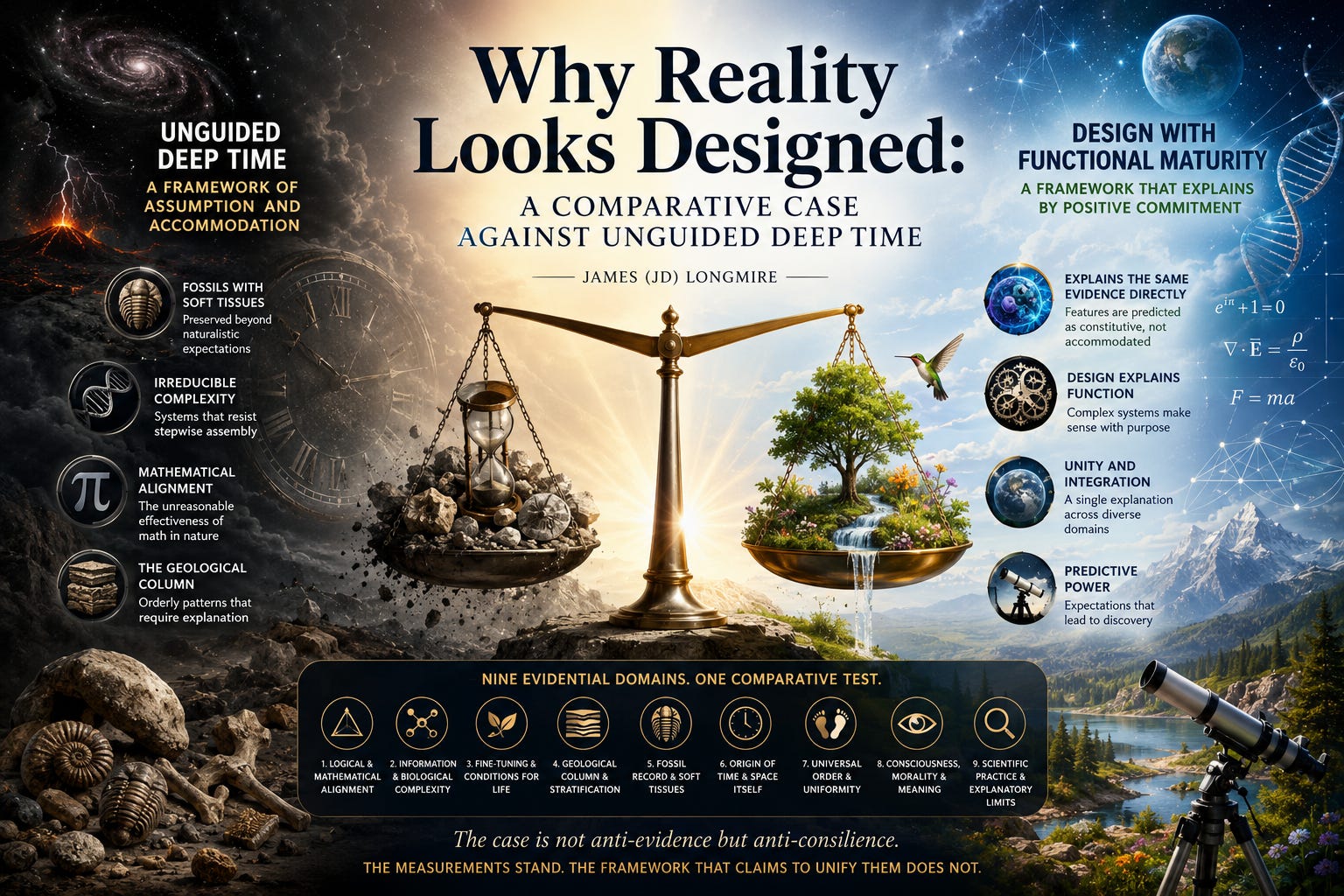
The article names the forms of inference at work, specifies the comparative criteria by which paradigms are weighed, applies those criteria across the nine domains, and shows that the pattern across the domains fits a Lakatosian diagnosis of a degenerating research programme on the naturalist side and a progressive one on the design side. The case is therefore not anti-evidence but anti-consilience. The measurements stand. The framework that claims to unify them does not.
A Note to the Christian Reader
If you grew up in the West and have any familiarity with mainstream education, popular science writing, or the broader intellectual culture, you have absorbed a great deal of naturalism without anyone announcing it. Methodological naturalism is presented as the neutral baseline from which serious inquiry begins. Deep time is presented as settled fact rather than as inference. The old-earth framework is treated as the position any reasonable person holds once the data is on the table.
You may have made room for these commitments in your faith without examining them. Many Christians have. The usual move is to keep Genesis and to keep the geological column, distant starlight, genetic similarities, and to assume they can be harmonized through some combination of day-age readings, theistic evolution, or framework hypothesis. Those moves are theologically possible. They are also philosophically expensive in ways that often go unnoticed, because they typically grant the naturalist framework its priors and then try to find room for design within them.
This article is meant to surface those priors and put them on the table. The claim is not that the deep-time framework is deductively impossible. It is that the deep-time framework and the design framework are competing paradigms, both operating with priors, and that the comparison favors design on standards the naturalist framework cannot meet. You are not required to abandon scholarly engagement to take the design framework seriously. You are required to notice that the choice between frameworks is yours, that the data does not make it for you, and that the framework you may have unconsciously absorbed is itself a contestable commitment rather than the conclusion of evidence.
The argument that follows is meant to give you the tools to make that choice deliberately rather than by default. Whether you end up where I do is your call. The case for doing the work openly is that the alternative is to keep operating under priors you did not consciously adopt and may not, on reflection, want to keep.
How the Argument Reasons
Three forms of inference do most of the work in any argument about origins, and naming them up front lets the reader see what kind of claim is being made at each step.
Deduction runs from general premises to a necessary conclusion. If the premises are true and the form is valid, the conclusion follows with certainty. Mathematics and formal logic operate this way. Most empirical arguments about the deep past do not, because the premises are rarely both general and certain.
Induction runs from observed instances to a general pattern. If every observed swan is white, the inductive generalization is that swans are white. Induction yields probability rather than certainty, and it depends on the assumption that observed instances are representative of unobserved ones. Uniformitarian geology relies heavily on induction, extending present rates and processes into the unobserved past.
Abduction runs from observed evidence to the best available explanation. A doctor reasoning from symptoms to a diagnosis, a detective reasoning from clues to a suspect, and a scientist reasoning from data to a theory are all using abduction. The term traces to Peirce (1931-1958), and the philosophical literature has developed it under the label of inference to the best explanation (Harman 1965; Lipton 2004). Abduction does not prove its conclusion. It identifies which available explanation best accounts for the evidence under specifiable criteria. Almost all historical reasoning, including reasoning about origins, is abductive whether or not it announces itself that way.
This article is an abductive argument. It asks which paradigm, unguided naturalistic deep time or intentional design with functional maturity, best explains the total pattern of evidence under the criteria of scope, parsimony, ad hoc resistance, and predictive success.
Bayesian reasoning is the formal structure for comparing explanations (Earman 1992). The basic move is to update the credibility of a hypothesis as evidence arrives. Three quantities matter. The prior is how credible the hypothesis was before the evidence. The likelihood is how well the hypothesis predicts the evidence. The posterior is how credible the hypothesis is after the evidence is taken into account.
Two implications follow that matter for this argument.
First, evidence does not arrive into a vacuum. It arrives into a prior. A reader who assigns a high prior to naturalism will require strong evidence to shift toward design, and the same evidence will move a reader with a different prior differently. This is not a flaw in the reasoning. It is how rational belief revision works. The honest move is to name the priors rather than pretend the evidence speaks for itself.
Second, the likelihood comparison is what does most of the actual work. The question is not whether a hypothesis is compatible with the evidence but how well the hypothesis predicts the evidence relative to its rivals. A hypothesis that fits the evidence only after repeated adjustment scores poorly on likelihood even if it remains compatible. A hypothesis that predicts the evidence as a structural feature scores well.
The argument that follows is therefore neither a proof nor a refutation. It is a comparative likelihood argument. It claims that across nine domains, the evidence is better predicted by design with functional maturity than by unguided deep time, and that the priors favoring deep time are themselves contestable rather than worldview-neutral.
The Comparative Criterion
Two paradigms are in view. The first is unguided naturalistic deep time, which holds that present processes extrapolated over billions of years, combined with unguided chemical and biological evolution, account for the totality of physical and biological reality. The second is intentional design with functional maturity, which holds that reality was designed and instantiated intentionally, with the logical, mathematical, informational, and physical features necessary for a functioning world, in an initially complete and operative state.
Both paradigms operate with priors. Both interpret evidence through those priors. The question is which paradigm better satisfies the standards that any explanatory framework should meet. Four criteria apply.
Scope. Does the paradigm address the full range of evidence, or does it bracket entire categories as outside its remit?
Parsimony. Does the paradigm account for the evidence with fewer auxiliary hypotheses, or does it require continuous expansion of its mechanism set?
Ad hoc resistance. When the paradigm encounters counter-evidence, does it respond with substantive explanation grounded in independent principles, or does it adjust its mechanisms to absorb the anomaly?
Predictive success. Does the paradigm make risky predictions that have been confirmed, or does it largely accommodate evidence after the fact?
The claim of this article is that design with functional maturity scores better than unguided deep time on all four criteria when applied across the nine domains examined below.
Domain One: Logical and Mathematical Alignment
Physical reality conforms to abstract mathematical structures with a precision and predictive power that has no naturalist explanation. Wigner (1960) named this the unreasonable effectiveness of mathematics. The naturalist options are evolutionary adaptation, which fails because mathematical structures vastly overdetermine survival requirements, anthropic selection, which is not explanation but observation about which universes can host observers, or brute fact, which is paradigm protection.
The design framework predicts this alignment directly. A reality grounded in rational intent should exhibit logical and mathematical structure as a constitutive feature, not as an accidental correlation requiring further explanation.
Scope advantage to design. Parsimony advantage to design. Ad hoc move on the naturalist side: brute fact assertion.
Domain Two: Informational Richness
Two levels of informational richness require explanation. Cosmic information appears in the specified initial conditions, the values of physical constants, and the boundary conditions that permit a structured universe. Biological information appears in DNA sequences, regulatory networks, and the integrated functional architecture of living systems (Meyer 2009).
The naturalist account for cosmic information defaults to fine tuning explanations, which will be addressed in domain four. The naturalist account for biological information rests on the claim that natural selection acting on random variation can generate functional sequences. This claim faces the well-documented problem that functional protein sequences are rare in sequence space, that selection cannot act on sequences before they reach functional thresholds, and that the waiting times for relevant mutations exceed available evolutionary timescales for many observed transitions.
Scope advantage to design. Ad hoc moves on the naturalist side: continuous expansion of evolutionary mechanisms to cover information generation, none demonstrated to produce specified functional information at the required rates.
Domain Three: Dynamic Action and Sustained Being
The deeper question is not why there is something rather than nothing but why there is sustained dynamic existence. Causal continuation, the moment by moment maintenance of being, has been a philosophical problem since Aquinas and has no naturalist account that does not smuggle in some version of necessary being. Naturalism typically treats existence as brute, which is paradigm protection rather than explanation (Plantinga 2011).
The design framework grounds sustained being in the continuous causal action of a necessary being. This is not a gap argument. It is a structural feature of the framework that addresses a question naturalism cannot address from within its own resources.
Scope advantage to design. Ad hoc move on the naturalist side: bracketing the question as outside the scope of physics.
Domain Four: Universal Fine Tuning
The values of physical constants and the boundary conditions of the universe fall within ranges that permit complex chemistry, stable stars, and habitable environments. The ranges are narrow on any reasonable measure, and the standard naturalist responses are increasingly strained (Barnes 2012).
The multiverse hypothesis is unfalsifiable in its current forms and faces measure problems that have not been solved (Tegmark 2009; Vilenkin 2013). Necessity arguments fail because the constants do not appear logically necessary. The anthropic principle is selection effect, not explanation.
Parsimony advantage to design. Ad hoc move on the naturalist side: multiverse postulation without independent evidence.
Domain Five: Earth’s Privileged Placement and Fine-Tuned Functional Maturity
Earth occupies a configuration of conditions whose joint probability has not been calculated rigorously by naturalism but whose individual improbabilities compound. The galactic habitable zone, the circumstellar habitable zone, the lunar stabilization of axial tilt, the plate tectonics requirement, the magnetic field requirement, and the increasingly specific requirements for complex chemistry converge on a configuration the naturalist must absorb through appeals to the sheer size of the universe.
The radiogenic heating constraint sharpens the point and makes the design framework’s internal coherence visible. Earth’s long-term habitability depends on a narrow window of radiogenic heat production from long-lived isotopes, principally uranium-238, uranium-235, thorium-232, and potassium-40. Too little radiogenic heat leaves a planet geologically stagnant, with no sustained mantle convection, no plate tectonics, no volcanic recycling of volatiles, and no geodynamo to generate a protective magnetic field. Too much produces destabilizing volcanism that prevents the long-term surface stability complex life requires. Earth’s radiogenic inventory falls within the habitability window (Luo, O’Rourke and Deng 2024).
This is fine-tuning at the planetary scale, and it integrates directly with functional maturity. The same isotopic inventory that calibrates Earth’s heat budget for habitability also produces the parent-daughter ratios that radiometric dating reads as elapsed time. Within the design framework these readings are not anomalies to be explained away. They are the expected signature of a planet designed in an initially complete and operative state, with the isotopic composition required to sustain habitability over the functional lifetime of the system. A world made ready to function as a long-term habitat necessarily exhibits the isotopic features that produce radiometric age signals.
Within the deep-time framework, the same isotopic inventory is read as a record of elapsed duration, but that reading depends on priors including uniformitarianism, the indefinite extension of present decay rates, the assumption of closed-system behavior, and methodological naturalism. These priors are not worldview-neutral and are not established by the data they interpret. The design framework reads the same measurements as features of fine-tuned functional maturity, where the isotopic composition serves the habitability function and the radiometric signature follows as a consequence rather than as the primary fact being explained.
The naturalist response treats the habitability fit as fortunate and the radiometric signal as decisive evidence of duration. The design response treats the habitability fit as designed and the radiometric signal as a structural feature of that design. The likelihood comparison runs in design’s favor on both counts. Fine-tuning is predicted by design as a constitutive feature rather than absorbed by naturalism through probability resources whose adequacy has not been demonstrated.
Scope advantage to design. Parsimony advantage to design. Ad hoc moves on the naturalist side: sheer size of universe as probability resource without rigorous calculation, and treatment of radiometric signatures as worldview-neutral when they are framework-dependent inferences.
Domain Six: Chemical to Biological Transition
The origin of life problem has not improved meaningfully in decades (Tour 2016). The prebiotic soup model failed. RNA world faces serious chemical problems including the instability of ribose, the implausibility of prebiotic nucleotide synthesis, and the information problem. Metabolism first faces thermodynamic problems. Hydrothermal vent scenarios have not produced the relevant chemistry.
The naturalist response is largely promissory. The expectation that future research will produce a mechanism is offered as if it were a substitute for one.
Parsimony advantage to design. Ad hoc move on the naturalist side: promissory mechanism assertion, multiple framework shifts without empirical resolution.
Domain Seven: Specified Complexity
When complexity is joined to an independent specification, design becomes the better explanation. This intuition does not depend on any particular mathematical formalism, though formal treatments have been offered in the design literature. The naturalist response has been to challenge the formalism rather than to demonstrate that unguided processes can produce specified complexity at the required rates and scales.
Biological systems exhibit specified complexity across multiple scales, from molecular machines to integrated developmental programs. The functional specification is independent of the complexity in the relevant sense, because the specification is given by the function the system performs in the organism rather than by the sequence itself.
Scope advantage to design. Ad hoc move on the naturalist side: challenging formalism without producing demonstrated mechanism for specified complexity generation.
Domain Eight: The Origin of Novelty
Naturalistic evolution has no demonstrated mechanism for the origin of genuine novelty. The modern synthesis accounts for variation within existing types through mutation and selection. It does not account for the origin of new body plans, new organs, new integrated systems. The extended evolutionary synthesis is itself an admission that the modern synthesis cannot account for novelty (Laland et al. 2015), and the proposed extensions, including niche construction, developmental plasticity, and epigenetic inheritance, are real phenomena but none of them generate the functional information required for genuinely novel architectures.
The Cambrian explosion, the origin of flight in multiple lineages, the origin of consciousness, and the origin of language stand as specific cases where the naturalist mechanism is gestured at rather than demonstrated.
Scope advantage to design. Ad hoc move on the naturalist side: continuous expansion of evolutionary mechanism set without demonstration that any extension produces the required novelty.
Domain Nine: Soft Tissue in Allegedly Ancient Fossils
Schweitzer et al. (2005) reported preserved soft tissues, including blood vessels, osteocytes, and recognizable proteins, in a Tyrannosaurus rex specimen, findings since replicated and extended. The molecular decay studies independently constrain how long these structures should survive under any plausible chemistry. The proposed preservation mechanism involving iron chelation (Schweitzer et al. 2014) has not been demonstrated to work over the required timescales.
The mainstream response has been to extend the preservation timeline by orders of magnitude beyond what independent chemistry supports. This is paradigm protection through mechanism extension, applied to keep the deep-time timeline intact rather than to follow the chemistry where it leads.
Parsimony advantage to design. Ad hoc move on the naturalist side: preservation timeline extension beyond independently supported chemistry.
The Pattern
Across nine domains, the same pattern appears. The naturalist paradigm encounters evidence that resists its mechanisms. The paradigm responds by extending its mechanism set, postulating unobserved entities, offering promissory accounts, or bracketing the question as outside its scope. None of these moves is illegitimate in isolation. The question is whether their frequency and breadth indicate a paradigm doing successful explanatory work or a paradigm protecting itself.
Design with functional maturity, by contrast, addresses each domain through a single framework commitment. Reality was designed intentionally, with the logical, mathematical, informational, and physical features necessary for a functioning world, in an initially complete and operative state. This commitment is large but it is one commitment, not nine.
The comparative criterion was specified at the outset. Scope, parsimony, ad hoc resistance, predictive success. Design with functional maturity scores better on all four when applied across the nine domains. This is not a complaint about one dating method or one evolutionary mechanism. It is the claim that the naturalist deep-time paradigm fails its own consilience test, and that the design framework satisfies the test the naturalist paradigm fails.
A Lakatosian Frame for the Pattern
Imre Lakatos (1970) developed a framework in the philosophy of science that names what the pattern across the nine domains actually is. Lakatos argued that science does not proceed by testing isolated hypotheses against neutral evidence. It proceeds through research programmes, each with a hard core of commitments that practitioners hold immune to refutation and a protective belt of auxiliary hypotheses that absorb anomalies and adjust to new evidence. Programmes are not judged by simple falsifiability. They are judged by whether their problemshifts are progressive or degenerating.
A progressive problemshift generates independent novel predictions that subsequent investigation confirms. A degenerating problemshift only patches known anomalies without independent predictive success. Lakatos held that rational scientific commitment tracks this distinction over the long run. A research programme that consistently generates progressive problemshifts earns continued allegiance. A programme whose adjustments are consistently degenerating loses rational warrant regardless of how internally coherent its hard core remains.
In Lakatos’s terms, the naturalistic deep-time programme has a hard core that includes methodological naturalism, the indefinite extension of present processes, and the sufficiency of matter, energy, and chance to account for the structural features of reality. Its protective belt includes specific origin-of-life scenarios, multiverse postulations, evolving evolutionary mechanisms, soft-tissue preservation mechanisms, and the rest of the adjustments documented in the nine domains. The question is whether those adjustments constitute progressive problemshifts or degenerating ones. The pattern across the domains suggests degenerating. Origin-of-life mechanisms shift without empirical resolution. Multiverse postulations remain without independent evidence. Preservation timelines extend by orders of magnitude beyond what independent chemistry supports. The protective belt grows without generating novel predictions that subsequent investigation confirms.
Design with functional maturity, by contrast, predicts the structural features of reality as constitutive rather than absorbing them as anomalies. The mathematical alignment, the informational richness, the fine-tuning, the radiogenic habitability window, and the integrated complexity of biological systems are not anomalies the framework must patch. They are what the framework predicts. That is the structure of a progressive problemshift at the framework level, where the framework’s hard core generates expectations that the evidence subsequently confirms rather than expectations the evidence subsequently strains.
The Lakatosian framing answers the falsifiability objection at the level it is usually raised. No research programme is judged by simple falsifiability, because all programmes have hard cores held immune to refutation and protective belts that adjust. What distinguishes rational from irrational commitment is the long-run track record of problemshifts. On that criterion, the comparison favors design with functional maturity over unguided deep time.
Conclusion
Reality exhibits logical and mathematical alignment, informational richness at cosmic and biological scales, sustained dynamic being, universal fine tuning, terrestrial privilege, chemical-to-biological transitions that resist naturalist account, specified complexity, novelty that no demonstrated mechanism produces, and preservation patterns that strain the chemistry naturalism independently supports. These nine domains are not a grab bag. They are the structural features of a reality that the deep-time paradigm absorbs only through repeated ad hoc adjustment.
The design framework addresses these features through a single coherent commitment. By the comparative criteria of scope, parsimony, ad hoc resistance, and predictive success, the design framework outperforms the naturalist alternative across the domains where the alternative is most strained.
The case is therefore not anti-evidence but anti-consilience. The standard claim that naturalistic deep time unifies the evidence is the claim this article denies. The evidence is unified, but not by the paradigm that claims the unification.
References
Barnes, L.A. (2012) ‘The Fine-Tuning of the Universe for Intelligent Life’, Publications of the Astronomical Society of Australia, 29, pp. 529-564.
Earman, J. (1992) Bayes or Bust? A Critical Examination of Bayesian Confirmation Theory. Cambridge, MA: MIT Press.
Harman, G. (1965) ‘The inference to the best explanation’, The Philosophical Review, 74(1), pp. 88-95.
Lakatos, I. (1970) ‘Falsification and the methodology of scientific research programmes’, in Lakatos, I. and Musgrave, A. (eds.) Criticism and the Growth of Knowledge. Cambridge: Cambridge University Press, pp. 91-196.
Laland, K.N., Uller, T., Feldman, M.W., Sterelny, K., Müller, G.B., Moczek, A., Jablonka, E. and Odling-Smee, J. (2015) ‘The extended evolutionary synthesis: its structure, assumptions and predictions’, Proceedings of the Royal Society B: Biological Sciences, 282(1813), 20151019.
Lipton, P. (2004) Inference to the Best Explanation, 2nd edn. London: Routledge.
Luo, H., O’Rourke, J.G. and Deng, J. (2024) ‘Radiogenic heating sustains long-lived volcanism and magnetic dynamos in super-Earths’, Science Advances, 10(37), eado7603.
Meyer, S.C. (2009) Signature in the Cell: DNA and the Evidence for Intelligent Design. New York: HarperOne.
Peirce, C.S. (1931-1958) Collected Papers of Charles Sanders Peirce, 8 vols. Edited by C. Hartshorne, P. Weiss and A.W. Burks. Cambridge, MA: Harvard University Press.
Plantinga, A. (2011) Where the Conflict Really Lies: Science, Religion, and Naturalism. New York: Oxford University Press.
Schweitzer, M.H., Wittmeyer, J.L., Horner, J.R. and Toporski, J.K. (2005) ‘Soft-tissue vessels and cellular preservation in Tyrannosaurus rex’, Science, 307(5717), pp. 1952-1955.
Schweitzer, M.H., Zheng, W., Cleland, T.P., Goodwin, M.B., Boatman, E., Theil, E., Markus, M.A. and Fakra, S.C. (2014) ‘A role for iron and oxygen chemistry in preserving soft tissues, cells and molecules from deep time’, Proceedings of the Royal Society B: Biological Sciences, 281(1775), 20132741.
Tegmark, M. (2009) ‘Parallel Universes’, arXiv:0905.1283.
Tour, J. (2016) ‘Animadversions of a Synthetic Chemist’, Inference: International Review of Science, 2(2).
Vilenkin, A. (2013) ‘Global structure of the multiverse and the measure problem’, arXiv:1301.0121.
Whewell, W. (1840) The Philosophy of the Inductive Sciences, Founded Upon Their History. London: John W. Parker.
Wigner, E.P. (1960) ‘The unreasonable effectiveness of mathematics in the natural sciences’, Communications on Pure and Applied Mathematics, 13(1), pp. 1-14.
Soli Deo Gloria
JD Longmire