

I understand why Christians are cautious when talking about origins.
We have heard the stories. Galileo. Geocentrism. Christians supposedly standing in the path of scientific progress, Bible in hand, only to be embarrassed when the evidence finally came in.
The actual history is considerably more complicated than the popular version, but the lesson absorbed by much of modern Christianity is easy enough to understand: do not get caught on the wrong side of science again.
I wonder whether we have learned that lesson too well.
Modern science has been extraordinarily successful. There is no reason for Christians to minimize that accomplishment. We put spacecraft on other planets. We manufacture processors containing billions of transistors. We sequence genomes, build nuclear reactors, replace joints, manipulate electromagnetic radiation, and predict celestial events with extraordinary precision.
Operational science works.
But something changes when we move from investigating processes that can be observed, measured, tested, and repeated to reconstructing events in the distant past. The instruments may be the same. The physics may be the same. The mathematics may be impeccable. The epistemic problem is nevertheless different.
Consider a rock assigned an age of several billion years. What did we actually observe?
We did not observe several billion years.
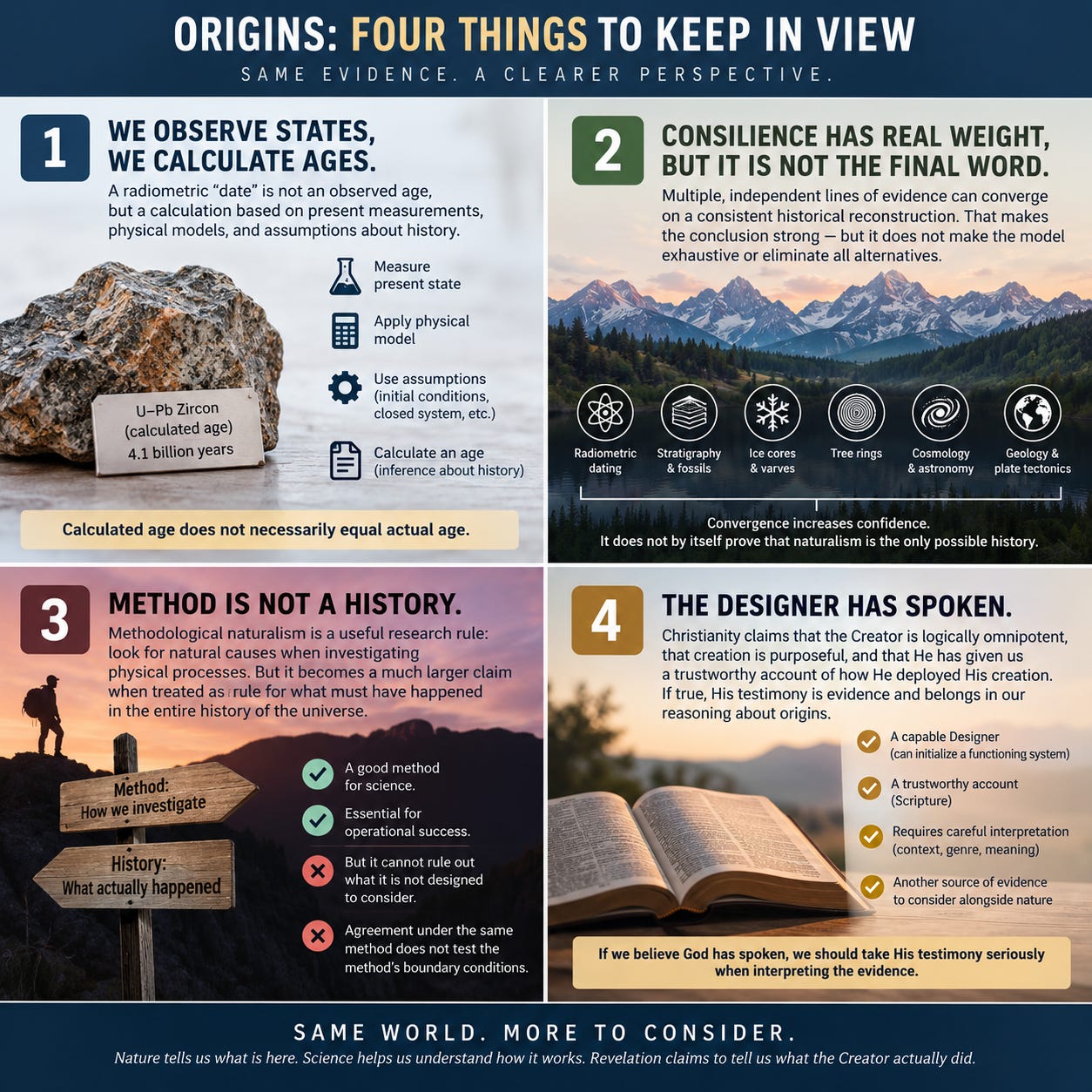
We observed the rock as it exists today. We measured characteristics of it. Perhaps we measured concentrations of parent and daughter isotopes. We applied what we know about radioactive decay. We made judgments concerning the history and initial state of the system. From all of that, we calculated an age.
That distinction matters.
Calculated age does not necessarily equal actual age.
That statement does not mean the calculation is fraudulent. It does not mean the scientist is incompetent. It does not mean radioactive decay is imaginary or that the mathematics is wrong. The calculation may be entirely correct given the measurements and assumptions employed.
It simply means that calculated age and actual historical age are different categories.
A calculated age is a result produced by interpreting a presently observed state through a model. Actual age is the amount of time that really elapsed in the history of the object. They may be identical. But their identity is something to establish, not something contained within the calculation itself.
This is one reason I have become uncomfortable with the familiar phrase “apparent age.”
Apparent to whom?
A rock does not “look four billion years old.” It has certain measurable characteristics. We observe those characteristics, interpret them using what we know about physical processes, and calculate an age. The age is an inference about history.
We observe states. We calculate ages. We reconstruct histories.
Those activities are closely related. They are not identical.
And once that distinction is visible, another question emerges. How much historical authority should we infer from the extraordinary operational success of science?
Suppose a methodology repeatedly demonstrates its reliability when investigating observable natural processes. That gives us excellent reason to trust it within that domain. But success in understanding how a system operates now does not automatically give us exhaustive knowledge of how that system was initially deployed.
Imagine finding a clock running in an abandoned building. You inspect it carefully. You understand its mechanism. You measure its rate with extraordinary precision. You can predict where its hands will be an hour from now.
You have learned a great deal about the clock.
But have you established when it was started, or what its hands displayed when it was started?
Perhaps other evidence will allow you to reconstruct that history. Perhaps you can reconstruct it with considerable confidence. But understanding how the clock operates does not, by itself, tell you how the clock was initialized.
Origins questions often contain this same problem. We know an enormous amount about how physical systems behave. That knowledge legitimately constrains possible histories. Some proposed histories will fit the evidence better than others. Some may be eliminated entirely.
But present evidence is still present evidence. We use it to reconstruct the past. We do not observe the past directly.
But Don’t All the Clocks Agree?
At this point an obvious objection appears.
Earth’s history is not reconstructed from one rock, one isotope, or one clock. Multiple radiometric systems converge. Their results correlate with stratigraphy and fossil succession. Other historical reconstructions draw upon ice cores, varves, tree rings, plate tectonics, stellar models, the cosmic microwave background, and nucleosynthesis.
Surely all those independent lines of evidence converging upon a broadly coherent history must establish that the history is correct.
This is a serious argument.
Consilience matters. When genuinely independent lines of evidence converge upon the same conclusion, our confidence in that conclusion should increase. A model that successfully explains multiple otherwise unrelated observations has accomplished something significant.
But the word independent is carrying considerable weight.
Different measurements can employ different physical processes while their historical interpretations still share assumptions about the kind of history being reconstructed.
Independent measurements are not necessarily independent historical assumptions.
Imagine several investigators reconstructing a crime. One studies fingerprints. Another analyzes DNA. A third examines security-camera timestamps. A fourth reconstructs cellphone locations.
Those are substantially independent sources of evidence. If all four converge, the historical inference may become extraordinarily strong.
But suppose every investigator begins with the unquestioned assumption that nobody entered the building before midnight. Their evidence may strongly constrain what happened after midnight without independently establishing that shared boundary condition.
The point is simple: convergence strengthens an inference to the extent that the relevant evidence is independent with respect to the proposition being tested.
That question cannot be answered merely by counting disciplines.
Radiometric dating, stratigraphy, paleontology, ice-core analysis, astronomy, and cosmology involve genuinely different observations and physical phenomena. Their agreements deserve real evidentiary weight. But before turning their convergence into proof of an entire historical narrative, we still have to ask which assumptions are shared, which are independently tested, how chronologies are calibrated against one another, and what kinds of historical alternatives were admitted into the comparison.
Consilience can make a historical reconstruction extremely strong.
It does not make the hypothesis space exhaustive.
And that distinction becomes particularly important when we reach origins.
When a Method Becomes a History
Methodological naturalism is extraordinarily useful as a working rule for science. When investigating physical phenomena, scientists seek explanations in terms of physical causes that can be observed, modeled, and tested.
Christians should have no particular problem with that.
If I want to understand lightning, I should investigate electrical charge, atmospheric conditions, and electromagnetic behavior. Saying that God governs His creation may be theologically true, but it does not tell me the voltage difference between a cloud and the ground.
The difficulty begins when a useful methodological rule quietly becomes a rule governing possible history.
“Look for natural causes when investigating natural processes” is a methodological commitment.
“The entire history of the physical world must be reconstructed exclusively through uninterrupted natural processes” is a much larger claim.
At that point we have constrained what the history of reality is allowed to contain.
If God actually created the universe, then a method that excludes special creation from consideration before examining the evidence will necessarily produce a history containing no special creation.
That result should surprise no one.
Creation did not lose an empirical contest under those conditions. It was excluded from the hypothesis space before the contest began.
This also exposes a limitation in appeals to consilience.
Suppose multiple scientific disciplines independently examine the present state of the world, but all admissible historical reconstructions operate under the requirement that physical states must be explained through antecedent physical states extending backward through natural processes.
Agreement among those reconstructions can tell us an enormous amount about the best history available under that condition.
It cannot use compliance with the condition as independent evidence that the condition itself is historically true.
Consilience matters.
But consilience is not magic.
It does not transform inference into observation. It does not eliminate shared assumptions merely because many measurements are involved. And it cannot demonstrate that an excluded class of explanations failed an empirical test it was never permitted to enter.
What If the Designer Told Us How He Deployed the System?
This brings us to the distinctly Christian part of the problem.
Christianity does not merely claim that some kind of God exists. It claims that God is the Creator, that His power extends to everything logically possible and consistent with His nature, that creation is purposeful, and that He has spoken truthfully about His creative work.
If we actually believe those claims, they belong in our reasoning.
Think of creation as the deployment of a designed system.
When engineers encounter an unfamiliar functioning system, they can learn an enormous amount by examining its present state. They can measure its behavior, reverse-engineer components, discover dependencies, characterize interfaces, and infer aspects of its history.
But imagine that another source of information becomes available: documentation from the system’s designer describing how the system was actually deployed.
That changes the investigation.
We would not ordinarily dismiss the designer’s documentation simply because reverse engineering produced a different reconstruction. We would ask whether the documentation was authentic, whether the designer was trustworthy, whether we had interpreted the documentation correctly, and whether assumptions in our reconstruction applied to the system’s actual deployment.
That is much closer to the Christian situation.
If God is logically omnipotent, then He is capable of deploying a functioning creation without requiring every component to arrive at its initial functional state through the processes by which that component subsequently operates.
A functioning system can begin in a functioning state.
Adam did not need to pass through infancy before functioning as a man. A tree specially created already bearing fruit would not require years of antecedent growth before possessing the physical characteristics of a mature tree. The wine at Cana did not require a vineyard, harvest, crushing, fermentation, and aging before it possessed the characteristics of wine.
If one examined any such created state while assuming an uninterrupted natural developmental history, one could reconstruct antecedent processes that never occurred.
This is precisely why calculated age and actual age must remain distinct.
And it is why “apparent age” is such an unhelpful description. Nothing deceptive is required. The system simply begins from its designed initial condition.
Running ordinary post-deployment processes backward beyond that initialization boundary would reconstruct a history the system never experienced.
Of course, divine omnipotence cannot become an escape hatch for every inconvenient observation.
“God could have done it” establishes possibility. It does not establish actuality.
The Christian claim is more specific.
We believe the Designer has given us a trustworthy account of His designed system deployment.
That account must be interpreted carefully. We must establish what Scripture actually claims rather than importing our preferred chronology into it. Genre matters. Language matters. Context matters. Canon matters. Christians can misinterpret revelation just as surely as scientists can misinterpret nature.
But once we have good reason to believe that God has spoken clearly about some aspect of creation history, His testimony is evidence.
That changes the epistemic structure of the problem.
Nature gives us the presently observable state of creation.
Science tells us an extraordinary amount about how that creation operates and allows us to reconstruct histories from its present state.
Revelation claims to tell us something that present-state investigation cannot directly observe: what the Creator actually did.
If Christianity is true, dismissing that testimony before reconstructing origins requires justification.
Methodological naturalism cannot provide that justification merely by having no category for revelation.
Why Are Christians So Quick to Reinterpret?
This is where I think Christians should examine our own reasoning carefully.
Scripture describes itself as God-breathed (2 Timothy 3:16) and says that men spoke from God as they were carried along by the Holy Spirit (2 Peter 1:21). Christianity therefore makes an extraordinary epistemic claim concerning origins:
There was an Observer at the beginning, and He has spoken.
That does not eliminate interpretation.
Christians still have to determine what Scripture actually says. We have to wrestle with language, genre, context, authorial intention, canonical relationships, and the difference between what the text states and what our traditions have taught us to see in it.
Scientific discoveries can expose bad interpretations of Scripture. Inspiration does not make interpreters infallible.
But something strange happens when Christians begin their reasoning with the sentence, “Science has established X, therefore Genesis must mean Y.”
Before reinterpreting Genesis, we should at least ask what exactly X represents.
Is it an observation?
A measurement?
A mathematical relationship?
A calculated age?
A model-dependent inference?
A historical reconstruction?
Or a philosophical conclusion built upon several of those things?
Those distinctions matter because they carry different kinds of epistemic weight.
Yet in ordinary conversation they are frequently collapsed into one enormous category called “science.” Once that happens, questioning any component of the resulting historical narrative sounds like questioning science itself.
Perhaps that helps explain some of the anxiety Christians experience around origins.
We do not want another Galileo.
We do not want our grandchildren reading about us as the generation that stubbornly resisted obvious evidence because we were unwilling to reconsider our interpretation of Scripture.
That concern is legitimate. Intellectual humility requires Christians to admit that we can be wrong, including about interpretations we hold very confidently.
But fear of repeating an earlier mistake can create another one.
The lesson of history should be careful reasoning.
Galileo does not establish that every future scientific reconstruction of the past must be correct. The success of modern medicine does not establish the chronology of the early universe. The accuracy of orbital mechanics does not establish the initial conditions of the cosmos. The reliability of radioactive decay does not, by itself, establish the initial state and complete history of every sample to which a dating method is applied.
Each claim has to carry its own evidentiary burden.
There is also a temptation for Christians who question conventional origins narratives to commit their own shortcut. We can too easily assume that every Christian who accepts an ancient universe or evolutionary history has simply surrendered to naturalism.
That is unfair, and it short-circuits the very inquiry we are asking others to undertake.
Many thoughtful Christians have examined both Scripture and scientific evidence and concluded that an ancient cosmos or some form of evolutionary history is compatible with Christian orthodoxy. Some believe the biblical text itself points in that direction.
Their arguments deserve to be heard in their strongest form.
They may be wrong.
So may we.
The relevant question is whether our conclusions survive careful examination once observations, interpretations, assumptions, and philosophical commitments have been identified.
That standard applies to everyone.
The Question Underneath the Question
I increasingly suspect that the deepest origins controversy is not really a contest between “the Bible” and “science.”
That framing obscures the more fundamental question:
What may count as knowledge about a past that no human being observed?
Science gives us extraordinarily powerful access to the present physical state of the world. From that state we can infer enormous amounts about its history. Multiple independent lines of evidence can converge and make particular historical reconstructions very strong.
Christians should take that evidence seriously.
And if we propose a different actual history, we inherit a substantial explanatory burden. We cannot simply point out that conventional reconstruction is inferential and declare victory. We have to explain why the present state of creation produces the measurements it does, why different measurements converge as they do, and why our proposed history accounts for those observations at least plausibly.
That is real scientific work.
But the burden runs both ways.
Consilience among present-state reconstructions does not establish that natural history is the only admissible kind of history. It cannot establish by methodological exclusion that special creation did not occur.
Christianity claims another source of historical knowledge: revelation.
If God exists, if God created, if God is logically capable of deploying a functioning creation, and if God has truthfully told us something about that deployment, then His testimony belongs in our reconstruction of origins.
That does not give Christians permission to ignore nature.
It gives us another source of evidence to interpret alongside nature.
So I return to the question that started this reflection.
Why do so many Christians feel the need to adopt the prevailing naturalistic reconstruction of origins?
For some, the answer is straightforward. They have examined the evidence and believe that reconstruction is correct. That deserves serious engagement.
But I suspect other forces are operating as well.
We remember the stories of Christianity being embarrassed by science. We know the intellectual and social cost of questioning scientific consensus. We have witnessed the extraordinary success of operational science and may have extended that authority into historical questions without noticing the additional inferential steps involved.
And perhaps methodological naturalism has sometimes slipped quietly from being a useful rule for conducting scientific investigation into being a rule governing what Christians themselves are permitted to regard as possible history.
If so, we should examine that move.
Christians have no reason to fear good science.
Measure carefully. Calculate honestly. Test relentlessly. Follow the physical evidence wherever it leads. Abandon bad arguments regardless of how useful they have been to our preferred position.
And take consilience seriously.
But be equally precise about what the evidence establishes.
We observe present states.
We calculate ages.
We reconstruct histories.
A calculated age may correspond exactly to actual history. Multiple independent calculations that converge can substantially strengthen that conclusion.
But calculated age does not necessitate actual age.
And consilience does not transform a methodological boundary into a fact about history.
The universe has a real history. Science attempts to reconstruct that history from what remains available to us in the present.
Christianity makes an additional and remarkable claim.
The Designer of the system has told us something about how He deployed it.
If we believe He is capable of doing what He describes, if we believe He is trustworthy, and if careful exegesis establishes that we have understood what He said, then we should take that testimony seriously.
Otherwise, we risk doing something peculiar.
We profess confidence that the Creator has spoken, while granting a methodology designed without access to His testimony the authority to tell us what He must have meant.
What a fantastic article! Your distinction between present observations and reconstructions of the past is important. Christians should examine scientific evidence honestly while recognizing its assumptions, just as we must interpret Scripture humbly: God’s Word is infallible, but our interpretations are not.
Science can investigate natural processes, but it cannot assume that God has never acted in creation. Because nature and Scripture come from the same truthful God, an apparent conflict should lead us to reconsider whether we have interpreted the scientific evidence, the biblical text, or both correctly.
Christianity does not ask nonbelievers to suppress reason, but to consider honestly whether reality includes more than natural processes. Creation may point us toward a Creator, but Jesus Christ brings the question into focus: Did God enter history, die for our sins, and rise again? If He did, each of us must respond.
Thank you for addressing this difficult subject with intellectual honesty, biblical conviction, and humility. You have shown that Christians can respect scientific evidence while remaining faithful to our Creator's testimony.