

The modern dispute over the age of the universe is usually framed as a contest between science and Scripture. On one side stands the contemporary cosmological reconstruction: approximately 13.8 billion years of cosmic history inferred from expansion, redshift, stellar development, background radiation, and other observations. On the other stands a straightforward reading of Genesis in which God creates the heavens and the earth deliberately and rapidly.
That framing conceals a more fundamental question.
What do we actually know about the beginning, and how do we know it?
God asks essentially that question in Job 38.
After Job and his companions have spent chapter after chapter reasoning about God, providence, causation, justice, and the structure of reality, God finally answers. His response is striking. He does not begin by supplying Job with additional data. He challenges Job’s epistemic position:
“Where were you when I laid the foundation of the earth? Tell me, if you have understanding.”
— Job 38:4 (ESV)
For disputes about origins, it is difficult to imagine a more appropriate question.
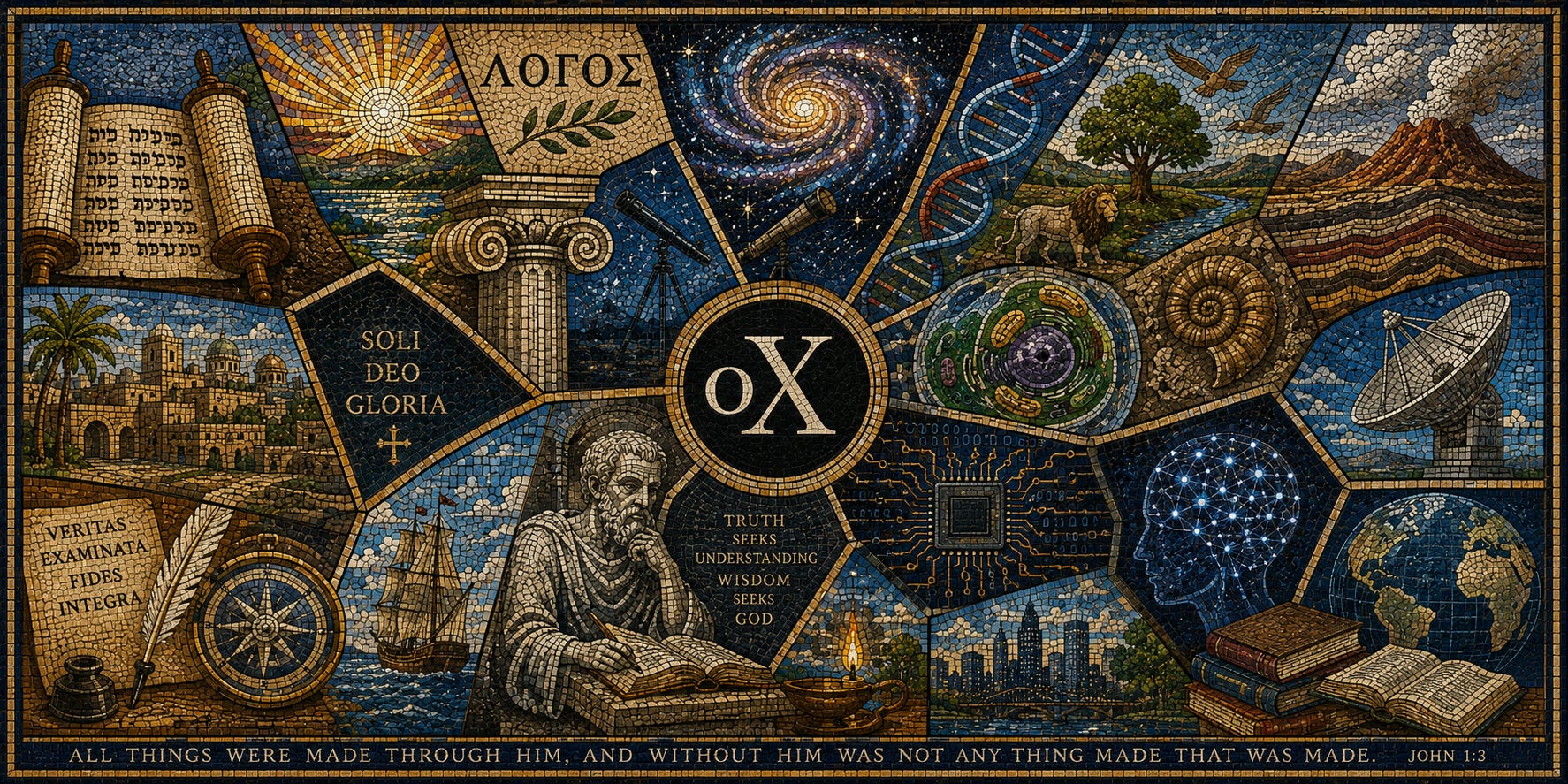
What We Observe
There is an important distinction between observing the universe and observing its history.
We observe galaxies. We measure redshifts. We detect radiation. We measure isotope ratios. We examine strata, fossils, stars, gravitational interactions, and the large-scale structure of the cosmos.
Those are observations.
An age is different.
No instrument directly measures “13.8 billion years” in the way that a ruler measures a meter or a clock measures an elapsed second in the laboratory. Cosmic age is a model-derived quantity. Scientists observe present phenomena and use physical theories to reconstruct the sequence of earlier conditions capable of producing them.
That is legitimate science. Historical sciences necessarily operate this way.
But reconstruction contains assumptions.
We begin with the universe as we presently observe it. We identify physical regularities that describe how it behaves. We then apply those regularities backward, asking what earlier conditions could have produced the conditions we see today. From those inferred earlier conditions, we extrapolate backward again. Repeated over enormous intervals, this process produces a reconstructed history of the universe.
The reasoning can be extremely powerful. Its historical conclusion nevertheless depends upon a crucial assumption: that the physical relationships being used to reconstruct the past remain applicable throughout the period across which we are extrapolating.
That assumption is generally reasonable when reconstructing the ordinary history of an already functioning physical system.
Origins introduce a particular complication.
What if the system itself was initialized?
If the universe began through an act that established a mature physical state, then ordinary processes observed after that beginning cannot automatically tell us how the initial state itself came to exist. Extrapolating those processes backward may describe how such a state could have developed naturally. It does not, by itself, establish that this is how the state actually originated.
That is the initialization problem.
The Initialization Problem
Consider something considerably less controversial than cosmology.
Suppose I create a computer simulation today and initialize it with a mature virtual environment. The simulation contains mountains, rivers, trees, weather systems, and populations. Once initialized, it follows consistent internal rules.
An investigator inside that simulation could observe its present state, discover those rules, and extrapolate backward.
The mathematics might imply that the mountains required millions of simulated years to erode into their present shapes.
Yet they did not.
The investigator has correctly discovered the system’s ordinary dynamics and incorrectly inferred its origin.
The error occurs because the investigator has extrapolated valid regularities through an initialization boundary.
Nothing about the mature mountain is false. Nothing about the physical regularities is false. Nothing about the investigator’s measurements is necessarily mistaken.
The historical inference fails because the initial state was supplied rather than generated by the ordinary processes subsequently governing the system.
That distinction matters enormously if Genesis is even potentially true.
Genesis does not describe God beginning with an immature universe and waiting for ordinary physical processes to develop it into functional condition. It repeatedly describes the direct establishment of functioning systems.
Plants are capable of reproduction. Animals are capable of reproduction. Adam and Eve are functioning human beings. The earth sustains life. The heavenly bodies provide light and mark “signs and for seasons, and for days and years” (Genesis 1:14, ESV).
Creation concludes with an operational world. God declares the completed creation “very good” (Genesis 1:31, ESV), and Genesis 2 describes the creative work as finished.
A biblical creation model therefore contains an initialization boundary by definition.
And that changes the epistemological problem.
Functional Maturity Is Not Mere “Appearance of Age”
This argument is often dismissed as the “appearance of age” hypothesis.
That description is inadequate.
The relevant biblical category is functional maturity.
Adam did not merely look like an adult. He was capable of performing the functions for which he had been created.
The trees did not merely appear mature. They actually produced fruit.
The ecosystem did not merely resemble an operating ecosystem. It operated.
Functional systems require the structures necessary to perform their functions. A functioning circulatory system requires developed vessels. A functioning tree requires roots, vascular structures, biochemical machinery, and reproductive capacity. A functioning astronomical system likewise requires whatever spatial, energetic, gravitational, and informational relationships are necessary for its appointed functions.
That produces an unavoidable consequence.
A mature initialized state can contain physical relationships which, when interpreted exclusively through ordinary post-initialization processes, imply an antecedent history that the system did not undergo.
The structures are real. Their properties are real. The processes we observe today are real.
The critical question is whether every present structure must have been generated by the ordinary historical process through which we would expect that structure to arise today.
That proposition requires argument.
It cannot simply be assumed.
God Is Not a Deceiver
At this point an objection naturally arises.
If God created a functionally mature universe whose present structures can be interpreted as evidence of an antecedent history, would that make God deceptive?
No.
The objection quietly transfers responsibility for our interpretation to the object being interpreted.
Creation does not come with labels saying, “This structure was produced by 4.2 billion years of antecedent physical development.” We observe a structure, measure its properties, identify processes capable of producing similar structures, and infer a history.
The history is our interpretation of the evidence.
If that interpretation is wrong, the error does not thereby belong to God.
God is not a deceiver. We are fallible interpreters.
This distinction becomes especially important for Christians because we do not possess only nature. We also claim to possess revelation from nature’s Creator.
Scripture and nature therefore do not occupy epistemically equivalent positions.
Nature is something we investigate.
Scripture is God’s propositional revelation by which we understand the creation we investigate.
This establishes an important hermeneutical order:
Scripture interprets nature. Nature does not interpret Scripture.
That principle does not give Christians permission to disregard empirical evidence. Our interpretation of Scripture is fallible. If we require Scripture to say something it does not actually say, careful investigation may expose the weakness in our interpretation.
The same distinction applies to nature.
Nature is real.
Our interpretation of nature is fallible.
The problem arises when a scientific reconstruction is elevated from an interpretation of observed evidence into an epistemic authority by which Scripture must subsequently be reinterpreted. The order has been reversed. Human reconstruction has become the controlling hermeneutic for divine revelation.
For the Christian, that is precisely backwards.
This Is Where Job Becomes Uncomfortable
Job 38 is sometimes treated as little more than a poetic declaration of God’s power.
It is considerably sharper than that.
God repeatedly distinguishes His knowledge of creation from Job’s reconstructed understanding of it.
“Where were you?”
“Who determined its measurements?”
“On what were its bases sunk?”
“Have you commanded the morning since your days began?”
“Have you entered into the springs of the sea?”
“Have you comprehended the expanse of the earth?”
“Can you bind the chains of the Pleiades or loose the cords of Orion?”
— Job 38:4-31 (ESV)
Notice what God does not do.
He does not disparage investigation of nature.
The entire interrogation concerns nature.
God points Job toward geology, oceans, light, meteorology, astronomy, animal behavior, reproduction, and ecology. Creation is intelligible. Its order matters. Job’s problem is not that he has examined nature too carefully.
His problem is epistemic overreach.
He is reasoning beyond what his position as a finite observer warrants.
“Where were you?” therefore establishes a distinction that remains relevant to origins science.
There is knowledge obtained by examining creation.
There is knowledge concerning the act by which creation came to be.
Those categories overlap, but they are not identical.
The Forgotten Witness
This becomes especially important for Christian theology because the biblical claim is not simply that nobody knows what happened at creation.
Someone does.
The Creator.
That changes the evidential structure.
If Genesis is merely an ancient human speculation about origins, then it competes with other human reconstructions and should be evaluated accordingly.
Christianity makes a much stronger claim.
Scripture presents creation as revelation from the One who performed the act.
The modern investigator can legitimately say:
“Given the universe we presently observe, and assuming that the relevant physical regularities can be extrapolated backward across the entire interval, this is the history that best explains the present state.”
That is a meaningful scientific statement.
But notice the conditional.
If the universe contains a genuine creation boundary at which its functional state was deliberately initialized, unrestricted backward extrapolation can reconstruct a physically plausible antecedent history without reconstructing the universe’s actual history.
The distinction is subtle.
It is also decisive.
The Clock Can Be Right While the History Is Wrong
Imagine finding a fully assembled mechanical clock running on a table.
You study its gears, measure their rates, understand the mechanism, and calculate backward.
After sufficient analysis you conclude:
“This clock must have been running for 47 years to reach its present configuration.”
But suppose someone assembled the clock yesterday and deliberately set its hands and internal counters before starting it.
Your understanding of clock mechanics could be impeccable.
Your measurements could be exact.
Your calculations could be flawless.
Your inferred history would still be wrong.
The problem would not lie in the clock.
It would lie in treating the current state as though it necessarily resulted from an antecedent trajectory governed exclusively by the mechanism you presently observe.
That is the issue creation places before cosmology.
The relevant question is therefore not merely:
“What age does the universe indicate under our current physical models?”
We must also ask:
“What assumptions are necessary to convert those measurements into an actual history of the universe?”
And then:
“Can those assumptions independently establish that no initialization boundary occurred?”
That last question is much harder.
Science Can Test the Model
None of this provides Christians with permission to dismiss inconvenient evidence.
A creation model should face empirical scrutiny.
If Scripture describes an orderly creation, Christians should expect observations of nature to exhibit coherence. A functional-maturity model that can accommodate literally any observation explains nothing.
The appropriate scientific question therefore remains open:
“If the universe was rapidly initialized into a mature functional state, what observable consequences should distinguish that history from a universe that reached the same state through billions of years of ordinary development?”
That is a legitimate research question.
It may expose severe difficulties for a young creation model.
Good.
A truth claim should survive attempts to falsify it.
But the same discipline must operate in the other direction.
Deep-time reconstruction should not be permitted to assume its central premise and then count the resulting reconstruction as independent proof of that premise.
If we infer ancient history by extrapolating present regularities backward, we cannot then point to the reconstructed history alone as proof that those regularities operated continuously through every relevant boundary.
The circularity can be subtle.
Job’s question exposes it.
“Tell Me, If You Have Understanding”
The Christian response to modern cosmology therefore has no need to fear science.
Measure carefully.
Model precisely.
Test competing explanations.
Distinguish observation from interpretation.
Identify assumptions.
Look for falsifiers.
And maintain the proper epistemic order.
Scripture interprets nature. Nature does not interpret Scripture.
That does not mean our interpretation of Scripture is beyond correction. It means that God’s revelation remains the authority by which our interpretations, whether exegetical or scientific, are ultimately judged.
When someone claims that the reconstructed history of the universe has eliminated the possibility of creation because present observations can be extrapolated into a history extending billions of years, there is a remarkably appropriate question available.
It is not ours.
God asked it first.
“Where were you when I laid the foundation of the earth? Tell me, if you have understanding.”
— Job 38:4 (ESV)
That question does not tell us the age of the universe.
It tells us something epistemologically prior.
We were not there.
Our instruments were not there.
Our laboratories were not there.
Our equations describe relationships within the creation we presently inhabit. Whether those relationships can reconstruct the act by which that creation itself was established is a further proposition requiring justification.
According to Christianity, however, the beginning was witnessed.
The Witness is the Creator.
The universe is God’s creation.
The reconstruction is ours.
We should be careful not to confuse the two.
God’s interrogation of Job remains devastatingly concise:
“Where were you?”