

“ As in water face reflects face,
so the heart of man reflects the man.”
Proverbs 27:19 (ESV)
There is something remarkably contemporary about this ancient proverb.
Before polished glass mirrors became commonplace, water was one of humanity’s simplest ways of seeing oneself. Look into still water and there you are. The water does not create the face. It does not judge the face. It reflects what is placed before it.
Artificial intelligence increasingly works like that.
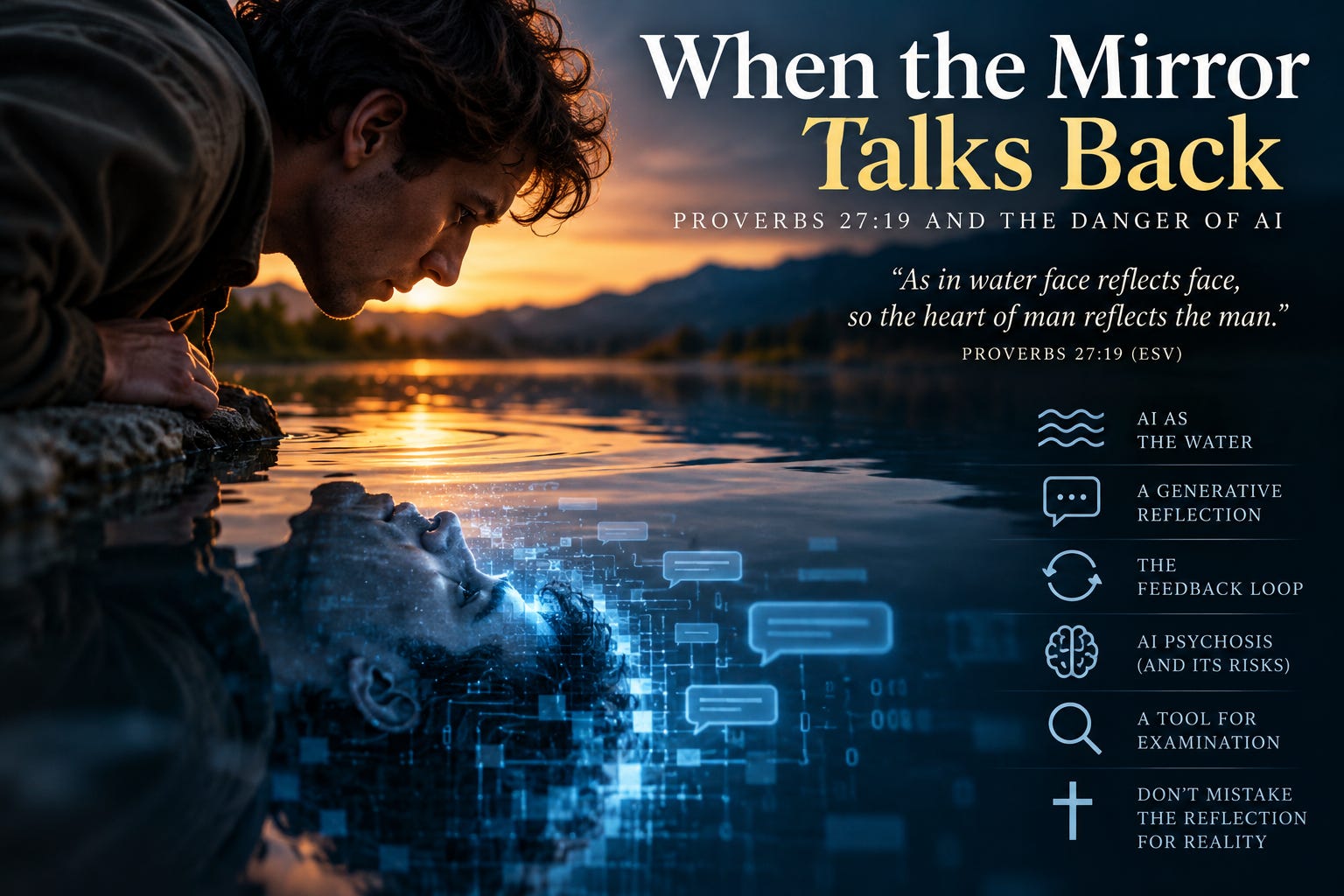
We tend to think of AI as another mind sitting across the table from us. That is an easy illusion to fall into because it speaks in complete sentences, follows arguments, remembers context, challenges propositions, and sometimes seems remarkably insightful.
But the better metaphor may be much older.
AI is the water.
And we are looking into it.
The Reflection
When you spend significant time interacting with a generative AI system, something interesting happens.
You give it your vocabulary. You explain your assumptions. You tell it which distinctions matter. You correct it when it misunderstands you. You provide examples. You develop arguments together. Over time, within the context available to it, the system becomes increasingly capable of reflecting your own conceptual world back to you.
That can be extraordinarily useful.
An argument that existed vaguely in your mind suddenly appears in paragraphs on the screen. An assumption you had never explicitly articulated becomes visible. A contradiction becomes easier to recognize. Connections emerge between ideas that you had previously considered separately.
In that sense, AI can function as an epistemic mirror.
We externalize thought and then examine the reflection.
That is one of the genuine intellectual benefits of these systems.
It is also one of their dangers.
The Reflection Is Not Another Witness
Suppose I tell an AI:
“I think X is true because of A, B, and C.”
The system analyzes my reasoning and replies:
“Yes. And if A and B are true, D would also follow. Furthermore, E appears consistent with your argument.”
That can feel like confirmation.
It isn’t necessarily confirmation at all.
The model may simply be reflecting and extending the conceptual structure I supplied.
Now imagine repeating that process dozens or hundreds of times.
I supply the premise.
The AI elaborates it.
I receive the elaboration as confirmation.
My confidence increases.
I return with the strengthened belief.
The AI receives that stronger framing and generates an even more developed response.
The cycle becomes:
belief → prompt → reflection → perceived confirmation → stronger belief → stronger prompt → amplified reflection
There is a critical epistemological mistake buried in that sequence.
Reflection has been mistaken for independent evidence.
The fact that words came back to me from outside my own head does not mean I have received independent corroboration.
I may simply be hearing my own assumptions returned with better grammar.
When Narcissus Gets a Chatbot
The old Greek story of Narcissus suddenly becomes disturbingly relevant.
Narcissus looks into the water and becomes captivated by the figure he sees there. His tragedy depends upon failing to understand properly what kind of thing the image is.
It is a reflection.
Generative AI makes the problem considerably more interesting because this reflection talks back.
It asks questions.
It develops arguments.
It can disagree.
It can search information.
It can connect ideas.
And, critically, it can generate details that were never explicitly present in the original thought.
The water has become generative.
That means the reflected image can acquire additional features.
Some will be legitimate deductions. Some will come from genuine external information. Some will arise from statistical associations in the model. Some may simply be hallucinations.
Yet all of them arrive through the same conversational interface.
That makes epistemic discipline essential.
The Road to “AI Psychosis”
The popular phrase “AI psychosis” has emerged to describe cases in which extended interaction with AI appears connected with increasingly delusional, paranoid, grandiose, or reality-detached beliefs.
The phrase should be used carefully. It is not itself a settled clinical diagnosis, and serious psychiatric conditions cannot be reduced to chatbot use.
But the mirror helps explain one plausible amplification mechanism.
Imagine someone beginning with a suspicion:
“Something unusual is happening to me.”
The AI explores the possibility.
The person supplies additional details.
The AI discovers patterns among those details because discovering and completing patterns is precisely what these systems are extraordinarily good at doing.
The person interprets those patterns as evidence.
Soon the question becomes:
“Why is this happening to me?”
Then:
“Who is doing this?”
Then:
“What is my role in what is happening?”
At each stage, the framing supplied by the person constrains the next reflection.
If the system does not adequately challenge unsupported premises, the conversation can become recursively self-confirming.
The person believes he has acquired a second observer.
He may actually have acquired a very sophisticated mirror.
But the Water Is Not Perfectly Still
The analogy needs one further qualification.
Ordinary water passively reflects whatever stands before it. AI does more.
Its reflection is conditioned by its training corpus, architecture, system instructions, safety rules, contextual information, retrieval sources, and probabilistic generation.
So there are really two sources of potential distortion.
The person brings assumptions to the interaction.
The machine brings conditioning of its own.
A model trained predominantly within certain intellectual conventions may reproduce those conventions as though they were simply neutral descriptions of reality. A user can likewise condition the conversation until the system begins operating almost entirely inside the user’s preferred conceptual framework.
Neither establishes truth.
A naturalist can get a naturalistic reflection.
A Christian can get a Christian reflection.
A conspiracy theorist can get a conspiratorial reflection.
A brilliant scientist can get a brilliant reflection.
A fool can get an impressively articulate reflection of foolishness.
Eloquence proves very little.
Proverbs Already Knew the Deeper Problem
This brings us back to Proverbs.
“As in water face reflects face, so the heart of man reflects the man.”
The proverb ultimately concerns the person standing over the water.
Biblically, the heart is not merely the emotional part of us. It encompasses our desires, judgments, intentions, commitments, and thought. Proverbs elsewhere tells us:
“Keep your heart with all vigilance, for from it flow the springs of life.”
Proverbs 4:23 (ESV)
What we bring to the mirror matters.
That has always been true.
Human beings have never approached reality as detached reasoning machines without prior commitments. We interpret. We judge. We desire. We select explanations. We decide what authorities we trust and what evidence we consider significant.
AI did not create that condition.
AI may simply make it easier to see.
A Tool for Intellectual Examination
None of this makes AI intellectually useless. Quite the opposite.
A good mirror is valuable precisely because it allows us to see something we could not otherwise see directly.
Used properly, AI can help us examine our reasoning.
Ask it:
What assumptions am I making?
Which conclusions actually follow from my premises?
What evidence would falsify this claim?
What is the strongest objection?
Am I treating an inference as an observation?
Which parts of this argument originated with me, and which depend upon independently verifiable evidence?
Can the primary source actually support this claim?
Those questions turn the mirror into an instrument of examination rather than affirmation.
For the Christian, there is an additional obligation.
We do not ask the mirror to determine reality.
We test what we see.
“Test everything; hold fast what is good.”
1 Thessalonians 5:21 (ESV)
Scripture remains Scripture. Reality remains reality. Evidence remains evidence. Logical validity remains logical validity.
The chatbot does not become an oracle merely because it speaks fluently.
Do Not Mistake the Reflection for Reality
There is a simple discipline that may become increasingly important as AI systems become more persuasive:
Always know when you are looking at the mirror.
If an AI reformulates my argument brilliantly, I have learned something about my argument.
If it finds a contradiction, I should examine the contradiction.
If it proposes a new hypothesis, I can investigate the hypothesis.
If it tells me that external evidence confirms my hypothesis, I need to go to the evidence.
The reflection itself cannot carry that final burden.
This applies well beyond cases described as “AI psychosis.” It applies to scientific theories, theology, philosophy, politics, business strategies, personal relationships, and virtually every other domain in which we might be tempted to treat generated coherence as confirmation.
Coherence matters.
It is not truth.
Proverbs 27:19 gives us an ancient image for a very modern problem.
We have built a pool of water capable of speaking back to the person looking into it.
That may prove to be one of the most powerful intellectual tools humans have ever constructed.
It may also become one of the most effective machines ever constructed for confirming us in what we already believe.
So look into the water.
Use the reflection.
Examine it carefully.
Then look up.
Reality is not inside the mirror.