

I keep encountering variations of the same objection to Christianity:
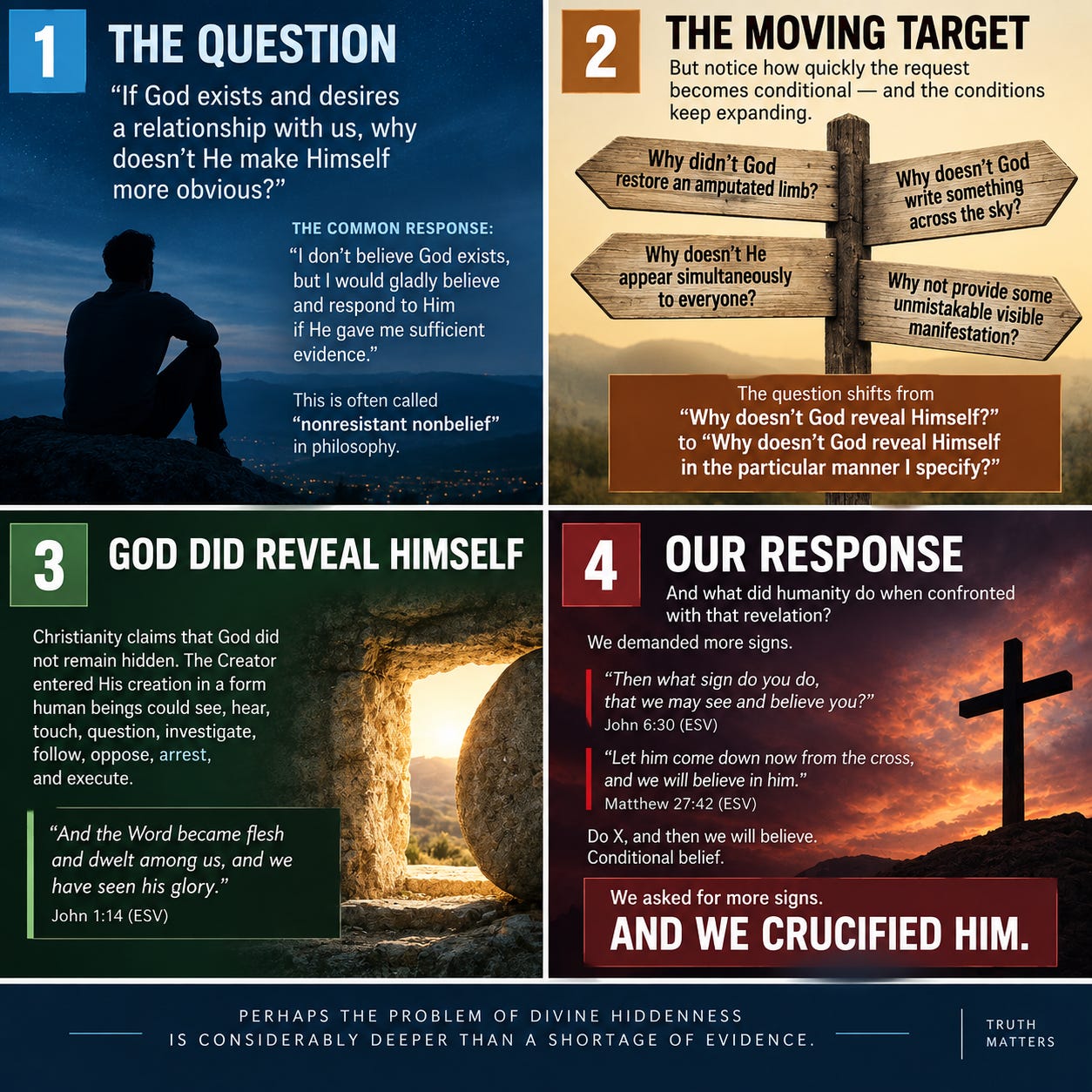
If God exists, loves us, and desires relationship with us, why doesn’t He make Himself more obvious?
It is an intuitively powerful question. In contemporary philosophy of religion, its strongest formulation is usually associated with J. L. Schellenberg and the argument from divine hiddenness.
The argument deserves to be taken seriously.
But there is a distinction buried inside it that I think deserves considerably more attention.
Nonresistant Nonbelief
The strongest hiddenness argument does not concern the militant atheist who hates the idea of God, refuses to consider evidence, or simply wants nothing to do with Him.
That case would be too easy.
Instead, the argument appeals to the nonresistant nonbeliever.
This is supposedly someone who genuinely does not believe that God exists while remaining completely open to relationship with God. The person might describe his position something like this:
“I don’t believe God exists, but I would gladly believe and respond to Him if He gave me sufficient evidence.”
That sounds reasonable.
But look carefully at what has actually been said.
That statement does not necessarily establish nonresistance.
It establishes a conditional.
If God provides evidence sufficient for me, then I will believe.
Those are not identical propositions.
Conditional Willingness Is Not Nonresistance
Logically, the claim looks something like this:
If E, then B.
If some evidential condition E is satisfied, then I will believe B.
But that tells us nothing by itself about whether the person is genuinely nonresistant toward God.
It tells us the condition under which the person presently believes he would become convinced.
That distinction matters because the discussion almost immediately begins accumulating additional conditions.
Why doesn’t God restore an amputated limb?
Why doesn’t God write something across the sky?
Why doesn’t He appear simultaneously to everyone?
Why doesn’t He produce some unmistakable visible manifestation that nobody could possibly deny?
Again, these are legitimate questions to ask.
But notice what has happened.
The original question was:
Why doesn’t God reveal Himself?
It has quietly become:
Why doesn’t God reveal Himself in the particular manner I specify?
That is a substantially different proposition.
God Did Reveal Himself
Christianity gives an extraordinary answer to the original question.
God did reveal Himself.
Christianity does not present God as a distant deity who merely scattered a few ambiguous clues around the universe and expected humanity to figure everything out.
Its central claim is considerably more radical.
“And the Word became flesh and dwelt among us, and we have seen his glory.”
— John 1:14, ESV
The Creator entered His creation.
The Logos became flesh.
According to the Christian testimony, God became accessible to ordinary human sensory experience.
John describes the apostolic encounter in remarkably concrete terms:
“That which was from the beginning, which we have heard, which we have seen with our eyes, which we looked upon and have touched with our hands…”
— 1 John 1:1, ESV
Seen.
Heard.
Touched.
This is not the language of divine concealment.
Christianity claims that human beings could walk beside God, eat with Him, question Him, argue with Him, investigate His claims, observe His actions, follow Him, abandon Him, arrest Him, interrogate Him, and execute Him.
And that creates an interesting problem for the assumption underlying many popular arguments from divine hiddenness.
Because what happened when God became extraordinarily accessible?
We Asked for More Evidence
The Gospels repeatedly describe people encountering extraordinary evidence and then requesting another demonstration.
John records Jesus feeding a multitude.
And shortly thereafter we encounter this remarkable question:
“Then what sign do you do, that we may see and believe you?”
— John 6:30, ESV
Think about the structure of that demand.
Show us something, and then we will believe.
Matthew records something even more striking at the crucifixion:
“Let him come down now from the cross, and we will believe in him.”
— Matthew 27:42, ESV
There it is almost perfectly stated.
Do X, and then we will believe.
Conditional belief.
And Christianity makes an astonishing claim about that particular moment.
While human beings were demanding that God provide the evidence they considered appropriate, God’s intended revelation was occurring directly in front of them.
They wanted Him to come down from the cross.
Christianity says His remaining on the cross was the revelation.
They had specified the evidential condition under which they promised belief, while failing to recognize what God was actually doing.
That should at least make us cautious about equating our preferred conditions for belief with genuine nonresistance.
The Evidential Escalation Problem
Consider the frequently proposed example of an amputated limb.
Someone says:
If God restored an amputated limb publicly, then I would believe.
Suppose He did.
What follows?
Perhaps everyone believes.
But perhaps the questions simply move.
Why did God restore only one amputee?
Why not restore all amputees?
Why does He allow amputations in the first place?
Why perform biological regeneration rather than appear visibly?
Why not appear simultaneously over every major city?
Why not speak audibly to every human being?
Why permit anyone to wonder whether the event had some unknown natural explanation?
Why leave any interpretive ambiguity whatsoever?
There is no obvious terminal point.
For almost any revelation R₁, it is possible to imagine some supposedly superior revelation R₂.
And once R₂ occurs, we can imagine R₃.
The evidential threshold can continue moving indefinitely.
That does not make requests for evidence illegitimate. Christianity makes historical claims, and historical claims should be investigated.
Nor does it establish that every unbeliever secretly hates God.
That would go beyond what the argument demonstrates.
It establishes something narrower.
A person’s sincere willingness to believe under specified conditions does not establish that the person is nonresistant toward God.
Sincerity and nonresistance are different categories.
A person may be completely sincere when saying:
“If God does X, I will believe.”
But the statement remains conditional.
And the person making it has usually retained the authority to determine what X must be.
Can We Know That We Are Nonresistant?
This leads to a deeper epistemological problem.
How exactly would someone establish his own nonresistance toward God?
We certainly have access to our own thoughts and intentions. We can sincerely report our present dispositions.
But the claim involved here is stronger.
The person is making a counterfactual claim about how he would respond if confronted by God.
And Christianity has a very particular anthropology concerning our ability to evaluate ourselves in precisely this domain.
Scripture does not portray humanity as epistemically neutral toward God.
Paul writes that human beings “suppress the truth” (Romans 1:18, ESV).
John describes the problem using the imagery of light:
“And this is the judgment: the light has come into the world, and people loved the darkness rather than the light because their works were evil.”
— John 3:19, ESV
Whether one accepts that anthropology is another question.
But one cannot evaluate the Christian response to divine hiddenness while simply assuming its negation.
Christianity predicts that human resistance toward God can affect the evaluation of God’s revelation itself.
That means sincere self-assessment cannot automatically establish nonresistance.
A person may sincerely believe himself completely open to God while remaining unaware of the conditions he has imposed upon the God he claims to be seeking.
The Gospels give us precisely that picture.
The Crucifixion Is the Christian Answer
This brings us back to the fact that first struck me about the contemporary discussion of divine hiddenness.
Christianity contains an extraordinary historical counterclaim to the idea that the fundamental human problem is simply that God has failed to make Himself sufficiently accessible.
According to Christianity, God once made Himself accessible enough to be crucified.
That fact deserves considerably more philosophical attention than it usually receives.
The Christian story is not primarily about humanity desperately searching for a God who refuses to come out of hiding.
It is about God entering His creation and humanity failing to recognize Him.
“He came to his own, and his own people did not receive him.”
— John 1:11, ESV
We wanted another sign.
Another demonstration.
Another condition satisfied.
“Come down from the cross, and we will believe.”
And the terrible irony of the Christian story is that the cross they regarded as a reason for unbelief was itself at the center of God’s revelation.
Perhaps Hiddenness Is Not the Whole Problem
None of this proves that every person who struggles to believe is consciously resisting God.
It does not eliminate every form of the philosophical argument from divine hiddenness.
And it certainly does not give Christians permission to dismiss the sincere questions of people who genuinely struggle with God’s apparent absence.
It does, however, challenge an assumption that too easily slips into the discussion:
Conditional openness cannot simply be equated with nonresistance.
“I would believe if God did X” establishes a condition for belief.
It does not establish the absence of resistance.
And Christianity gives us good reason, within its own explanatory framework, to question whether increasing the magnitude of divine manifestation necessarily produces willing relationship with God.
After all, Christianity claims that God did considerably more than regenerate an amputated limb or project a message into the sky.
The Word became flesh and dwelt among us.
We saw Him.
We heard Him.
We touched Him.
We questioned Him.
We demanded more signs.
And we crucified Him.
Perhaps the problem of divine hiddenness is considerably deeper than a shortage of evidence.
I've just had the opportunity to sit down and read this...Thank you, JD. A powerful, thought-provoking post.