

Start with something almost impossible to deny:
Something is actual.
You are reading these words. I am writing them. Whatever else we may disagree about, there is an actuality to explain.
That gives us an interesting way to approach one of philosophy’s oldest questions. Instead of beginning with everything we can imagine and asking which possibilities might be real, start with what is already actual and reason backward.
What must be true for anything to be actual at all?
That question leads somewhere interesting.
It leads to logic, information, and action.
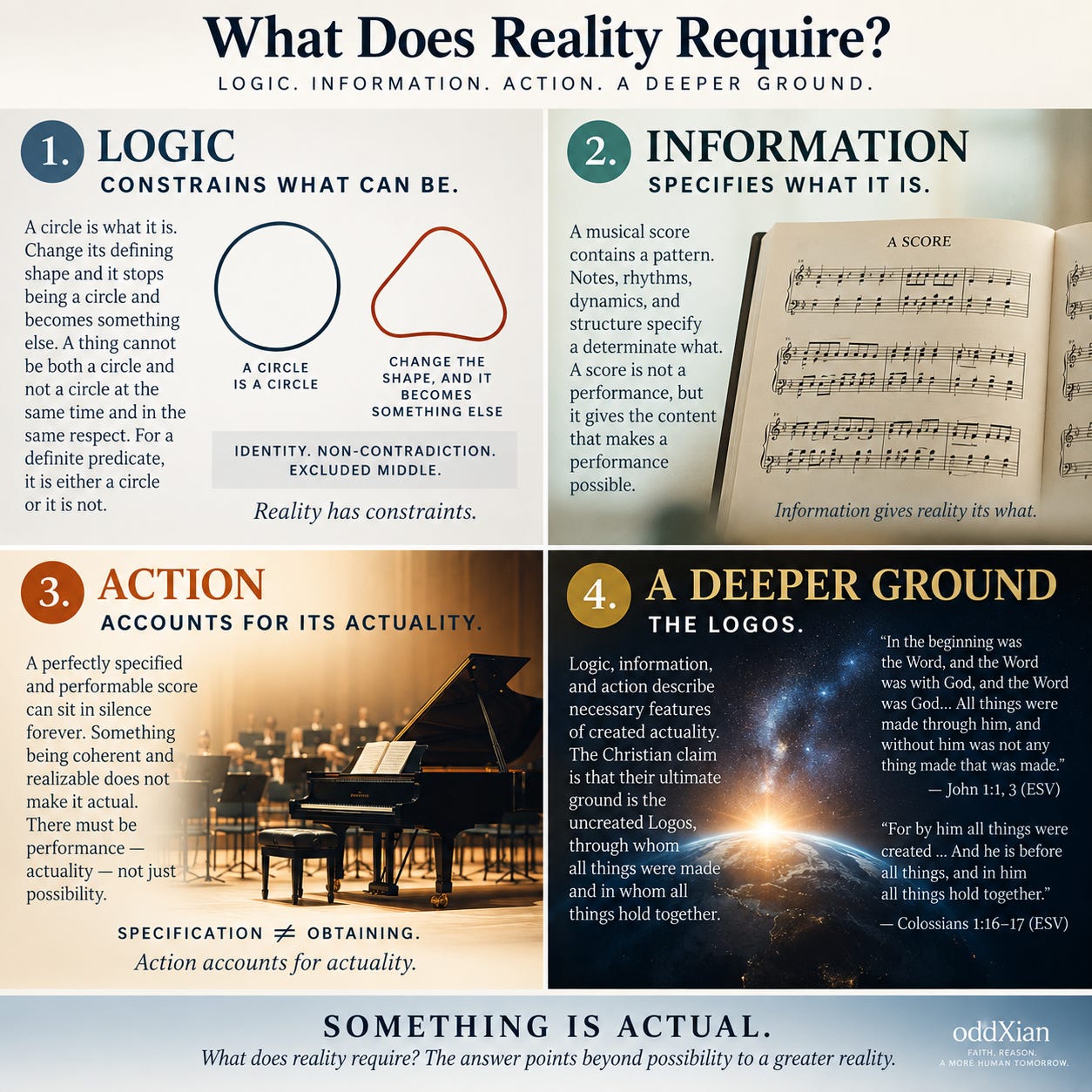
Logic: Reality Has Constraints
“Ontological” is one of those philosophical words that sounds more complicated than it is. It simply concerns what is real.
An ontological constraint, then, is a constraint on reality itself.
Consider three of the classical laws of thought: identity, non-contradiction, and excluded middle.
Start with something simple.
Imagine a circle.
A circle is what it is. That is identity: A is A.
Now change its defining shape. Put a corner in it. Flatten part of the circumference. Stretch it so that points on its boundary are no longer equidistant from its center.
At some point you no longer have a circle.
You have something else.
That is important. Reality permits enormous variation, but determinate things still have conditions under which they are what they are. Change a circle’s size and it remains a circle. Change one of the properties constitutive of its circularity and it ceases to be one.
Now consider non-contradiction.
The same geometric figure cannot be both a circle and not a circle at the same time and in the same respect. If it satisfies the defining conditions of circularity, then denying those same conditions of that same figure under the same qualification produces a contradiction.
Finally, consider excluded middle.
With the subject, definition, time, and respect held fixed, the figure either satisfies the defining conditions for being a circle or it does not. There is no third state in which it both escapes being a circle and escapes being a non-circle under that same predicate.
Circle or not-circle.
A or not-A.
That may sound almost trivial.
It is anything but trivial.
These logical distinctions are what make determinate identity possible in the first place. If a thing could simultaneously be itself and its negation in the same respect, or somehow occupy a third logical condition between satisfying and not satisfying the same definite predicate, then our categories would cease to discriminate reality.
“Heads” and “not-heads” could both obtain.
“Circle” and “not-circle” could both obtain.
A thing could be itself, not itself, and somehow neither.
Determinate description would collapse.
A useful analogy is a game’s physics engine.
A game designer can create radically different worlds. One might have ordinary gravity. Another might allow characters to fly. Another might contain creatures and environments unlike anything in our universe.
But whatever world is rendered must still satisfy the constitutive constraints that make it a determinate world rather than an unintelligible collection of everything and its negation.
Logic is not literally computer code. The analogy captures something more basic.
Logic constrains what can be.
Reality does not get to opt out of the conditions required for something to be determinately what it is.
But constraints alone do not give us a world.
We need a what.
Information: Reality Is Determinate
Suppose I say:
“Square circle.”
I have successfully produced two English words. That does not mean I have specified an object that could actually exist.
There is a difference between something being expressible in language, something specifying coherent content, and something being realizable.
That distinction matters.
Now consider something much more ordinary: sheet music.
A score contains a pattern. Notes, rhythms, dynamics, relationships and structure are specified.
But a score and a performance are not the same thing.
We can distinguish at least three things:
Score → performable score → performance
The first concerns specification.
The second concerns whether that specification can actually be realized under the relevant constraints.
The third concerns whether it is actually performed.
A composer can write marks on a page that no musician could coherently perform. A perfectly performable symphony can sit silently in an archive for centuries.
Specification does not entail actuality.
This is the informational dimension of the problem.
For something to be determinately actual, there must be some answer to the question:
What is it?
Information supplies differentiated content. It gives us the determinate what under consideration.
So we now have two pieces:
Logic constrains what can be.
Information specifies what it is.
And we still do not have actuality.
A score sitting on a music stand does not produce a concert.
Action: Possibility Does Not Make Itself Actual
This is where action enters.
Imagine a perfectly specified musical score. Every note is coherent. Every passage is playable. Every instrument is available.
Nothing about those facts entails that music will sound.
The score can remain silent forever.
Something being coherent does not make it actual.
Something being realizable does not make it actual.
Something being specified does not make it actual.
In compact form:
Specification ⇏ obtaining.
There is a categorical difference between what could obtain and what actually does.
This is the role I mean by Action.
The term is broader than physical movement. A thought can be an actual mental act without moving an external object. The important distinction is between a merely specified state and actuality.
In our musical analogy, there is a score.
There is a performable score.
Then there is music sounding in the room.
Action accounts for actuality.
Put the three together:
Logic constrains what can be. Information specifies what it is. Action accounts for its actuality.
Logic. Information. Action.
L-I-A.
Start With Actuality
There is an important direction to this argument.
I am not beginning with whatever the human mind can conceive and declaring it metaphysically possible.
That move is far too easy.
Human beings can assemble words into combinations that correspond to nothing coherent at all. “Square circle” demonstrates the problem immediately.
Instead, start from actuality.
Something is actual.
Then ask what must already be true of anything actual.
Anything actual must satisfy the logical conditions required for it to be determinate.
Anything determinate must possess differentiated content sufficient for it to be this rather than that.
Anything actual must actually obtain rather than remain merely specified or realizable.
Reasoning backward from actuality therefore gives us a much safer direction:
Actual → realizable → coherent → specified
The reverse direction is not guaranteed.
Something can be specified without being coherent.
Something coherent can remain unrealized.
Something realizable can remain unactualized.
That asymmetry matters.
Possibility does not manufacture reality.
But Now We Have Another Problem
Suppose this analysis is basically right.
We have identified three roles that appear to be unavoidable whenever we talk about determinate actuality:
Logic.
Information.
Action.
Have we explained reality?
No.
We have described some of the conditions actuality requires.
The deeper question remains:
Why does reality have this character at all?
Why is reality logically ordered?
Why is it informationally determinate?
Why is there actuality rather than an inert catalogue of possibilities?
Calling these things “laws,” “structures,” or “primitives” does not make the grounding question disappear. Those labels describe their role in our model. They do not explain why reality possesses them.
And this is where the Christian claim becomes particularly interesting.
The Logos
John opens his Gospel with extraordinary language:
“In the beginning was the Word, and the Word was with God, and the Word was God.”
— John 1:1 (ESV)
The Greek term translated Word is Logos.
John continues:
“All things were made through him, and without him was not any thing made that was made.”
— John 1:3 (ESV)
Paul describes Christ similarly:
“For by him all things were created, in heaven and on earth, visible and invisible…”
— Colossians 1:16 (ESV)
And then:
“And he is before all things, and in him all things hold together.”
— Colossians 1:17 (ESV)
There is an important distinction here.
I am not saying:
Logic + Information + Action = Jesus.
That would turn the Logos into an abstraction inside our model.
Christian theology says something much larger.
The Logos is the uncreated Son of God. Logic, information, action, fields, equations, Hilbert spaces, physical laws and every other structure we might use to describe creation are not containers into which Christ fits.
They belong to the reality that exists through Him.
The L-I-A structure describes necessary features of created actuality.
Christianity identifies their ultimate ground with the uncreated Logos, through whom all things were made and in whom all things hold together.
The model describes creation.
The Logos is not contained by the model.
The Question Beneath the Question
This changes how I think the discussion about God and reality should proceed.
The question is often framed:
Can we find something inside the universe that science cannot explain, and insert God there?
I think that starts far too late.
Before we investigate any particular object in the universe, we are already relying upon a reality that is logically ordered, informationally determinate, and actually existent.
Every scientific experiment presupposes those things.
Every mathematical argument presupposes them.
Every philosophical objection presupposes them.
Even the argument that God does not exist must be logically structured, must communicate determinate information, and must actually be asserted.
The interesting question therefore lies beneath individual gaps in scientific explanation.
It concerns the conditions under which explanation itself is possible.
Why should reality be intelligible?
Why should logical relations govern actuality?
Why should information correspond to real distinctions?
Why should there be actuality at all?
Calling these features “natural” does not answer those questions.
It names the reality requiring explanation.
The Storyline
So here is the storyline.
Something is actual.
Actuality is determinate.
Determinate actuality is logically constrained.
A thing is what it is. It cannot simultaneously be what it is and what it is not in the same respect. And for a definite predicate under fixed conditions, it either satisfies that predicate or it does not.
It possesses differentiated informational content.
And possibility alone cannot account for its obtaining.
So:
Logic constrains what can be.
Information specifies what it is.
Action accounts for its actuality.
And then comes the question the model itself cannot answer merely by describing those roles:
What ultimately grounds them?
Christianity has been making a remarkable claim for nearly two thousand years.
Reality is neither grounded in chaos nor suspended from impersonal abstractions that somehow explain themselves.
Creation exists through the Logos.
The One through whom all things were made is also the One in whom all things hold together.
That is not the end of the argument.
It is where the deeper one begins.