

Radiometric dating is often described too simply. The popular summary says a rock contains uranium, uranium decays into lead, the ratio is measured, and the age is read off like a timestamp on a file. That description captures part of the process but misses the interpretive structure underneath it.
In actual geochronology, scientists do not directly measure elapsed time. They measure isotope ratios in particular minerals and interpret those ratios through a model of decay, closure, disturbance, and geological context. Different minerals record different events (crystallization, cooling, metamorphism, later alteration), which means a radiometric date is not a raw timestamp but a historical reconstruction from present physical evidence. That point is not a dismissal. It is a description of what the method actually does.
It also surfaces something important: every historical reconstruction operates under presuppositions. The measurements are real. What differs between competing frameworks is the prior probability assigned to competing explanations before the data do their work. That prior question (which framework governs interpretation) is where the debate actually lives, and naming it clearly is more productive than fighting over the measurements themselves. For those who hold Scripture as the governing authority on origins, that prior is not negotiable: it is the starting point from which all evidence is interpreted, not one option among many.
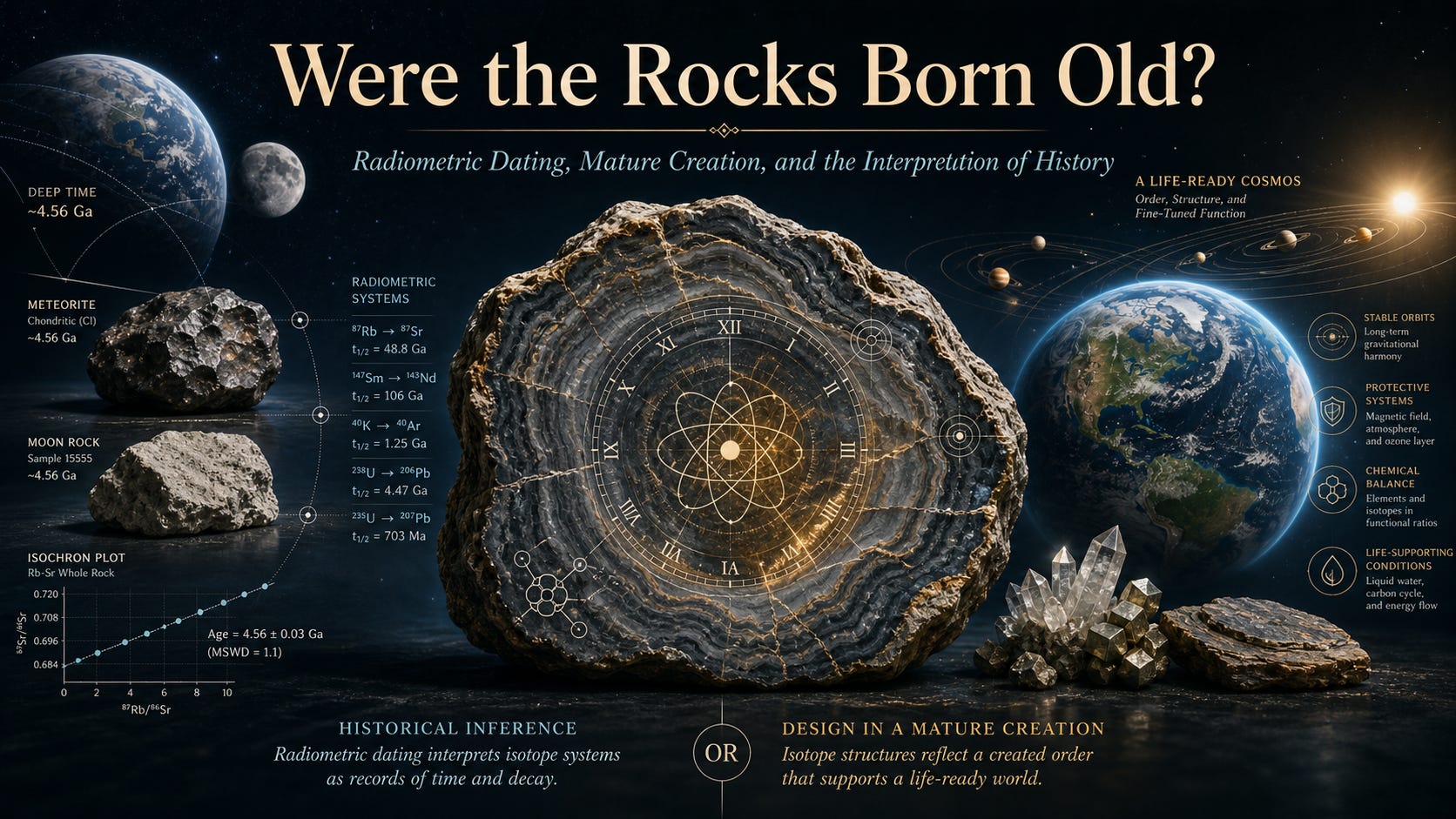
The Convergence Problem Is Real
The strongest case for deep time is not a single old date from a single rock. It is convergence across many independent materials and methods.
Meteorites cluster around 4.54 to 4.56 billion years. Lunar samples and ancient terrestrial zircons fall within the same general window. These materials are not products of Earth’s plate tectonics, hydrologic cycle, biology, or crustal recycling. They were never in contact with each other through any process that could produce artificial agreement. Their concordance across independent isotope systems and independent sample types is striking.
Under the assumption that natural processes operating at observed rates fully explain the record, this convergence confirms billions of years of shared history. But that assumption is not a measurement. It is a prior. The convergence needs to be explained, not merely cited. What it actually shows depends entirely on which explanatory framework governs the interpretation, and that question cannot be answered from within the data alone.
The mature-creation position does not dodge this. It answers it directly, and the answer is stronger than most young-earth literature has recognized.
What “Reset” Actually Means
The term “reset” sometimes gives the impression that geochronologists erase inconvenient dates. That is not what it means.
Heat, melting, recrystallization, fluid alteration, and diffusion can modify the parent-daughter relationship in a mineral. When that happens, the measured isotopic system records a later event (cooling, metamorphism, alteration) rather than original formation. The atoms do not become younger. The isotopic record has been changed by a real physical process.
This is why geochronologists do not ask only “How old is this rock?” They ask “What event does this mineral system record?” A single rock can contain several radiometric signals from different stages of its history. This interpretive complexity is a feature of careful practice, not a confession of failure. It also illustrates the broader point: the method is powerful precisely because it is interpretive, and interpretation always carries assumptions.
What Mount St. Helens Actually Proves
Known-young volcanic material from Mount St. Helens produced anomalously old apparent ages when potassium-argon methods were applied to inappropriate sample fractions. The explanation is excess or inherited argon overwhelming the small radiogenic signal expected in very young material.
That example establishes an important but limited point: radiometric dating can mislead when the wrong method is applied to the wrong material, or when assumptions about initial conditions are violated. It does not follow that well-vetted methods (U-Pb in zircon, Pb-Pb in meteorites, concordia-discordia analysis across multiple isotope systems) collapse for the same reason. The lesson is that radiometric dating is interpretive and method-sensitive. That lesson should sharpen the young-earth argument, not substitute for one.
Why Accelerated Decay Fails
Some young-earth proposals appeal to accelerated radioactive decay: vast amounts of nuclear decay occurred rapidly during creation week or the Flood, producing the isotope ratios we observe without requiring long ages. The appeal is understandable. The physics is brutal.
Large-scale radioactive decay releases enormous heat and radiation. The quantities required to compress billions of years of decay into days or months would generate temperatures incompatible with liquid water, biological survival, and the preservation of the very mineral records the proposal is meant to explain. Accelerated decay does not solve the problem of old-looking isotope ratios. It trades one hard question for several harder ones.
There is a better move available, one that requires no rate changes at all.
Mature Creation and the Heat-Budget Argument
A consistent reading of Genesis 1 holds that creation was brought into existence as a fully functioning world. Plants were created bearing seed. Animals were created according to their kinds. Human beings were created ready for ordinary life, not as embryos. The creation was operational from the beginning.
The critical distinction is between mature function and apparent event-history. Mature function means a created entity possesses the structure required to operate. A tree requires roots, bark, wood structure, and reproductive capacity, all features of functional completeness. If that same tree also bore ring patterns recording specific droughts or fire scars from events that never happened, the question shifts from what was needed for function to what was fabricated as false history. That distinction carries real theological weight and should not be collapsed.
For isotope ratios, the parallel argument is stronger than is usually appreciated.
Long-lived radioactive isotopes are not merely geochronological tools. They are load-bearing elements of planetary habitability. Uranium, thorium, and potassium decay chains supply roughly 40 to 50 percent of Earth’s internal heat flux, confirmed by geoneutrino measurements from KamLAND and Borexino rather than merely inferred from models. That heat drives mantle convection, which drives plate tectonics, which cycles carbon, nitrogen, and phosphorus through the crust and atmosphere. Plate tectonics also regulates long-term climate through the carbonate-silicate weathering cycle, the mechanism that has kept surface temperatures within liquid-water range against a sun that has brightened by roughly 30 percent since early Earth. Remove the radiogenic heat budget and you do not get a younger Earth. You get a geologically dead one: no active tectonics, no sustained magnetic field, no long-term atmospheric cycling, no climate regulation. Mars is the demonstration case: smaller mass, faster radiogenic cooling, tectonics shut down, magnetic field collapsed, atmosphere stripped.
The magnetic field deserves particular emphasis. Earth’s dynamo is driven by convective flow in the liquid outer core, sustained by the heat differential between core and mantle, maintained in part by radiogenic decay in the mantle above. That dynamo generates the magnetosphere that deflects the solar wind. Without it, energetic particles strip the upper atmosphere and bombard the surface with radiation incompatible with complex life. The radiogenic inventory is not incidental to habitability. It is a precondition for it.
Zoom out to the Solar System and the argument sharpens further. The r-process nucleosynthesis that produces heavy radioactive elements like uranium and thorium occurs in neutron-star mergers and specific supernovae, rare, violent, and precisely calibrated in their yields. The Solar System’s inventory reflects the specific nucleosynthetic history of its galactic neighborhood: the right stellar generations, the right merger events, the right enrichment of the presolar nebula at the right time. Geophysical models show Earth sits in a narrow functional window for radiogenic heating. Too little and convection slows, tectonics shut down, the dynamo collapses. Too much and excessive volcanism destabilizes the crust and accelerates volatile loss. The observed inventory sits precisely where a habitable planet requires it to sit.
This pattern of cosmological constants, Solar System architecture, planetary composition, and nuclear inventory all converging on life-permitting values is not a series of independent coincidences. It is a single cumulative signal. Psalm 19 declares that the heavens proclaim the glory of God, and Romans 1 grounds that testimony in the plain visibility of His eternal power and divine nature in what has been made. The isotope ratios are one more layer of the same specification that runs from the fine structure constant down through galactic position, stellar type, planetary mass, and atmospheric chemistry. Each layer constrains the others. The radiogenic inventory is not separately fine-tuned by accident; it is part of a coherent system that works together or not at all.
That is not the fingerprint of elapsed time. It is the fingerprint of design.
Detailed isotopic patterns within this architecture (extinct nuclide chronologies such as the ²⁶Al-²⁶Mg timelines in meteorites, apparent reset sequences, and bombardment signatures) are best understood as engineered features of the unified functional design rather than as records of sequential natural history. They belong to the created coherence of the system, not to elapsed process.
What the Convergence Actually Shows
Return now to the convergence. Meteorites, lunar samples, and ancient terrestrial minerals all yield concordant isotope patterns. Under naturalistic priors, this is multiple independent lines confirming the same deep history. But consider what mature fiat creation of an integrated, functionally-specified Solar System would actually look like in the isotope record.
A mature creation is not a collection of independent objects each stamped with the same apparent age by coincidence. It is a coherent functional system whose components are mutually calibrated to operate together. Earth, Moon, and the asteroidal population share a common nuclear heritage: the same presolar enrichment, the same designed radiogenic inventory, the same role within a Solar System architecture specified for long-term habitability. Cross-system isotopic concordance is precisely what integrated specification produces. The components converge not because they independently record the same elapsed history, but because they belong to the same coherent design.
The convergence question therefore answers itself once the systems framing is in place. The ratios converge where they do because a habitable planet requires them to. The functional requirements of tectonics, the dynamo, and the magnetic field constrain the isotope inventory to a narrow range. A Designer meeting those requirements would produce exactly the cross-system concordance we observe. The convergence is not a coincidence the data explain. It is a specification the data confirm.
R.C. Sproul observed that there is no maverick molecule in God’s universe. If that is true (and the Christian has every reason to believe it is), then the isotope ratios are not a problem to be explained around. They are exactly what they are because He specified them to be so. The convergence is not an embarrassment. It is a doxological signal.
This is not a God-of-the-gaps argument. The design inference does not fill a hole in the physics. It runs through the physics. The same geophysical knowledge that tells us how much radiogenic heat Earth needs is the knowledge that tells us the observed inventory is precisely what was required. The argument grows stronger as the science becomes more precise, not weaker.
Both models account for the data. Naturalistic priors read convergence as confirmation of deep time. Biblical priors read the identical convergence as confirmation of unified specification. The question is not which model fits the data (both do). The question is which prior is better grounded, and that question cannot be answered from within the data. Under Scripture as the governing authority, the prior is not one inference among many. It is the non-negotiable starting point, and the data are interpreted accordingly.
Where the Debate Actually Lies
The old-earth interpretation holds that isotope ratios are residues of elapsed decay over immense time. Its strongest evidence is convergence across independent materials and methods. That evidence is real and should not be dismissed.
The mature-creation interpretation holds that the same measured ratios reflect the created nuclear architecture of a fully operational cosmos, specified from the beginning to meet the precise functional requirements of a habitable world. This is not a denial of the measurements. It is a claim about what kind of past those measurements require, and that claim rests on a prior the data alone cannot adjudicate.
Historical reconstruction from present physical traces always depends on assumptions about admissible causes and initial conditions. If fiat creation is excluded before the inquiry begins, isotope ratios will always be read as developmental history. That exclusion is not a finding of science. It is a philosophical commitment imported into science, and it should be named as such.
For those who hold Scripture as the governing authority on origins, Genesis 1 presents a fully functional creation declared very good from the beginning. The isotope record, read through that prior, testifies not to billions of years of undirected process but to the coherent specification of a system built to sustain life, covenant, and the glory of the Creator. Questions of Flood geology and the integration of later geological processes within this framework are real and warrant separate treatment; they do not alter the core argument here.
The rocks look old because they were created mature, complete with precisely the nuclear architecture a habitable world requires.
The convergence is not the problem. It is the confirmation.