

Another headline announces that scientists have discovered the “fundamental building blocks of life” on an asteroid.
Amino acids. Nucleobases. Organic compounds associated with the chemistry of living organisms.
Fascinating discoveries. Scientifically valuable. Worth investigating.
But I have a question.
Where is the assembly mechanism?
Imagine announcing that scientists had discovered the fundamental building blocks of a quantum computer scattered across an asteroid.
Silicon. Carbon. Metals. Perhaps even materials suitable for superconducting circuits.
Would anyone conclude that we were closer to explaining how quantum computers spontaneously emerge?
Of course not.
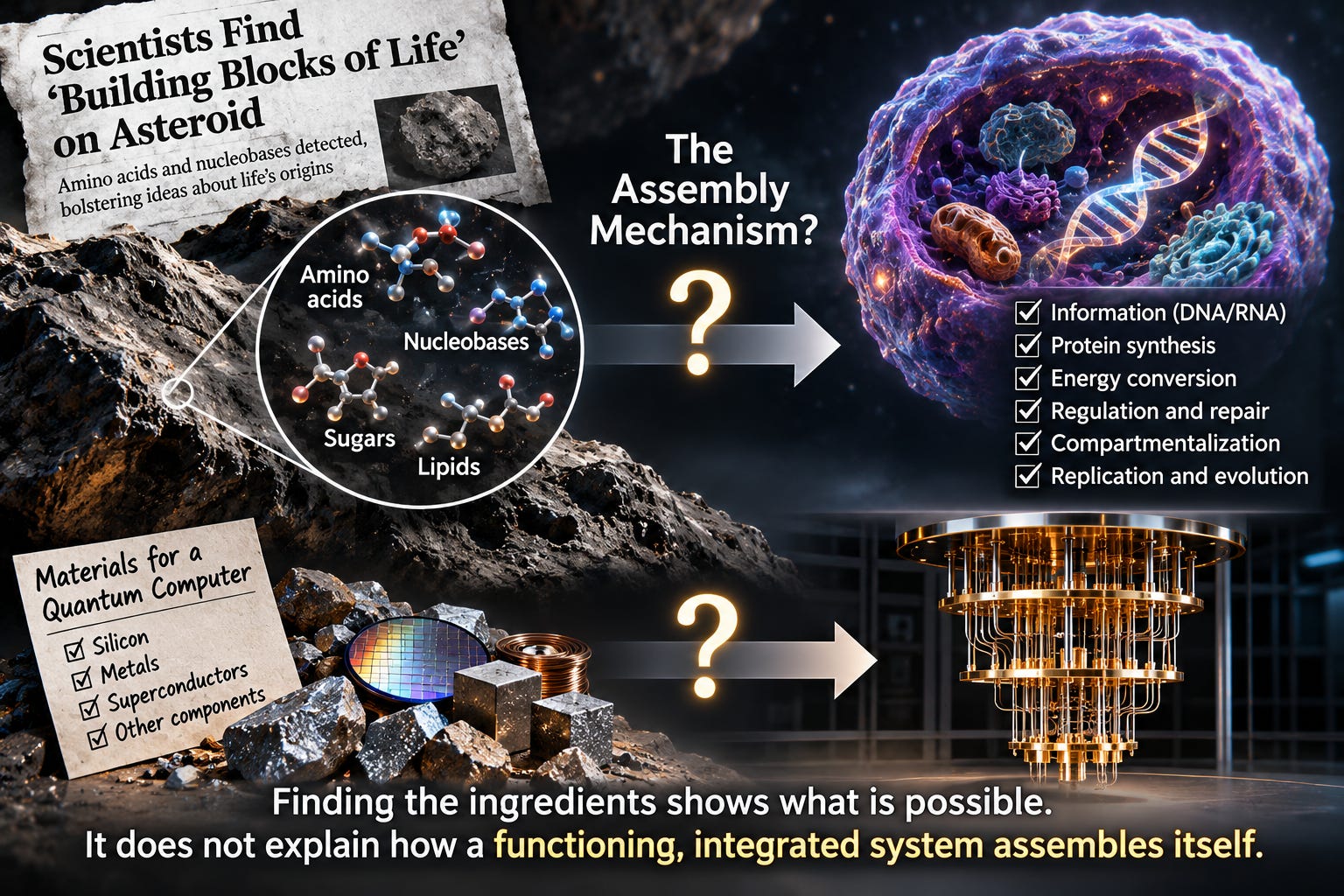
We would recognize immediately that possessing the materials required to construct a quantum computer tells us remarkably little about how those materials become a functioning quantum computer.
The architecture matters. The organization matters. The relationships between components matter. The information processing matters.
And above all, the mechanism that produces that functional organization matters.
Now consider something vastly more sophisticated in its integrated capabilities.
A living cell.
The Problem Is Not the Ingredients
A living cell is an extraordinary system of interdependent molecular processes.
It stores hereditary information. It translates encoded sequences into functional molecular structures. It captures and converts energy. It maintains boundaries, regulates chemical reactions, repairs damage, and reproduces.
Even the simplest known free-living organisms possess astonishingly complex biochemical organization.
Finding amino acids on an asteroid does not explain how amino acids become functional proteins.
Finding nucleobases does not explain how they become organized into hereditary polymers.
And finding organic molecules does not explain how a chemical system develops the integrated capacity to maintain itself, reproduce, and undergo heritable evolution.
These are different explanatory problems.
The presence of components establishes that certain chemistry is possible. It does not establish a physically sufficient pathway to biological functionality.
Yet popular reporting frequently moves from the discovery of ingredients to the suggestion that the origin of life has become substantially less mysterious.
Has it?
Or have we simply demonstrated that the raw materials are more widely distributed than previously established?
The Quantum Computer on the Asteroid
Let’s extend the analogy.
Suppose an asteroid contained every material necessary to manufacture a state-of-the-art quantum computer.
Would we expect those materials, given enough time and the right environmental conditions, to spontaneously organize into a functioning machine?
We would demand an explanation.
What process establishes the architecture?
What constrains the arrangement of components?
What produces the required functional relationships?
What makes the resulting system capable of information processing?
And how does the system maintain operational coherence?
We would not accept the observation that all the ingredients were present as an answer.
Now apply those same questions to the origin of life.
What produces the molecular organization?
What establishes a system capable of hereditary information storage?
What couples that information to functional chemistry?
What enables replication with sufficient fidelity for evolutionary continuity?
What integrates energy utilization, molecular synthesis, and compartmentalization into a self-maintaining system?
These questions are not answered by discovering more organic molecules.
They require an assembly mechanism.
But Doesn’t Chemistry Self-Organize?
Yes. And this is where the discussion becomes particularly interesting.
Chemistry can produce remarkable forms of spontaneous organization.
Crystals form. Lipids assemble into membranes. Chemical reactions generate spatial patterns. Autocatalytic networks can amplify their own production under appropriate conditions.
These phenomena are real.
Origin-of-life researchers are investigating whether combinations of such processes could eventually produce primitive replicating systems and protocells.
That research deserves serious attention.
But the existence of chemical self-organization does not establish that the particular organization required for biological life follows from it.
A crystal is ordered. A living cell is functionally integrated.
A lipid vesicle establishes a boundary. A living cell coordinates transport, metabolism, information processing, and reproduction across that boundary.
An autocatalytic reaction can sustain chemical production under suitable conditions. A living system must coordinate many processes while maintaining the conditions necessary for its continued operation.
The question is whether known physical and chemical mechanisms can bridge these transitions.
And importantly, the first living system need not have possessed the full complexity of a modern cell. Simpler precursors are entirely legitimate hypotheses.
But proposing a simpler precursor transfers the explanatory question to that precursor.
How did it arise?
How did it acquire the relevant functionality?
How did its organization become heritable?
At some point, a proposed pathway must demonstrate the causal transitions it invokes.
Simply saying that chemistry self-organizes is insufficient.
Information Is the Difficult Question
There is another dimension to the problem that deserves particular attention.
Biological systems depend on information-bearing molecular structures.
DNA sequences encode hereditary information. RNA participates in information transfer and regulation. Molecular machinery interprets sequences through biochemical relationships that connect stored information with functional outcomes.
Of course, the existence of biological information does not automatically establish an intelligent source. That conclusion requires an argument.
Nor should we assume that the first biological information system resembled the genetic machinery operating in contemporary organisms.
Nevertheless, a substantial explanatory problem remains.
How does prebiotic chemistry produce systems in which molecular sequences can be copied, inherited, and coupled to functions that contribute to the persistence of those systems?
Natural selection provides a powerful explanation for the differential survival and reproduction of systems possessing heritable variation.
But appealing to natural selection does not eliminate the need to explain the emergence of systems capable of participating in that process.
The origin of heredity itself is part of the problem.
Before biological evolution can explain the diversification of living systems, origin-of-life research must account for the emergence of the chemical capacities that make heritable evolution possible.
That distinction matters.
The Design Question
As a Christian, I approach the natural world with the conviction that reality is intelligible because it is grounded in the Logos.
John opens his Gospel with a profound declaration:
“In the beginning was the Word, and the Word was with God, and the Word was God.”
John 1:1, ESV
The Greek term Logos carries profound philosophical significance. Reason, intelligibility, and rational order are not foreign to the Christian understanding of creation.
The world is intelligible because its ultimate ground is rational.
That conviction does not relieve us of the responsibility to investigate natural mechanisms. Indeed, it provides a theological reason to expect that creation possesses discoverable order.
And it certainly does not authorize us to declare every unresolved scientific problem a demonstration of divine intervention.
An explanatory gap is not automatically evidence of design.
But neither does the possibility of an undiscovered natural mechanism constitute a demonstrated explanation.
We should apply the same intellectual standards regardless of our philosophical commitments.
If someone proposes that biological organization emerged through unguided chemical processes, the proposal should be evaluated by its causal mechanisms and experimental evidence.
If someone proposes that the organization of life reflects intelligent design, that proposal also requires positive argumentation and examination of competing explanations.
Neither position should be insulated from scrutiny.
My concern is that popular discussions of abiogenesis frequently confuse progress in identifying chemical ingredients with progress in demonstrating the origin of biological organization.
Those are related research questions.
They are not equivalent.
The Question That Remains
I welcome the discovery of organic compounds on asteroids.
I welcome laboratory demonstrations of prebiotic synthesis.
I welcome research into autocatalysis, RNA replication, primitive membranes, and chemical evolution.
Every legitimate discovery contributes something to our understanding of the physical world.
But scientific progress requires precision about what has actually been demonstrated.
Finding the materials needed for a quantum computer does not explain the origin of a quantum computer.
Finding the chemical constituents associated with life does not explain the origin of a living system.
In both cases, the explanatory challenge concerns the emergence of functional organization.
For biological life, that challenge includes the origin of heritable information, coordinated chemical processes, energy utilization, and autonomous replication.
Perhaps future research will demonstrate a physically sufficient abiotic pathway. If so, we should examine the evidence and follow it.
Until then, we should resist treating the availability of ingredients as though it resolves the question of assembly.
We found the building blocks.
Now show us the assembly mechanism.
oddXian | Christianity, Reason, and the Courage to Question
Scripture quotation from the English Standard Version (ESV).