

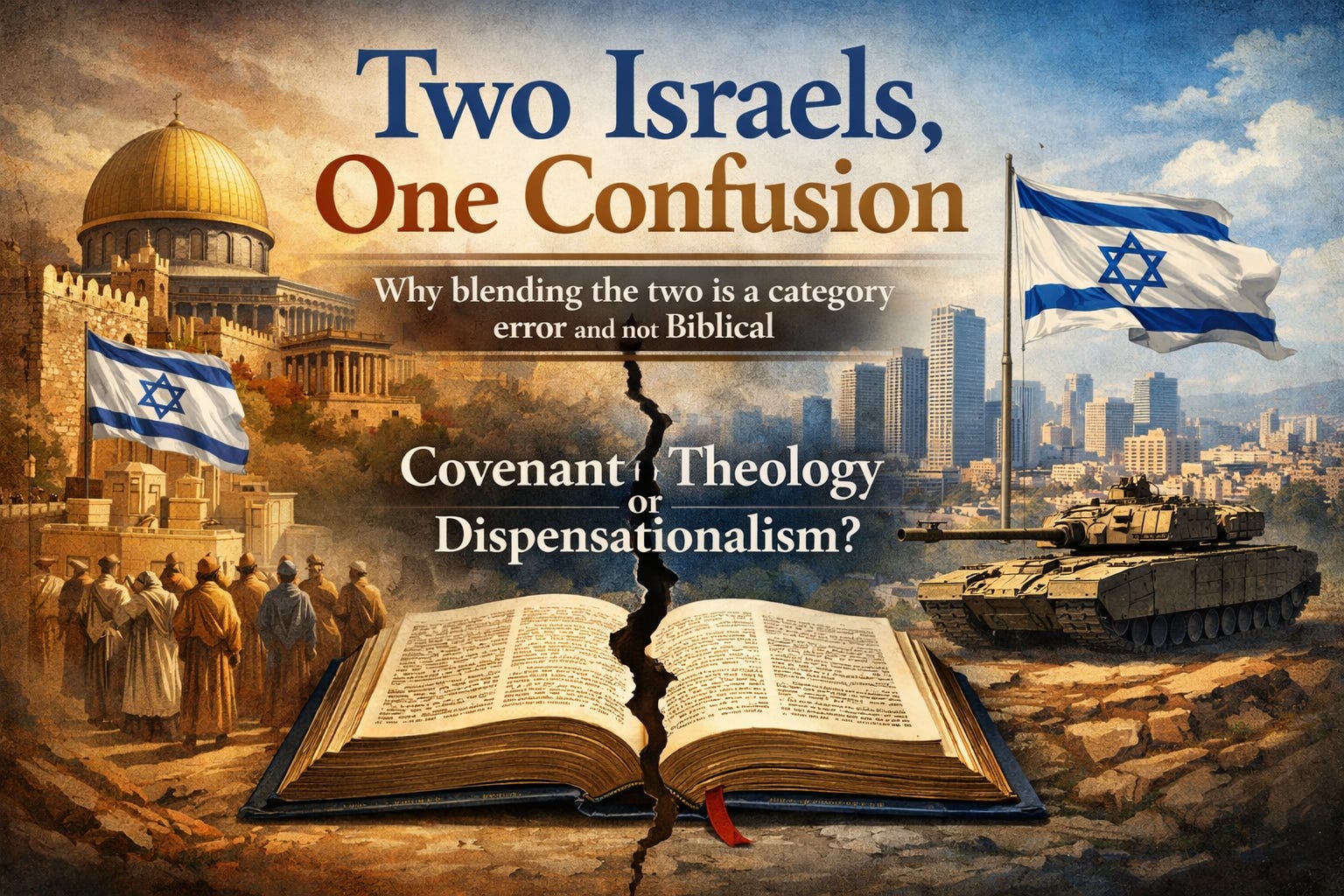
The debate between covenant theology and dispensationalism gets written off as an intramural squabble over end-times charts. It isn’t. It’s a fight about how to read the Bible, who the people of God are, and whether modern nation-states can carry covenantal weight. Get this wrong and you don’t just have a bad eschatology. You have a corrupted political theology.
That’s worth taking seriously.
The Basic Divide
Covenant theology reads Scripture as one unfolding redemptive drama. The covenants progress, deepen, and converge on Christ. He is not a parenthesis inserted between two Israel-focused epochs. He is the telos, the fulfillment toward which the whole story was moving. The people of God are defined by union with him, not by ethnic or national identity.
Dispensationalism draws a sharper line. It distinguishes Israel and the church as two distinct peoples with two distinct destinies. Old Testament land, nation, and kingdom promises are expected to be fulfilled for ethnic-national Israel in a future earthly sense, even after Christ’s coming. In its popular American form, this becomes the controlling grid through which the entire Bible gets read.
That’s not a minor exegetical difference. It governs everything.
The Hermeneutical Question
Here’s what I keep coming back to: how do the apostles handle the Old Testament?
Not how we wish they did. Not how a flat literalism would expect them to. How do they actually handle it?
The answer is consistent. They read the Hebrew Scriptures christologically, covenantally, typologically. The seed promise narrows to Christ and opens outward through union with him. The temple theme is transfigured. Davidic kingship is fulfilled in the enthroned Son. Abrahamic inheritance is administered through faith, not ethnicity. The dividing wall between Jew and Gentile is demolished, not preserved.
This is not spiritualizing the text. It is fulfillment, and fulfillment intensifies rather than merely duplicates. A land promise widened into world-inheritance isn’t an evasion. A temple promise fulfilled in Christ and his body isn’t a retreat. These are the apostles’ own moves, made without apology.
Dispensationalism’s instinct toward “literal” fulfillment sounds conservative. In practice, it can freeze the type at the level of shadow, treating old covenant forms as permanent endpoints rather than forward-pointing realities. The irony is that it can end up under-reading the Old Testament, missing the richer covenantal substance the text itself was always gesturing toward.
The real question has never been literal versus spiritual. It’s whether the form of fulfillment is controlled by apostolic exegesis.
One People, Not Two
Covenant theology sees one people of God across redemptive history, administered under different covenants but unified in the one Messiah. That doesn’t erase Israel’s role. Israel’s place in the story is unique, non-repeatable, and irreplaceable. Through Israel came the covenants, the worship, the patriarchs, the Messiah according to the flesh.
But Israel’s covenantal purpose reaches its goal in Christ. The church is not a divine detour. It is the eschatological people of God gathered in him, including Jew and Gentile, one olive tree, one covenant community.
Dispensationalism resists this because it insists on maintaining a parallel redemptive track for ethnic-national Israel alongside the church. The language sounds like faithfulness to God’s promises. But it assumes the only faithful fulfillment is one that preserves old covenant categories in essentially national-political terms. The New Testament doesn’t operate with that restriction.
Romans 11 deserves honest engagement here, and some covenant theologians have handled it too casually. Paul’s grief in Romans 9 is real. His hope in Romans 11 is not decorative. A significant future mercy toward Jews is a live biblical expectation and covenant theology should say so plainly.
But even if Romans 11 points to a large-scale future turning of ethnic Jews to Christ, that is still incorporation into the same olive tree, not entrance into a separate redemptive organism. Grafting, not bifurcation. The structure remains one people in one Messiah.
Covenant theology can affirm all of that without conceding the dispensational architecture.
Where It Goes Wrong Politically
Once prophecy is detached from its christological and covenantal frame, it becomes easy to weaponize it politically.
Modern headlines become exegetical lenses. Nations become prophetic props. Foreign policy becomes a badge of doctrinal orthodoxy. Support for a modern state gets wrapped in theological urgency, and criticism of that state gets stigmatized as resistance to God’s plan.
That is a category error, and it’s a serious one.
To be direct about it: the United States may have perfectly good reasons to support Israel -- democratic alliance, regional stability, shared strategic interests. Those are legitimate foreign policy arguments and Christians can make them. But the moment you reach for Leviticus or Zechariah to close the case, you’ve committed a category error. Biblical covenant and modern geopolitics are not the same register. Conflating them doesn’t strengthen the argument; it corrupts the text.
Covenant theology’s insistence that the modern State of Israel is not the direct covenantal heir of Old Testament Israel is not indifference to Jewish people. It is not antisemitism. It is a hermeneutical boundary that keeps Scripture from being conscripted into foreign policy. Modern Israel, like every modern state, is subject to moral evaluation. So is every government. So is ours.
Dispensationalism in its popular form struggles to sustain that balance because it has already front-loaded theological significance into one modern state. Once that move is made, prudence is muted and the church becomes vulnerable to becoming an echo chamber for a nation’s strategic narrative.
That is a corruption of the church’s calling.
The Better Answer
Dispensationalism gained influence for understandable reasons. It tries to defend God’s faithfulness, the concreteness of Old Testament promises, and the future significance of Jewish history. Those concerns are not wrong. Some covenant theologians have answered them poorly, sounding evasive or indifferent to passages like Romans 9-11.
But the answer to bad covenant theology is not dispensationalism. It’s better covenant theology: more explicitly christological, more careful with typology, more honest about the future mercy of God toward Jews, and more resistant to collapsing redemptive history into modern nationalism.
The apostles don’t leave us without a method. They show us how to read Moses and the Prophets. That method is covenantal. It is christological. And it is more than sufficient.
When we follow it, we don’t need two tracks. We have one story, one Messiah, one people, one inheritance.
And that’s enough.
Soli Deo Gloria