

“There is no evidence for the Christian God.”
I see this proclaimed constantly on atheist-Christian debate boards.
And frankly, it is a remarkably poor argument.
It does not make atheism look stronger. It makes the person making the claim look unfamiliar with what “evidence” means.
There is a perfectly respectable skeptical position:
“I have examined the evidence for Christianity and do not find it sufficient to justify belief.”
Fine. Now we have something to debate.
But “there is NO evidence” is an entirely different proposition.
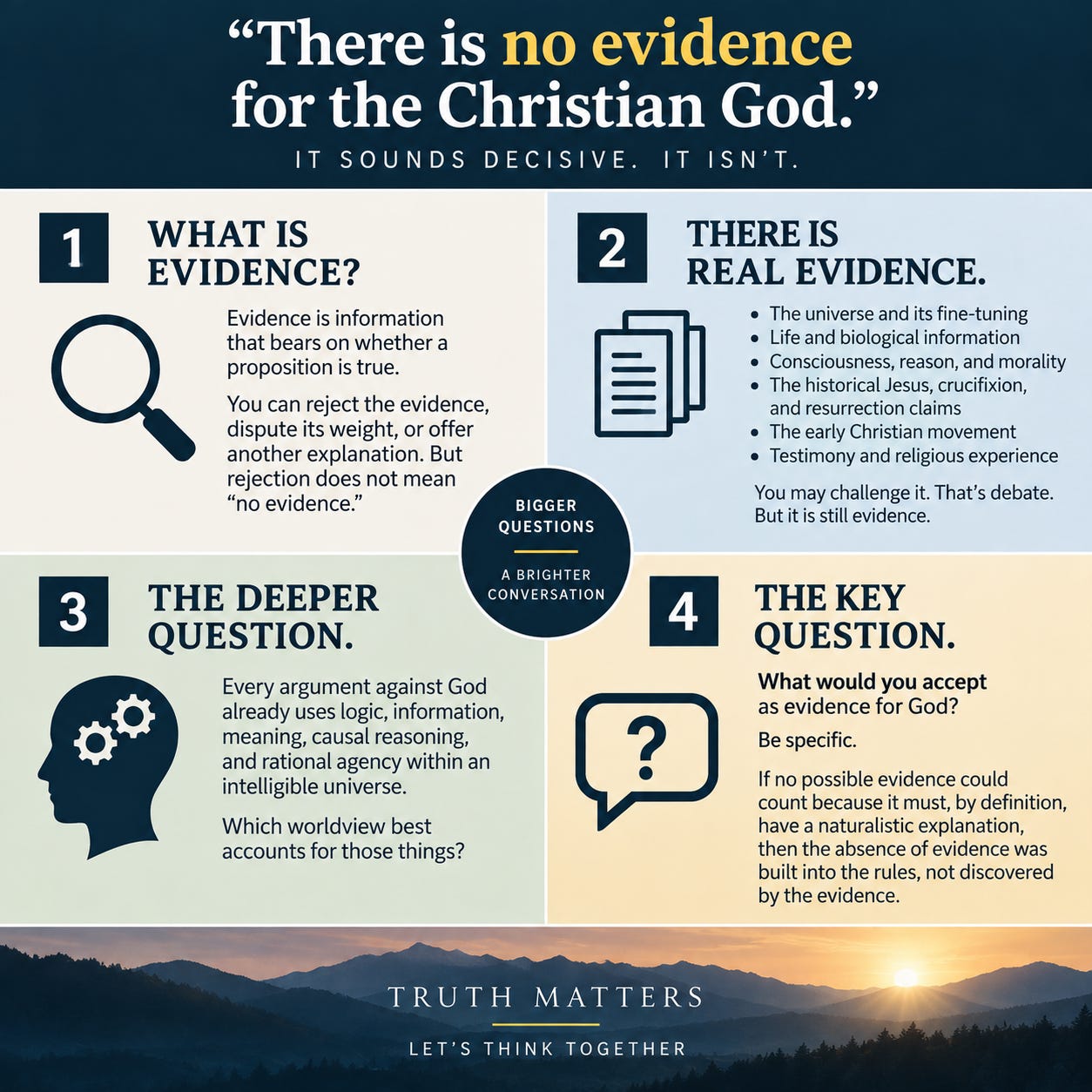
Evidence is information that bears on whether a proposition is true. Evidence does not become “non-evidence” because you reject it, assign it little weight, or believe another explanation accounts for it better.
The Christian evidential case draws from:
• Why anything exists rather than nothing
• The contingency and intelligibility of the universe
• Mathematical and physical lawfulness
• Fine-tuning
• Functional biological information
• Consciousness and intentionality
• Rational inference and semantic meaning
• Objective moral obligation
• The historical Jesus and his crucifixion
• The extremely early resurrection proclamation
• The claimed postmortem appearances
• Paul’s conversion
• The emergence of Christianity in its original historical setting
• Religious experience and testimony
There are entire academic disciplines and centuries of philosophical argument surrounding these subjects.
An atheist can challenge every one of them.
Please do.
Argue that fine-tuning has a better explanation. Challenge arguments from contingency. Develop a naturalistic account of consciousness, intentionality, rationality, morality, or biological information. Examine the historical evidence surrounding the resurrection and propose a better explanation.
That is serious engagement.
But simply declaring “there is no evidence” does something rather different.
It can make the atheist appear unaware of the enormous body of material being discussed, or worse, aware of it but unwilling to recognize anything as “evidence” unless it already establishes the conclusion beyond dispute.
And that standard would wreck reasoning everywhere else.
There is also a deeper issue.
Every argument against God already employs logic, information, semantic meaning, causal reasoning, rational agency, and truth-directed inference within an intelligible universe.
Christianity is therefore entitled to ask:
What worldview adequately accounts for those things?
Which brings me to the question I increasingly ask whenever someone declares that there is “no evidence for God”:
What would you accept as evidence for God?
Be specific.
Because if every conceivable observation must ultimately receive a naturalistic explanation, regardless of what we discover, then naturalism has been protected from contrary evidence by definition.
At that point, “there is no evidence for God” was never an empirical conclusion.
It was built into the rules.
An atheist who says, “I think the evidence is insufficient,” has opened a serious debate.
An atheist who says, “There is no evidence,” has first taken on the much more difficult burden of explaining why none of the foregoing even qualifies as evidence.
That is a burden I rarely see acknowledged.