

Start with something almost too obvious to notice. The world is intelligible. Not just to specialists with the right equipment, but to a child sorting blocks by color, to a farmer reading clouds, to anyone who has ever traced a pattern and found that the pattern held. We move through reality as if it were addressed to us, and most of the time it answers.
This should be stranger than it feels.
There is no obvious reason that a universe of particles and fields should yield to minds made of the same stuff. A rock does not understand other rocks. Wind does not comprehend pressure gradients. Yet somewhere in the long unfolding of things, arrangements of matter appeared that could read the universe back to itself, and the universe submitted to the reading. The equations work. The predictions land. The cathedral of modern science stands on the quiet assumption that the world will keep playing fair.
Pause on that. The world plays fair.
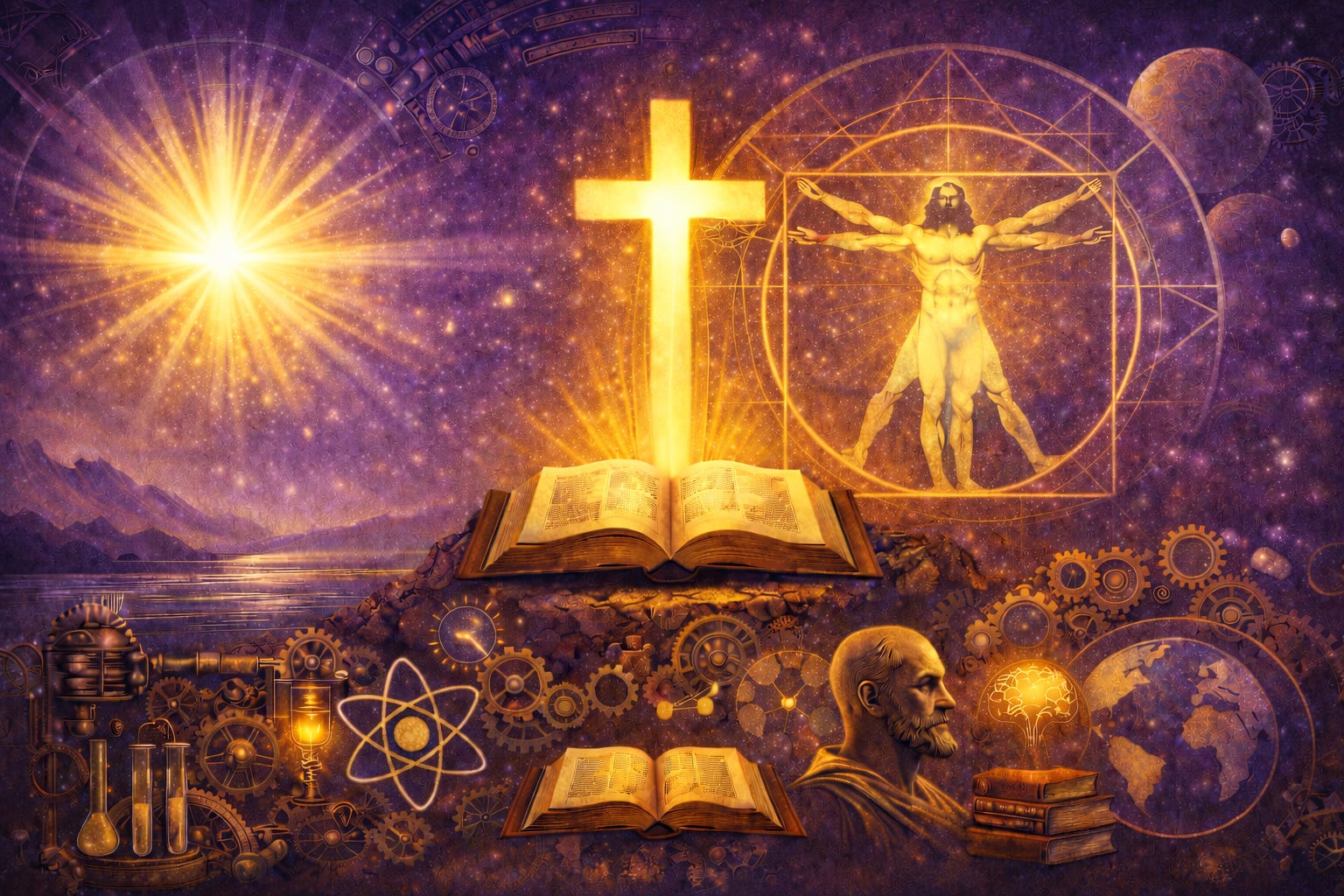
When you look closely at what makes the world intelligible, three features keep showing up together. The world is logically constrained: contradictions do not occur, identity holds, the excluded middle bites. The world is informationally specific: it is not noise, it carries distinguishable patterns, it can be measured and described and compressed. The world is dynamically intelligible: it changes, but it changes in ways that follow from what came before, so that yesterday’s physics is still useful tomorrow.
These are not three separate facts. They travel together. A world that violated logic could carry no stable information. A world without informational specificity would have no dynamics worth tracking. A world without intelligible change would freeze into a single timeless point and tell us nothing. Pull on any one thread and the other two come with it.
Now look at minds.
The same three features appear, but turned inward and intensified. A mind reasons, which means it tracks logical constraint and notices when constraint is violated. A mind represents, which means it carries informational specificity about things other than itself. A mind moves, which means it processes, learns, anticipates, remembers. Take away any of these and what remains is not a diminished mind but no mind at all.
The convergence is the thing. The features that make the world knowable are the features that make minds knowers. The fit is not approximate. It is not the fit of a key roughly jammed into a lock. It is the fit of a key cut for the lock, or a lock cut for the key, or both cut together by something that had both in view.
The cheap explanation is that the fit is an accident. Minds evolved in a world with these features, so of course minds came to mirror them. Selection pressure did the work. There is something to this, but not enough. Evolution can explain why a mind that tracks logical constraint outcompetes a mind that does not. It cannot explain why the world has logical constraint to be tracked in the first place. The fit between mind and world is not just biological adaptation. It is the deeper fact that there was something there for biology to adapt to, something already structured, already addressable, already speaking a language a mind could learn.
So the question pushes back a step. Why is the world the kind of thing minds can read?
One answer is that the world is itself mind, or a region of mind, or differentiation within a single cosmic Mind whose dissociations we call particles and persons. This is a serious philosophical position with serious defenders, and it has the virtue of explaining the fit by collapsing the distinction. If world and mind are the same stuff, of course they correspond.[^1] But it pays for parsimony with a steep ontological bill: the loss of any real distinction between Creator and creation, the dissolution of the world’s independence from our knowing, and a metaphysics that strains hard against the lived experience of a world that does not bend to our wanting.
The older answer is leaner. The world is intelligible because it was spoken. Not metaphorically. There is a Mind prior to the world, ontologically distinct from it, whose act of speech is what the world is. The features that make the world readable are the marks of authorship. The features that make minds readers are the marks of being made in the image of the Author. The fit is covenantal correspondence, not identity. The lock and the key were cut by the same hand, and the hand is not the lock.
This is what Christians have always meant by Logos. In the beginning was the Word, and the Word was with God, and the Word was God. All things were made through him. The world is intelligible because intelligence preceded it. The world plays fair because it was made by One who keeps faith.
If this is right, you would expect the signature to show up everywhere, and it does. You would expect mathematics to describe physics with embarrassing precision, and it does. You would expect deep theoretical structures to be discovered before their empirical applications, sometimes by centuries, and they are. You would expect minds equipped with no obvious evolutionary need for higher mathematics, formal logic, or cosmological reasoning to nonetheless turn out to be capable of them, and they are. The world is over-engineered for our knowing. We are over-engineered for its reading. Somebody put both in place, and the fit between them is the receipt.
You would also expect, if the Author is personal, that the disclosure would not stop at structure. A signature in the stone is something. A voice from the stone is more. The pattern of the argument so far gives you a Mind behind the world, an Author of intelligibility. It does not yet give you a face. For that, the disclosure has to come from the other side. The Author has to speak.
This is where Christianity makes a move no other framework even attempts. Not there is a divine principle, contemplate it. Not the One emanates, ascend toward it. A specific claim about a specific man in a specific place at a specific time. The Logos who structured the cosmos entered the cosmos. The Author wrote himself into the book.
You can dismiss the claim, but you cannot pretend it is not the claim being made.
What makes the Christian claim philosophically serious is not just its boldness but its falsifiability. Paul puts the whole structure on a single nail. If Christ has not been raised, your faith is futile. Not “futile but still meaningful.” Not “futile but psychologically helpful.” Futile. The architecture comes down. You will not find this kind of public, dated, falsifiable wager at the center of most religious systems. The Christian claim makes itself vulnerable on purpose, because the claim is that something actually happened, and if it did not happen, the claim deserves to die.
So did it happen?
The minimal historical facts, accepted by the substantial majority of scholars in the field including many who hold no Christian commitment, are these. Jesus of Nazareth was executed by crucifixion under Pontius Pilate. His tomb was found empty shortly after. His followers, who had scattered in fear, reported encounters with him alive, and these reports began circulating within a span far too short for legendary development to account for them. The earliest creedal formulation, embedded in 1 Corinthians 15, dates within a few years of the events themselves, naming named witnesses still alive when Paul wrote. The movement these followers founded grew under persecution, made claims that broke decisively with their own Jewish framework, and would have been ended in its first month by the simple production of a body. No body was produced.
You can construct alternative explanations. Each requires assuming something for which there is no positive evidence, and each runs into the same wall: the early, coordinated, sacrificial transformation of people who had every reason to know whether they were lying. People die for what they believe is true. People do not die for what they know they made up.
The resurrection is not proven the way a theorem is proven. It is the best explanation of the evidence we have, and the alternatives bleed at the seams. If you accept it, the whole architecture clicks into place. The Logos who structured the cosmos entered the cosmos, was killed by the cosmos, and defeated the death the cosmos imposed. The signature in the stone was not just a signature. It was a sending.
So this is where the argument lands. The fit between mind and world is real, and it is evidence. It points to a single personal Author rather than to brute fact, emergent accident, or cosmic dissociation. The Author is not silent. The Author has spoken, finally and historically, in a man who was killed and rose. The whole structure is offered for testing, not for swallowing. Pull on it. Push it. Try to find where it gives.
The remarkable thing, and I say this as someone who has spent years trying to find where it gives, is that it does not. The world is intelligible because it was made by Intelligence. We can read it because we were made by the same Hand. And the Hand, in the fullness of time, took on a wrist and a pulse and bled out on a Roman cross, and three days later the tomb was empty, and the disciples who had run were suddenly the disciples who would not stop talking, and here we are two thousand years later still trying to account for it.
The signature is in the stone. The Author has signed his name.
[^1]: This is roughly the position taken by analytic idealists such as Bernardo Kastrup, who reads physical reality as the extrinsic appearance of a unified field of consciousness, with individual minds as dissociated alters of that field. It is a coherent metaphysics and a serious option, but it is not the Christian one. Christianity holds the Creator–creature distinction as load-bearing: the world is real, distinct from God, and contingent on his sustaining act, not differentiation within him. The convergence between mind and world is explained by common authorship, not common substance.