

It is one of the oddest little passages in the Bible, and for most of my life I read straight past it. The sons of God saw that the daughters of man were attractive, and they took as their wives any they chose. Then giants. Then the Flood. Four verses, and they have launched a thousand late-night documentaries.
The popular reading, the one with the wind at its back right now, says the sons of God were angels. They came down, took human wives, and the Nephilimwere the hybrid children of that union, a race of giants so corrupt that God reset the world with water. It is dramatic. It is ancient. And before I tell you why I think it falls apart, I want to give it its strongest case, because the people who hold it are not fools and the text really is strange.
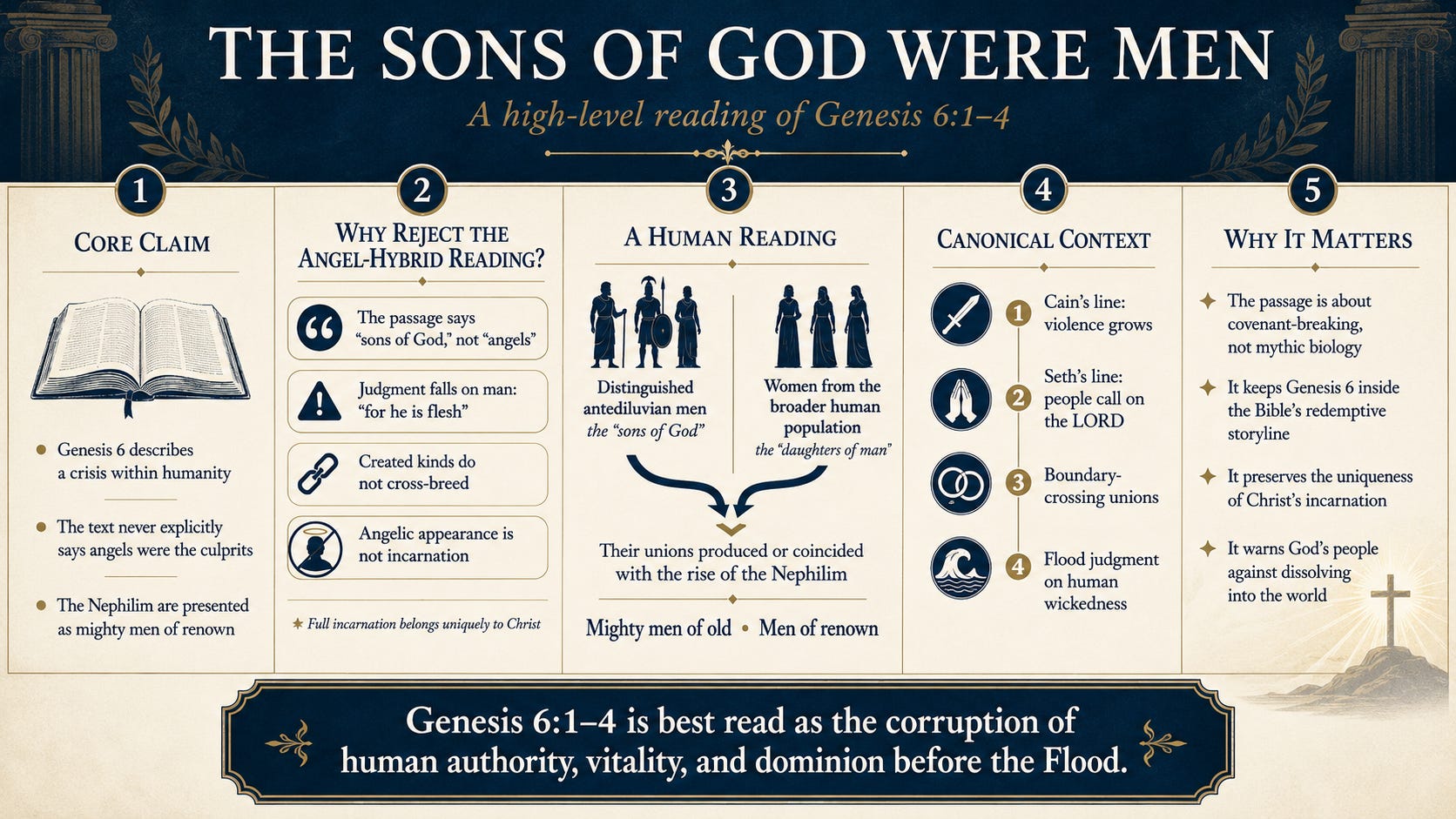
Here is that case at full strength. The phrase sons of God, bĕnê hāʾĕlōhîm, turns up in Job, where the sons of God present themselves before the LORD and shout for joy at the founding of the earth. Those are heavenly beings. So the phrase can mean angels. The Book of Enoch, circulating in the centuries before Christ, tells exactly this story: heavenly Watchers descend, take wives, father giants. Jude even quotes a line from Enoch, which feels like a wink of approval. And the offspring are called mighty men, men of renown, which sounds like a good deal more than the result of ordinary marriages. Put it together and you get a reading that is old, textually anchored, and frankly more exciting than anything I am about to offer. I get the appeal.
Now let me tell you where it started to come apart for me.
The first crack is small, but it matters. The whole angelic reading leans on the assumption that sons of God has to mean angels. It does not. Scripture hands the title around freely. Adam is called the son of God. Israel is God’s son, my firstborn. The covenant people are told, you are the sons of the LORD your God. Those led by the Spirit are sons of God. The phrase is covenant language for people who belong to God long before it is ever a word for angels. So the lexical necessity the angelic reading needs simply is not there. Job shows the phrase can mean heavenly beings. It never shows it must.
That alone settles nothing. It just takes the steering wheel out of the angelic reading’s hands and gives it back to context. Which is where the real trouble shows up.
Think about what the hybrid reading is actually asking you to believe. Angels and humans produced children together. Set the drama aside for a second and ask the plain question: how? There are only two answers. Either it happened naturally, with angels possessing or acquiring the equipment to breed with women, or it happened by some supernatural act.
Take the natural route first. Scripture says angels are spirits, ministering servants. Every time they appear in the story they are doing a job, delivering a message, guarding a gate, executing a judgment, and then they go. They never settle into a human body and start a family. Jesus says the angels in heaven neither marry nor are given in marriage. So the natural route runs straight into what the Bible actually says angels are.
Here someone reaches for the obvious objection. Kinds cross all the time, they say. Look at a mule. Horse plus donkey. So why not angel plus human?
Slow down, because that objection is hiding a word swap. A mule is a horse crossed with a donkey, true enough. But horse and donkey are not two different kinds in the Bible’s sense. The biblical kind, the mîn of Genesis 1, is a broad family, far wider than the narrow species of a modern biology textbook. Horse and donkey sit inside one kind. A mule is motion within that kind. It is variation inside the fence, and the fence still stands. So the mule proves exactly nothing about kinds crossing.
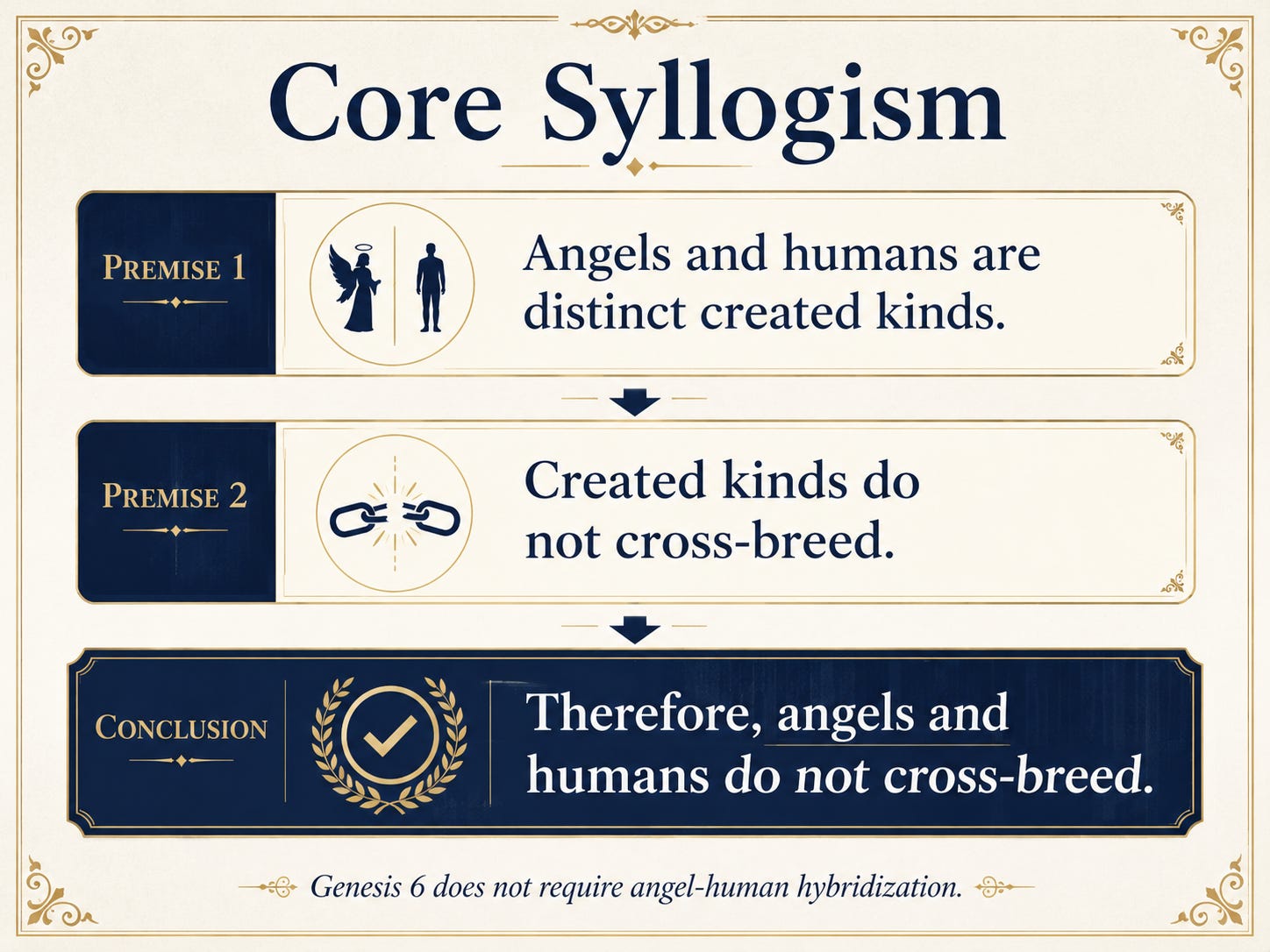
And even if you waved all of that away, look at what the angelic reading is really proposing. The cross it needs is between a spirit and a body, between the order of spirit and the order of flesh. That divide is deeper than anything separating two creatures of the dust from each other, deeper than horse from donkey by an immeasurable distance. No mule gets you anywhere near it. The hardest case in all of animal breeding does not so much as gesture at what the hybrid reading requires.
So the natural route is closed. That leaves the supernatural one, and watch what happens the moment you take it. The instant you say the offspring came by some special supernatural act, you have stopped reading Genesis and started supplying it, because Genesis describes no such act. The doctrine of creation knows God. It knows the kinds he made, each after its own kind. It knows man as his image-bearer and the angels as ministering spirits. It knows one permanent joining of natures, and that is the Son taking flesh. It does not know a third thing, a tertium quid, begotten of heaven and earth. That creature is nowhere in the canon. It lives on a different shelf entirely, in the mythology of the nations, where gods and their consorts crank out heroes and demigods on a schedule. To finish the hybrid reading you have to walk over to that shelf and borrow the category. The text never hands it to you.
That is the heart of it. The hybrid reading is not merely thin on evidence. It is a category error. It answers a question Genesis is not asking with a being Genesis does not have.
Once you see that, the passage stops being weird and starts being obvious, because the text tells you who is on trial. Right between the marriages and the giants, God speaks: My Spirit shall not abide in man forever, for he is flesh. Man. Flesh. And a verse later: the LORD saw that the wickedness of man was great, that every intention of the thoughts of his heart was only evil continually. Read the sentence God actually passes. It lands on man, by name, twice over. If incorporeal beings were the real villains here, the verdict has a strange way of showing it, because the corruption it indicts is human through and through.
And the moment you ask who these sons of God and daughters of man actually are, the two chapters right before Genesis 6 answer you. Genesis 4 follows Cain’s line down to Lamech, a man who boasts about murder and collects wives. Genesis 4 closes the line of Seth with one quiet sentence of enormous weight: in those days people began to call upon the name of the LORD. Two communities. One that worships, one that does not. Then Genesis 6 opens, and the worshiping line looks at the other line, likes what it sees, and marries in without a second thought for the calling it is walking away from.
If you have read the rest of the Old Testament, you already know this sin. It is the exact thing Israel is warned against again and again, do not intermarry with them, for they will turn your heart away. It is the thing that wrecks Solomon. It is the thing Ezra weeps over. Genesis 6 is the first run of a pattern that threads the whole story: the people of God forgetting that they are set apart and dissolving into the world around them. That is no myth. It is a reading on the human heart, and it has not changed.
But the New Testament, someone says. Doesn’t Jude settle this for the angels?
This is the strongest card the other side holds, so let me play it all the way out. Jude says certain angels did not stay within their own position of authority but left their proper dwelling, and are kept now in chains for judgment. Two Greek words carry the freight. Their position of authority is their archē, their office. Their proper dwelling is their oikētērion, their station. Read the words for what they say. They describe servants who walked off the post they were given. That is rebellion, the very rebellion the Bible states plainly elsewhere. What the words do not contain, anywhere, is marriage, women, offspring, or a body taken on in order to breed. That content comes from Enoch and gets read back into Jude. Strip Enoch away and Jude is talking about angels who abandoned their office, full stop. He never mentions Genesis 6.
Then comes the line about Sodom going after strange flesh, which everyone wants to chain to the angels. Look at the grammar, because the grammar decides it. The pursuit of strange flesh is pinned, by the very form of the words, to the cities, to Sodom and Gomorrah and the towns around them. It is their sin being described. And their sin is no secret. The men of Sodom meant to force themselves on visitors they took for men. The strange flesh is flesh other than the God-given counterpart, men reaching for men. That is what the verse condemns. It is a statement about Sodom, and it never travels back up the passage to the angels, let alone all the way to Genesis 6. The only thing that carries it there is the Enoch story riding shotgun in the reader’s head.
Peter does what Jude does. He lists the angels who sinned, then the ancient world drowned in the Flood, then Sodom turned to ash, and he draws one lesson: the Lord knows how to rescue the godly and hold the unrighteous for judgment. It is a list of examples. Setting the angels next to the Flood on a list does not make the angels the cause of the Flood. A catalogue is not a row of dominoes.
So the three passages everyone reaches for do not actually name the hybrid reading. They speak of rebellion, and of Sodom, and of judgment, and they are perfectly at home in the human reading.
Here is why I care about getting this right, and it has nothing to do with giants.
The Bible tells one story. God makes us for communion with him, a love that shows itself in obedience. We break it in a garden. Israel breaks it and goes into exile. And the whole thing is answered, at last, by one faithful Son who never breaks it, who always does what pleases the Father, obedient all the way to a cross. Genesis 6, read as covenant-breaking, sits right inside that story. The sons of God forsake their consecration, as Adam did before them and Israel would after them, and the Flood is the judgment on a humanity that would not keep faith. Read it this way and it points, like every other chapter, to the Son who kept the communion the rest of us forsook.
Read it as a hybrid myth and it falls out of the story altogether. It becomes a bizarre cul-de-sac about angel genetics, hooked to nothing before it and nothing after. You gain a monster movie and you lose the thread.
There is even a quiet gift buried in the human reading. Every time an angel appears in Scripture, the form is on loan. The angel takes a shape, does the work, and gives the shape back. One being in all of Scripture takes human nature and keeps it, permanently, without sin, joined to himself forever, and that is the eternal Son. Keep Genesis 6 clear of cross-kind unions and you guard, all the way back in the primeval history, the uniqueness of the one union that actually saves you.
And there is a warning in it, aimed straight at us. The sin of Genesis 6 is the people of God deciding the line between themselves and the world is not worth keeping. That sermon preaches in any century.
So no, I do not think the sons of God were angels. I think they were men who knew better, men who held a calling and traded it for whatever they wanted, and who left us a flood and a warning. It is a harder story than the one with the giants. It usually is.
I remember my seminary professor back in the late 90s exploring both of these options in our Old Testament class. Before then, I’d never heard of this option for angels and humans making babies. You outline a good case for the non-angelic reading, which is where I land.
To me, the strongest argument against the hybrid theory is the fact that Joshua's spies found Nephilim in the land of Canaan.
If Nephilim were an unnatural race of beings that God sent a flood to eradicate, then having them around after the flood kind of makes the whole thing pointless, and makes God look weak and ineffective. If, on the other hand, Nephilim refers to their ideology and evil practices, then it makes far more sense: people in Canaan have restored the ancient evil practices, but they're only in this one place this time rather than taking over the entire world, and God sends Israel to wipe them out rather than sending a calamity.