

The Framework
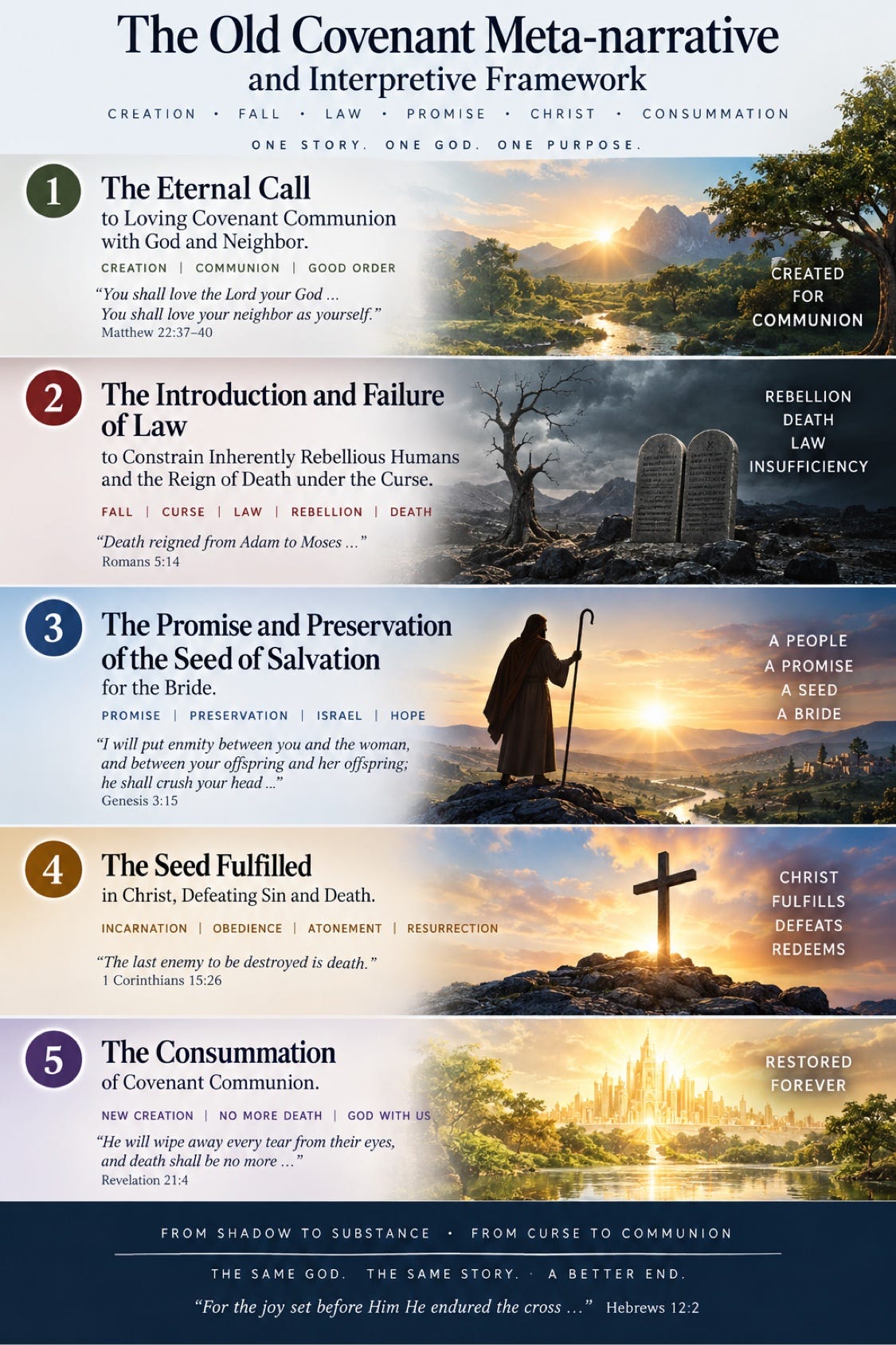
The eternal call to loving covenant communion with God and neighbor.
The introduction and failure of law to constrain inherently rebellious humans and the reign of death under the Curse.
The promise and preservation of the Seed of Salvation for the Bride.
These three movements provide the direct framing for the argument that follows. The paper develops their internal logic by distinguishing primordial divine law from its later Mosaic codification, natural and properly ordered self-love from autonomous self-reference, and the righteous function of law from its inability to regenerate the fallen heart. In that fuller account, the “introduction” of law in the second movement refers to its progressive formal articulation and covenantal codification within fallen human history, since divine command itself is already present in Eden.
Abstract
Old Testament ethical challenges are often isolated from the canonical story that gives them their theological function. This paper develops an interpretive rubric grounded in ordered covenant love. Humanity is created for communion with God and neighbor under divine authority. Natural creaturely self-love is good within that communion and is presupposed rather than commanded. Creaturely autonomy disorders love by making the self the governing reference point of good. Rebellion brings the Curse and death. Divine law is present before the Fall and is later expanded and covenantally codified for fallen humanity. Law can reveal, order, restrain, condemn, and teach, but external law cannot regenerate an autonomous heart. The Old Testament therefore moves through communion, rebellion, Curse, law, judgment and accommodation, promise and preservation, toward the promised Seed, the redeemed Bride, and restored communion. This rubric clarifies national judgment, slavery and servitude, and related challenges while leaving every individual passage accountable to its own exegesis.
1. Canonical trajectory
The Old Testament does not begin at Sinai. It begins with creation. Before Israel, Mosaic civil legislation, slavery, warfare, and national judgment stands a created order in which humanity receives being, vocation, relationship, moral boundaries, and the knowledge of God (Gen. 1:1-2:25; Rom. 1:18-23).
The pattern of Genesis 1-3 establishes the governing categories. God creates by speech, orders by separation, evaluates as good, commissions humanity as image-bearers with dominion, and institutes covenant communion with explicit command (Gen. 1:3-2:25). The Fall disrupts every category at once: communion is broken, vocation is cursed, relationships fracture, and death enters (Gen. 3:1-24).
2. External law and ordered love
Divine law does not originate at Sinai. Adam receives explicit external command before the Fall (Gen. 2:16-17). Sinai is an expanded covenantal codification of divine law to a people already living under the Curse. The decisive change is therefore the human subject standing under law, not the goodness of law itself.
Jesus identifies love of God and love of neighbor as the commands upon which the Law and Prophets depend (Matt. 22:37-40; Deut. 6:5; Lev. 19:18). The formulation contains an anthropological asymmetry. God-love is commanded. Neighbor-love is commanded. Self-love is presupposed: the neighbor is to be loved “as yourself.” Paul similarly assumes ordinary nourishment and care of one’s own flesh (Eph. 5:28-29).
Principle of Ordered Love
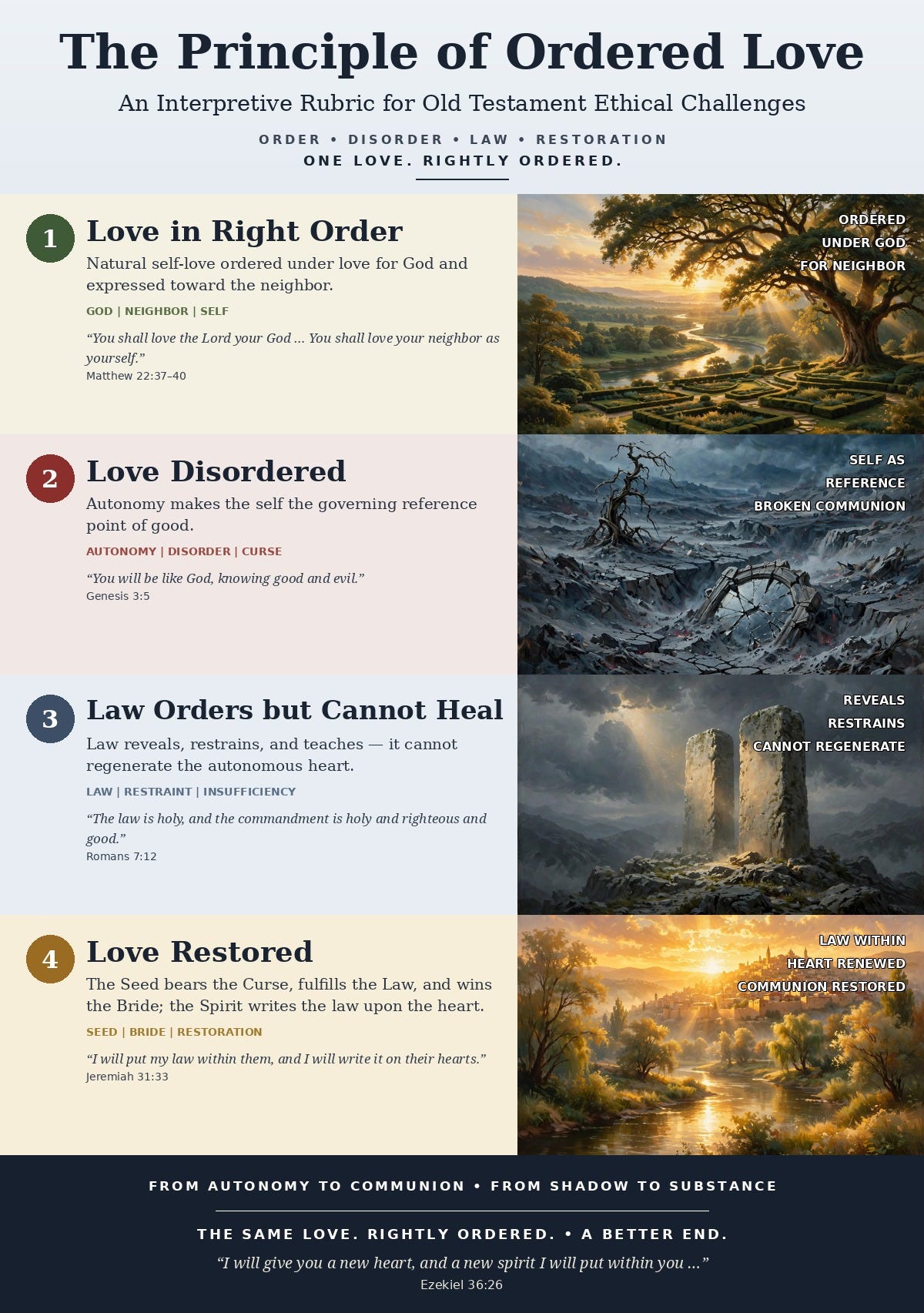
Human beings naturally possess creaturely self-love and therefore require no command to seek their own good. Within proper covenant communion, natural self-love is ordered under love for God and expressed toward the neighbor. Creaturely autonomy disorders this relation by making the self the governing reference point of good. Divine law commands love toward God and neighbor and establishes the boundaries within which natural self-love remains properly ordered.
Self-love itself is therefore not the Fall. The disorder arises when the creature claims authority to make the self the ultimate moral reference.
3. Autonomy, Curse, and the limits of external law
Genesis 3 presents the temptation to be “like God, knowing good and evil” (Gen. 3:5). Humanity receives God’s judgment concerning good and evil and asserts an alternative authority. The causal structure is:
Creaturely autonomy -> self as governing reference -> disordered love -> transgression -> broken communion -> Curse and death.
The consequences immediately move in both directions of commanded love. Adam and Eve hide from God (Gen. 3:8). Adam turns accusation toward the woman and indirectly toward God (Gen. 3:12). Cain kills Abel (Gen. 4:8). Rebellion against God and destruction of neighbor belong to the same disorder.
The Curse precedes the Mosaic covenant. Paul emphasizes that death “reigned from Adam to Moses” (Rom. 5:14) precisely to establish that death already held humanity under its dominion before the Mosaic Law was given. The giving of the Law therefore neither originates death nor creates the fallen condition it confronts. Death’s reign begins with Adamic rebellion and continues through the Mosaic administration until its decisive defeat in the death and resurrection of Christ, while biological death remains the last enemy awaiting final abolition at the consummation (Rom. 5:12-21; 1 Cor. 15:20-26, 54-57; Rev. 20:14; 21:4). Paul can therefore affirm that the law is holy, righteous, and good while describing sin as exploiting the commandment (Rom. 7:7-13).
The redemptive chronology is consequently: Adam: death begins to reign -> Moses: Law enters an already death-ruled world -> Christ: death is decisively defeated -> consummation: death is finally abolished.
External law can reveal righteousness, identify transgression, restrain conduct, order covenant society, establish judicial boundaries, and teach typologically. It cannot regenerate the autonomous heart. Fallen humanity’s problem is deeper than ignorance of the good. It resists receiving the good from God as authoritative.
4. The Decalogue as an ordering of love
The Ten Commandments (Ex. 20:1-17; Deut. 5:6-21) exhibit the ordered-love structure directly. The first tablet (commands 1-4) orders love toward God: exclusive allegiance, reverent worship, honored name, consecrated time. The second tablet (commands 5-10) orders love toward neighbor: honored parents, protected life, faithful marriage, respected property, truthful speech, contented heart.
The Decalogue’s prohibitions function as boundary markers within which natural self-love remains properly ordered. “You shall not murder” does not command love of neighbor directly; it establishes the boundary that disordered self-love may not cross. The positive ordering of love is supplied by the two great commandments, which Jesus presents as the hermeneutical center of the whole Law (Matt. 22:37-40).
5. Interpretive taxonomy
Old Testament ethical challenges sort into distinct categories under the ordered-love rubric, and each category requires its own interpretive handling:
• National judgment addresses mature corporate rebellion that has destroyed covenantal order.
• Accommodation regulates fallen social realities (such as servitude and divorce) without endorsing them as creation ideals.
• Ceremonial structure teaches through typological shadow rather than functioning as timeless moral prescription.
• Redemptive preservation carries the promise of the Seed forward through a particular people.
Confusing these categories produces the standard objections. Treating accommodation as endorsement, or ceremonial shadow as moral ideal, or redemptive preservation as favoritism, misreads the text’s own theological function.
6. National judgment
The conquest narratives and prophetic oracles of judgment against nations (including Israel itself) belong to the first category. The rubric clarifies their logic: when corporate rebellion reaches maturity and destroys the covenantal and neighborly order that law exists to protect, divine judgment removes the destroyers. The Canaanite practices cited as warrant (child sacrifice, cultic sexual violence; Lev. 18:21-30; Deut. 12:31) represent precisely the inversion of ordered love: the strong consuming the vulnerable.
Judgment is therefore not an exception to ordered love but its judicial expression. A God of ordered love cannot be indifferent to the strong devouring the weak. The same rubric that commands neighbor-love authorizes the judgment of those who make neighbor-destruction their settled practice.
7. Slavery and servitude
Old Testament servitude legislation (Ex. 21; Lev. 25; Deut. 15) belongs to the accommodation category. In a fallen world where debt, famine, and warfare produce destitution, the law regulates servitude with boundaries: time limits, release provisions, protection from brutality, and Sabbath rest (Ex. 21:2; Lev. 25:39-43; Deut. 15:12-15).
Accommodation is not endorsement. Jesus applies exactly this logic to divorce: Moses permitted it “because of your hardness of heart,” but “from the beginning it was not so” (Matt. 19:8). The creation ideal remains the reference point; the legislation manages the fallen reality. The same structure applies to servitude: the law restrains and humanizes an institution it does not present as the creational good.
8. Promise, Seed, and Bride
Running through judgment and accommodation is the promise. From the protevangelium (Gen. 3:15) through the Abrahamic covenant (Gen. 12:1-3; 15; 17), the Davidic covenant (2 Sam. 7), and the prophetic expectation of a new covenant (Jer. 31:31-34; Ezek. 36:25-27), God preserves a people through whom the Seed will come.
The Bride imagery (Hos. 1-3; Ezek. 16; Eph. 5:25-32; Rev. 19:6-9; 21:2) gathers the whole story into covenantal marriage: God pursuing an unfaithful people, bearing the cost of their redemption Himself, and finally presenting them without spot. Ordered love reaches its goal when the beloved is made capable of returning love in the proper order.
9. New Covenant and consummation
Christ fulfills the Law (Matt. 5:17), bears the Curse (Gal. 3:13), defeats death (1 Cor. 15:20-26, 54-57), and pours out the Spirit who writes God’s law upon the heart (Jer. 31:33; Ezek. 36:26-27; 2 Cor. 3:3). What external law could not accomplish — the regeneration of the autonomous heart — the Spirit accomplishes from within.
The consummation restores covenant communion: no more death, no more Curse, God dwelling with His people (Rev. 21:1-4; 22:1-5). The end is the beginning restored and surpassed: ordered love, now unbreakable.
10. Method and limits
This rubric is an interpretive framework, not a substitute for exegesis. Every individual passage remains accountable to its own literary context, historical setting, and canonical placement. The rubric tells the reader where to stand; it does not do the work of standing there.
The framework also sets its own boundary: it clarifies the theological function of difficult texts but does not dissolve every tension. Some passages retain a remainder of mystery, and the rubric is honest about that remainder rather than explaining it away.
Conclusion
The Old Testament’s difficult texts belong to a coherent redemptive history. Humanity is created for loving covenant communion under divine authority. Natural creaturely self-love is good within that communion and requires no separate command. Love of God and neighbor are commanded because autonomy can turn natural self-concern into the governing reference point of good.
The Fall disorders love. The Curse and death follow. Divine law, already present before the Fall, is progressively articulated and covenantally codified in a world of fallen creatures. It reveals the good, restrains evil, orders covenant life, exposes transgression, and teaches redemptively. It cannot regenerate the heart.
Judgment addresses mature rebellion and its destruction of covenantal and neighborly order. Accommodation regulates fallen social realities without necessarily identifying them as creation ideals. Ceremonial structures teach through shadow. Redemptive preservation carries the promise forward. The Seed comes in Christ, bears the Curse, fulfills the Law, gives Himself for the Bride, and secures the Spirit who writes God’s law upon the heart.
The canonical story therefore moves from ordered love, through autonomous rebellion and the long shadow of death, to the restoration of covenant communion in Christ. The difficult texts belong inside that story. Their interpretation must begin there and then return to the text itself for judgment.
Primary scriptural loci
Genesis 1:2; Genesis 2:16-17; Genesis 3:5; Matthew 22:37-40; Romans 5:14; Romans 7:7-13; Jeremiah 31:31-34; Ezekiel 36:25-27; 1 Corinthians 15:26; Revelation 21:4