

“Test everything; hold fast what is good.” (1 Thessalonians 5:21, ESV)
Few interpretations have experienced a greater resurgence in modern evangelical theology than the claim that the Nephilim were the offspring of angels and human women.
Popularized through the Divine Council movement and the scholarship of Michael Heiser, this interpretation is often presented as the straightforward reading of Scripture. Genesis 6 introduces the event. Daniel identifies the participants as Watchers. Jude and 2 Peter confirm the interpretation. First Enoch supplies the historical detail.
The result is a coherent narrative. The question is whether it is the narrative the canon itself demonstrates.
This article does not deny the supernatural worldview of Scripture. The heavenly host is real. The Divine Council is real. Angels, cherubim, seraphim, rulers, authorities, principalities, and Watchers are real.
The question is narrower.
Does canonical Scripture demonstrate that the Nephilim were the hybrid offspring of the angelic kind and the human kind?
I contend that it does not. The canonical writers never complete the interpretive chain required to reach that conclusion.
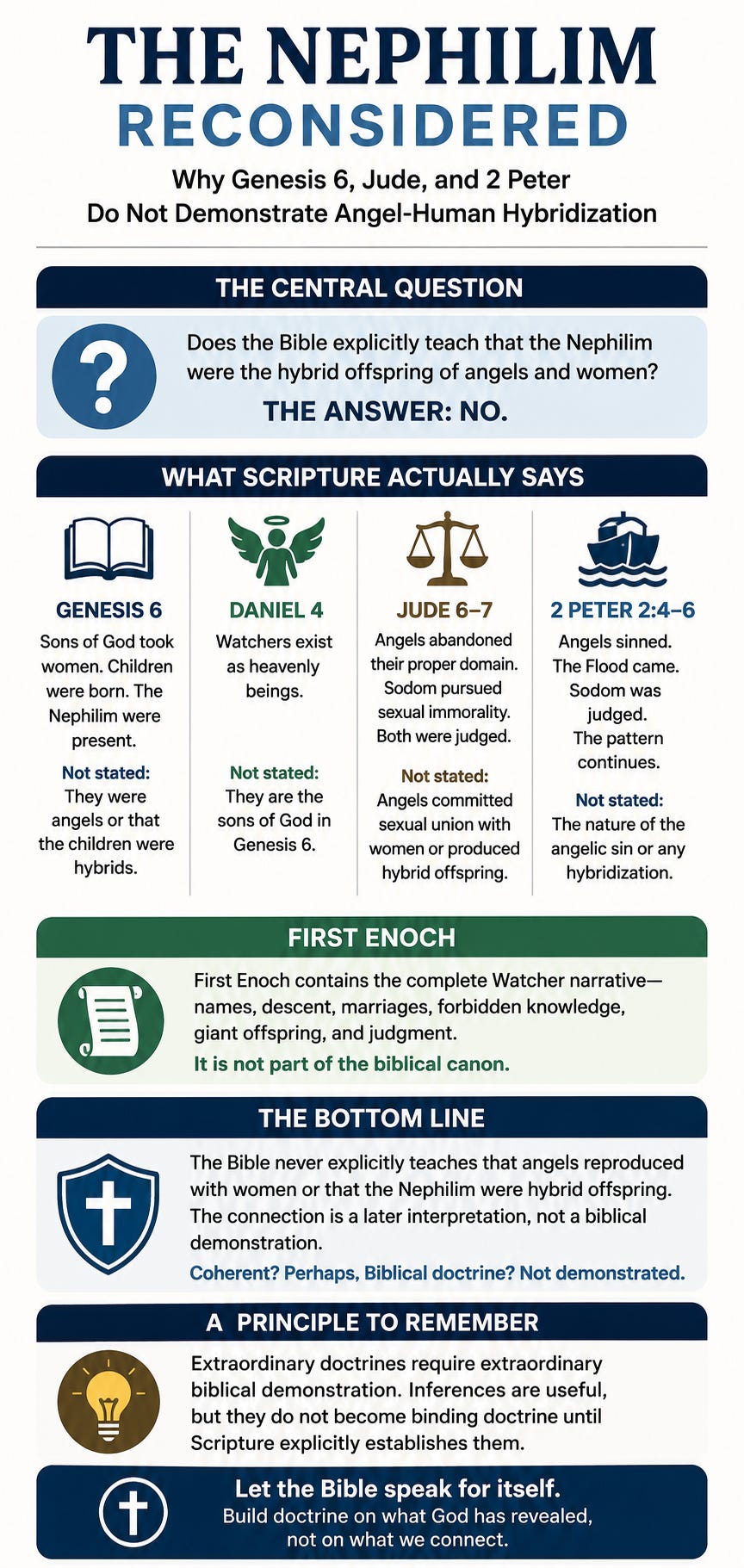
A Principle of Biblical Doctrine
Christian doctrine should rest upon what Scripture demonstrates. Inference has a legitimate role in theology, but the more extraordinary the claim, the clearer the biblical demonstration should be. The Watcher interpretation asks readers to affirm biological reproduction between two distinct created orders. Such a claim requires strong textual evidence.
What Genesis 6 Actually Says
Genesis establishes that the sons of God took wives, children were born, the Nephilim were present, human wickedness increased, and God judged mankind through the Flood. It never explicitly identifies the sons of God as angels, calls them Watchers, describes supernatural conception, explains reproduction between heavenly and human beings, or identifies the Nephilim as a hybrid kind. Those conclusions arise through interpretation, placing the burden of proof on the interpreter.
Scripture Distinguishes the Human Kind from the Heavenly Kind
Scripture consistently presents humanity and the heavenly host as distinct created orders. Human beings are created from the dust, bear God’s image within creation, enter marriage, reproduce, and die. The heavenly host, whether elect or fallen, was created to serve God’s sovereign purposes. Unlike humanity, Scripture never presents them as bearing God’s image within creation, entering the covenant of marriage, or reproducing according to their kind. Scripture also distinguishes their judgment from the ordinary death of mankind. The canon never demonstrates reproductive compatibility between the heavenly kind and the human kind.
Physical Manifestation Is Not Biological Generation
Angels appear in bodily form, speak, eat, walk, grasp Lot by the hand, and exercise physical force. None of those actions demonstrates reproductive capacity. Physical manifestation is not biological generation, and Scripture never equates the two.
The Incarnation Provides No Parallel
Jesus Christ was not produced through reproduction between heavenly and human kinds. The eternal Son assumed true humanity through the miraculous work of the Holy Spirit. The virgin conception was a unique act of God, not an example of cross-kind reproduction.
Daniel Introduces the Watchers
Daniel 4 establishes the existence of Watchers but never connects them to Genesis 6, the sons of God, the Nephilim, marriage, or reproduction. Even if Watchers constitute a specialized order within the heavenly host, Daniel never demonstrates reproductive compatibility with humanity.
Jude’s Argument
Jude presents a sequence of divine judgments involving unbelieving Israel, rebellious angels, Sodom and the surrounding cities, and finally false teachers. The angels abandoned their proper domain. Sodom abandoned God’s moral order through sexual immorality. Both were judged. Jude never mentions Genesis 6, the sons of God, the Nephilim, hybrid offspring, or angel-human reproduction. His comparison is moral and judicial rather than biological.
Reading Jude and 2 Peter Together
Second Peter follows the same pattern while restoring Noah and the Flood to the sequence. Peter confirms God’s consistent pattern of judging rebellion and preserving the righteous. He never defines the angelic sin as sexual union with women, never mentions the Nephilim, and never explains a crossing between the heavenly kind and the human kind.
The Role of First Enoch
The complete Watcher narrative appears in First Enoch, where named Watchers, marriages with women, giant offspring, and the expanded account are presented together. Jude quotes a prophetic statement from Enoch, but quoting a source is not the same as canonizing every interpretation within that source. The complete hybrid narrative depends upon First Enoch, not upon the canonical text alone.
The Canonical Chain
Genesis 6 introduces the sons of God, daughters of men, children, and the Nephilim without identifying the sons of God as angels or the Nephilim as hybrids. Daniel introduces Watchers without linking them to Genesis 6. Jude speaks of angels abandoning their proper domain without identifying the event as angel-human reproduction. Peter speaks of angels who sinned before the Flood without defining their sin. The complete Watcher interpretation emerges only when these texts are joined through the framework supplied by First Enoch.
The Burden of Proof
The issue is not whether God possesses the power to accomplish extraordinary things. The issue is whether He has revealed that such an event occurred. Possibility does not establish history, and literary allusion does not establish every element of the source tradition. Until the canon itself demonstrates a crossing between the heavenly kind and the human kind, the claim remains an inference rather than established doctrine.
Conclusion
The supernatural worldview of Scripture should be affirmed. The heavenly host should be taken seriously. The Divine Council should not be ignored. None of these commitments requires the conclusion that the Nephilim were the offspring of angels and women. The burden of proof belongs to the one asserting a crossing of created kinds. Until the canon itself demonstrates that crossing, angel-human hybridization should remain an interpretive proposal rather than a doctrine binding the Christian conscience.
Thank you JD for your post. Many confused Christians need to hear this.
Blessings
I'm intrigued by the level of detail in your findings but seems to be missing some critical points that get no airtime.
If you conclude that no angel-hybrid exists only humans then can you explain Revelation 17:8 and Revelation 9:6?
Revelation 17:8
The beast that you saw—it was, and now is no more, but is about to come up out of the Abyss and go to its destruction. And those who dwell on the earth whose names were not written in the Book of Life from the foundation of the world will marvel when they see the beast that was, and is not, and yet will be.
"was" = the past
"is" = the present
"yet will be" = the future.
Indicating the nephilim beast proven to exist IN THE PAST at least by witnesses at the battle at Gath (2 Samuel 21:20) and subsequent battle at Gath again (1 Chronicles 20:6) where is was told "...a man of great stature, whose fingers and toes were four and twenty, six on each hand, and six on each foot".
Nephilim is not in active in our PRESENT day society.
Nephilim will exist in THE FUTURE as written in God's Word, inferring that tribulation will be a one religion of worshipping the Nephelim (Antichrist) as the beast who's mark will be in the foreheads or right arm.
Are you deliberately ignoring Revelation 17:8 and 9:6 that helps confirm there will be angel-human or hybrid species during Tribulation (Nephelim) when at some point the demonic science put into converting our cells to hybridize us, will eventuate to a point when even death will flee from those who are not in the Lamb's book.
So if there was absolutely no angel-human hybrids then how do you think the science and transhumanism is going today?
WE HAVE
- Nephilim discovered in Egypt and Jerusalem
- The CRISPR DNA technology that pulls DNA from "prehistoric" remains and can insert Genes in humans.
- The science pushing to bring back " prehistoric creatures".
- Science aiming to reanimate cells - bring life from death (already done by the way).
- COVID jabs transhumanising humans
- The mingling of mury clay with iron which does not bind.
- The demonic AI sentience
- CERN's occultic ceremony and hadron collider to open the spiritual portal.
The world changed since the Covid lockdowns and 5 G "(cell)ular" network rollout and CERN's occultic ceremony to bring in demonic gods.
I was expecting your last paragraph would be calling for the unsaved to come to God through the blood of Jesus Christ for salvation.
The endgame is now and it also seems the current transhumanism effort due to "covid" is very much succeeding and is a hybrid-human scenario along with the genetic code spelling "God" is essentially cut out leaving space for demonic insertions.
What DNA has actually been inserted into the population to hybridize them when the EXACT SAME CRISPR TECHNOLOGY has been used for prehistoric DNA extraction. Would you even entertain the possibility that Nephilim DNA has already been discovered and used in the CRISPR technology that is boasted by science to be central to blasphemingGcritic the record I am no conspiracy theorist, I just have a very good radar (aka discernment) to detect deceptive commentary or at the very least misunderstanding due to deliberate omission or missing information, knowing or unknowing.
You hit some very good points until the angel-human hybrid part and missing critical sections about rapture and post rapture tribulation where a Nephelim Antichrist will appear to reign.
Therefore, I respectfully disagree that the thought human-angels don't exist is a false narrative, and to the contrary, the angel-human hybrid aka Beast Nephelim "YET WILL BE" (rev 17:8) leaving unbelievers left behind after rapture to worship the BEAST as hybrids (due to current efforts to convert blood cells and installing nanotechnology in us all - a demonic and beyond criminal act by the way) where they will be unable to escape death, except for those who come to Jesus Christ but will be beheaded by guillotines.
My conclusion is Nephilim existed in the past, currently laying dormant but will reign as Antichrist.
The Nephelim is released perhaps at the culmination of AI, digital Id (mark of the beast system), and nanotech has done it's job along with the setting up of the new world order aka new world religion where the Nephilim (Antichrist) will sit on the throne in the third temple and 3.5 years into tribulation satan will come down from heaven to possess the hybrid. I actually believe the underground bases people get shot trying to get in to potentially holds the key to this biological-spiritual horror show. feels like an abyss of sorts but this srretches my confidence although from what I have seen it shouldn't be out of the equation.
The church (bride of Christ) is raptured first, the rest will remain and go through what would seem like literal hell and torment in tribulation where nobody will buy or sell unless the mark of the beast is taken. refusing is not an option.
There's lots of theories out there and commentary but maybe a very few might just hit the nail on the head dead center in one shot to explain true prophesy.
here's some useful references to chew on and activate new synapses.
Ancient and versatile CRISPR–Cas nuclease created with ancestral sequence reconstruction | Nature Biotechnology
https://www.nature.com/articles/s41587-024-02468-w
https://biocascades.com/articles/crispr-resurrection-woolly-mammoth/
https://www.impactlab.com/2019/07/08/using-crispr-to-resurrect-the-dead/
https://www.yalescientific.org/2025/04/dead-as-a-dodo/
https://discoverwildscience.com/crispr-and-the-possibility-of-reviving-extinct-species-6-264595/
https://www.animalsaroundtheglobe.com/crispr-and-the-comeback-of-extinct-animals-6-350854/
https://www.stem-journal.com/blog/sd1r375wii6u9jkhi48ozt8a941rjk
https://www.sciencealert.com/body-resurrects-cells-marked-for-death-solving-a-50-year-mystery
https://www.science.org/doi/10.1126/science.aad5147
https://www.nature.com/articles/s41564-022-01265-y
Hybrid not clone
https://www.smithsonianmag.com/science-nature/these-are-extinct-animals-we-can-should-resurrect-180954955/
https://medium.com/swlh/bringing-animals-back-from-the-dead-with-gene-editing-3c6f4caa2cdc
Neanderthal growth hormone receptor increases muscle mass in people today, study shows
https://phys.org/news/2026-08-neanderthal-growth-hormone-receptor-muscle.html
Could CRISPR be Used to Revive Extinct Species?
https://www.azolifesciences.com/article/Could-CRISPR-be-Used-to-Revive-Extinct-Species.aspx
CRISPR/Cas system: A powerful tool for de-extinction
https://www.researchgate.net/publication/376701594_CRISPRCas_system_A_powerful_tool_for_de-extinction
CRISPR and SCNT: The Twin Engines of Species Resurrection
https://themiawave.org/24509/all-stories/crispr-and-scnt-the-twin-engines-of-species-resurrection/
Nimrod and the Tower of Babel
https://www.smashingpillarsinternational.org/single-post/nimrod-and-the-tower-of-babel
Nephilim: The humans walking around with fallen angel DNA
https://www.msn.com/en-us/society-culture-and-history/history/nephilim-the-humans-walking-around-with-fallen-angel-dna/ar-AA1TBQlo