

Every worldview eventually reaches a point where it can no longer ask, “Why?” It arrives at its ultimate explanatory ground.
The naturalist appeals to the laws of nature. The Platonist appeals to abstract logical forms. The theist appeals to God. The question is whether that ultimate ground can actually account for the very act of reasoning used to defend it.
This is the purpose of the Logos Transcendental Argument.
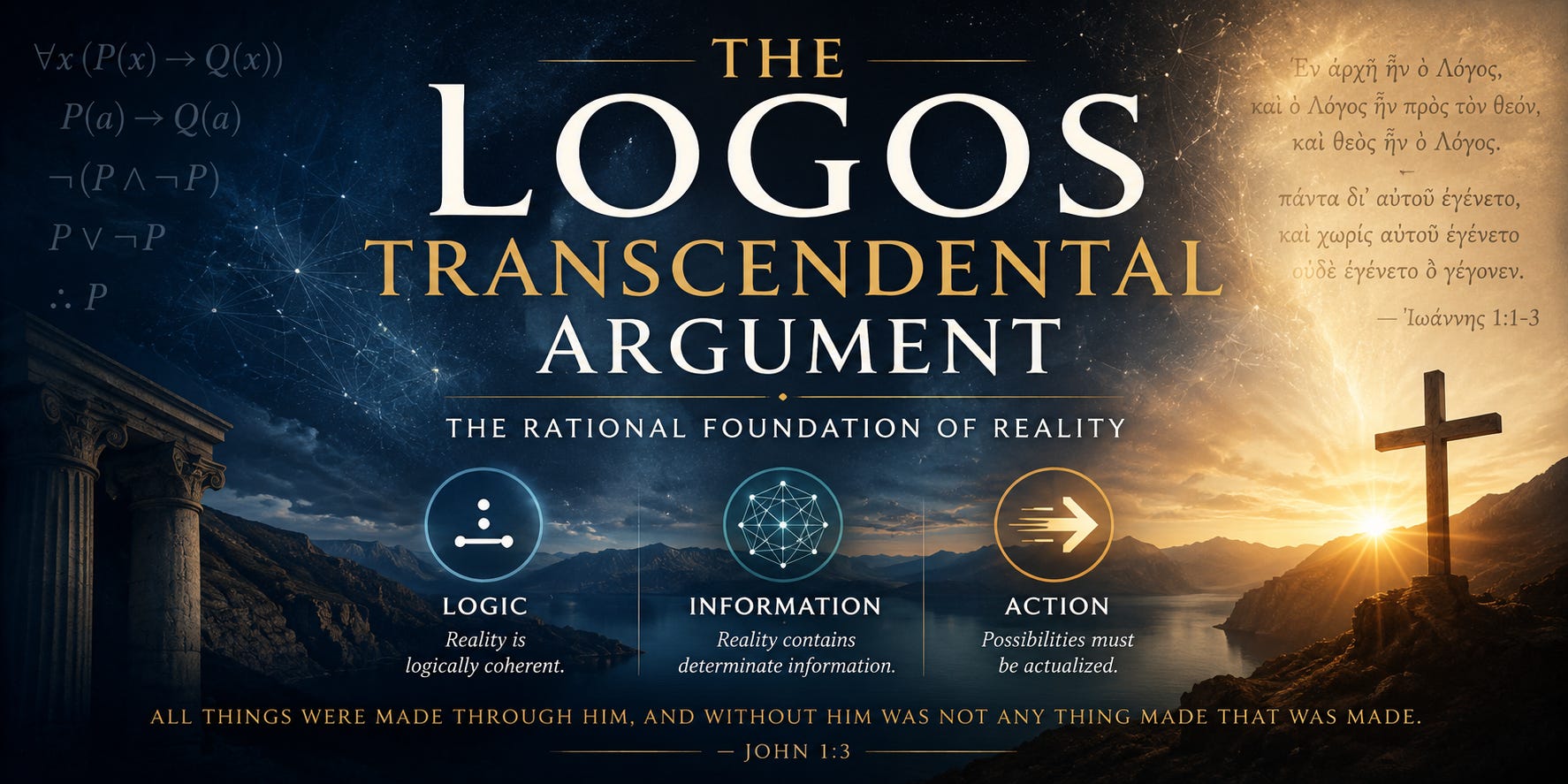
A transcendental argument does not begin by asking what exists. It asks what must already be true for rational thought, science, mathematics, morality, and communication to be possible at all.
Three features appear unavoidable.
First, reality must be logically coherent. Identity, non-contradiction, and rational inference cannot be optional conventions. If contradictions can be true in the same respect at the same time, meaningful thought and being immediately dissolves.
Second, reality must contain determinate information. Knowledge requires distinguishable states. Mathematics, language, physical law, and scientific models all presuppose that information is objectively representable rather than merely invented by observers.
Third, possibilities must become actual. A universe containing only logical possibilities never becomes the universe we inhabit. Something must actualize one coherent state from among the many that are logically conceivable.
These three primitives may be summarized as Logic, Information, and Action.
None reduces to the others. Logic cannot generate information. Information cannot actualize itself. Action without logical constraint produces no intelligible order.
Together they form a minimally complete description of the preconditions for reality.
The Christian claim is that these are not independent eternal principles. They are grounded in the eternal Logos.
John begins his Gospel with remarkable precision: “In the beginning was the Word, and the Word was with God, and the Word was God.” (John 1:1, ESV). He later writes that “all things were made through him” (John 1:3, ESV).
This is a profound metaphysical claim. Logical coherence exists because the Logos is inherently rational. Information exists because the Logos eternally knows. Action exists because the Logos creates, sustains, and governs.
The universe is therefore intelligible because it reflects the character of its Creator.
This perspective also explains why science succeeds. Scientists assume that nature is ordered, that mathematical descriptions correspond to reality, that observations communicate genuine information, and that causal relations remain consistent. These assumptions arise naturally if reality is the expression of an eternal rational mind.
The Logos Transcendental Argument proceeds in four steps:
1. Rational inquiry presupposes logic, information, and actualization.
2. These realities require an ultimate ontological ground.
3. An impersonal universe cannot explain why they possess objective, universal, and necessary character.
4. The eternal Logos uniquely grounds all three because they are expressions of His nature rather than realities external to Him.
The argument is not that Christianity merely accommodates reason. It is that reason itself is only possible because reality is grounded in the Logos.
If that is true, then every act of reasoning, every scientific discovery, every mathematical proof, and every search for truth already depends upon the One through whom all things were made.
The Christian does not begin with an arbitrary appeal to God. He begins with the undeniable reality that rational thought is possible and asks what must be true for that fact to exist. The answer is that logic, information, and action are grounded in the eternal Logos, who is both the source of reality and the precondition of every intelligible inquiry.