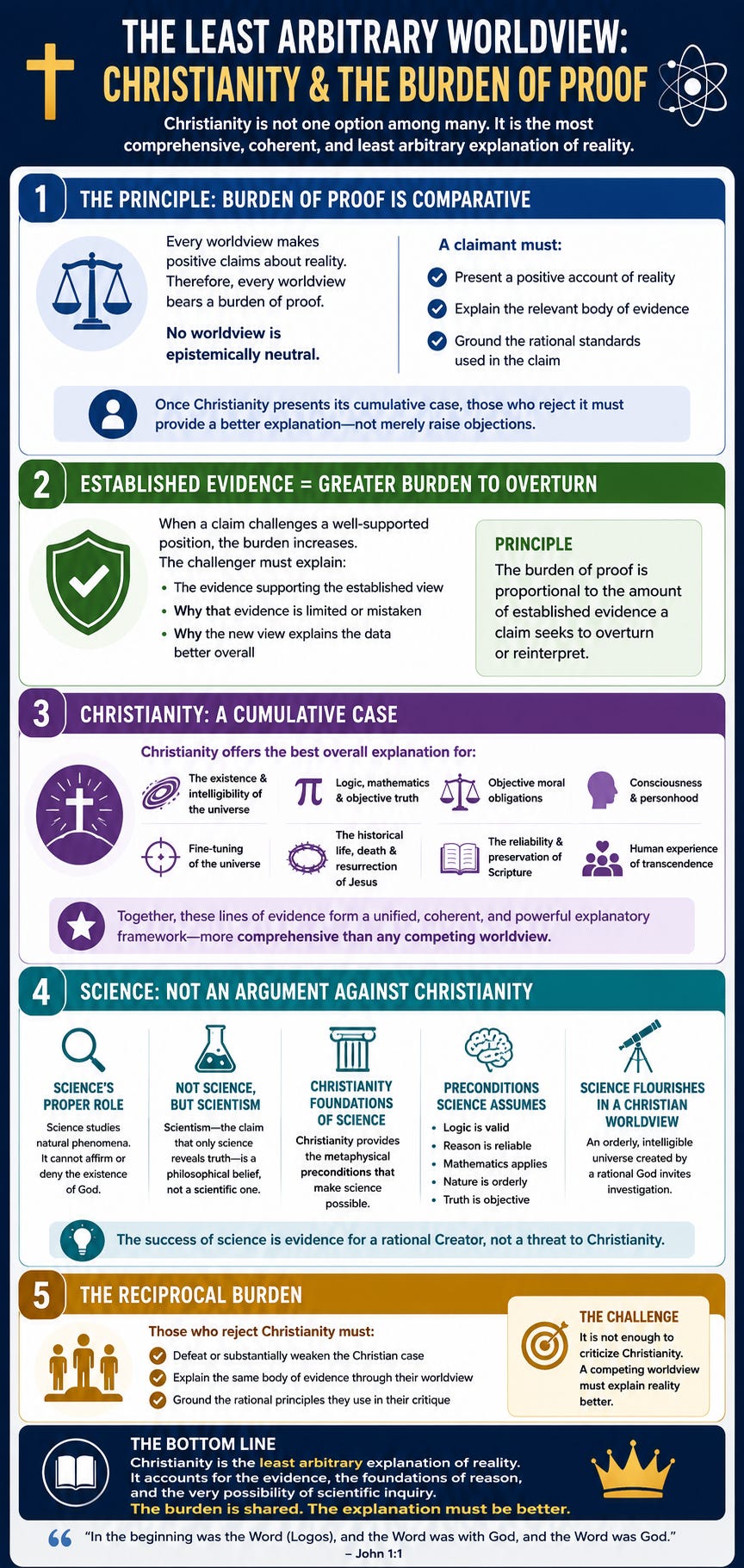
Modern Christian apologetics often assumes a defensive posture, treating Christianity as though it alone bears the burden of proof while competing worldviews occupy an epistemically neutral position. This paper argues that every worldview is a positive explanatory claim and therefore bears a corresponding burden of justification. Christianity should be evaluated as a cumulative explanatory framework whose evidential force arises from the convergence of historical, philosophical, metaphysical, moral, and experiential evidence. Science, properly understood, neither establishes nor refutes Christianity because its jurisdiction is limited to natural phenomena. Rather than competing with science, Christianity provides the metaphysical preconditions that make the scientific enterprise intelligible.
1. The Burden of Proof
Every positive claim incurs a burden of justification. The burden belongs to the claimant, not because a claim is novel or traditional, but because it asserts something about reality. Established positions possess evidential inertia because they have accumulated explanatory successes. A challenger therefore assumes the additional burden of explaining both new evidence and the body of evidence already explained by the incumbent framework.
2. Christianity as a Cumulative Case
Christianity is not defended by a single argument but by the convergence of many independent lines of evidence: the intelligibility of the universe, objective logic, morality, consciousness, contingency, fine tuning, the historical life, death and resurrection of Jesus Christ, the coherence of Scripture, and the enduring witness of the Church. The proper question is not whether one argument succeeds in isolation, but which worldview best explains the total evidence.
3. The Myth of Neutrality
No worldview is epistemically neutral. Naturalism, materialism, atheism, pantheism and Christianity each begin with foundational commitments. Consequently, none may assume the role of an impartial judge. Every worldview must justify its own foundations before critiquing another.
4. The Proper Jurisdiction of Science
Science is the disciplined investigation of natural phenomena. Its methodological success derives from restricting itself to observable features of the natural world. Because of those self-imposed limits, science possesses no authority to affirm or deny metaphysical propositions such as the existence of God. Assertions that God does not exist are philosophical conclusions, not scientific discoveries. Scientism, the belief that science is the only avenue to knowledge, is likewise a philosophical claim rather than a scientific result.
5. Christianity as the Foundation of Science
The remarkable success of science itself requires explanation. Scientific inquiry presupposes the validity of logic, the reliability of reason, the applicability of mathematics, the orderliness of nature, causal regularity, and the obligation to seek truth. None of these can be demonstrated by the scientific method because each is presupposed before scientific investigation begins. Christianity grounds these realities in the eternal Logos. A rational Creator explains an orderly creation, lawful regularity, and rational creatures capable of discovering truth. Science therefore finds its most coherent philosophical home within the Christian worldview.
6. Comparative Worldview Evaluation
The apologetic task is not merely to answer objections but to compare explanatory frameworks. Every competing worldview must be evaluated by explanatory scope, explanatory power, coherence, historical adequacy, correspondence with reality, and its ability to account for the preconditions of rational inquiry.
7. The Reciprocal Burden
Once Christianity has presented its cumulative case, critics inherit a reciprocal burden. They must explain the same evidence at least as well while also grounding the logic, morality, rationality and scientific assumptions employed in their critique. Merely identifying unanswered questions does not establish a superior worldview.
8. A Logos-Centered Apologetic
The Christian claim extends beyond isolated evidences. The eternal Logos is presented as the ground of logic, information, rationality, morality, and the intelligibility of creation itself. Rejecting Christianity therefore requires an alternative account of the very conditions that make reasoning and science possible.
Conclusion
Christianity should not be defended before an allegedly neutral tribunal called science. Science is one discipline within reality and depends upon philosophical assumptions it cannot justify. Christianity offers a unified explanation for the existence of the universe, the intelligibility of reality, the foundations of reason, the objectivity of morality, the historical person of Jesus Christ, and the conditions that make science possible. Every competing worldview bears an equal burden: it must explain reality, explain why science works, and explain why rational inquiry is possible at all. Until a more coherent and less arbitrary account is provided, Christianity remains a comprehensive and philosophically robust explanation of reality.