

We know how to detect minds.
Not from philosophy textbooks. From practice. Archaeologists do it when they pick up a flint. SETI researchers do it when they scan incoming signals. Forensic investigators do it when they read a crime scene. The criteria aren’t exotic. They’re the same ones we reach for every time we need to distinguish an artifact from a natural formation.
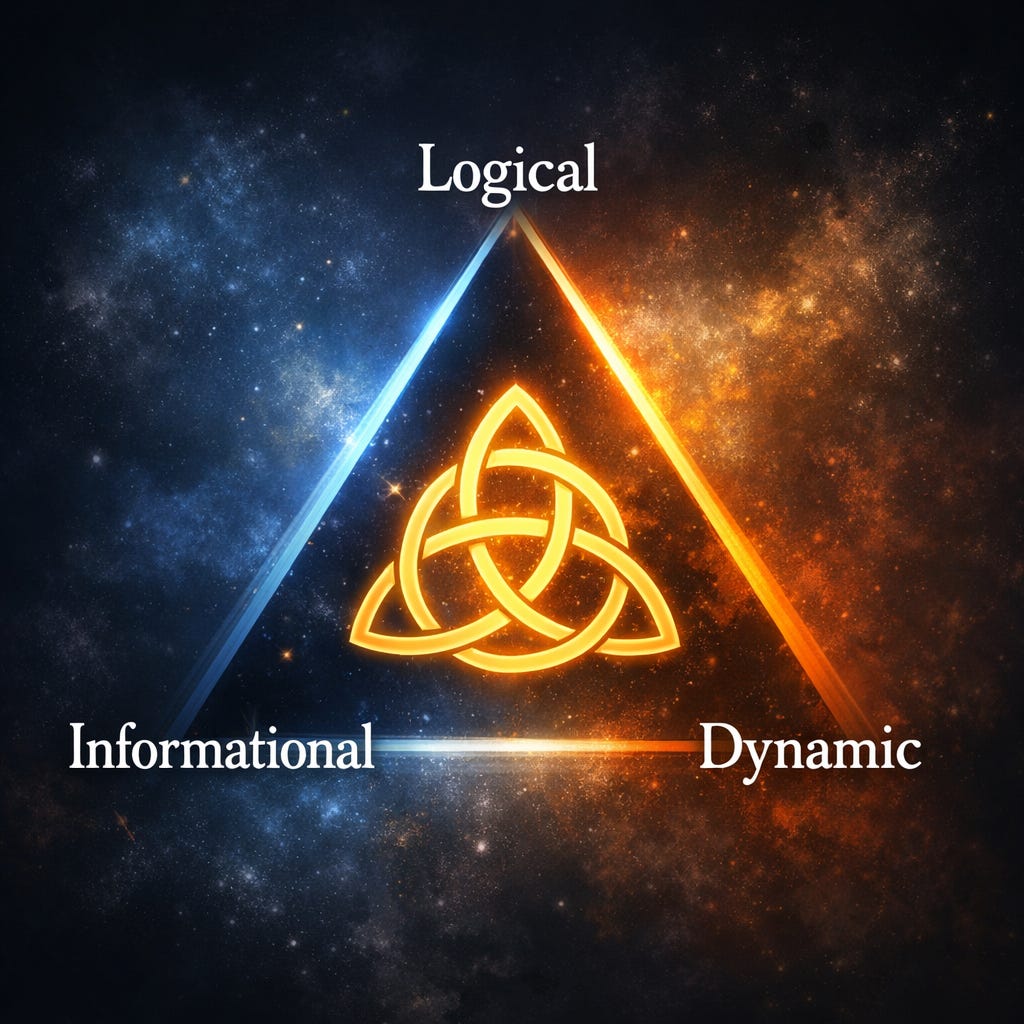
Three features, appearing together, do the work:
Deep logical structure: internally consistent, mathematically expressible order.
Specified information: the arrangement carries functional meaning, not just complexity.
Dynamic organization toward outcomes: the system is arranged to produce and sustain states that matter.
Call this the Irreducible 3. Any two without the third fails. A crystal has logical structure but no specified information. Random noise can be complex but isn’t organized. A tornado is dynamic but not directed. The complete triad is what reliably triggers the inference to mind.
Here’s the argument in explicit form:
Premise 1 (Empirical practice). In our uniform experience, whenever we encounter a system that is (a) deeply logical in structure, (b) rich in specified information, and (c) dynamically organized toward outcomes, we rationally ascribe it to personal or agent-based sources (for example, in SETI, archaeology, art, and forensics).
Premise 2 (Principle of parity). We ought to apply the same criteria of inference consistently: like effects call for like kinds of causes, unless there is a strong reason to treat a case as exceptional.
Premise 3 (Cosmic triad). The universe as a whole exhibits that same triad: (a) pervasive, mathematically expressible order; (b) vast amounts of specified, functional information (in physical laws and life); and (c) a dynamic history that produces and sustains complex, goal-conducive structures (such as stable stars, chemistry, and living systems).
Premise 4 (Best explanation). Given Premises 1 through 3, the best explanation for the universe’s displaying this triad is that its ultimate source is likewise personal or mind-like, rather than wholly impersonal.
Conclusion. Therefore, it is reasonable to infer that the ultimate source or ground of the universe is personal (a primordial Mind or Person, i.e., God), not an impersonal brute fact.
The presence of the triad in physical reality is not in dispute. The universe is logical, informational, and dynamic: these are observations, not interpretations. What remains open to challenge is the inference: whether a personal source is the best explanation for a reality that exhibits all three. An objector must take on that explanatory question directly, not simply assert that cosmic design inferences are different in kind from the practical ones we make every day.
The practical cases are worth sitting with, because the argument lives or dies on them.
SETI researchers don’t look for loud signals. They look for signals that encode mathematical relationships in ways that serve a communicative function. The Wow! signal got attention because it looked purposive. Had it repeated with variations encoding a message, the inference to intelligence would have been locked in. All three criteria met.
Archaeologists distinguish a hand-axe from a frost-cracked rock by looking for the same pattern: consistent flaking angles (structure), a shape suited to a function (specified information), evidence of secondary working to refine the edge (goal-directed production). Find all three, and you’ve found an artifact. This isn’t interpretation; it’s the methodology.
Forensic investigators do the same. A suspicious death is suspicious because the evidence shows structure, encodes the sequence of events, and points to actions taken to achieve a result. The inference is defeasible (new evidence can overturn it), but it’s reliable enough that we stake lives and reputations on it.
In every case, the criterion isn’t complexity alone. It’s the complete triad.
Now consider the universe.
Structure. The laws of physics are mathematically expressible with extraordinary precision. The fine-structure constant, the mass ratios of fundamental particles, the cosmological constant: these aren’t arbitrary. They form a coherent system. Change the values and the physics collapses.
Specified information. The initial conditions of the universe, combined with those laws, carve out a vanishingly narrow range of outcomes that permit complex chemistry and life. The information isn’t just vast; it’s functional. The universe doesn’t merely exist: it does something with what it has.
Dynamic organization toward outcomes. The cosmic story unfolds in a direction: stable stars, heavy elements, planetary chemistry, and on at least one planet, self-replicating molecular systems that explore possibility space and generate increasing complexity. Whether or not that’s deterministic, it has a shape.
The triad is complete.
The objections are predictable, and worth taking seriously.
“The scale is different.” True. The universe is vastly larger than any artifact we’ve examined. But the argument doesn’t depend on size. It depends on the presence of the triad. A larger system exhibiting the same pattern calls for the same kind of explanation.
“We have prior experience of human designers. We have none for cosmic ones.” This mislocates the issue. We’re not claiming independent prior evidence of a cosmic designer. We’re noting that the same evidential pattern that justifies design inferences in other contexts is present here. The question is whether the triad is good evidence for mind when we find it in a signal, and the same question applies when we find it in physics. If there’s a relevant difference, the objector needs to identify it.
“Natural selection explains biological complexity.” Yes, given certain preconditions: replication, variation, selection. But that’s precisely what the argument is asking about. Natural selection presupposes physics that permits it. We’re asking about the ground of that physics, not its operation.
“Maybe there are infinitely many universes, and we happen to be in one that permits observers.” The multiverse doesn’t dissolve the question; it relocates it. Now we need to explain why there’s a multiverse-generating mechanism with the right properties to produce life-permitting universes at all. The triad reappears at the level of the mechanism. And notice what’s happening: the multiverse is itself a postulated entity to explain the appearance of design. Theism and the multiverse are competing explanations for the same data, not asymmetrically positioned.
“We should be epistemically humble about cosmic-scale inferences.” Agreed. The conclusion is that it’s reasonable to infer a personal source, not that certainty has been achieved. But epistemic humility cuts both ways: confident assertions that the universe “just is” also exceed our warrant.
One precision point worth acknowledging: the three features aren’t equally uncontested. Structure and specified information have clean analogues in designed artifacts. The third criterion (dynamic organization toward outcomes) is the one a careful naturalist will push on hardest. They’ll say that “toward outcomes” is observer-projection: stars aren’t tryingto burn, carbon isn’t trying to bond. Thermodynamics and chemistry do the work without any reference to purposes.
That’s a fair challenge, and it requires a distinction. The empirical premise isn’t that the universe has intentions. It’s that the universe exhibits functional arrangement producing and sustaining outcome-conducive states in ways that, in every other context where we encounter them, reliably indicate agency. The inference from that arrangement to a personal source is what the argument claims is warranted, and the naturalist needs to say why the cosmic case is the exception.
What does the argument actually establish?
Not the Trinity. Not the Incarnation. Not the authority of Scripture. Something more modest: that the best explanation for the universe exhibiting the Irreducible 3 is a personal source rather than an impersonal one.
That’s not nothing. If the ultimate reality is personal, then revelation becomes possible. If it’s impersonal, there’s no one to reveal anything. The argument opens a door; it doesn’t furnish the room.
But an open door is what we need first. The rest of the case can follow.
Soli Deo Gloria