

Critics of young-earth cosmology have a habit of demanding a finished product. Point to a relativistic time-dilation framework built to address distant starlight, and the response is often not “here is where the metric breaks down” but “this isn’t a complete theory, so it doesn’t count.” That is a fair objection to a finished model. It is a much weaker objection to a model in progress, and it quietly assumes something that isn’t true: that other origins frameworks get to keep their unfinished business while this one doesn’t.
Two verses set the terms honestly. “The secret things belong to the Lord our God, but the things revealed belong to us and to our children forever” (Deuteronomy 29:29, ESV) is a boundary on curiosity. “Test everything; hold fast what is good” (1 Thessalonians 5:21, ESV) is a mandate for rigor. Held together, they rule out two failure modes at once: dogmatic overreach dressed up as settled science, and lazy appeals to mystery that dodge the data. The question worth asking is whether both sides of the origins debate actually live by both verses, or only invoke the one that’s convenient.
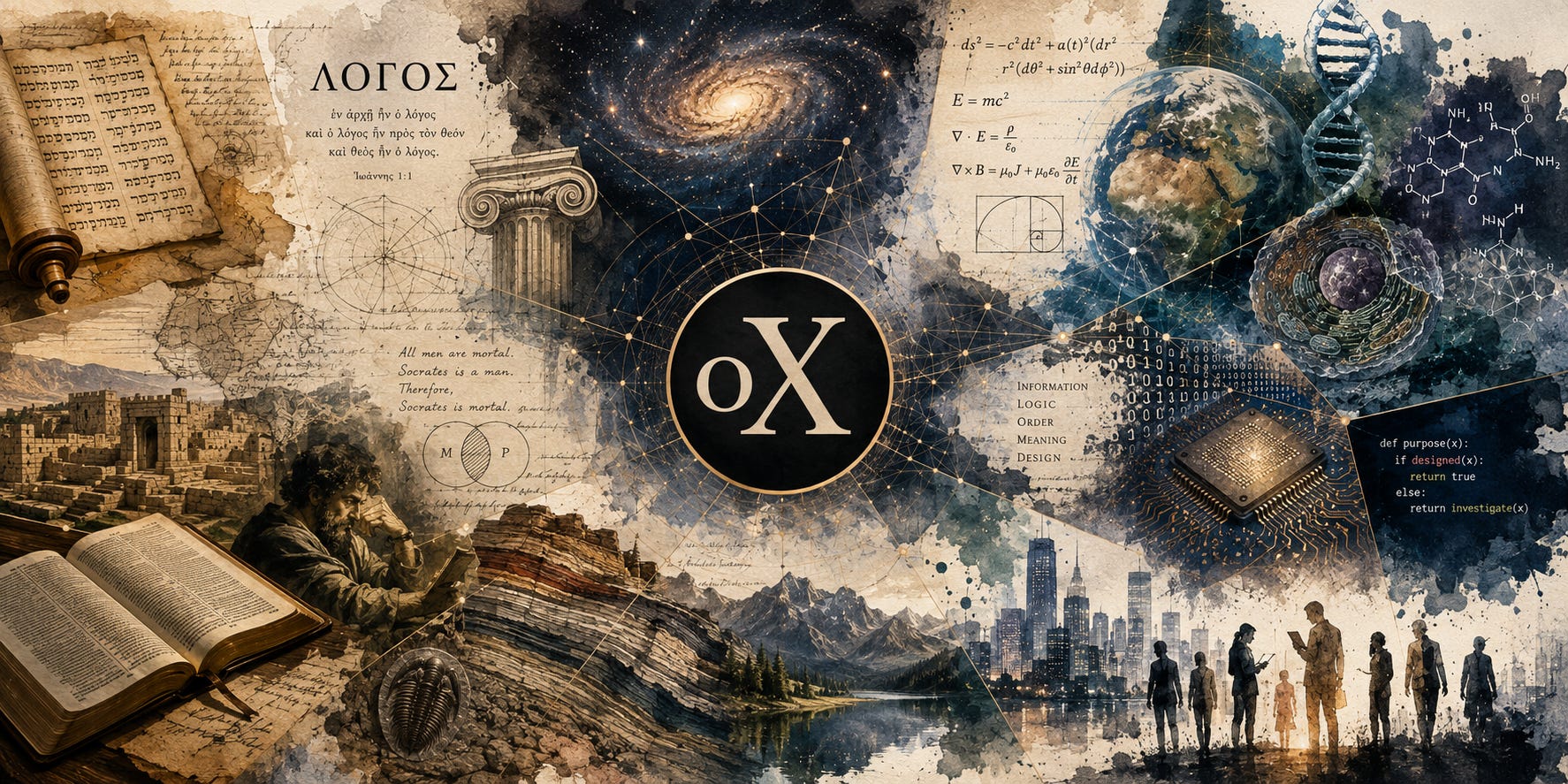
Start with the parity claim naturalism usually gets accused of, since it is stated too loosely to survive contact. Abiogenesis, dark matter and dark energy, and fine-tuning get lumped together as though they were the same kind of debt. They aren’t.
Abiogenesis is a missing mechanism. Nobody has an observed, testable pathway from non-living chemistry to a self-replicating cell. That absence is the gap itself.
Dark matter and dark energy sit in a different category. They are inferred from multiple independent lines of evidence, galaxy rotation curves, gravitational lensing, the structure of the cosmic microwave background, even without a detected particle or a settled account of what dark energy actually is. Planck’s 2018 measurements put the universe at roughly 5 percent ordinary matter, 27 percent dark matter, and 68 percent dark energy. That is a real gap, but it is an evidenced gap, built on converging observations rather than a bare placeholder.
Fine-tuning is a third category again. It isn’t a missing mechanism or an unexplained detection. It’s an interpretive dispute over what the precision of the physical constants means, and reasonable people read the same numbers toward design, toward a multiverse, or toward “we don’t yet know why these values and not others.”
Three different kinds of “we don’t know yet,” not one undifferentiated credit line. Sorted correctly, the comparison gets stronger rather than weaker, because a young-earth cosmology has an analogue in each category too: a missing mechanism here, an evidenced-but-unexplained pattern there, an interpretive dispute over what the data mean somewhere else. None of those analogues gets treated as automatically disqualifying when the framework doing the guessing is naturalism.
• • •
Here is the asymmetry worth admitting instead of smoothing over. A naturalistic gap is, in principle, closeable by observation. Someone could find the abiogenesis pathway. Someone could detect the dark matter particle. The gap is a research program with a possible end.
Deuteronomy 29:29 draws a boundary that doesn’t dissolve with better instruments. It treats some of what happened at creation as secret by design, a limit set by the nature of the thing being described, not a gap waiting on more research funding. That is a real theological commitment, and a different kind of commitment than “we haven’t built the detector yet.” Treating the two as interchangeable, as though every worldview just has brute facts so everybody’s even, invites the obvious reply: one side’s mystery is a research program, the other’s is a doctrine. Better to say what’s actually true. Both frameworks require commitments beyond the available evidence, and those commitments aren’t the same shape. That difference deserves stating plainly rather than smoothing over for the sake of a clean parity argument.
• • •
None of this means a young-earth cosmology gets to claim more than it has earned either. Differential proper time is philosophically coherent. It breaks the naive assumption that every clock in the universe ran at the same rate. It is not a finished, peer-reviewed account of the universe’s whole history, and I made that argument in more detail in Ordinary Days, Extraordinary Creation: distant starlight is a serious modeling problem, not a logical disproof of a young earth. That claim still stands, and I won’t re-litigate it here.
What’s worth adding is where the credit-card analogy actually cashes out. Naturalism borrows against an open-ended future: given enough time and enough unobserved intermediate steps, the gaps close. That’s a defensible bet, and it also functions as faith in the solvent power of deep time itself, a faith that deserves to be named as such rather than treated as the default, mystery-free position every other framework gets graded against. A creation model borrows against the character and competence of the one doing the creating. Neither loan gets called in by any data anyone currently has.
• • •
Hold both verses at once and the standard becomes consistent instead of lopsided. 1 Thessalonians 5:21 keeps the physics honest: test the model, refine it, don’t wave anomalies away. Deuteronomy 29:29 keeps the humility honest: some of what happened at the origin of the universe was never going to be fully reconstructed by instruments built after the fact, on either side of this debate.
Every origins account ends somewhere past the reach of the evidence. An uncaused quantum fluctuation. An infinite multiverse nobody can observe. Or a spoken word from a sovereign God who stepped into the dark and said, “Let there be light.” The question was never whether an origins model has a mystery at the bottom of it. It’s whether you’re honest about which mystery you’ve chosen, and why.
Very good, I like this JD