

Recent years have seen renewed interest in what has become known as “Divine Council Theology,” particularly through the work of Michael Heiser and others. This movement has reminded many Christians that Scripture presents a genuinely supernatural worldview populated by angels, rebellious spiritual beings, and a heavenly court. In this respect, it serves as a healthy corrective to the practical naturalism that has often characterized modern Western Christianity.
The question is not whether a divine council exists. Scripture plainly depicts one.
The deeper question is where the divine council belongs within the biblical narrative.
The divine council is best understood as part of the backdrop of biblical history, not the controlling theme of redemptive history. The controlling theme is the enthronement of Jesus Christ.
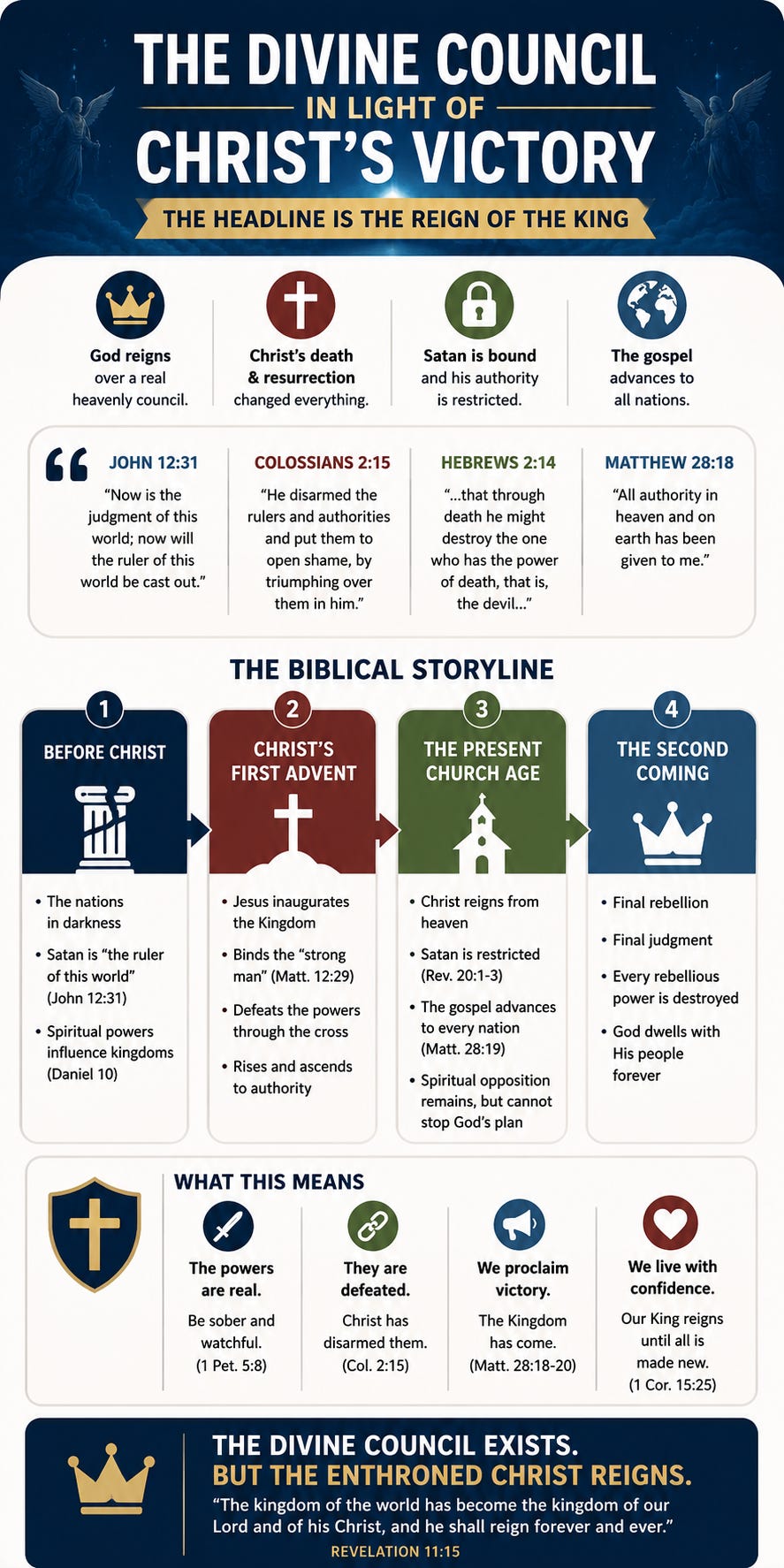
The Reality of the Divine Council
The Old Testament consistently portrays God surrounded by His heavenly host.
Job opens with “the sons of God” presenting themselves before the LORD (Job 1:6). Micaiah sees “the LORD sitting on his throne, and all the host of heaven standing beside him” (1 Kings 22:19). Daniel sees the heavenly court seated before the Ancient of Days (Daniel 7:9–10). Psalm 82 pictures God standing in the midst of a divine assembly to pronounce judgment.
These passages should not be dismissed or allegorized away. God created an ordered heavenly realm populated by personal spiritual beings who serve His sovereign purposes. Some remained faithful. Others rebelled.
The New Testament continues this picture through its references to angels, principalities, powers, rulers, authorities, and dominions.
The supernatural worldview is not optional Christianity. It is biblical Christianity.
The Cross Changed Everything
Where some modern presentations require qualification is in the amount of emphasis placed upon the continuing authority of these spiritual powers.
The New Testament consistently presents the crucifixion, resurrection, and ascension as the decisive turning point in cosmic history.
Jesus declared:
“Now is the judgment of this world; now will the ruler of this world be cast out.”
— John 12:31, ESV
Paul writes:
“He disarmed the rulers and authorities and put them to open shame, by triumphing over them in him.”
— Colossians 2:15, ESV
The author of Hebrews explains that Christ came
“…that through death he might destroy the one who has the power of death, that is, the devil.”
— Hebrews 2:14, ESV
Finally, the risen Christ announces:
“All authority in heaven and on earth has been given to me.”
— Matthew 28:18, ESV
These are not merely promises concerning the future. They describe a present reality inaugurated through Christ’s victory.
The New Testament never portrays the powers as equal rivals competing with Christ. It portrays defeated enemies awaiting final judgment.
Their authority is not abolished in activity, but revoked in right.
The Binding of the Adversary
Revelation 20 provides an important interpretive key.
Satan is bound so that he might no longer deceive the nations. This binding is best understood functionally rather than absolutely, and as coinciding with Christ’s first coming and the gospel’s global advance.
Scripture still warns believers that Satan prowls like a roaring lion (1 Peter 5:8). Spiritual warfare remains real (Ephesians 6:10–18). Demonic opposition continues.
Yet something fundamental has changed.
Before Christ, the nations largely remained in darkness. After Christ, the gospel advances into every nation.
The Great Commission itself demonstrates that Satan’s former authority over the nations has been judicially broken. The Church does not invade enemy territory hoping for victory. It proclaims the victory already won by its King.
The Nations and the Powers
Texts such as Psalm 82 and Deuteronomy 32 deserve direct attention because they stand near the center of divine council discussions.
Those passages indicate that the nations were, in some sense, given over to lesser heavenly powers and that those powers themselves stood under God’s judgment. Yet the New Testament presents Christ as the one through whom that fractured order is being overturned.
The story of Scripture is not the long-term management of the nations by lesser powers, but the reclamation of the nations by the Son.
That is why the mission of the Church is so central in the present age. The ingathering of disciples from every tribe, language, people, and nation is not incidental to Christ’s reign; it is one of its clearest public demonstrations.
The Divine Council Under the Reign of Christ
This perspective places the divine council within its proper theological context.
The council exists. Created spiritual beings remain active. Rebellious powers continue to oppose God’s people.
Yet all of these realities now exist beneath the universal reign of the ascended Christ.
The emphasis therefore shifts from the authority of the powers to the supremacy of the King.
Paul consistently writes this way. Christ is
“…far above all rule and authority and power and dominion…”
— Ephesians 1:21, ESV
Every throne, dominion, ruler, and authority exists beneath His sovereign lordship.
The council has not disappeared. Its significance has changed.
The Biblical Storyline
The biblical storyline can be summarized in four movements.
Before Christ
The nations lie largely in darkness. Hostile spiritual powers exercise significant influence over the kingdoms of the earth.
Christ’s First Advent
Jesus inaugurates the Kingdom of God, binds the strong man, defeats the powers through the cross, rises from the dead, and ascends to universal authority.
The Present Church Age
The Church advances into every nation under the authority of the risen Christ. Spiritual opposition remains real but operates under severe judicial restraint. The powers cannot prevent the ingathering of God’s elect from every tribe, language, people, and nation.
The Second Coming
Christ returns to judge the living and the dead. Every rebellious power is finally destroyed. God dwells with His redeemed creation forever.
This storyline places the divine council where the apostles place it: within the broader drama of Christ’s kingdom.
Christ Is the Center
The greatest strength of the Divine Council movement is its recovery of Scripture’s supernatural worldview.
Its greatest weakness appears when the unseen realm becomes the interpretive center of biblical theology.
The apostles consistently make Christ the center.
Their message is never, “Understand the hierarchy of spiritual powers.” Their message is: “The crucified and risen Christ now reigns.” Everything else is interpreted through that reality.
The divine council belongs within the biblical worldview. The enthroned Christ belongs at the center of it.
The Church therefore need not fear the principalities and powers. They are real. They are active. They are dangerous.
They are also defeated.
The headline of redemptive history is not the activity of the heavenly council. The headline is the reign of the King.
“The kingdom of the world has become the kingdom of our Lord and of his Christ, and he shall reign forever and ever.”
— Revelation 11:15, ESV