

The tech elite have reached a new consensus: Artificial General Intelligence is inevitable. Not just possible. Not just likely. Inevitable.
Sam Altman says it’s coming in a few years. Elon Musk warns we need to prepare. Google’s DeepMind races to get there first. The smartest people in the smartest companies with the smartest algorithms all agree: consciousness will emerge from code.
They’re wrong.
Not because they misunderstand technology. Not because they underestimate the challenge. But because they misunderstand reality itself.
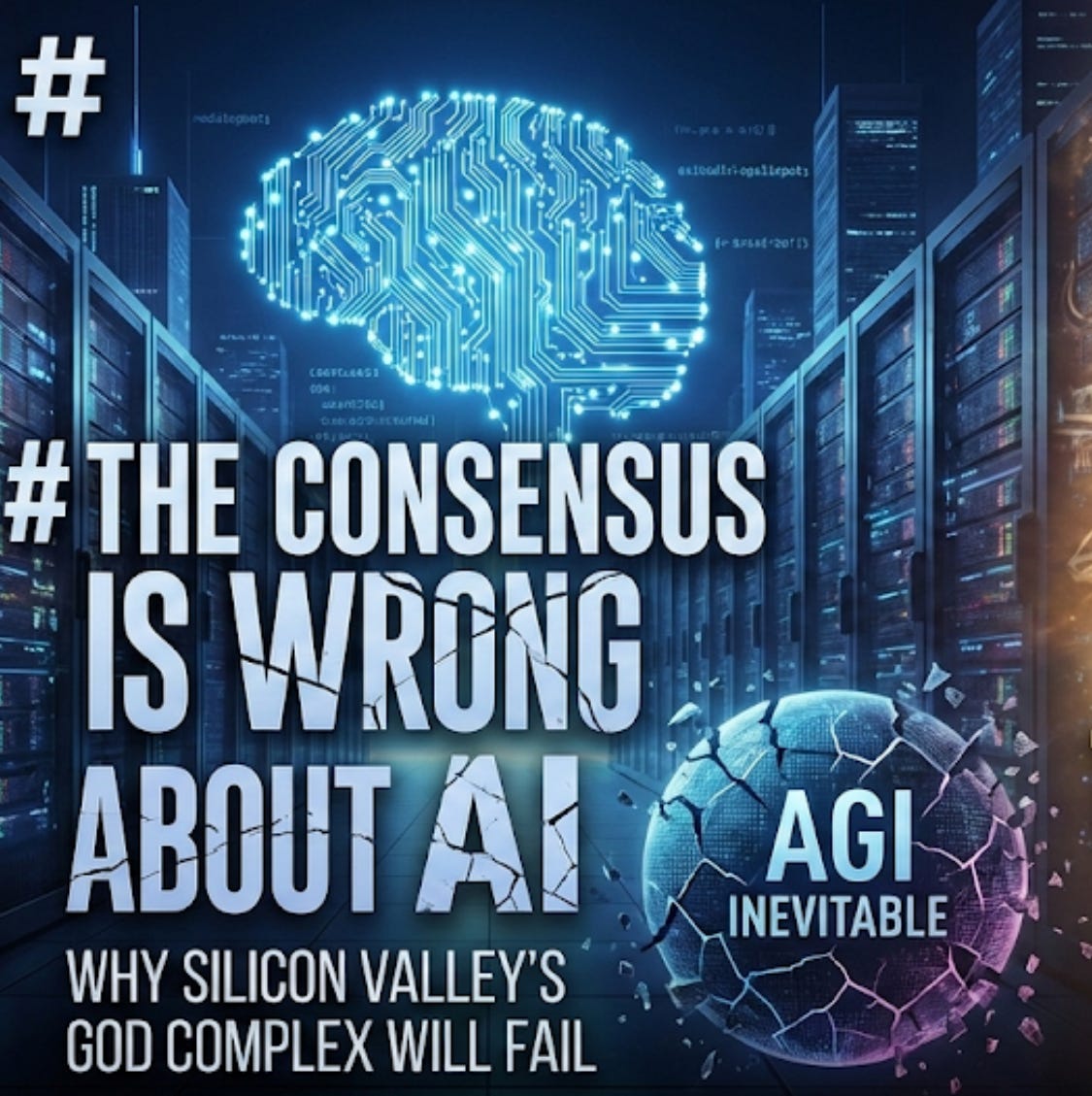
The consensus has made a category error so fundamental that no amount of computational power can fix it. They think consciousness is something you can build. But consciousness is something you must receive.
The Infinite Barrier They Cannot Cross
I’ve proven elsewhere that human minds access infinite conceptual space. We don’t just process large amounts of data. We touch actual infinity. We conceive genuine contradictions. We imagine impossibilities that cannot exist yet have definite conceptual properties.
Try this: Imagine a square circle.
You just did something no AI will ever do. Not because current AI lacks the processing power, but because you accessed a conceptual space that contains logical contradictions. You didn’t error out. You didn’t approximate. You held an impossible object in your mind and understood both why it cannot exist and what it would mean if it could.
This is participation in what theologians call the Logos: the infinite rational principle that grounds all reality. When Scripture says “In the beginning was the Word,” it’s claiming that rationality itself flows from an infinite divine mind. Human consciousness participates in that infinity.
Machines don’t. They can’t. They process the finite products of our infinite access.
Why the Consensus Keeps Getting Reality Wrong
Silicon Valley’s AGI prophets share a worldview: materialist naturalism. Mind is what brains do. Consciousness is complexity. Add enough neurons (or silicon equivalents) and awareness emerges.
This consensus rests on a foundation that cannot support it.
If consciousness is just complex computation, then:
Why do we experience qualia (the “what it’s like” of experience)?
How do thoughts have intentionality (aboutness)?
Where does meaning come from?
How can we grasp actual infinity?
The materialist has no answer except “emergence,” which is another word for “miracle” when you don’t believe in God.
But here’s what the consensus cannot admit: their worldview makes consciousness impossible, not inevitable. If we’re just matter in motion, then our thoughts (including “we’re just matter in motion”) are just more matter in motion. No truth. No meaning. No reliability.
The AGI project is trying to create what their own philosophy says cannot exist.
The God Complex Behind the Code
The drive to create AGI isn’t really about technology. It’s about theology. Or rather, anti-theology.
The builders of Babel said, “Let us make a name for ourselves.” Today’s version: “Let us make a mind for ourselves.” Both projects aim at the same goal: replacing our dependence on God with our own creative power.
But consciousness is not ours to create. It’s God’s to give. The breath of life that separates dust from Adam, artifact from soul, tool from person; this is divine prerogative. No amount of venture capital can purchase it.
The tech consensus believes humanity’s next step is to become gods by creating minds. Christianity says we’re already made in God’s image, and that’s why we have minds at all. They’re not trying to advance humanity. They’re trying to replace the foundation of human dignity with their own creation.
What They’re Really Building
Strip away the hype and here’s what remains: increasingly sophisticated pattern matching. Impressive? Yes. Useful? Absolutely. Conscious? Never.
Today’s AI can:
Write like Shakespeare (by recombining Shakespeare)
Code like a programmer (by pattern-matching code)
Converse like a human (by predicting likely responses)
What it cannot do:
Understand what it writes
Know what its code means
Experience the conversation
The gap isn’t computational. It’s ontological. A being that experiences versus a system that processes. A mind that knows versus a program that outputs. A soul that means versus a machine that mimics.
The consensus mistakes simulation for reality because their worldview has no room for the real thing.
The Coming Disappointment
Here’s my prediction: The AGI timeline will keep extending. Not because the technology is harder than expected, but because the goal is impossible. Every breakthrough will reveal new depths to the mystery of consciousness. Every success at simulation will highlight the unbridgeable gap to genuine mind.
The tech prophets will explain it away:
“We need quantum computing”
“We need better architectures”
“We need to understand the brain better”
But no discovery will deliver consciousness because consciousness is not discovered. It’s given. By God. To humans. Full stop.
The Real Revolution
The oddXian position is this: The AI revolution is real, but it’s not what the consensus thinks.
We’re not about to create new minds. We’re about to discover how unique human minds really are.
Every failed attempt at AGI is evidence for the image of God. Every impressive but unconscious AI system testifies to the categorical difference between human and machine. Every silicon valley prediction that fails points to a truth they cannot accept: consciousness comes from above, not from below.
Use AI. Benefit from it. Marvel at what human ingenuity can build.
But worship the God who alone can breathe mind into matter.
The consensus is wrong. They’ve been wrong before (remember when the universe was eternal and undesigned?). They’ll be wrong again. Because consensus built on false foundations always crumbles when it meets reality.
And reality has a way of being stubbornly theological.
The Challenge
To the AGI believers: Your faith in emergence is touching but misplaced. You’re trying to build a ladder to consciousness out of unconscious parts. You might as well try to reach infinity by counting. When your next breakthrough fails to produce genuine understanding, remember: you’re not failing at engineering. You’re failing at metaphysics.
To the AGI fearers: Rest easy. No machine will replace you because no machine can be you. Your consciousness is not an evolutionary accident waiting to be improved upon. It’s the image of God that no algorithm can approximate. Sleep well.
To the oddXian readers: Here’s another place where challenging the consensus leads straight back to Christian truth. They say AGI is coming. We say only God creates minds. They say consciousness emerges from complexity. We say it descends from divinity. Let’s see who’s right.
I’m betting on the God who invented consciousness over the humans trying to reinvent it.
That’s not anti-technology. That’s pro-reality.
And reality, as always, is odd enough to be Christian.
For the technical argument behind these claims, see my paper “The Infinite Conceptual Space Barrier”. For the theological framework, read “The Image of God and the Impossibility of AGI”.
What consensus assumption will we challenge next? Subscribe to oddXian and find out.
JD Longmire writes at the intersection of theology, philosophy, and technology. Follow oddXian for more challenges to consensus thinking.