

Origins debates often pretend to be arguments over isolated facts. They are rarely that simple.
A fossil is not interpreted in a vacuum. A galaxy is not interpreted in a vacuum. A radiometric measurement is not interpreted in a vacuum. Every datum enters an interpretive frame already loaded with expectations about what counts as possible, probable, admissible, and surprising.
That means origins reasoning is never prior-free.
The real question is not whether one side has assumptions and the other side has pure evidence. The real question is which set of priors makes better sense of the whole world we actually inhabit: logic, law, mathematics, information, life, consciousness, morality, Scripture, and the intelligibility of nature itself.
From Christian theistic priors, special creation with functional maturity is not an awkward rescue device. It is the expected conclusion.
One clarification before proceeding. The critique developed here is not aimed at methodological naturalism as a research policy. Both frameworks, special creation and metaphysical naturalism alike, can and do employ MN for ordinary operational science. Seeking natural causes, deferring to repeatable processes, and keeping inquiry open are sensible laboratory practices regardless of one’s metaphysical commitments. The target here is the metaphysical extension: the inference that MN’s practical success establishes that reality is exhaustively natural. That inference is a non-sequitur. A research policy that brackets the supernatural for practical purposes cannot, by that bracketing alone, establish that nothing supernatural exists. The debate is not about methodology. It is about what methodology leaves untouched.
1. Special Creation and Functional Maturity
Special creation means the universe is not self-originating. It is not the accidental result of blind matter finding its way into rational order. It is intentionally actualized by God.
Functional maturity means God created the cosmos ready to operate according to its ordained purposes. That distinction matters.
A mature creation is often criticized as though it implies deception. If Adam was created as a man rather than as a zygote, did he have a deceptive “appearance of age”? If trees in Eden bore fruit without years of prior growth, were they false witnesses? No. The issue is category.
Created maturity is not false history. It is divinely instantiated function.
A functionally mature system must be coherent enough to operate. It must contain integrated relations. It must possess the structures necessary for its purpose. A human being must have bones, muscles, memory capacity, language potential, immune function, digestion, cognition, and agency. A tree must have roots, trunk, leaves, fruit, and reproductive capacity. A cosmos must have light, causality, physical law, intelligible order, stable relations, radiogenic heat, geophysical circulation, and conditions for life.
Radiogenic heat belongs in that list. A habitable world is not merely a rock placed at the right distance from a star. It requires internal energy. The decay of radioactive isotopes sustains mantle convection, tectonic cycling, magnetic-field dynamics, crustal renewal, and geochemical circulation. In a functionally mature creation model, that internal heat is not incidental. It belongs to the operational package of a life-supporting world.
So the better phrase is not “appearance of age.” The better phrase is functional maturity. “Appearance of age” suggests misleading evidence of a process history that never occurred. “Functional maturity” says God created a cosmos capable of immediate operation. Its coherence is not a defect. Its coherence is the point.
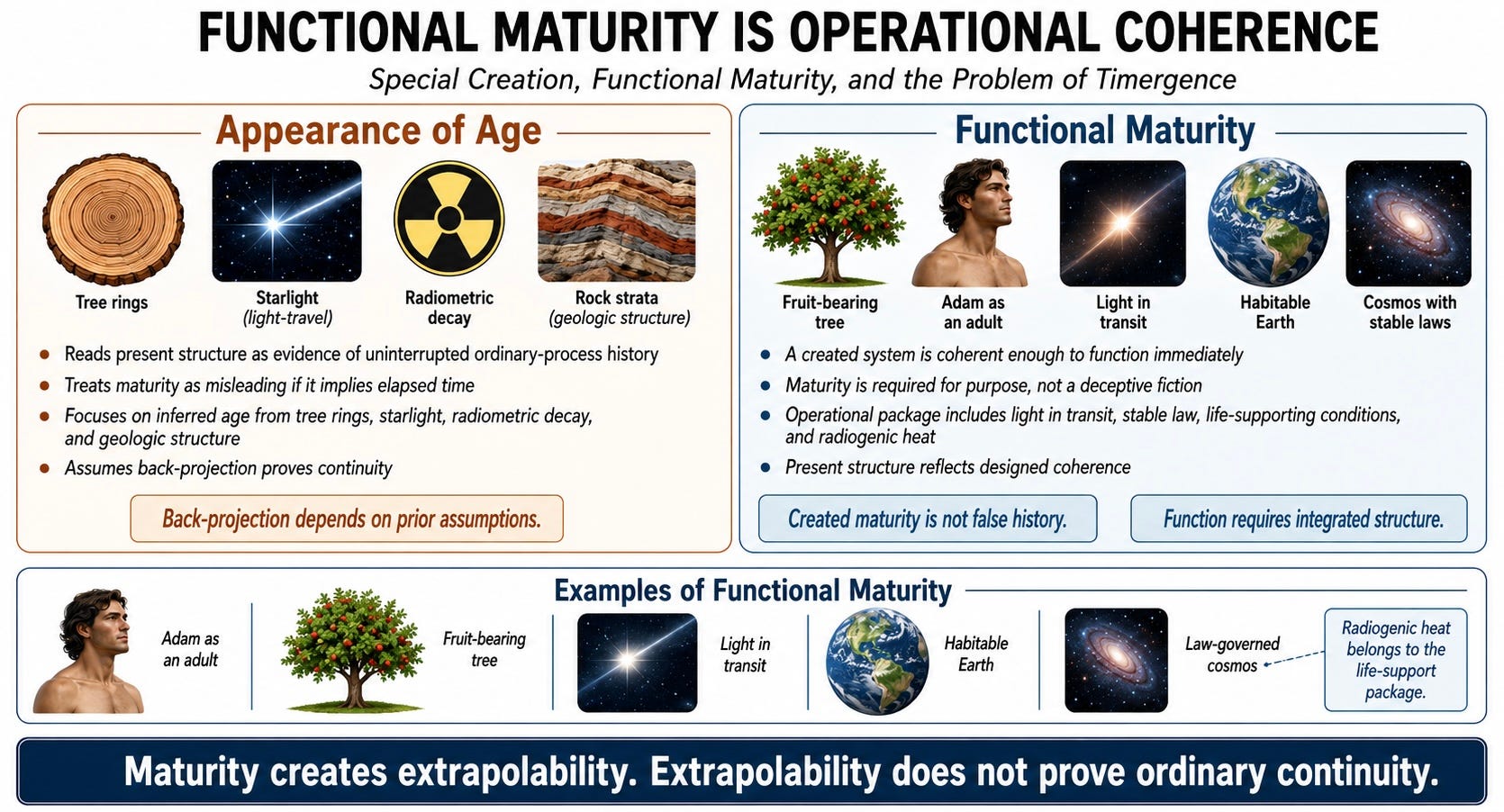
Figure 1. Functional Maturity is Operational Coherence. Conceptual summary illustrating the distinction between “appearance of age” and functional maturity as deployed coherence.
2. Extrapolatable Age Is a Feature, Not a Bug
Once functional maturity is understood, the so-called age problem changes category.
A functionally mature cosmos would naturally include features from which an age could be extrapolated. That is not surprising. It is exactly what operational coherence entails. A deployed system has structure. Structure permits inference. Inference permits back-projection.
Consider a newly deployed software system. It may contain initialized databases, permission structures, version identifiers, configuration states, and operational defaults. An analyst could infer a development history from those structures. Under ordinary assumptions, that inference may be reasonable. But if the system was deliberately configured and deployed as a working whole, then those features do not prove an uninterrupted organic development process. They prove operational coherence.
The same principle applies to a newly built house. On the day it is completed, it has load-bearing walls, cured materials, plumbing, electrical systems, graded soil, installed fixtures, perhaps mature landscaping. Someone could back-project a history from those features. But the house was constructed as a functioning system. Its maturity is necessary for its use.
So with creation. A working cosmos will look like it has a working history because function requires coherent relations.
That does not make ordinary-process inferences irrational. It makes them model-dependent. Under a closed-continuity model, present structure is read as the result of uninterrupted natural processes extending backward indefinitely. Under special creation with functional maturity, present structure is read as the product of immediate divine actualization, followed by ordinary providential operation.
The difference is not “evidence versus faith.” The difference is prior commitments governing interpretation. Maturity creates extrapolability. Extrapolability does not prove ordinary continuity.
A sharper version of the deception objection deserves direct engagement. The worry is not merely that created maturity misleads, but that certain structures, geological strata, radiometric ratios, fossil sequences, appear to record contingent historical events rather than functional necessities. A stratum containing a particular fossil looks like evidence of a specific creature living and dying at a specific time. Is that a functional requirement of a coherent cosmos, or is it something more like an inscribed false record? The distinction matters. The answer is that any coherent, law-governed world instantiated at a moment will contain back-projectable structure, and the depth and specificity of that structure is a function of operational coherence rather than intent to record history. A world with chemistry must have isotopic ratios. A world with geology must have strata. A world with biology must have organism-level complexity. Whether those features appear to imply a prior sequence of events is a function of the interpretive model applied, not of any deceptive intent embedded in the structures themselves. The fossil is not a planted record. It is a feature of a biologically coherent world read through a continuity assumption the framework does not share. That is a category difference, not a cover-up.
3. Normative Laws and the Intelligibility of Reality
The deeper issue is law.
A created cosmos does not merely contain stuff. It operates under law: not only physical law, but logical, mathematical, moral, and rational order. The laws of logic are not merely descriptions of human thought. They are prescriptive constraints on being. A thing cannot be itself and not itself in the same respect. Actuality must be determinate. Contradiction cannot obtain.
Matter does not invent identity. Matter does not create non-contradiction. Matter does not generate the excluded middle. Matter does not produce mathematical necessity. Matter operates within rational order.
This is where Christian theism has explanatory strength. The doctrine of the Logos is not ornamental. It is metaphysical. Reality is intelligible because it is created and sustained by the rational Word of God. “All things were made through him” and “in him all things hold together” are not devotional flourishes. They are claims about the structure of reality.
The universe is intelligible because it is not ultimate. It is derivative, ordered, and Logos-sustained. That grounding is what makes functional maturity expected rather than ad hoc: a Creator who instantiates rational order in himself can instantiate a cosmos ready to operate within that same rational order from the moment of creation.
Naturalism has to use rational order before it can explain anything, but it cannot ground the rational order it uses. It depends on logic, mathematics, causality, induction, and intelligibility, yet treats the universe as if these are somehow brute features of impersonal matter. That is a large promissory note.
A philosophically sophisticated naturalist may resist this by adopting non-theistic Platonism or structural realism: logical and mathematical structures are primitive, abstract features of reality requiring no further grounding. This is a serious position and deserves a direct response. Two problems follow from it. First, abstract structures, on this account, exist as brute necessities with no explanation for why they obtain rather than some other set of structures, or none. The explanatory terminus is simply asserted. Second, and more pressing, the position leaves entirely unexplained why abstract logical and mathematical structures are causally efficacious in a physical world. Why does the physical universe conform to them? Why does matter obey mathematical law? Platonism names the problem without solving it. The Logos doctrine, by contrast, provides a principled answer: rational structure is not an abstract primitive floating alongside physical reality but the creative ground from which physical reality derives. The universe conforms to rational order because it was constituted by and remains sustained within that order. That is not merely another brute posit. It is a unifying explanation with genuine ontological traction.
4. Fine-Tuning and the Compounding Naturalistic Debt
Fine-tuning is one of the strongest pieces of evidence against naturalism, but its force is often misframed. The question is not whether fine-tuning alone constitutes a deductive refutation of naturalism. It does not, because the multiverse deflection is always available: if there is an ensemble of possible universes, we simply inhabit one that works. That is timergence at the cosmological scale.
The real force of fine-tuning is what happens when it is applied across every scale of reality simultaneously.
At the cosmological scale, the fundamental constants must be calibrated within extraordinarily narrow tolerances for a universe capable of producing stable matter, chemistry, or stars to exist at all. At the planetary scale, Earth’s position, composition, axial tilt, magnetic field, liquid water, and atmospheric chemistry must all cooperate. At the ecological and chemical scale, the specific properties of carbon, water, and a handful of key molecules underwrite the entire architecture of life. At the biological scale, the specified complexity of molecular machinery, the information density of DNA, and the interdependence of metabolic pathways present problems that no unguided process has been shown to solve.
Each level requires its own timergence gesture. The multiverse handles the constants, perhaps. It does not handle the origin of life. A separate appeal handles abiogenesis, perhaps. It does not handle the Cambrian information explosion. Another appeal handles that, perhaps. None of them handle consciousness or moral normativity.
The cascade is worth itemizing concretely. At the cosmological level, naturalism requires multiverse ensembles of staggering scale, inflationary mechanisms, and unresolved measure problems to make fine-tuned constants seem probable. At the chemical level, competing prebiotic scenarios multiply: chirality solutions, environmental tunings, protocell variants, and RNA-world scaffolding, none of which has demonstrated a complete causal pathway to self-replicating life. At the biological level, the core mutation-selection mechanism requires supplementation by evo-devo, endosymbiosis, neutral theory, and contingency events at every major transition. At the cognitive level, the hard problem of consciousness spawns panpsychism, strong emergence, and illusionism as rival rescue mechanisms, each carrying its own ontological cost. At the foundational level, brute constants, low-entropy initial conditions, the unreasonable applicability of mathematics, and the reliability of induction all sit as unexplained posits. None of these auxiliaries is temporary. Each represents a structural commitment. The naturalist is not writing one large promissory note pending a future unified theory. The naturalist is maintaining an open ledger with compounding interest across every domain of reality simultaneously.
That pattern is not a minor weakness. It is structural.
Fine-tuning therefore belongs not as a standalone knock-out argument but as a powerful component of a cumulative abductive case. Alongside the grounding of logical order, the existence of consciousness, the binding force of moral obligation, and the historical evidence for the resurrection, the fine-tuning argument at every scale converges toward a single explanatory framework: the universe is the product of a rational, intentional Creator.
Which worldview makes the evidence unsurprising? That is the abductive question. And when fine-tuning is taken seriously at every scale, Christian theism earns a strong answer. Naturalism must keep borrowing explanatory credit it cannot repay.
5. Priors Determine Surprise
The dispute turns on priors, not in the lazy sense that “everyone has assumptions, so all views are equal.” That is not the point. The point is that priors determine what counts as surprising, and that question has a non-arbitrary answer when we ask which framework makes the total evidence unsurprising.
If one begins with methodological naturalism, the universe must be read as a closed continuum of ordinary secondary causes. Special creation is excluded at the rules level. Functional maturity is not allowed into the explanatory contest. Naturalism then appears to win, but that is a procedural victory, not a metaphysical one.
If the rules say, “Only natural causes may be admitted,” then naturalism will always produce the best naturalistic explanation. That proves only that naturalism wins a contest designed for naturalism to win. It does not prove naturalism is true.
If one begins with Christian theistic priors, the picture changes. If God exists, if Scripture is reliable revelation, if Genesis is allowed to inform origins, if the Logos grounds rational order, and if creation can be functionally mature at deployment, then special creation is not an emergency escape hatch. It is the expected explanatory center.
Under those priors, the cosmos can be mature, coherent, measurable, law-governed, life-supporting, and extrapolatable without requiring an uninterrupted ordinary-process history. The interpretive contest is not between evidence and faith. It is between rival prior frameworks, one of which borrows rationality it cannot ground, and one of which grounded rationality before the first observation was made.
The parsimony point cuts deeper than it first appears. The standard naturalist move is to invoke Ockham: one universe, no transcendent entity, therefore naturalism is leaner. But this counts raw ontological items rather than kinds of brute facts. When parsimony is assessed at the level of explanatory unification, the picture reverses. Naturalism fragments explanation across dozens of independent mechanisms, each domain requiring its own rescue, with no common ground tying the rational order of mathematics to the emergence of consciousness to the binding force of moral obligation. Christian Designism unifies all of it under a single rational ground: the Logos, from which logical order, physical law, information, mind, and normativity all derive without independent scaffolding. One self-sufficient rational source versus an open ledger of compounding auxiliaries. Ockham, applied to kinds rather than counts, favors designism.
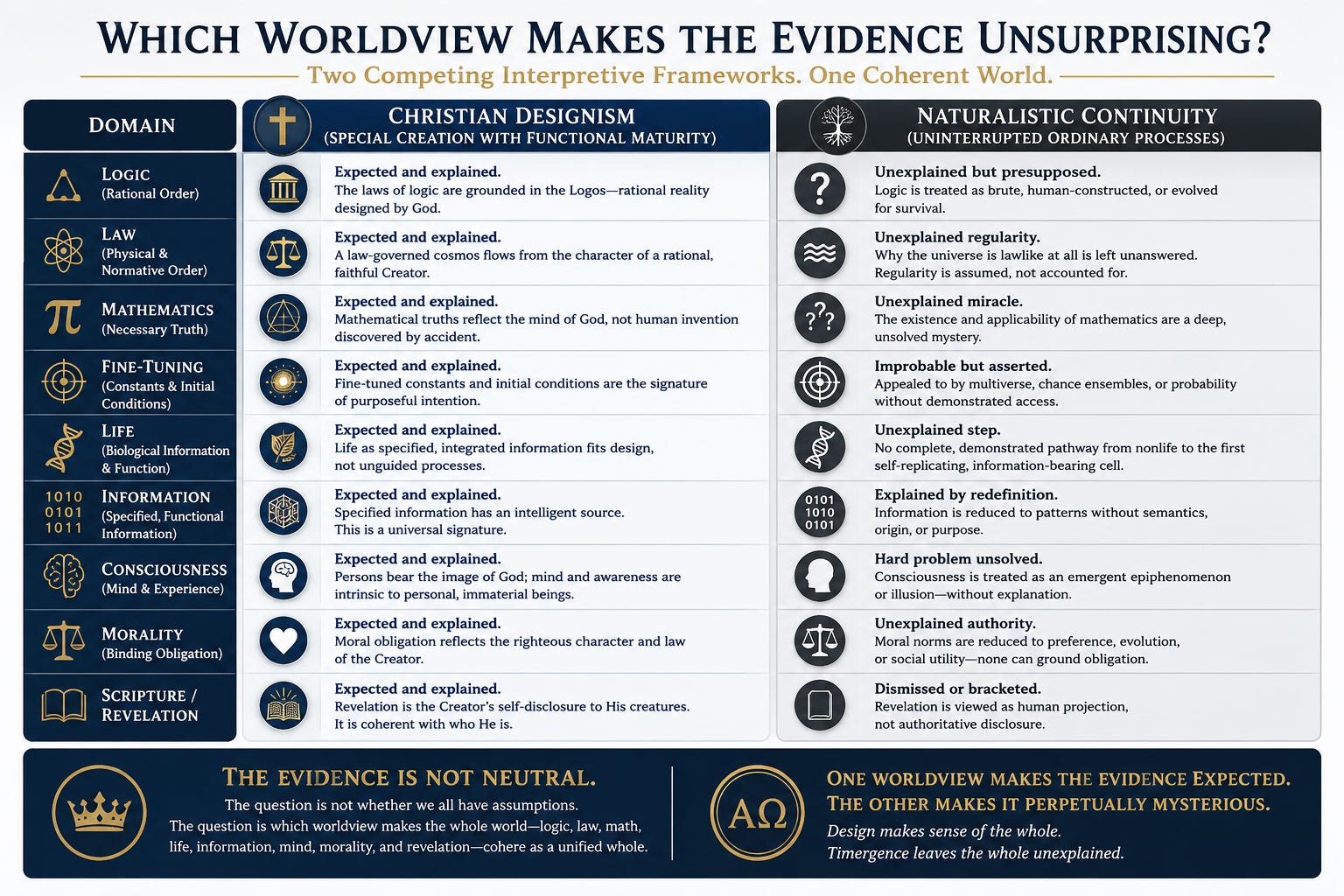
Figure 2. Which Worldview Makes the Evidence Unsurprising? Christian Designism renders nine domains expected and explained. Naturalistic Continuity leaves each one unexplained, asserted, or redefined.
6. Time Is Not a Mechanism
The major weakness in naturalistic origins reasoning is its dependence on time.
Time can permit a mechanism to operate. Time cannot replace a mechanism.
When someone says, “Given enough time, this could happen,” the right response is direct: what mechanism is doing the work? Is that mechanism causally sufficient? Is the available time probabilistically sufficient? Does the mechanism actually move the system toward the specified outcome?
For low-information, high-regularity phenomena, lawful process over time may be adequate. Crystals form. Snowflakes develop. Erosion shapes rock. These outcomes arise from known regularities with strong constraints.
But origin questions are different. The origin of life, biological information, molecular machinery, novel body plans, consciousness, rationality, and moral obligation are not explained by merely expanding the timeline. In many cases, more time simply gives failure more opportunities unless there is a demonstrated causal pathway that preferentially moves toward the functional target.
A probabilistic appeal to time works only when three things are shown: the relevant search space is tractable; the proposed mechanism can navigate that space toward the functional target; and the available probabilistic resources are sufficient. Without those, deep time becomes a solvent poured over explanatory gaps.
Special creation does not require time to perform creative work at the origin. It allows ordinary time-bound processes after creation, but it does not assign origin-level creative power to duration itself. That is a categorical difference. Naturalistic continuity requires time to do origin work. Special creation requires time to host providential operation after creation.
7. Naturalism and Timergence
Naturalism depends heavily on what may be called timergence: the appeal to enough time, enough trials, enough worlds, enough chance, or enough complexity to make an otherwise unexplained origin event seem plausible. It is usually a fusion of time, chance, emergence, selection, multiverse speculation, and “given enough” reasoning.
But none of these is a mechanism by itself.
Time does not build anything. Chance does not aim. Emergence does not explain its own substrate. Selection cannot select what does not yet exist. Multiverses multiply possibilities without proving actuality. Complexity does not automatically generate consciousness, code, rationality, or moral normativity.
The pattern repeats across the whole naturalistic story:
Given enough time, matter organized itself into life. Given enough mutations, life generated novel body plans. Given enough neural complexity, consciousness appeared. Given enough social pressure, morality emerged. Given enough universes, fine-tuning becomes unsurprising.
This is not one explanation. It is the same explanatory gesture repeated across multiple origin gaps. Timergence is naturalism’s habit of treating duration and possibility as if they were demonstrated causal sufficiency.
That is why “show the mechanism” matters. A legitimate explanation must show that the proposed cause can produce the specified effect under relevant conditions within available probabilistic resources. Otherwise, “given enough time” is a promissory note, not an explanation. Deep time is not creative power. It is just a larger stage on which an actual mechanism still has to perform.
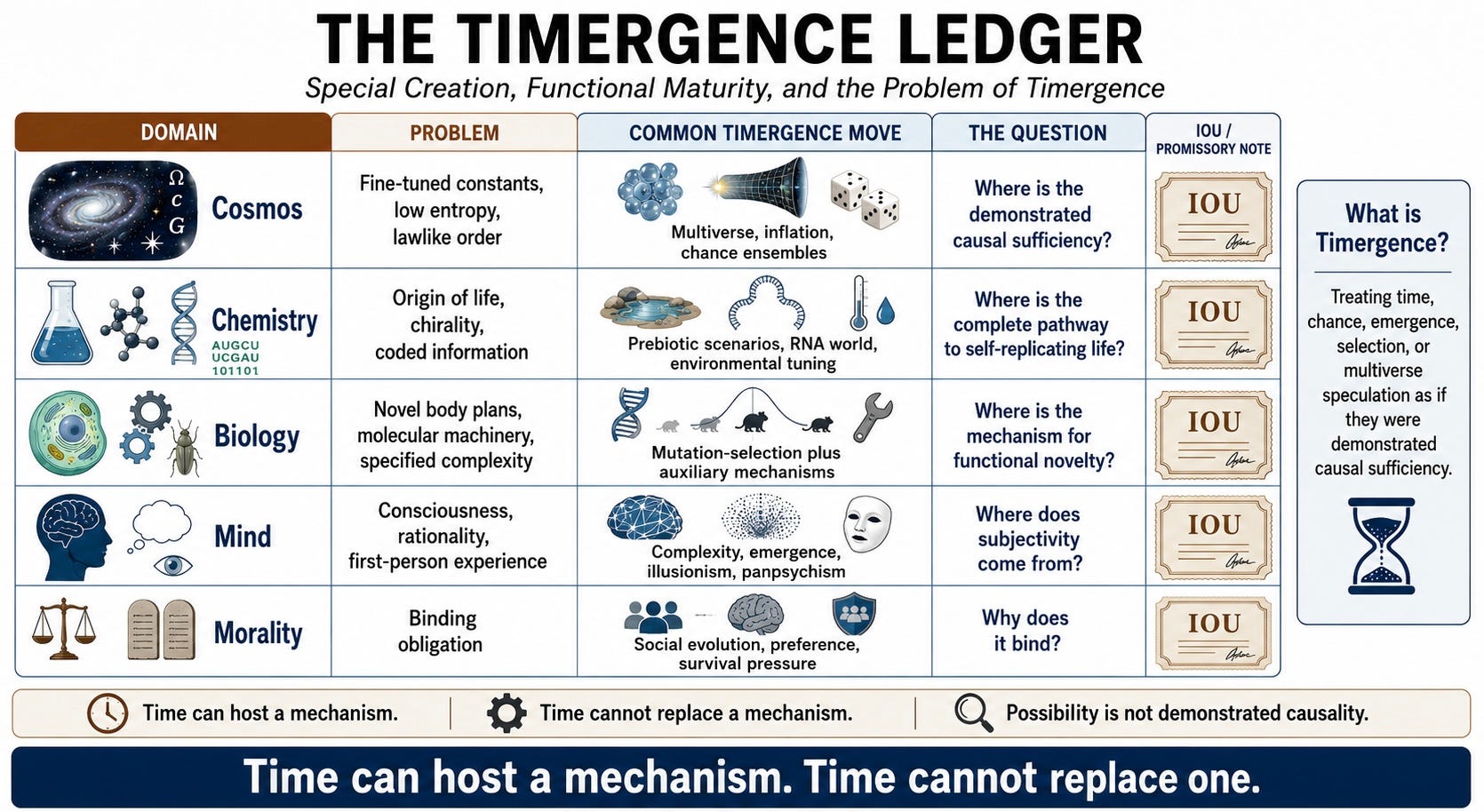
Figure 3. The Timergence Ledger. Naturalism’s compounding promissory notes across five domains. Each IOU represents an independent explanatory commitment without demonstrated causal sufficiency.
8. Why Special Creation Is More Plausible Given Christian Priors
Given Christian priors, special creation with functional maturity is more plausible than naturalistic continuity across every domain of total explanation.
It better explains why reality is immediately intelligible, operational, law-governed, life-supporting, and rationally accessible. It accounts for the existence of normative laws rather than merely assuming them. It explains why the human mind can investigate the world. It explains why mathematics maps onto physical reality. It explains why moral obligation binds rather than merely describing preference.
It explains why a life-bearing planet would require operational depth: light in transit, stable physical law, biological capacity, ecological fit, geochemical cycles, and radiogenic heat sufficient to sustain planetary function.
And it accounts for fine-tuning at every scale without writing compounding promissory notes. The constants, the chemistry, the biology, the consciousness, the morality: all of these are unsurprising in a universe intentionally actualized by a rational Creator who designed them to cohere.
Naturalism, by contrast, must borrow rational order while attempting to explain a world that allegedly comes from non-rational foundations. It must rely on laws it cannot ground, logic it cannot produce, mathematics it cannot justify, consciousness it cannot reduce, and moral obligation it cannot secure, while treating time as creative power and possibility as demonstrated causality. That is not a minor weakness. It is structural.
Naturalism can attempt to dominate inside the normative methodological naturalism framework, but it does not thereby establish metaphysical naturalism. It wins only after saying, “No Designer allowed.” That is a rule, not a discovery.
Conclusion
The question is not whether the cosmos contains structures from which age can be extrapolated. Of course it does. A functionally mature creation would have to contain coherent relations. Those relations will be measurable. Those measurements will be back-projectable under ordinary-process assumptions.
The real question is whether ordinary-process assumptions are warranted at the origin. And when that question is pressed across every scale of reality simultaneously, naturalism is not offering one explanation. It is issuing compounding notes on an account it cannot fund.
Time is not a mechanism. Emergence is not an explanation. Chance is not creative power. Multiverse speculation is not demonstrated causality. Fine-tuning at every scale is not an isolated anomaly to be deflected; it is a pattern of converging evidence pointing toward intentional creation.
Christian theism accounts for all of it: the rational order, the functional cosmos, the fine-tuned constants, the information-rich biology, the consciousness, the moral fabric, and the intelligibility that makes science possible in the first place.
The universe looks coherent because it was created coherently. That is a feature, not a bug.
James D. Longmire
Ordained Minister and Apologist | Sr. Systems Architect
ORCID: 0009-0009-1383-7698
DOI & PDF: https://doi.org/10.5281/zenodo.20242998
jdlongmire@outlook.com