

What Does Genesis 1 Require Us to Believe About the Creation Days?
I want to begin by thanking Riley for his opening statement. It was clear, charitable, and helpful. He has identified his position as a cosmic-temple view of Genesis 1, with a regional Flood, a literal Adam and Eve, a literal Fall, and animal death, predation, disease, natural disasters, and extinction existing before Adam’s sin.
That helps focus the discussion.
The central issue in this round is not whether Genesis 1 is theological. It clearly is. The central issue is whether the theological meaning of Genesis 1 is carried by a real sequence of divine creative acts, or whether that sequence functions only as a literary or temple-framework device without chronological force.
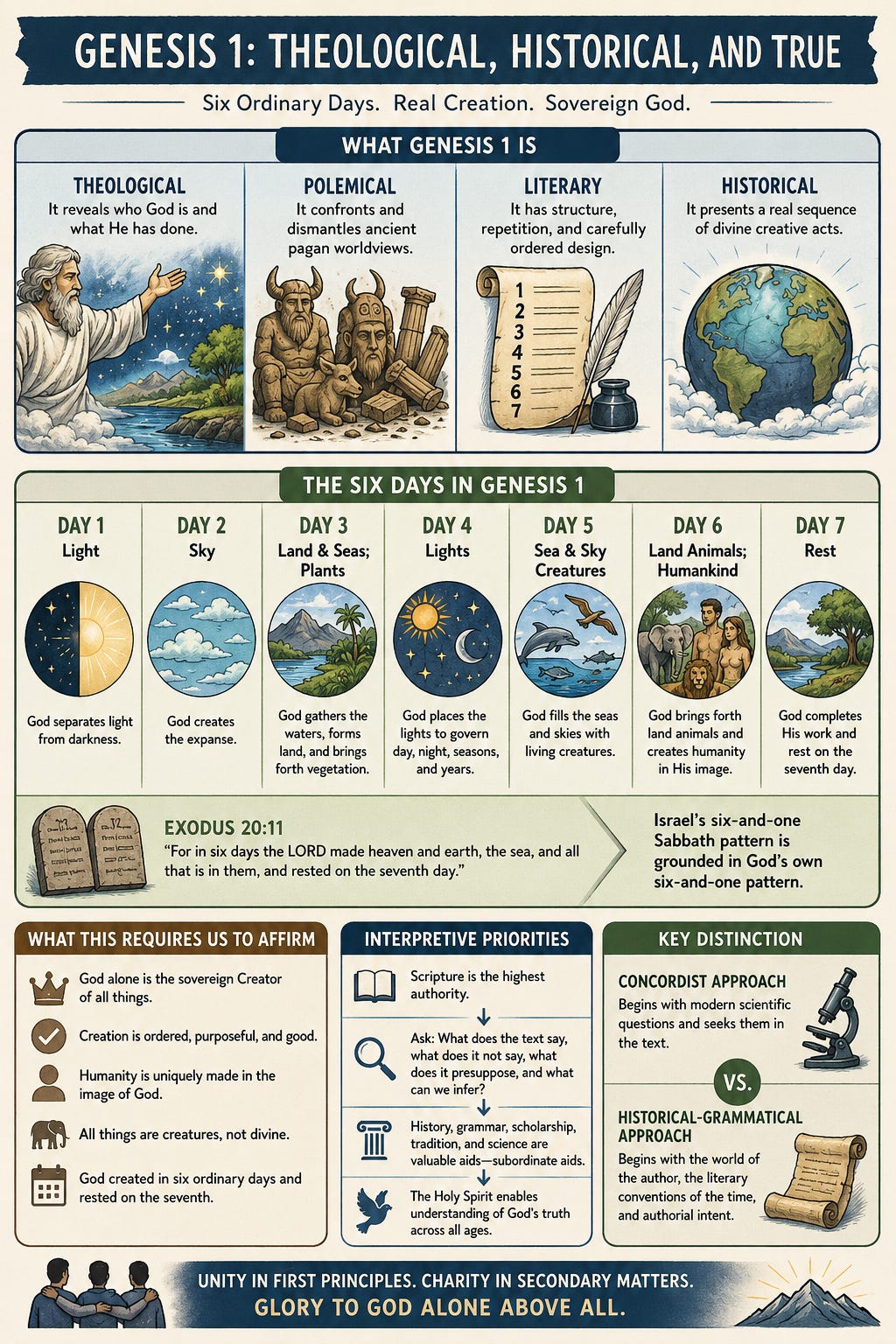
My position is that Genesis 1 requires us to affirm six ordinary creation days.
That claim does not mean Genesis 1 is a modern scientific textbook. It is not. It does not mean the chapter lacks literary structure. It has structure. It does not mean Genesis 1 is disconnected from ancient Near Eastern religious claims. It certainly speaks against pagan cosmologies by presenting one sovereign Creator who makes all things by His word.
But none of those observations remove the historical and sequential claims of the text.
A text can be theological and historical. A text can be polemical and sequential. A text can be beautifully structured and still intend to tell us what God did, and in what order He did it.
My Approach to Interpretation
My approach to Scripture and interpretation can be stated simply.
Scripture is the revealed Word of God to His people and the highest authority for matters of faith, reason, and practice.
The first task of interpretation is to ask what the text says, what it does not say, what it presupposes for narrative and theological purposes, what it authorizes us to infer, and how that reading coheres with the whole counsel of God.
History, grammar, scholarship, tradition, and science are valuable aids. They are not enemies of interpretation. But they are subordinate aids. Scripture interprets Scripture first.
The Holy Spirit is the steward of truth and has curated the Word so that ordinary means may be employed to understand God’s revealed truth across all ages and peoples.
So the question before us is not whether Genesis 1 is ancient, literary, theological, or polemical. I affirm all of that. The question is whether those features displace the text’s own chronological presentation.
I do not think they do.
The Days Are Presented as Ordinary Days
Genesis 1 presents the creation week through a repeated pattern:
God speaks.
God creates or orders.
God names or evaluates.
There is evening.
There is morning.
The day is numbered.
That pattern is not incidental. It is the structure by which the chapter communicates divine action in time.
The phrase “evening and morning” is especially significant. Whatever range the Hebrew word yom may have in other contexts, Genesis 1 does not merely use yom in isolation. It uses numbered days, bounded by evening and morning, in a sequential narrative. That strongly points to ordinary days.
This does not require us to deny that yom has a broader semantic range. It does. “Day” can refer to daylight, a calendar day, or an undefined period depending on context. But context determines meaning.
In Genesis 1, the context does not point to long ages, symbolic ages, or timeless theological categories. It points to a sequence of days.
The burden of proof rests on the interpretation that removes chronological force from that sequence.
The Sabbath Command Confirms the Pattern
Exodus 20:11 is decisive for my reading:
“For in six days the LORD made heaven and earth, the sea, and all that is in them, and rested on the seventh day.”
That verse grounds Israel’s six-and-one Sabbath pattern in God’s own six-and-one creation pattern.
The logic is not vague. Israel works six days and rests one day because God made all things in six days and rested on the seventh. The human week is patterned after the divine creation week.
If the days in Genesis 1 are not ordinary days, then the force of the Sabbath analogy becomes less direct. The command still has theological meaning, but its grounding becomes less natural. The text does not say, “God ordered creation according to a literary framework, therefore Israel should observe a seven-day week.” It says God made heaven, earth, sea, and all that is in them in six days and rested the seventh.
That does not settle every interpretive question by itself, but it is a major canonical control. Scripture interprets Scripture.
Genesis 1 gives the pattern. Exodus 20 applies it.
Literary Structure Does Not Cancel History
Riley’s cosmic-temple view places emphasis on function, order, sacred space, and theological polemic. I agree that Genesis 1 includes themes of function, order, and divine rule. I also agree that Genesis 1 opposes pagan accounts of origins. The sun, moon, stars, sea creatures, animals, and humanity are not gods. They are creatures. God alone is Creator.
But theological polemic does not require non-history.
The Exodus was theological polemic against Egypt’s gods, but it was also historical. The resurrection of Christ is theologically loaded, but it is also historical. The tabernacle is symbolic, but it was also real. Symbol and history are not enemies in Scripture.
So when Genesis 1 presents God creating in six days, the existence of theological meaning does not erase the chronological claim. The sequence is not a disposable container for theology. The sequence is part of the theology.
God creates by sovereign command. God orders creation in stages. God fills what He forms. God declares it good. God completes the work. God rests. The week itself becomes the foundation for human worship and labor.
The theology depends on the ordered sequence.
What the Text Asserts, Presupposes, and Authorizes
Riley rightly suggested that we distinguish between what the text explicitly asserts, what it presupposes for narrative purposes, and what we infer from it. I agree.
So let me apply that distinction.
Genesis 1 explicitly asserts that God created by His word, that creation occurred across numbered days, that those days are marked by evening and morning, and that God completed His creative work before His seventh-day rest.
Genesis 1 presupposes that God is sovereign over time, matter, life, light, land, sea, heavens, animals, and humanity.
Genesis 1 authorizes us to infer that the creation week is a real temporal framework, especially because Exodus 20:11 later grounds the human workweek in God’s creation week.
By contrast, I do not think Genesis 1 authorizes us to infer that the numbered days are merely literary panels with no chronological force. That conclusion may be possible within a broader interpretive model, but I do not see it arising naturally from the text itself.
It appears to be brought to the text by external concerns, whether those concerns are ancient Near Eastern comparative studies, modern scientific chronology, or a prior genre judgment.
Those aids may be useful. They cannot overrule the textual pattern.
What Genesis 1 Requires
Genesis 1 requires us to affirm that God is the sovereign Creator of all things.
It requires us to affirm that creation is ordered, purposeful, and good.
It requires us to affirm that humanity is uniquely made in the image of God.
It requires us to affirm that creation is not divine. The heavenly bodies, animals, seas, and earth are creatures under God’s command.
It also requires us to affirm that God created in six days and rested on the seventh.
That last claim is not a modern scientific imposition on the text. It is the text’s own presentation, reinforced by Exodus 20:11.
The ordinary-day reading is not an attempt to force Genesis into modern categories. It is an attempt to let Genesis speak in its own canonical voice.
Genesis 1 is not less theological because it is historical. It is theologically powerful precisely because it tells us what the living God actually did.
Three Questions for Riley
Riley, I appreciate your clarity in identifying your view as a cosmic-temple reading. Here are my three questions for this round.
1. What internal textual marker tells us that the numbered days of Genesis 1 lack chronological force?
I am not asking whether Genesis 1 has literary structure or theological purpose. I agree that it does. I am asking what in the text itself tells us the day sequence should not be read as a real temporal sequence.
2. How does your view account for Exodus 20:11?
If Israel’s six-day labor and seventh-day rest are grounded in God’s six-day creative work and seventh-day rest, why should the creation days be understood differently from the ordinary days used in the Sabbath command?
3. Can Genesis 1 be both cosmic-temple theology and historical narrative?
If not, why not? If so, what prevents us from reading the chapter as both theological polemic and a real sequence of divine creative acts?
I look forward to your response.
Respectfully,
JD
JD,
Thank you for a thoughtful and charitable article. I have appreciated both your interaction with Riley and your commitment to allowing Scripture to speak in its own voice. As I read this discussion, I found myself approaching the questions through the Narrative-Redemptive Method of Bible study we use at FaithBindsUs.
The purpose of this methodology is not to predetermine conclusions but to help readers ask questions in the order Scripture itself unfolds. We begin with the text, place it within the larger biblical narrative, follow its redemptive trajectory, and ultimately ask how it points us to Christ and the fulfillment of God's purposes.
From that perspective, I would offer the following observations.
Question 1: What internal textual marker tells us that the numbered days of Genesis 1 lack chronological force?
When I read Genesis 1 through the Narrative-Redemptive lens, I find no explicit textual marker that requires the reader to remove chronological force from the days. The repeated pattern of numbered days, evening and morning, divine speech, divine action, and divine evaluation naturally presents God's creative work as unfolding in an ordered sequence (Genesis 1:3–31).
This observation alone does not settle every interpretive question, but it does establish the starting point. The text presents itself as an ordered account of God's creative activity.
At the same time, the Narrative-Redemptive Method reminds us that chronology is not the chapter's ultimate purpose. The larger purpose is to establish God as Creator, humanity as His image-bearers, creation as good, and history as the stage upon which redemption will unfold.
The question, therefore, becomes not merely, "Are the days sequential?" but "Why does Scripture present them sequentially?" The answer appears to be that God's orderly creation establishes the foundation for His orderly redemptive work throughout the rest of Scripture.
Question 2: How does your view account for Exodus 20:11?
From a canonical perspective, Exodus 20:11 is highly significant because Scripture itself appeals back to Genesis 1. The Sabbath command states: "For in six days the LORD made the heavens and the earth, the sea, and all that is in them, and rested the seventh day" (Exodus 20:11).
The Narrative-Redemptive Method gives special weight to this because later revelation is helping interpret earlier revelation. Whatever literary structures may be present in Genesis 1, Exodus presents the creation week as the foundation for Israel's work-and-rest pattern.
This does not necessarily answer every question concerning the nature of the days, but it does suggest that the six-and-one pattern possesses real significance beyond mere literary arrangement. More importantly, the Sabbath itself becomes part of the redemptive storyline. The seventh-day rest points forward to the greater rest ultimately fulfilled in Christ (Hebrews 4:1–10). Thus, Genesis, Exodus, and Hebrews together reveal a unified redemptive theme moving from creation to redemption to consummation.
Question 3: Can Genesis 1 be both cosmic-temple theology and historical narrative?
I believe it can. Throughout Scripture, theological meaning and historical reality regularly coexist. The Exodus was both a historical deliverance and a theological revelation (Exodus 12–15). The Tabernacle was both a real structure and a theological symbol of God's presence (Exodus 25:8–9). The Temple was both historical and symbolic (1 Kings 8:10–13). Most importantly, the death and resurrection of Christ are profoundly theological realities grounded in actual history (1 Corinthians 15:3–8). For that reason, I see no necessary conflict between recognizing temple themes within Genesis 1 and affirming that God is describing real creative acts. Scripture often communicates theology through history rather than instead of history.
Why the Narrative-Redemptive Method Matters
What I appreciate most about this discussion is that it reminds us of an important principle: Genesis 1 was not given merely to answer questions about chronology. It was given to begin God's redemptive story. Genesis 1 introduces the Creator. Genesis 2 introduces humanity. Genesis 3 introduces sin. The remainder of Scripture reveals God's plan of redemption culminating in Jesus Christ.
John deliberately echoes Genesis when he writes, "In the beginning was the Word" (John 1:1). Paul identifies Christ as the One through whom all things were created (Colossians 1:16–17). The Bible concludes with a new creation where God dwells with His people forever (Revelation 21:1–5).
Therefore, while discussions about the creation days are important, the greater question is whether our interpretation preserves the role Genesis 1 plays in the unfolding redemptive narrative of Scripture. In that regard, I believe your article helpfully reminds readers that theology, history, and redemption are not competing categories in the Bible. More often than not, they work together.
Respectfully,
Mark Donnelly
FaithBindsUs