

What Is My Position, and What Am I Trying to Defend?
This is the opening round in my cross-blog dialogue with Riley Barton of The Evidence is Plain: Thoughts and Musings on Christianity. Riley is writing from an old-earth creation position. I am writing from a young-earth / functionally mature special creation position.
The purpose of this first round is definition. Before we argue over Genesis 1, biblical chronology, death before sin, Noah’s Flood, geology, fossils, or starlight, we need to define what we mean.
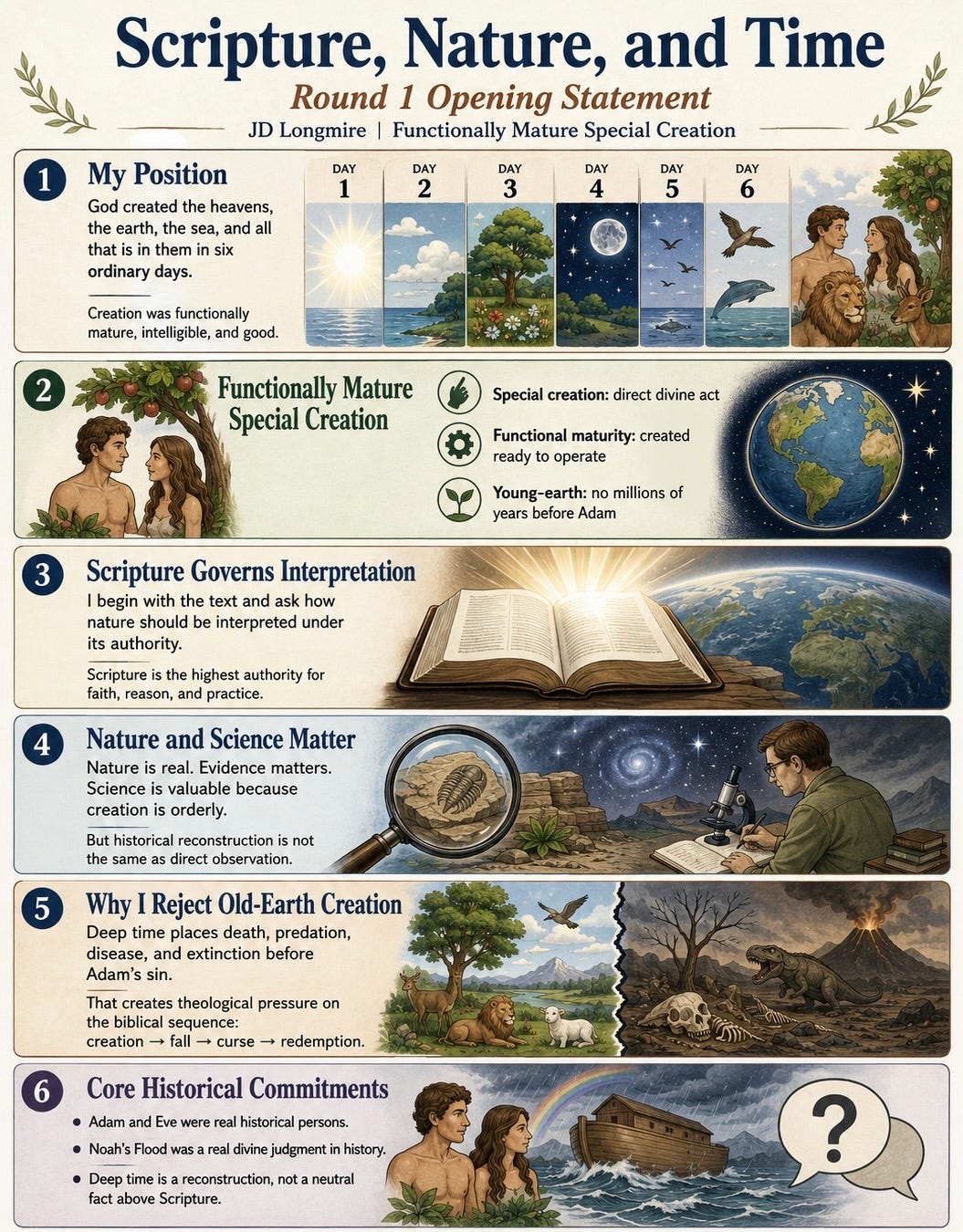
My position is this:
God created the heavens, the earth, the sea, and all that is in them in six ordinary days, as presented in Genesis 1 and summarized in Exodus 20:11. The created order was made functionally mature, intelligible, and good. Adam and Eve were specially created as the first human pair. The Fall was a real historical rupture. Death entered the human order through sin. Noah’s Flood was a real divine judgment in history. Nature is real, evidence matters, and science is a legitimate tool for studying God’s world.
At the same time, creation, fall, and flood are not ordinary providential events that can be reconstructed as though they were merely long sequences of present-day processes.
That is the framework I am defending. I call it functionally mature special creation.
By “special creation,” I mean that the origin of the heavens, earth, life, and humanity was a direct divine act, not merely the result of ordinary providential processes extended backward into the unobserved past.
By “functional maturity,” I mean that God created the world ready to operate according to its appointed purposes. Adam was not created as an embryo. Eve was not created as an infant. Fruit trees were created bearing fruit. The heavenly lights were appointed to govern days, seasons, and years. The world was created with real function from the beginning.
By “young-earth,” I mean that I do not believe Scripture gives us room for millions or billions of years of natural history before Adam. I do not claim every chronological question is simple. I do claim that the biblical text places creation, Adam, sin, death, and redemption into a historical structure that is difficult to reconcile with deep time.
What I Am Not Arguing
I am not arguing that nature is an illusion, science is useless, Christians should ignore evidence, every old-earth creationist is compromising Scripture, or God created a chaotic universe that only appears orderly.
I am arguing that the created order must be interpreted within the theological and historical structure Scripture gives us.
There is a difference between studying the present creation and reconstructing origins. There is a difference between ordinary providence and special creation. There is a difference between what can be observed, tested, and repeated in the present and what must be inferred about the unobserved past.
That difference matters.
Scripture as the Governing Authority
My starting point is that Scripture is the revealed Word of God and the highest authority for faith, reason, and practice.
This does not mean nature is false. God made the world. Creation genuinely reveals God’s power, wisdom, and divine nature. The problem is not nature. The problem is autonomous interpretation.
When Scripture and modern reconstructions of natural history appear to be in tension, I do not treat the modern reconstruction as the fixed authority and Scripture as the flexible material to be adjusted. I start with Scripture.
That does not settle every interpretive question in advance. It does establish the hierarchy.
Genesis presents creation as a sequence of divine acts. God speaks, and things come to be. The text marks days. It gives evening and morning. It presents Adam and Eve as historical persons. It presents sin as an intruder into the created order. It presents the curse as judgment. Later Scripture treats Adam, Eve, Cain, Abel, Noah, and the Flood as real history.
That cumulative witness matters.
Old-earth creationists often argue that Genesis 1 has a literary structure, that yôm can have a range of meaning, that biblical genealogies may contain gaps, and that nature gives strong evidence for deep time. Those claims deserve examination. We will get to them.
For this opening round, I am simply stating my starting point. I do not begin with deep-time reconstruction and then ask which readings of Genesis can accommodate it. I begin with the text and then ask how nature should be interpreted under the authority of that text.
Nature, Evidence, and Historical Reconstruction
I affirm the real intelligibility of nature.
The world is not random noise. It is not a trick. It is the creation of the living God, upheld by His providence and made available to human investigation. Christians should have a high view of evidence because Christians have a high view of creation.
At the same time, historical reconstruction is not the same thing as direct observation.
When we investigate the present world, we can measure, test, repeat, and refine. When we reconstruct the distant past, we infer from present evidence to past causes. That process is unavoidable. It is also assumption-laden.
This does not make historical science worthless. It means Christians should ask what assumptions govern the reconstruction.
Does the model allow special creation as a real historical event? Does it allow functional maturity at creation? Does it allow catastrophic divine judgment in history? Does it allow the Fall to alter the created order? Does it allow Scripture to define the basic sequence of origins?
If the answer is no, then the model is not religiously neutral. It may still contain accurate observations. It may still identify real patterns. It may still be useful in many domains. But it is not operating from the same first principles Scripture gives us.
The old-earth position usually treats deep time as an established reconstruction of natural history and then reads Genesis in a way that can coexist with that reconstruction. My concern is that this gives the reconstruction disciplinary authority over the text.
That is the central issue I want to test in this dialogue.
Creation, Fall, and Death
A major reason I reject old-earth creation is theological.
Deep time does not simply add years to the creation account. It places vast ages of death, predation, disease, extinction, violence, and natural suffering before Adam’s sin.
That creates serious theological pressure.
If animal death, predation, parasitism, disease, extinction, and suffering existed for millions of years before Adam, then those things are part of the original created order. They belong to the world God called “very good.”
Some old-earth models respond by limiting “death through sin” to human death. Others distinguish physical death from spiritual death. Others argue that animal death has no direct connection to the Fall. Those answers need to be weighed carefully.
My concern is that Scripture presents creation, fall, curse, death, and redemption as a coherent theological sequence. The goodness of creation comes first. Human rebellion follows. Curse and death follow sin. Redemption in Christ answers the curse.
For that reason, I do not think death before sin is a small detail. It touches the biblical arc from Genesis to Revelation.
Adam, Flood, and History
I affirm that Adam and Eve were real historical persons specially created by God.
Adam was formed from the dust of the ground. Eve was made from Adam. They were the first man and woman, placed in covenantal relation to God, given moral command, and held accountable for rebellion.
This matters because later Scripture treats Adam as historically and theologically significant. Paul’s argument in Romans 5 depends on a real Adam and a real Christ. First Corinthians 15 contrasts Adam and Christ. The biblical storyline depends on the movement from creation to fall to redemption to new creation.
I also affirm that Noah’s Flood was a real divine judgment in history.
I will not argue its full scope here. That belongs to a later round. For now, I will simply say that my position treats the Flood as more than a local Mesopotamian water event. Genesis presents it as a catastrophic judgment upon the world of the ungodly. Later Scripture treats it as a paradigmatic act of judgment.
That matters because historical reconstruction of the earth cannot simply assume uninterrupted gradualism if Scripture gives us catastrophic divine judgment as part of the past.
What I Am Trying to Defend
I am defending a hierarchy of authority.
Scripture governs interpretation. Nature is real and meaningful because God made it. Science is valuable because creation is orderly. Historical reconstruction is useful, but limited. Special creation cannot be reduced to ordinary providence. The Fall cannot be treated as a minor spiritual metaphor. The Flood cannot be ignored as an interpretive boundary.
Deep time is not a neutral fact sitting above theological interpretation. It is a reconstruction of the past that depends on assumptions about process, continuity, initial conditions, and permissible causes.
My position is that Genesis gives us a better framework: special creation, real history, functional maturity, moral rupture, catastrophic judgment, and ultimate redemption in Christ.
Three Questions for Riley
Riley, I appreciate your willingness to engage this carefully and charitably. For this opening round, here are my three questions.
1. What specific form of old-earth creation do you hold?
For example, would you describe your view as progressive creation, day-age, analogical days, framework interpretation, cosmic temple, or something else?
2. In your model, what existed before Adam’s sin?
Specifically, do you believe animal death, predation, disease, extinction, parasitism, and natural disasters existed before the Fall? If so, how do you understand those realities in relation to God calling creation “very good”?
3. When Scripture and modern scientific reconstructions of natural history appear to conflict, which one has interpretive priority?
I am not asking whether nature matters. I affirm that it does. I am asking which authority disciplines the other when the two appear to be in tension.
I look forward to your opening statement.
-JD