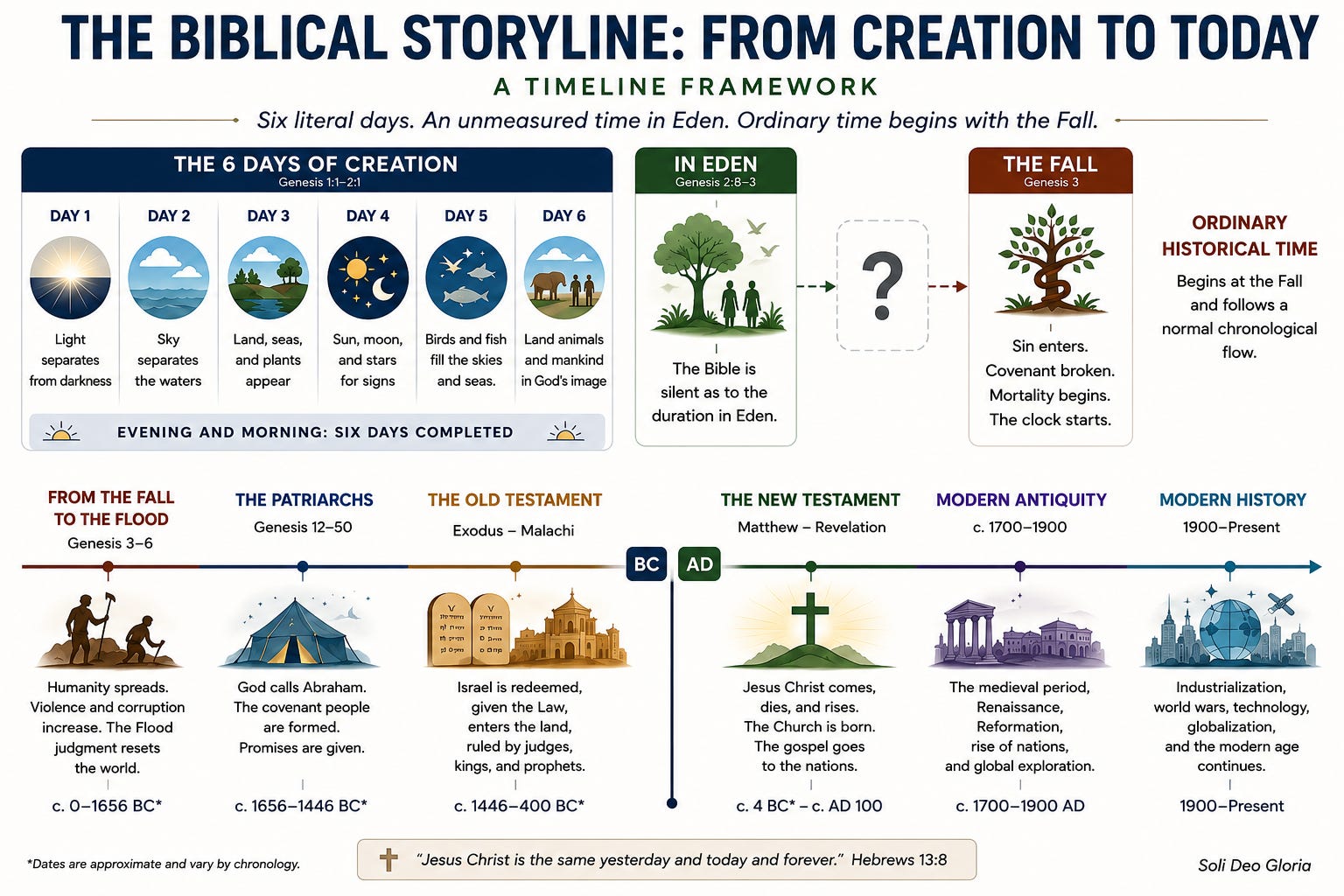
Author’s notes: Thomas Reid’s common-sense realism begins with the ordinary meaning of language and resists speculative systems that outrun the evidence. Applied here, that means taking Genesis at face value, distinguishing what it says from what it leaves unsaid, and refusing to make conjecture carry the authority of the text.
This framework proceeds by constrained canonical inference. It does not claim that every conclusion is stated as an isolated proposition in Genesis. It asks which reconstruction best integrates the explicit text, the narrative silences, Adam’s federal headship, and the Genesis–New Creation correspondence without contradicting anything Scripture directly affirms.
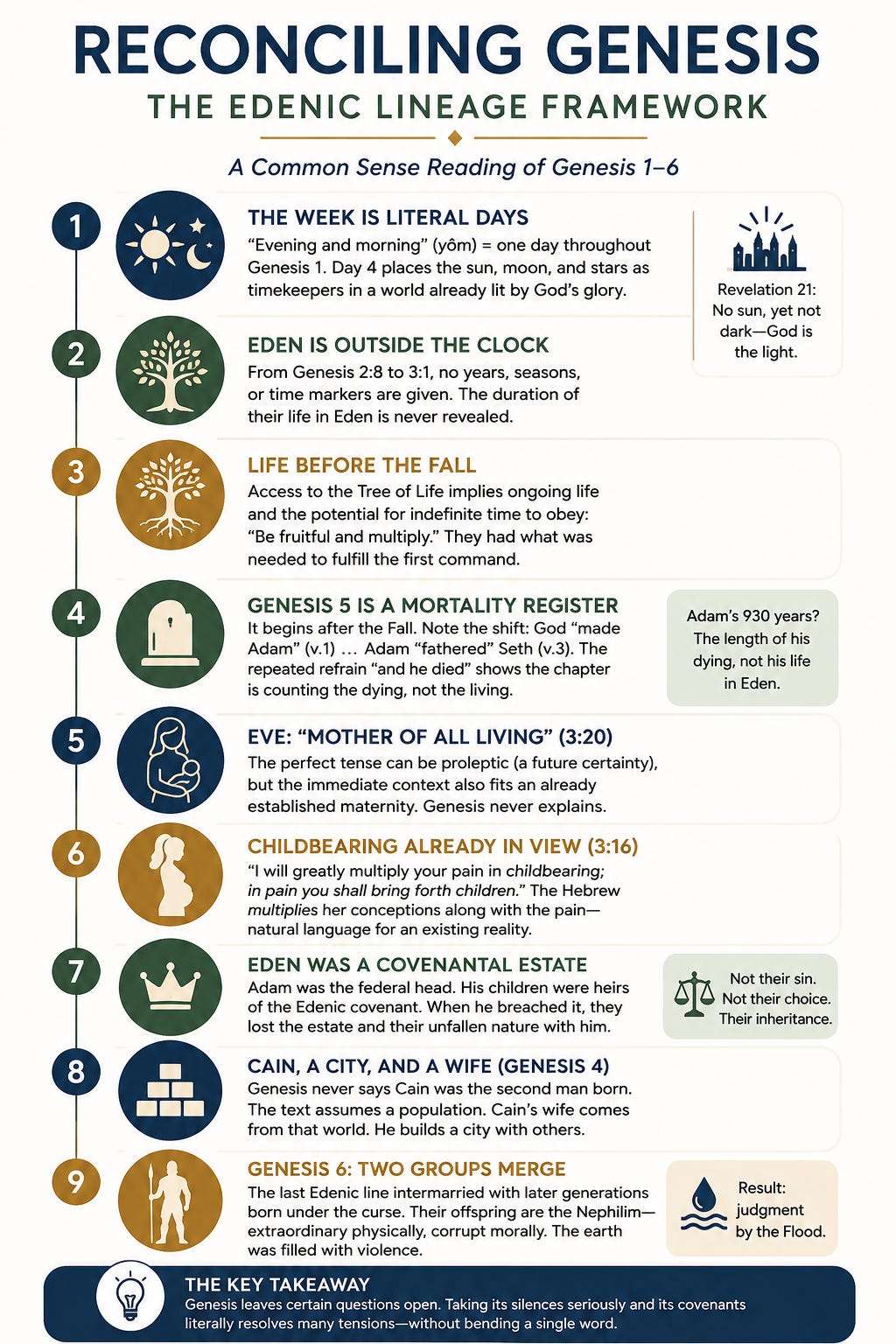
Early Genesis leaves a trail of loose ends, and most of us learned to walk past them. Evenings and mornings before there is a sun. A murderer exiled into a world that supposedly holds four people, who then finds a wife and builds a city. Sons of God taking wives. Nephilim in the earth. Read the chapters straight and the questions arrive faster than the answers.
The usual moves all involve stretching something. Make the days long. Gap the genealogies. Turn the sons of God (bene ha’elohim) of Genesis 6 into angels with a biology problem. Every one of those costs you something in the text.
There’s a way through that doesn’t bend a word. It only requires noticing what Genesis declines to say.
Start with the week. Yom with an ordinal, evening and morning. In Hebrew narrative that’s a day, every single time, and there’s no literary pressure to read it otherwise.
The objection has always been the sun. Nothing in the sky until day four, so what exactly is having an evening?
The answer sits at the far end of the canon. The New Jerusalem has no sun and it isn’t dark, because the glory of God lights it. So day four didn’t invent light, and it didn’t invent time. It delegated them. The lamps got installed in a room that was already lit.
Now notice the silence.
Genesis 1 is obsessively chronometered. Day one, day two, evening, morning, a metronome running through the whole chapter. Then Adam and Eve are placed in the garden and the clock simply stops. No years. No seasons. Nothing measured between the sixth day and the serpent.
How long were they in there? The text will not tell you. A week is possible. So is a millennium (or more).
And then, before the exile, while the curse is still being handed down, Genesis 3:20: Adam named his wife Eve, because she was the mother of all living. That’s past tense reporting a present reality. It reads badly as a prophecy about a womb that hadn’t opened yet.
The curse itself carries the same assumption a few verses earlier. I will greatly multiply your pain in childbearing. Multiply. You increase a quantity that exists. And the Hebrew object is not pain alone, it is her conceptions along with the pain attending them. That is strange phrasing for a woman who has never conceived. Someone will answer that the increase is measured against the childbearing she was designed for rather than childbearing she had done, and that reading holds up on its own. It holds up less well four verses later, when the same speech ends with her already being the mother of all living. One hint is an inference. Two in the same scene, pointing the same way, look more like the narrator assuming something his readers already knew.
She was already a matriarch. The first command given to them was to be fruitful and multiply, and they had a deathless environment and an unmeasured stretch of time in which to obey it.
Here’s where it gets pushed back on. Genesis 5 says Adam was 130 at Seth’s birth and lived 930 years total. Looks like a hard ceiling on the whole scheme.
Ask what a lifespan measures. A lifespan counts down. Putting years on an immortal is like timing a race with no finish line. In the day that you eat of it, you shall surely die.That’s the starting gun, and the 930 is the length of Adam’s dying.
The chapter says as much about itself, if you read its opening carefully. Genesis 5:1 recalls that God made Adam in His own likeness. Two verses later, Adam fathers Seth in his likeness, after his image. Nobody switches possessives like that by accident. Something happened between verse 1 and verse 3, and the whole chapter is written downstream of it. Then the refrain starts. And he died. Over and over down the list, with one famous exception, the only thing every entry has in common.
Genesis 5 is a mortality register. It announces itself as one. It is counting the dying, and Adam’s entry starts where his dying started.
Eden was a treaty, and Adam held it as a federal head rather than as a private citizen. That distinction does most of the work here.
Children born before the breach were born inside an intact covenant. Original righteousness, unbroken communion with the Creator, physical perfection, all of it standard issue. Which makes sons of God a legal title. They were the recognized heirs of the Edenic estate, and the phrase means roughly what it would mean on a deed.
Then the deed gets forfeited.
Picture a father who holds a magnificent self-sustaining estate and breaches the contract that secures it. His household is evicted. The children signed nothing and breached nothing, and they lose everything anyway. What they inherit is the eviction and following consequences, not the crime.
Be careful how much weight that analogy is asked to carry, though, because the estate they lost included their own nature. This was no mere change of address. They did not walk out of the garden as intact people in reduced circumstances. They walked out corrupted, by nature children of wrath like everyone born since.
That’s the whiplash. They went to sleep immortal heirs and woke up mortal exiles in bodies that had turned against them.
Outside, bread costs sweat. Sweat means scarcity, scarcity breeds competition, mortality breeds fear. Jealousy and hoarding and tribalism follow fast. None of that made them sinners. It only showed them what the forfeiture had already made them.
Which tells you who Cain was afraid of. Where he found a wife. Who laid the bricks at Enoch.
And notice that nothing here requires Cain to be the second human ever born. The text never claims he was. What Genesis 4:1 actually gives us is Eve’s line at his birth: I have gotten a man with the help of the LORD. Set that against the promise just made about the seed who would bruise the serpent’s head, and it reads as a mother’s hope about which son this is. Cain is the first child of the promise. Birth order was never the claim.
All of which sets up Genesis 6, the hardest passage in the section and the one this framework earns its keep on.
By then two classes of human share the planet, divided by covenantal history rather than by species. The exiles, born under the first covenant, still carrying Edenic longevity and vitality in their bodies. The natives, born into the curse from their first breath, who never knew anything else.
Genesis 6 records the merger. The last remnants of the first covenant abandon a distinct heritage and assimilate completely. The offspring are Nephilim, heroes of old, men of renown: Edenic physical capability running on fallen moral software. Formidable, dominating, and wicked enough that the earth had to be washed.
None of this needs long days, angelic hybrids from imported Jewish mythology, or a population boom the text never mentions. It needs two things. Take the silence in Eden seriously, and take the covenant seriously as a legal instrument rather than a metaphor.
Perhaps the strangest thing about Genesis is not what it says, but what it never feels compelled to explain. We often rush to fill those silences with speculation, then defend our speculation as though it were Scripture itself. A common-sense reading asks less of the text. It lets Genesis speak where it speaks, remain silent where it remains silent, and discovers that many of the supposed problems disappear without bending a single word.
Historically, there’s been plenty of “filling in the blanks” of the early books of Genesis with some pretty interesting and titillating speculation that a common sense reading with the right context can plainly solve. This is my approach to that. Hope it’s helpful.
Soli Deo Gloria
My proposed Biblical chronology