

I spend a good part of my working life in systems architecture reviews, and the most common error I see there has nothing to do with technology. Someone puts up a diagram with four boxes and calls it simple. Someone else puts up a diagram with forty and gets asked to justify the complexity. But the four-box design pulls in four external dependencies nobody controls, and the forty-box design derives thirty-nine of its components from a single one. The second design is simpler. It just does not look that way.
Simplicity is a count of what you cannot derive from anything else. Everything else is drawing.
Keep that in mind, because the same confusion runs through one of the most common objections to theism.
The objection arrives in nearly identical form every time. If everything requires an explanation, then who created God?
Christians have answered this for centuries. God is not a contingent being. He is the necessary ground of contingent reality, and asking what caused Him is asking what caused the sort of thing that by definition has no cause. The objection usually shifts at this point rather than disappearing.
Then you are just calling God a brute fact.
Grant it for the sake of argument. I do not think the label fits, since a necessary being is self-explanatory while a brute fact has no explanation at all, and those are different claims. But set that aside, because the concession costs nothing and clarifies everything. If unexplained termination is philosophically permissible, it is permissible for everyone.
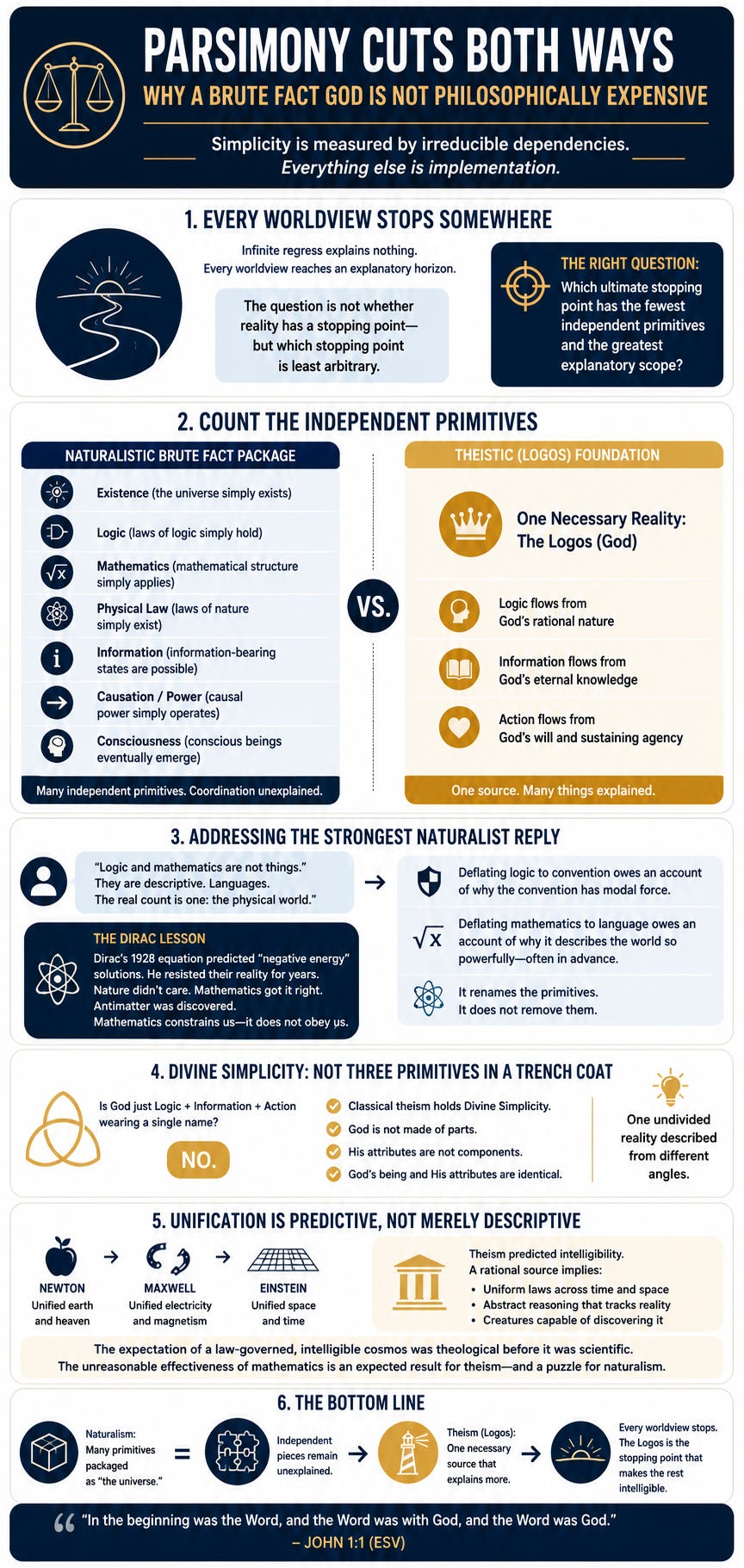
The discussion has changed. It is no longer about whether reality terminates in something unexplained, since every worldview reaches an explanatory horizon somewhere. The live question is what makes one stopping point less arbitrary than another.
I would propose this measure: fewest independent primitives, greatest scope of what they account for.
Run the count. Naturalism, in its ordinary form, treats a fair number of things as fundamental features requiring no deeper account. Existence itself. The laws of logic. Mathematical structure. Physical law. Informational order. Causal power. Consciousness gets added by anyone honest about how badly it fits.
Christianity proposes one necessary reality and derives the rest.
Now, the serious naturalist has a reply here, and it is better than the one usually attributed to him. He denies the tally. Logic and mathematics are not furniture in the world, he says. They are descriptive. Logic is how we talk about inference. Mathematics is a language that happens to work. Neither is a thing the ontology has to pay for, so the real count is one brute fact, the physical world, plus some notation.
That is the argument worth engaging, and it has a bill of its own. Deflate logic to convention and you owe an account of why the convention has modal force. The law of non-contradiction does not feel like a rule we adopted, and it does not behave like one either, since we cannot coherently imagine dropping it. Deflate mathematics to language and you owe an account of why that language, invented for no physical purpose, keeps turning out to describe the world in advance of the measurement.
Consider what happened to Dirac. His 1928 equation for the electron produced solutions with negative energy, which nobody wanted and which classical physics said could not exist. Dirac spent the next two years trying to domesticate them, proposing in 1930 that the unoccupied states in the negative-energy sea were simply protons, since inventing a new elementary particle seemed the more extravagant option. Oppenheimer and Weyl demolished that reading. Only in 1931, cornered, did he grant that a hole would have to be an unknown particle with the electron’s mass and the opposite charge. Anderson found it in a cloud chamber the following year. The legend that antimatter fell straight out of the equation is false. What actually happened is more interesting. The mathematics extracted a prediction from a man who spent three years resisting it.
The deflationary move does not eliminate the primitives. It renames them and hands the bill to epistemology.
Here is the objection that actually threatens my count, and it is the one I would raise if I were arguing the other side.
Is a God who is rational, omniscient, and volitional not just three primitives bundled into a single noun? You said Logic, Information, and Action. Then you said God’s nature, God’s knowledge, God’s will. The count looks identical. You have stapled the primitives together and declared unification.
If God were a composite being who happens to possess those three attributes, the objection would land, and land hard. Classical Christian theology denies exactly that. Divine simplicity holds that God is not made of parts, and that His attributes are not components assembled into a whole. God does not have rationality. He is rationality, and His knowing is not a faculty distinct from His being. What we name separately as wisdom, knowledge, and will is one undivided reality described from different angles, the way a single solid throws different shadows depending on where you stand.
This is the doctrine that makes the parsimony argument work, and it is not a recent patch. Augustine argues it in City of God XI.10 and Aquinas in Summa Theologiae I.3, both of them precisely because theism cannot claim ontological economy while treating God as a bundle.
So the triad does reduce. In a framework I have been developing that treats Logic, Information, and Action as irreducible categories of physical reality, the philosophical question is whether those three are independent brute facts or one source seen under three descriptions. Logic reflects the divine rational nature. Information reflects the divine knowledge. Action reflects the divine will. Not three foundations placed side by side. One foundation, refracted.
There is a fair challenge to the unification analogy too, so let me pay for it rather than borrow it.
Newton unified terrestrial and celestial mechanics. Maxwell unified electricity and magnetism. Einstein unified space and time. Each of those unifications earned its keep by predicting something nobody had seen yet. The obvious retort is that theistic unification predicts nothing and merely relabels what we already knew.
Except it did predict, and historically it predicted in advance. If reality is grounded in a rational source, you should expect the universe to be intelligible rather than opaque. You should expect its order to hold uniformly across time and space rather than locally. You should expect abstract reasoning to track physical structure. You should expect creatures capable of doing the tracking.
That is not a retrofit. Peter Harrison has documented that when the idea of immutable mathematical laws of nature first rose to prominence in the seventeenth century, it was bound up with a theological account of natural order, and that for Descartes, Boyle, and Newton the invariable uniformity of nature followed from God’s continuous engagement with the world rather than His absence from it. The expectation of a law-governed cosmos was a theological expectation before it was a scientific result. It was vindicated to a degree that still embarrasses the alternative. The unreasonable effectiveness of mathematics is a live puzzle for naturalism and an expected result for theism.
None of this is a proof, and I will not dress it up as one. It is a cost comparison, and cost comparisons can be contested at every line item. If someone can show that the deflationary account of logic pays its bill, or that divine simplicity is incoherent, the argument takes real damage. I would want to know.
But the reflexive form of the objection is finished. Theism does not multiply entities. It proposes one and derives the rest, which is what every successful explanation in the history of science has tried to do.
“In the beginning was the Word, and the Word was with God, and the Word was God.” (John 1:1, ESV)
Every worldview stops somewhere. The Logos is a stopping point that explains why there was anything to explain.
Sources
Dirac, P.A.M. (1928) ‘The Quantum Theory of the Electron’, Proceedings of the Royal Society A, 117, pp. 610–624; Dirac, P.A.M. (1930) ‘A Theory of Electrons and Protons’, Proceedings of the Royal Society A, 126, pp. 360–365; Dirac, P.A.M. (1931) ‘Quantised Singularities in the Electromagnetic Field’, Proceedings of the Royal Society A, 133, pp. 60–72. Chronology of the proton identification and its abandonment as recounted in Kragh, H. (1990) Dirac: A Scientific Biography, pp. 91–103. Requires verification against the primary papers before publication.
Harrison, P. (2019) ‘Laws of God or Laws of Nature? Natural Order in the Early Modern Period’, in Harrison, P. and Roberts, J.H. (eds) Science Without God? Rethinking the History of Scientific Naturalism. Oxford: Oxford University Press.
Augustine, City of God XI.10; Aquinas, Summa Theologiae I.3. Wigner, E. (1960) ‘The Unreasonable Effectiveness of Mathematics in the Natural Sciences’, Communications in Pure and Applied Mathematics, 13(