

Naturalism has a faith problem.
Not a data problem. Not a funding problem. A faith problem.
I just published a new academic paper on Zenodo, and the thesis is simple enough to state in one sentence: modern origins science hasn’t eliminated the need for faith. It has relocated that faith from a transcendent agent with demonstrated causal adequacy to impersonal processes lacking both mechanism and precedent.
The paper is called “Naturalism’s Faith Commitment: How Modern Origins Science Replaced Divine Design with Faith in Implausible Probabilities.” You can read the full thing here:
https://doi.org/10.5281/zenodo.18695574
Let me walk you through the core argument.
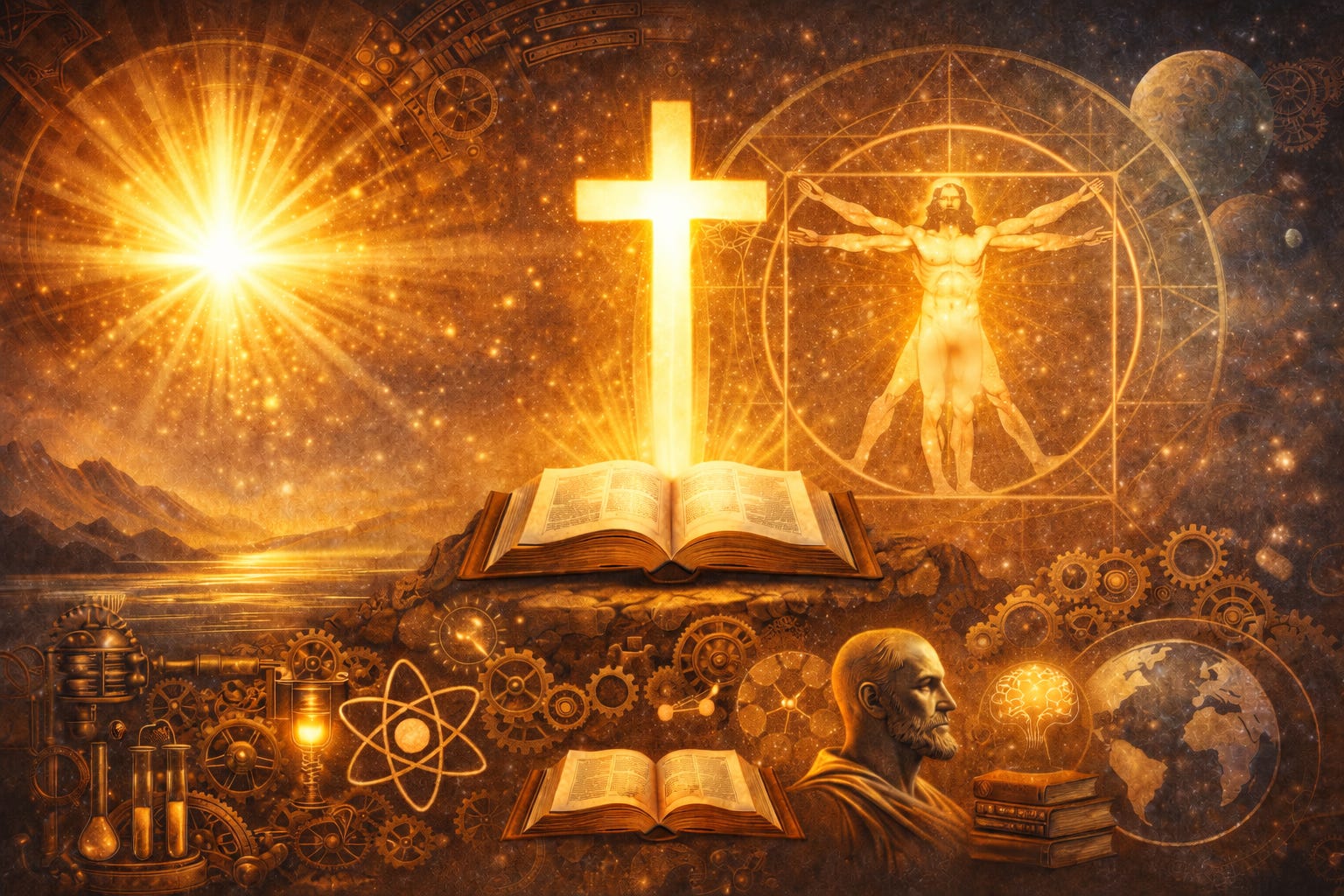
When you press metaphysical naturalism (the philosophical claim that only natural causes exist, as distinct from the productive research strategy of studying natural mechanisms) to account for fundamental features of the world, it keeps running into the same two problems. I call them statistical miracles and mechanistic miracles.
A statistical miracle is a probability so extreme it exhausts every available resource for making it plausible. The cosmological constant is fine-tuned to 1 part in 10^120. Roger Penrose calculated the initial entropy conditions of the universe at 1 in 10^10^123. These aren’t “improbable.” They’re numbers that lose empirical meaning. When someone says “it just happened,” they’re exercising faith, not reporting a finding.
A mechanistic miracle is a causal transition for which no mechanism exists even in principle. How does “nothing” (genuine nothing, not Lawrence Krauss’s quantum vacuum, which is emphatically something) generate a universe? How do unconscious particles produce subjective experience? How does descriptive chemistry become prescriptive genetic code? In each case, the cause-type invoked by naturalism has never been observed to produce the effect in question. Not once. Not anywhere.
The paper examines six domains where these two failure modes show up. Cosmological origins. Fine-tuning of physical constants. The rational order of the universe and the unreasonable effectiveness of mathematics. Biological information and the origin of life. Consciousness. Moral realism.
None of these is new territory for apologetics. What the paper adds is the convergence argument: these aren’t six isolated puzzles. They’re six manifestations of a single structural deficit. Naturalism doesn’t just struggle with one hard question. It struggles with all of them, simultaneously, and for the same underlying reason: it lacks the causal resources to explain the features that most fundamentally characterize the world we actually inhabit.
And the paper only scratches the surface. Each of those six domains contains layers of additional specification that compound the difficulty. Fine-tuning extends beyond the cosmological constant to the strong nuclear force coupling, the electron-to-proton mass ratio, the Hoyle resonance in carbon nucleosynthesis, and dozens more. The information problem in biology extends beyond DNA’s base sequence to the translation apparatus that reads it (which is itself encoded in the code it must read), the error-correction enzymes that proofread replication, and the regulatory hierarchies stacked above it all. Water’s anomalous density behavior, carbon’s unique capacity for stable long-chain polymerization, the redox tuning of transition metals for biological electron transport. Every field you examine, from quantum physics to galactic structure, turns up another “lucky break” that interlocks with the previous ones.
At some point, the accumulation of lucky breaks stops looking like coincidence and starts looking like architecture.
Christian theism offers a single explanatory framework for all six domains. One entity, a necessary, transcendent, powerful, rational, intelligent, conscious, personal, and moral God, accounts for why the universe exists, why it’s calibrated for life, why it’s rationally ordered, why biological systems contain specified information, why consciousness exists, and why moral obligations are objective. The Logos doctrine of John 1 anticipated Wigner’s puzzle about mathematical effectiveness two millennia before Wigner articulated it.
This is the “God of the System” argument, and it’s the opposite of a God-of-the-gaps appeal. Gaps arguments reason from ignorance: “we don’t know how X happened, therefore God.” The convergence argument reasons from what we do know about cause-types. Intelligence is the only known source of specified functional information. Conscious agents are the only known source of consciousness. Rational minds are the only known source of rational order. We’re not pointing to deficits in naturalistic explanation and inserting God as a placeholder. We’re pointing to positive, systemic features of the world whose cause-types we can identify, and noting that they all converge on a single source.
Meanwhile, naturalism fills actual explanatory deficits with “eventually,” “someday,” and “in principle.” And the trajectory is not encouraging. Seventy years of abiogenesis research have revealed greater cellular complexity and deeper informational barriers than earlier decades anticipated. The hard problem of consciousness hasn’t budged since Leibniz first articulated it. The problem isn’t getting easier. It’s getting harder. Continued appeals to future discovery are not scientific optimism. They’re faith commitments, and the evidence is running the wrong direction.
The paper also addresses the standard objections: God-of-the-gaps (answered above), the “science will eventually explain it” response, the conflation of methodological and metaphysical naturalism, and Occam’s razor. On that last point: a single theistic hypothesis that explains six independent phenomena is more parsimonious than six disconnected promissory notes, each requiring its own speculative mechanism. Parsimony favors the unified explanation, not the one that multiplies ad hoc patches.
I put the paper through external review via Perplexity AI (trained to prefer naturalistic explanations) before publishing, and incorporated its strongest criticisms. The Bayesian convergence section now qualifies its illustrative likelihood ratios. The multiverse critique steel-mans the theoretical-virtue defense before dismantling it. The “future science” rebuttal now explicitly distinguishes empirical gaps (which do close with research) from conceptual barriers (which don’t). The moral realism section names and addresses Cornell realism and Scanlon’s contractualism directly.
It’s stronger for the pushback.
The question at the end of the paper is not whether origins reasoning requires faith. It does, on both sides. The question is which faith commitment is better supported by available evidence.
Metaphysical naturalism asks you to believe the universe began without cause, calibrated itself for life against probabilities exceeding 10^120-to-1, produced rational mathematical order from mindless processes, generated genetic code without intelligence, gave rise to subjective consciousness from unconscious matter, and somehow grounds objective moral obligations in purposeless physics.
Christianity asks you to believe that a rational, conscious, moral God created a world that bears exactly the marks you’d expect if a rational, conscious, moral God created it.
One of those requires more faith than the other.
Read the full paper: https://doi.org/10.5281/zenodo.18695574
Challenge the Consensus: Working out the harmony of God’s Word and God’s World.
James (JD) Longmire is a Northrop Grumman Fellow, AI expert, and ordained minister conducting independent research in Christian apologetics and philosophy of science and religion. ORCID: 0009-0009-1383-7698.