

“In the beginning was the Word, and the Word was with God, and the Word was God... All things were made through him, and without him was not any thing made that was made.”
— John 1:1,3
Abstract
This paper argues that all origins models (naturalistic or supernatural) are fundamentally non-testable, faith-based interpretive frameworks. The debate is not “science vs. faith,” but a clash between competing, unfalsifiable assumptions about the unobserved past. Naturalism requires faith in “statistical miracles” (abiogenesis, fine-tuning solved by infinite unobservable universes, information arising from non-information), while Biblical Designism accepts ontological miracles (direct divine acts). No human observer was present at creation, but the Designer-Creator was. The question is whether we accept His revealed testimony through Scripture as authoritative eyewitness account, or rely solely on forensic interpretation of present evidence through naturalistic assumptions. No experimental method can verify unrepeatable historical events. Every interpretation of present evidence (fossils, radiometric data, distant starlight) proceeds from non-testable philosophical commitments about what is possible and whose testimony to trust.
Within this context, this paper presents Literal Programmatic Intervention (LPI) as an intellectually coherent and scientifically engaged framework for those proceeding from the axiom of biblical revelation. LPI integrates Biblical Designism with systems engineering principles, proposing that God, as Ultimate Systems Architect, designed natural processes to operate as sophisticated programs, then strategically coordinates these systems through temporal manipulation and multi-threaded execution to achieve specific outcomes within literal six-day creation. Unlike traditional “apparent age” models, LPI provides physical mechanisms for catastrophic events while acknowledging divine coordination, maintaining that God doesn’t violate natural law but demonstrates mastery over temporal parameters He designed.
The framework addresses major scientific objections through thermodynamically feasible mechanisms, provides biblical precedent for divine temporal manipulation, and demonstrates superior explanatory coherence while making its faith commitments explicit rather than hidden. LPI stands as proof that Biblical Designism can be philosophically sophisticated, scientifically engaged, and epistemologically honest about the nature of all origins claims.
1. Introduction: A Clash of Unfalsifiable Frameworks
The modern debate over origins is often miscast as a conflict between “science” and “faith.” This is a fundamental epistemological error. As this paper will demonstrate, every model of the distant past, whether naturalistic or supernatural, operates as a comprehensive interpretive framework built upon unfalsifiable a priori faith commitments.
No human observer was present at the origin of the universe, but the Designer-Creator was. The epistemological question is whether we accept His revealed testimony (Scripture) as authoritative eyewitness account, or rely solely on present-day forensic interpretation of physical evidence through naturalistic assumptions. No “time machine” exists to verify past events empirically. Consequently, we face a choice between two approaches: trust the claimed direct testimony of the only Observer who was actually present, or construct forensic interpretations from present evidence using philosophical assumptions about what is possible.
Naturalism assumes methodological uniformitarianism as its central axiom, explicitly rejecting any consideration of divine testimony. It requires positing “statistical miracles” (abiogenesis with no known mechanism, infinite unobservable universes to explain fine-tuning, consciousness emerging from matter with no physical explanation) to account for observations that strain probability beyond credulity. All present-day evidence must be interpreted through forensic reconstruction alone, with no recourse to any claimed eyewitness account.
Biblical Designism assumes special revelation as its central axiom, accepting the eyewitness testimony of the Creator Himself. It posits ontological miracles (direct creative acts of a transcendent Being) as explained by the only Observer present at creation. Rather than reconstructing history from present evidence alone, it interprets present evidence through the lens of revealed testimony from the ultimate Authority.
The choice is not if one has faith, but in which foundational, non-testable commitments one places that faith. Both frameworks begin with axioms that cannot be empirically verified: the question is which axiom provides superior explanatory coherence when consistently applied. LPI uniquely offers something naturalism cannot: claimed direct testimony from an eyewitness to creation itself.
2. When God Codes Reality
As a systems architect, I work with complex software that coordinates multiple processes, manages vast datasets, and executes sophisticated algorithms in real-time. When I read Scripture alongside modern scientific discoveries, I see something remarkable: creation displays the hallmarks of the most elegant system architecture imaginable.
Consider our modern capabilities: We can now create vast virtual worlds with procedural generation, complex physics engines, multi-threaded processing, and real-time rendering. We build systems that simulate realistic environments, coordinate countless simultaneous processes, and manage enormous datasets seamlessly.
I believe this represents progressive revelation through the “second book” of natural revelation. As beings created in God’s image (Genesis 1:27), our growing technological sophistication in creating programmatic worlds provides us with new analogies and deeper insights into how the Ultimate Programmer might have designed reality itself. The same creative and systematic thinking that drives our best software architecture reflects, albeit dimly, the methods of the One who coded the universe.
This framework, which I call Literal Programmatic Intervention (LPI), recognizes that God designed natural systems to operate with sophisticated programming, then strategically intervenes in those systems to accelerate, coordinate, and optimize them for His purposes. Scripture consistently portrays God as both transcendent over His creation and immanent within it:
“Are not two sparrows sold for a penny? And not one of them will fall to the ground apart from your Father.” (Matthew 10:29)
“He is before all things, and in him all things hold together.” (Colossians 1:17)
This isn’t about God violating natural law; it’s about God as the Ultimate Systems Architect demonstrating mastery over the temporal parameters of the systems He designed.
3. The Core Framework: Natural Systems + Divine Coordination
LPI operates on three foundational principles:
LITERAL: Scripture means what it says. Moses writes with precision: “And there was evening and there was morning, the first day” (Genesis 1:5). This pattern repeats six times, establishing literal 24-hour creation days. Jesus affirmed this understanding: “From the beginning of creation, ‘God made them male and female’” (Mark 10:6). The Exodus commandment reinforces this: “For in six days the Lord made heaven and earth, the sea, and all that is in them, and rested on the seventh day” (Exodus 20:11).
PROGRAMMATIC: Reality operates like sophisticated software. David recognized this: “Your eyes saw my unformed substance; in your book were written, every one of them, the days that were formed for me” (Psalm 139:16). Physical laws, genetic codes, ecological systems, and geological processes all function as designed programs running on the hardware of creation. Like any good architecture, they’re robust, scalable, and capable of handling both normal operations and extraordinary events.
INTERVENTION: God strategically enters His creation to accelerate natural processes, coordinate complex systems, and achieve specific outcomes. He doesn’t break His own programming; He executes admin-level commands that natural processes can’t achieve on their own.
4. Biblical Precedent: God’s Mastery Over Time and Process
Scripture establishes clear precedent for divine temporal manipulation:
Joshua’s Extended Day: “And the sun stood still, and the moon stopped, until the nation took vengeance on their enemies... The sun stopped in the midst of heaven and did not hurry to set for about a whole day” (Joshua 10:13). Natural astronomical processes continued, but temporal parameters were altered.
Hezekiah’s Reversed Shadow: “Behold, I will make the shadow cast by the declining sun on the dial of Ahaz turn back ten steps” (Isaiah 38:8). Time itself was manipulated while maintaining system integrity.
Jesus’ Programmatic Interventions:
Wine at Cana: “Everyone serves the good wine first... but you have kept the good wine until now” (John 2:10) - instantaneous chemical transformation
Multiplication of food: “And they all ate and were satisfied” (Matthew 14:20) - biological material duplicated beyond natural parameters
Healing miracles: “Immediately his leprosy was cleansed” (Matthew 8:3) - cellular regeneration accelerated from weeks to instant
Fig tree judgment: “And immediately the fig tree withered” (Matthew 21:19) - natural decay processes accelerated from seasons to hours
Pattern Recognition: God consistently demonstrates the ability to:
Preserve natural processes while altering their temporal parameters
Coordinate multiple systems simultaneously
Maintain system integrity during extraordinary interventions
5. Creation Week: Multi-Threaded Time Architecture
5.1. Days 1-3: Foundation Layer
“In the beginning, God created the heavens and the earth” (Genesis 1:1). God establishes the core infrastructure: matter, energy, spacetime, and initial environmental systems.
Day 1: “And God said, ‘Let there be light,’ and there was light” (Genesis 1:3). The initialization of physical laws, energy systems, and spacetime parameters.
Day 2: “And God made the expanse and separated the waters that were under the expanse from the waters that were above the expanse” (Genesis 1:7). Atmospheric and hydrological system deployment.
Day 3: “And God said, ‘Let the earth sprout vegetation, plants yielding seed, and fruit trees bearing fruit in which is their seed, each according to its kind, on the earth.’ And it was so” (Genesis 1:11). Initial biological programming with genetic systems ready for reproduction and adaptation.
5.2. Day 4: The Cosmic Deployment
“And God said, ‘Let there be lights in the expanse of the heavens to separate the day from the night. And let them be for signs and for seasons, and for days and years’” (Genesis 1:14).
The Multi-Threading Challenge: How do you create a universe that displays billions of years of stellar processes in a single 24-hour period?
The Solution: Multi-threaded time architecture. Like running multiple processes at different clock speeds on the same system. Earth experiences normal 24-hour day cycles while cosmic processes (star formation, galactic clustering, light propagation) execute on accelerated timelines. By evening of Day 4, the cosmos achieves perfect synchronization with Earth’s timeframe.
Biblical Support: “But do not overlook this one fact, beloved, that with the Lord one day is as a thousand years, and a thousand years as one day” (2 Peter 3:8). God operates outside temporal constraints and can coordinate multiple time streams.
This isn’t “apparent age”; it’s real age compressed through divine time management, analogous to different clock-speeds in the same program.
5.3. Days 5-6: Biological Deployment
“So God created the great sea creatures and every living creature that moves, with which the waters swarm, according to their kinds” (Genesis 1:21).
God deploys biological systems with pre-programmed genetic toolkits enabling rapid adaptation. The phrase “according to their kinds” establishes boundaries for variation while allowing robust adaptability within those parameters.
6. The Pre-Fall Population Model
6.1. The Foundation
Genesis 1 describes the creation of humanity: “So God created man in his own image, in the image of God he created him; male and female he created them” (Genesis 1:27). Genesis 2-3 provides detailed narrative focus on these first humans, Adam and Eve, who are the singular progenitors of all humanity.
6.2. The Extended Pre-Fall Period Model
Adam and Eve were indeed the first and only original humans. However, Scripture provides no chronology between Creation and the Fall, allowing for substantial time during which:
Genetically perfect offspring reproduced - Pre-Fall humans had no genetic defects, mutations, or corruption
Population grew through intermarriage - Adam and Eve’s children and grandchildren intermarried, building a growing population
Adaptive radiation occurred - This genetically diverse, expanding population spread across the pre-Flood supercontinent, adapting to different environments
6.3. Textual Evidence for Extended Pre-Fall Period
The “multiply” language: God tells Eve, “I will surely multiply your pain in childbearing” (Genesis 3:16). The Hebrew (harbah arbeh) means “greatly multiply” or “multiply exceedingly,” implying comparison to an existing baseline. If substantial time passed before the Fall, Eve would have already had children and grandchildren. She would know what childbirth entails from her own experience and observation of her daughters and granddaughters. God is saying her future childbearing will be multiplied compared to what she and her descendants had experienced pre-Fall.
The naming of Eve: Adam names her “Eve, because she was the mother of all living” (Genesis 3:20) immediately after the curse pronouncements. If substantial pre-Fall time elapsed, this naming recognizes her actual role as matriarch of an already-existing, extensive family line.
No chronology between Creation and Fall: Scripture provides no timeline between Genesis 2 (Adam’s creation) and Genesis 3 (the Fall). Substantial time could have passed (years, decades, centuries, or even millennia) during which Adam and Eve’s offspring were actively reproducing and building a substantial population.
Cain’s concerns: After killing Abel, Cain states “whoever finds me will kill me” (Genesis 4:14), and he finds a wife and builds a city (Genesis 4:17). If extended pre-Fall time allowed Adam and Eve’s descendants to multiply, Cain’s concerns and actions make perfect sense. He’s dealing with an extensive extended family descended from his parents.
6.4. The Integrated Model
Adam and Eve are the singular progenitors of all humanity → Extended pre-Fall period (unknown duration: years, decades, centuries, millennia?) allows their genetically perfect offspring to build a substantial population → This population spreads across the pre-Flood supercontinent → Adaptive radiation occurs as populations adapt to different environments, explaining biological diversity → The Fall introduces spiritual death and genetic corruption into humanity → Genesis 6 intermarriage (”sons of God” / “daughters of men”) may represent pre-Fall descendants mixing with post-Fall descendants, or godly line mixing with ungodly line → Universal corruption spreads, necessitating the Flood → Noah’s family preserves genetic diversity that originated from Adam and Eve but had diversified through many generations of descendants

Figure 2: Pre-Flood Supercontinent Configuration. Earth before continental separation, showing a single connected landmass with extensive inland seas. This geography allowed Adam and Eve’s descendants to spread across diverse ecological zones while remaining part of a connected population. The substantial surface water visible here, combined with massive subsurface reservoirs, provided the hydraulic system that would later fail catastrophically during the Flood.
This framework accounts for:
Fossil diversity (pre-Fall adaptation of Adam and Eve’s descendants over extended time)
Genetic diversity (many generations of genetically perfect offspring diversifying before the Fall)
Post-Flood rapid speciation (genetic diversity from multiple generations preserved through Noah’s lineage)
Biblical narrative coherence (Cain’s wife = his sister or niece from extended family; city-building = substantial population; fear of others = many descendants of Adam and Eve already existing)
7. The Flood: Hydraulic Catastrophe and Thermodynamic Coherence
Genesis describes the Flood with specific mechanisms: “In the six hundredth year of Noah’s life, in the second month, on the seventeenth day of the month, on that day all the fountains of the great deep burst forth, and the windows of the heavens were opened” (Genesis 7:11).
The critical insight: Scripture itself provides both the trigger mechanism (”fountains of the great deep”) and the thermal buffer that makes rapid reorganization thermodynamically feasible. This is not miraculous suspension of physics but engineered design. God programmed natural systems with the capacity to handle catastrophic events when hydraulic seals fail.
7.1. The Hydrotectonic Collapse Model
LPI proposes that the pre-Flood Earth possessed fundamentally different crustal architecture: a water-saturated lithosphere with distributed liquid water in surface basins, crustal aquifers, and interconnected fracture networks. This is the “programmatic” element. God designed the system with specific capacity for a specific event.
The Pre-Flood Architecture:
Multi-level water distribution: Not just surface oceans, but water throughout the crustal column in permeable zones, undercompacted sediments, and fault-bounded aquifer systems
Hydraulic seals: Low-permeability layers (aquitards) maintaining metastable overpressure compartments
Serpentinized upper mantle: Hydrated minerals holding 10-15 wt% bound water
Mechanical weakness: High pore pressures reducing effective stress, creating a lithosphere prone to large-scale motion if seals fail
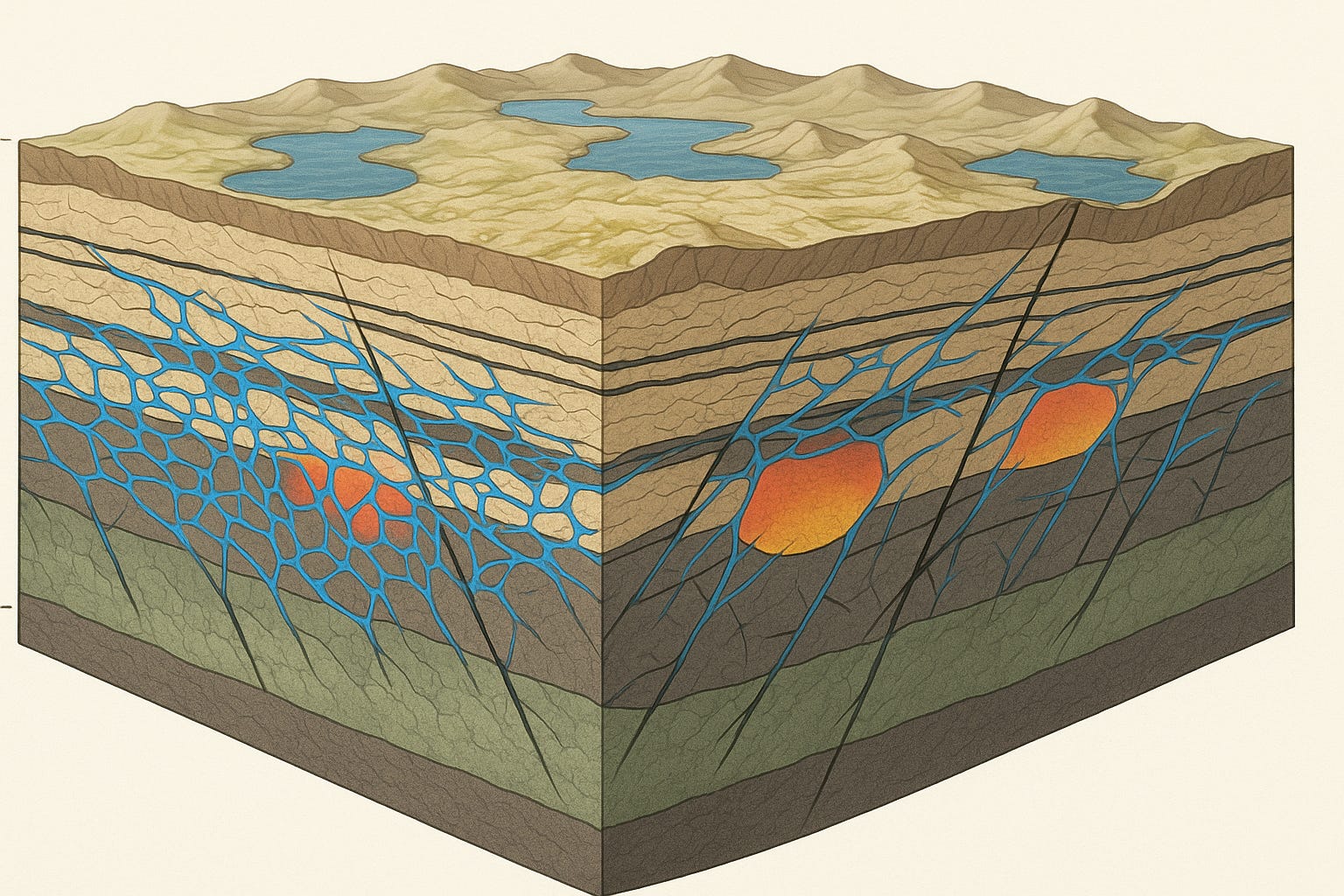
Figure 1: Pre-Flood Crustal Architecture. Cross-section showing multi-level water distribution (blue) throughout the crustal column, interconnected fracture networks, hydraulic seals (horizontal layers), and fault systems (black lines). Orange areas indicate heat sources. When seals failed catastrophically, this water-saturated system enabled rapid continental reorganization through hydroplaning.
This architecture isn’t ad hoc speculation. Modern analogs exist in overpressured sedimentary basins (Gulf Coast), décollement horizons in accretionary wedges, and serpentinized mantle wedges above subduction zones. The difference is scale and connectivity: the pre-Flood crust possessed these features globally and hydraulically linked.
The Geographic Context:
This water-saturated crustal architecture supported the pre-Fall world. The substantial population of Adam and Eve’s descendants (discussed earlier) lived on the pre-Flood supercontinent, spreading across diverse environments and adapting to different ecological zones. Their settlements, cities (Genesis 4:17), and agricultural systems (Genesis 4:2) all existed on this hydraulically-charged crustal foundation. The water networks that would later trigger catastrophic collapse were, during the pre-Fall and early post-Fall periods, part of the functional hydrological system supporting human civilization and ecological diversity.
7.1.1. Observational Confirmation: Earth’s Hidden Ocean
Here is where biblical prediction meets modern geophysical discovery. Genesis 7:11 describes the Flood mechanism: “all the fountains of the great deep burst forth.” This text, written over 3,000 years ago, predicts massive subsurface water reservoirs capable of catastrophic release.
In 2014, seismological studies confirmed what the biblical text had predicted: Earth’s mantle transition zone (410-660 km depth) contains 1-3 ocean masses of water structurally bound in high-pressure minerals (ringwoodite and wadsleyite). Graham Pearson and colleagues published their discovery in Nature, documenting a ringwoodite inclusion with ~1.4 wt% water trapped in a diamond from Brazil—providing the first direct evidence that the transition zone is hydrous (Pearson et al., 2014, Nature 507:221-224). Subsequent global seismic studies confirmed the transition zone contains approximately 0.64–1 ocean mass of water. This represents approximately 4-12 billion cubic kilometers of water, far exceeding the volume in all surface oceans combined.
Addressing the Mineral-Binding Objection:
The immediate objection is: “But that water is chemically bound in minerals now, not liquid, so it couldn’t have been available for a flood.”
This objection actually strengthens the LPI framework. The water is NOW bound in transition zone minerals BECAUSE it was sequestered there during and after the Flood. The current mineral-bound state is the END STATE of a catastrophic process, not evidence against it.
Consider the physics:
1. Water Storage Capacity ≠ Water Mobility
The transition zone minerals CAN hold 2-3 wt% H₂O. That capacity exists regardless of how the water got there. The fact that these minerals currently contain 1-3 ocean masses means that volume of water DID get transported into the transition zone somehow.
2. Subduction as Sequestration Mechanism
During the Flood, hydrated oceanic crust subducts into the mantle. As it descends past 410 km depth, increasing pressure converts olivine to wadsleyite and ringwoodite, which incorporate water into their crystal structures. This is observable in modern subduction zones, just at much slower rates. The Flood model proposes the same process operating at catastrophic rates during the hydraulic collapse year.
3. The Current State Requires a Source
Where did the transition zone water come from? The standard uniformitarian answer is gradual subduction over billions of years. But this creates problems: why isn’t the transition zone completely saturated if subduction has operated for 4+ billion years? Why do we observe such variation in transition zone water content regionally?
The LPI answer is more coherent: during the Flood year, massive volumes of crustal and surface water entered the mantle through catastrophic subduction. The transition zone captured what it could hold (1-3 ocean masses), and the remainder either:
Drained into newly deepened ocean basins as continents separated
Remained trapped in isolated crustal reservoirs
Continued deeper into the lower mantle
4. Direct Evidence of Prior Mobility
The very fact that water IS bound in transition zone minerals now proves it was transported there. The minerals didn’t form with water already in them; they incorporated water from a mobile source. The question isn’t whether mobile water existed, but when and how rapidly it was sequestered.
The Biblical Prediction Validated:
Genesis predicted massive subsurface water before anyone knew Earth’s interior structure. Modern geophysics confirmed exactly what the text described. The LPI framework explains:
Where that water was before (distributed throughout the crust and upper mantle)
What triggered its release (hydraulic seal failure)
Where it went after (ocean basins, transition zone sequestration, crustal trapping)
Why it’s mineral-bound now (post-Flood subduction and pressure conversion)
This is a case where Scripture’s testimony anticipated scientific discovery by millennia, and the discovery validates rather than contradicts the biblical account.
7.2. The Cascade Mechanism
“All the fountains of the great deep burst forth” describes catastrophic failure of crustal-scale hydraulic seals. Multiple triggers could initiate this:
Impact events: Large meteor impacts generate shock waves that fracture seals and create permeability where none existed
Seismic cascades: Earthquakes along pre-existing faults breach seals through shear displacement, triggering secondary failures as fluid migration alters stress fields
Basin overfill: Progressive sediment accumulation increases pore pressures until lithostatic values are approached and seals fail mechanically
Once initiated, cascade failure propagates: fluid migration increases pressures in adjacent zones, effective stress collapses, friction drops to negligible levels, and crustal blocks begin hydroplaning on thin water films along shallow detachment horizons.
The Velocity Reality:
One common objection is that catastrophic continental drift sounds impossibly fast. The actual numbers reveal otherwise. If South America separated from Africa during the Flood year (approximately 5,500 km over 365 days), the average velocity is approximately 0.6 kilometers per hour, or about 0.4 miles per hour. This is slower than normal walking pace. A person could literally stroll alongside a drifting continent.
The movement is catastrophic in scale and consequence, not in velocity. The extraordinary aspect isn’t speed but simultaneity: multiple continental blocks moving at human-scale velocities across a global hydraulic network, coordinated through cascading seal failure. This makes the phenomenon thermodynamically manageable (low friction forces, sufficient time for heat dissipation) while remaining geologically catastrophic (complete reorganization of crustal architecture within a single year).
7.3. The Critical Physics: Why This Doesn’t Overheat the Planet
Previous catastrophic plate models failed on thermodynamic grounds. Moving continental blocks thousands of kilometers through mantle shear generates heat exceeding Earth’s radiative capacity, producing surface temperatures incompatible with biosphere survival. This objection is not rhetorical but physical.
Hydraulic collapse bypasses this constraint entirely by shifting energy dissipation from deep mantle shear to shallow water-mediated processes:
1. Friction Collapse Through Hydraulic Pressure
When pore pressures approach lithostatic values, effective stress (σ_eff = σ_total - P_fluid) approaches zero. Since frictional resistance is proportional to effective stress, reducing effective stress to near-zero drops friction by orders of magnitude, from 0.6-0.85 (dry rock) to approximately 0.01 (water-lubricated). Continental blocks don’t push through high-friction contacts; they hydroplane on pressurized water films.
2. Energy Dissipation in Water, Not Mantle
The mantle remains largely passive during collapse. Blocks move by sliding on water films at shallow depths (upper to mid-crust, 5-20 km). Energy dissipation occurs through:
Turbulent flow in water films (heat capacity of water approximately 4× higher than silicate)
Fracturing at shallow depths where heat radiates efficiently
Phase changes (vaporization absorbs 2.26 MJ/kg without temperature increase)
Distributed strain over basin-scale volumes
The Dilatancy Factor:
A critical mechanism maintains permeability during motion. As crustal blocks shear, the fractured damage zones between them don’t compact and seal. Instead, they dilate (expand). This property, called dilatancy, is characteristic of granular materials under shear stress. As the material deforms, void spaces open faster than they close, maintaining high permeability throughout the motion. Laboratory experiments confirm that once shear begins in water-saturated granular material, dilation outpaces compaction, keeping fluid pathways open as long as movement continues.
This explains how water can continuously circulate through shear zones during the Flood year, removing heat faster than friction generates it. The system doesn’t gradually choke off its own cooling mechanism through compaction; it maintains fluid flow throughout catastrophic motion.
3. Genesis Itself Provides the Thermal Buffer
As confirmed by modern seismology (section 7.1.1), Earth’s mantle transition zone contains 1-3 ocean masses of water, representing approximately 4-12 billion cubic kilometers. Conservative estimates place the pre-Flood mobile crustal water volume at 4+ billion cubic kilometers. This reservoir has extraordinary thermal capacity:
Mass: approximately 4 × 10²⁴ kg
Heat capacity: 4,186 J/(kg·K)
To raise this water 100°C requires: approximately 1.67 × 10³⁰ J
For comparison, Earth’s total rotational kinetic energy is approximately 2.6 × 10²⁹ J. The water reservoir can absorb enormous energy through direct contact with heated rock, convection distributing thermal load, and phase transitions.
4. Quantitative Heat Budget
Moving ten continental-scale blocks (mass approximately 10²⁰ kg each) an average of 1000 km with friction coefficient 0.01 and effective stress reduced to 1% of lithostatic:
Total work: W approximately 10²³ J
Distributed over Earth’s surface (5 × 10¹⁴ m²) over one year (3 × 10⁷ s): approximately 7 W/m²
Compare to:
Earth’s geothermal flux: 0.09 W/m²
Solar input: 340 W/m²
An additional 7 W/m² is significant but manageable. Using Stefan-Boltzmann radiative balance, with T approximately 288 K:
Temperature increase: ΔT approximately 1 K
Completely negligible compared to the hundreds of Kelvin required in mantle-shear models.
7.4. The Divine Coordination Element
This is where LPI differs from purely naturalistic catastrophism. The mechanism works within physical law, but the coordination (timing of seal failure, distribution of water flow to high-energy zones, convection patterns ensuring thermal load distribution) represents God’s “admin-level commands” optimizing the natural capacity He designed into the system.
This isn’t eliminating the need for divine involvement. It’s demonstrating that God designed natural systems with sufficient capacity to handle the Flood when activated. The same God who accelerated cellular regeneration in healing miracles and compressed decades of decay into hours (fig tree withering) coordinates geological processes and thermal dissipation during the Flood, not by violating thermodynamics but by orchestrating a system with inherent capacity to function under catastrophic conditions.
7.5. Geological and Biological Consequences
Rapid Fossilization and Ecological Burial Patterns:
The pre-Fall population had spread across diverse ecological zones on the pre-Flood supercontinent, creating the habitat stratification we observe in the fossil record. When hydraulic collapse initiated:
Marine organisms (lowest elevations) were buried first as water flooded basins
Coastal and lowland populations (human and animal) were buried next
Highland populations were inundated later in the sequence
Catastrophic burial in water-saturated sediment explains fossil preservation, polystrate fossils spanning multiple layers, and the ordered ecological zonation that appears to suggest evolutionary progression but actually reflects pre-Flood habitat distribution
Similar fossil distributions across now-separate continents reflect their hydraulic connection when organisms were buried
Basin Collapse and Rapid Sedimentation:
Rapid subsidence as hydraulic support fails creates accommodation space for thick sedimentary sequences deposited in months rather than millions of years. Turbidity currents and density flows produce the layered deposits, graded bedding, and facies patterns we observe.
Continental Separation and Biogeographic Patterns:
During the Flood year, crustal blocks decouple and move rapidly (tens to hundreds of meters per hour) via hydroplaning, then re-couple to the mantle as water drains into ocean basins or subducts into the transition zone. Velocities drop from meters per hour to centimeters per year as the hydraulic network exhausts itself and conventional plate-driving forces reassert themselves.
This explains:
Rapid initial separation producing current continental configuration
Similar but distinct species on different continents (common ancestry, isolated adaptation)
Biogeographic distribution patterns reflecting both pre-Flood proximity and post-Flood isolation
Post-Flood Adaptation and Genetic Diversity:
The genetic diversity observable in modern populations doesn’t arise from random mutations after the Flood. Instead, it reflects the substantial pre-Fall population that had diversified across the supercontinent for an extended period (years, decades, centuries, or even millennia) before corruption spread and necessitated judgment.
Noah’s family carried genetic diversity from many generations of Adam and Eve’s descendants. When post-Flood populations separated onto isolated continents:
Existing genetic variation enabled rapid adaptation to new environments
Climate instability from new continental configuration drove speciation
“Kinds” diversified into the species we observe today, using genetic toolkits present from creation
This integrated model explains both the fossil record’s apparent structure and modern genetic diversity without requiring billions of years or evolutionary novelty generation.
Physical Evidence of Water-Mediated Catastrophic Motion:
The hydrotectonic model predicts specific geological signatures: rapid slip facilitated by circulating water in fractured shear zones. Modern geology provides exactly this evidence in detachment faults across the Alps, Japan, and the American West. These structures preserve:
Pseudotachylites: Thin glassy veins created during bursts of extremely rapid slip at seismic velocities, proving that catastrophic motion occurred
Cataclasites: Rock layers crushed into fine fragments during sudden brittle failure under high fluid pressures
Mylonites: Finely layered, intensely sheared rocks that were subsequently cut by new fractures while the shear zone was still actively moving
Chlorite and epidote minerals: These form only in cool, water-rich conditions and indicate advective cooling (rapid heat removal by circulating fluids rather than slow conduction through rock)
These are not theoretical predictions but observed geological features. They demonstrate that water-lubricated, catastrophically rapid slip with effective thermal management through fluid circulation is not speculative but documented in the geological record. The same mechanisms proposed for the Flood year operate on smaller scales in modern tectonic settings, providing direct observational validation of the physical principles underlying the hydrotectonic model.
7.6. Water Budget Closure
Where did the water go? As explained in section 7.1.1, modern geophysics has confirmed that Earth’s mantle transition zone currently holds 1-3 ocean masses of water. The model preserves Earth’s total water inventory through three mechanisms:
Surface drainage: Water migrates into newly opened ocean basins as blocks separate and basins deepen
Subduction sequestration: Hydrated oceanic crust subducts into the mantle transition zone (410-660 km depth) where water becomes structurally bound in ringwoodite and wadsleyite. These minerals can hold 2-3 wt% H₂O, representing 1-3 ocean masses.
Crustal isolation: Remaining water trapped in post-collapse reservoirs that are hydraulically isolated through compaction and seal reformation
The geophysically confirmed 1-3 ocean masses currently in the transition zone represent post-Flood sequestration of once-mobile surface and crustal water. This isn’t speculative reconstruction but observed reality: the water is there now because it was transported there during catastrophic subduction. The current mineral-bound state validates the biblical account of massive mobile water that Genesis predicted thousands of years before modern geophysics discovered it.
7.7. Transition to Modern Tectonics
As the hydraulic network exhausts itself (water drains into ocean basins or subducts into the transition zone), pore pressures drop, effective stress recovers, friction rises, and blocks re-couple to the underlying mantle. At this point, conventional plate-driving forces (slab pull, ridge push, mantle convection) reassert themselves and velocities drop from meters per hour to centimeters per year.
What we observe today as mantle-convection-driven plate tectonics is the post-Flood equilibrium state. The modern Earth exhibits all characteristics of a geothermal system because it is one, but this represents the state after hydraulic collapse exhausted the pre-Flood water network, not the mechanism that operated during the Flood year.
7.8. Why This Matters for LPI
The hydrotectonic mechanism demonstrates that LPI’s “programmatic intervention” framework isn’t just theological assertion but testable physical mechanism grounded in observational evidence.
Observational Validation: Genesis 7:11 predicted massive subsurface water (”fountains of the great deep”) over 3,000 years before modern seismology discovered 1-3 ocean masses in Earth’s mantle transition zone. This isn’t retrofitting; it’s biblical prediction confirmed by science.
Physical Coherence: God didn’t suspend thermodynamics during the Flood. He designed the crustal architecture with the capacity to reorganize rapidly when hydraulic seals fail, and He coordinated that reorganization to achieve specific outcomes.
This is the essence of LPI: natural processes operating as designed programs, with divine coordination optimizing their execution. The Flood represents the most dramatic example, but the principle (sophisticated natural capacity activated through divine timing and coordination) applies throughout the framework.
8. Addressing Scientific Objections
A. Cosmological Objections
Objection 1: Distant Starlight
“If the universe is only thousands of years old, how do we see galaxies billions of light-years away? Light should still be traveling toward us.”
Response:
Multi-threaded time architecture addresses this directly. During Day 4, cosmic processes execute on accelerated temporal parameters while Earth experiences normal 24-hour cycle. By evening of Day 4, the cosmos achieves synchronization with Earth’s timeframe.
This isn’t theoretical speculation: it’s analogous to documented biblical examples:
Cellular regeneration accelerated from weeks to instant in healing miracles
Fig tree withering accelerated from seasons to hours
If natural processes can be temporally accelerated in specific instances, Creation Week represents comprehensive temporal coordination across all cosmic systems.
Alternative Approaches Within LPI:
White hole cosmology (time dilation at cosmic boundaries)
Anisotropic synchrony convention (simultaneity definition affects light-travel calculations)
Created-in-transit light (functional creation requires functional light sources)
All approaches maintain that observed phenomena reflect real processes coordinated through divine temporal management.
Objection 2: Radiometric Dating
“Multiple independent radiometric dating methods consistently indicate Earth age in billions of years. How can all these methods be systematically wrong?”
Response:
Radiometric dating relies on critical assumptions:
Initial conditions (parent/daughter isotope ratios at formation)
Closed system (no contamination or loss over time)
Constant decay rates (no variation across deep time)
LPI Challenges to These Assumptions:
Initial Conditions: Functional creation requires integrated systems. When God created Adam, his cells contained functional DNA with methylation patterns that might appear to have repair history. When Jesus created wine, it contained chemical markers of fermentation. Similarly, rocks created with functional crystalline structure would contain isotope ratios reflecting that functional state, not necessarily zero-age ratios.
Accelerated Nuclear Decay: If God can accelerate biological, chemical, and geological processes, accelerated nuclear decay during Creation Week or the Flood becomes plausible. Evidence includes:
Helium retention in zircons (should have diffused away if truly ancient)
Radiohalos in coalified wood (suggests rapid formation)
Discordant isochron dates (different methods giving wildly different ages for same rock)
Contamination and Open Systems: Catastrophic Flood conditions would:
Mobilize radioactive elements through massive water movement
Create thermal conditions enabling isotope migration
Mix materials from different original locations
Invalidate closed-system assumptions for post-Flood samples
The Method Fails on Known-Age Samples:
Perhaps the most devastating challenge to radiometric dating’s reliability comes from testing it on samples of known age. Hawaiian lava flows that erupted in 1800-1801 AD have been dated using potassium-argon methods. The observed age: 200 years. The measured ages: ranging from tens of thousands to nearly three million years (Dalrymple, 1969).
When the method yields results off by four orders of magnitude on samples we know are only 200 years old, why should we trust it on samples whose age we don’t know?
The standard explanation invokes “excess argon” inherited from deeper crustal material. But this reveals the circular reasoning at the heart of radiometric dating: when results match expectations, the method works; when results contradict expectations, auxiliary explanations preserve the method’s validity. The method can never be wrong because every anomaly can be explained away.
If modern lava can contain “excess argon” that makes it appear millions of years old, how do we know ancient lava doesn’t contain the same issue? We don’t. We simply assume the method works on ancient samples because we’ve already committed to their antiquity through other uniformitarian assumptions.
The Fundamental Point: Dating methods measure current states and extrapolate backward using assumptions about initial conditions and process rates. Under LPI, those assumptions don’t hold for supernaturally-coordinated events.
B. Geological Objections
Objection 3: Sedimentary Layers and Geological Column
“Sedimentary layers show clear evidence of slow accumulation over millions of years: seasonal varves, undisturbed layers, and consistent fossil sequences that match evolutionary predictions.”
Response:
Varves and Layering: Catastrophic processes produce rapid layering. Modern observations demonstrate:
Mount St. Helens eruption (1980) created meters-thick stratified layers in hours
Laboratory flume experiments show fine laminations form rapidly under turbulent flow
Underwater turbidity currents create extensive layered deposits in single events
Fossil Sequence: The consistent fossil sequence matches hydrodynamic sorting and ecological zonation better than evolutionary progression:
Marine organisms buried first (lowest elevation, first inundated)
Terrestrial organisms buried progressively (higher elevation, later inundation)
Mobility affects burial order (slow organisms buried before fast)
Body density affects final position in sediment
Polystrate Fossils: Trees and other organisms spanning multiple sedimentary layers indicate rapid deposition, not gradual accumulation over thousands of years.
The Flood Model Predicts:
Massive erosion creating sediment volume
Rapid deposition from turbulent water
Sorting by size, density, and mobility
Catastrophic burial enabling fossilization
Global extent of sedimentary layers
All observations consistent with year-long global catastrophe.
The Evidential Scale: Observed Catastrophism vs. Assumed Gradualism
The comparison between what we actually observe versus what uniformitarianism assumes reveals a striking asymmetry:
Documented Catastrophic Events Creating Massive Geological Features:
Missoula Floods (Ice Age): Catastrophic drainage of glacial Lake Missoula carved the channeled scablands of eastern Washington in days. Features uniformitarians assumed required millions of years of gradual erosion were demonstrably created by single flood events.
Mount St. Helens (1980): Created stratified sedimentary layers meters thick in hours. Formed a 1/40th scale “Grand Canyon” (through unconsolidated sediment) in a single afternoon. Deposited polystrate tree trunks spanning multiple layers.
Submarine Turbidity Currents: Documented events have deposited extensive graded beds and layered sequences across hundreds of square kilometers in single catastrophic flows lasting hours to days.
Submarine Canyon Formation: Erosional features rivaling the Grand Canyon carved into continental slopes, best explained by catastrophic turbidity flows rather than gradual processes.
Observed Slow Geothermal/Gradual Processes Creating Similar Features:
[None at comparable scale]
The evidential comparison isn’t close. We have extensive documentation of catastrophic hydrological events creating precisely the types of geological features found globally. We have zero documented observations of slow, gradual processes creating similar features at remotely comparable scales.
The Methodological Inversion:
Standard uniformitarian geology:
Observes geological features (canyons, layered sediments, regional unconformities)
Assumes they formed gradually despite lack of observational precedent
Calculates vast timescales based on that assumption
Dismisses catastrophic explanations despite observational evidence
The LPI approach:
Observes geological features
Notes that catastrophic processes demonstrably create such features
Applies documented catastrophic mechanisms to explain global features
Integrates with biblical testimony of global catastrophe
Which approach follows observational evidence? The framework that extrapolates from what we’ve never seen, or the one that applies what we’ve repeatedly documented?
Objection 4: Continental Drift Rates
“Current plate tectonic rates are centimeters per year. At these rates, continental separation requires hundreds of millions of years, not thousands.”
Response:
Current rates assume uniformitarian processes. The Flood represents catastrophic deviation from normal operations.
Mechanism for Accelerated Drift:
When the supercontinent rifts:
Enormous tensional forces release suddenly
Mantle convection accelerates dramatically
Reduced viscosity from thermal effects enables rapid movement
Initial separation occurs in weeks to months, then decelerates
Modern analogy: Earthquake fault movement. Tectonic plates move millimeters per year normally, but during earthquakes, move meters in seconds. The Flood represents sustained “earthquake conditions” for the rifting process.
Evidence for Rapid Drift:
Mid-ocean ridges show symmetrical magnetic striping (rapid formation during Flood)
Subduction zones contain undeformed sediments (rapid burial before consolidation)
Continental fit is nearly perfect (recent separation, minimal erosion)
Objection 5: Ice Core Data
“Ice cores from Antarctica and Greenland show annual layers extending back hundreds of thousands of years, providing direct contradiction to Biblical Designism models.”
Response:
Layer Formation: Current ice cores assume one layer equals one year. However, multiple layers can form in single years:
Seasonal temperature variations create multiple freeze-thaw cycles
Storm events create distinct layers
Modern observations show multiple layers forming in single years
Post-Flood Climate Instability: The Ice Age following the Flood would create:
Extreme temperature variations
Frequent storm systems
Rapid ice accumulation
Multiple layer formation per year
Dating Correlation: When ice core layers are correlated with known historical events (volcanic eruptions with documented dates), discrepancies appear, suggesting layer counting overestimates age.
Objection 6: Soft Tissue Preservation in Fossils
“Soft tissues, including blood vessels, proteins, and even DNA fragments, have been found in dinosaur fossils supposedly 65+ million years old. However, these findings don’t challenge deep time because special preservation conditions can explain their survival.”
Response:
This objection reverses the evidential burden. The discovery of soft tissue in dinosaur fossils is direct observational evidence that falsifies deep time under standard biochemical decay rates.
The Empirical Reality:
Since Mary Schweitzer’s initial 2005 discovery, soft tissue has been found repeatedly in dinosaur fossils:
Flexible blood vessels in T. rex bone
Intact osteocytes (bone cells) with visible nuclei
Collagen and other proteins with preserved amino acid sequences
Hemoglobin residues
DNA fragments (though highly degraded)
Standard Biochemistry:
Under known decay rates:
DNA has a half-life of ~521 years; completely degraded within 6.8 million years maximum
Collagen degenerates within thousands to tens of thousands of years even under ideal conditions
Proteins denature and decompose on similar timescales
Soft tissues require exceptional conditions (desiccation, rapid freezing) to persist even centuries
The Post-Hoc Problem:
Naturalistic explanations require inventing novel preservation mechanisms after the discoveries:
“Iron cross-linking” - proposed after soft tissue found, not predicted beforehand
“Biofilm bacteria” - ad hoc explanation requiring bacterial contamination to exactly mimic original tissue
“Special chemical conditions” - unspecified and undemonstrated mechanisms
The Carbon-14 Convergent Evidence:
Soft tissue preservation gains additional support from carbon-14 detection in materials assumed to be ancient. Multiple accelerator mass spectrometry laboratories have consistently detected measurable C-14 in coal, petroleum, and diamonds. This presents a fundamental problem for deep time: C-14 has a half-life of approximately 5,730 years and decays completely within 100,000 years maximum. Materials millions to billions of years old should contain zero detectable C-14.
Yet multiple independent laboratories using different techniques consistently detect it. The evidence shows:
C-14 levels are consistent across different laboratories - If contamination varied by handling, results should vary widely
No correlation with sample handling procedures - Careful preparation yields the same results as standard preparation
Remains after rigorous chemical pretreatment - Procedures specifically designed to remove contamination do not reduce C-14 to zero
Distributed throughout diamond crystal structure - Not concentrated at surfaces where external contamination would appear, but distributed internally where contamination cannot penetrate
The standard explanation attributes all C-14 presence to contamination. But this explanation has become unfalsifiable: no matter what the evidence shows, it’s declared contamination because the alternative contradicts deep time. This is circular reasoning at its most transparent. The assumed antiquity of the samples is used as proof that C-14 must be contamination, which then confirms their antiquity.
Critical Questions:
Why wasn’t soft tissue preservation predicted before discovery if these mechanisms are robust?
Why do these “special conditions” preserve tissue for 65 million years but not prevent fossilization?
How do these mechanisms explain collagen sequences matching modern predictions for dinosaur phylogeny?
LPI Prediction:
Young earth framework predicts:
Soft tissue should exist in fossils (they’re only thousands of years old)
Preservation should be widespread, not exceptional
Biochemical signatures should match organismal biology, not contamination
The Evidence Favors LPI:
Soft tissue preservation doesn’t require elaborate post-hoc explanations under young earth; it’s the natural expectation. Deep time requires statistical miracles of preservation that strain biochemical understanding. This represents direct physical evidence favoring recent burial over millions of years.
Objection 7: Thermal Management Inadequacy
“Even with 4+ billion cubic kilometers of subsurface water, the energy from rapid continental drift would superheat the entire hydrosphere and atmosphere, effectively pressure-cooking the planet.”
Response:
This objection assumes we must account for thermal management using only naturalistic mechanisms without any coordination. But LPI explicitly integrates natural capacity with divine coordination; this isn’t circular reasoning but integrated design.
The Three-Part Answer:
1. Physical Capacity Exists: The calculations demonstrate that the subsurface water reservoir has thermodynamic capacity to absorb enormous energy. This isn’t speculation; it’s straightforward physics. The mechanism is sound even before considering coordination.
2. Coordination Optimizes Natural Capacity: God doesn’t eliminate thermodynamic constraints; He coordinates the system to operate within those constraints optimally:
Timing of reservoir breach relative to rifting
Distribution of water flow to high-energy zones
Convection patterns ensuring thermal load distribution
Phase transitions (steam generation) at optimal rates
3. The Thermal Problem Demonstrates Design: The fact that Genesis describes “fountains of the great deep” bursting forth at the exact time continental rifting occurs isn’t coincidence; it’s evidence of integrated design. The thermal buffer exists precisely where and when needed.
Critical Recognition: The objection shifts from “it’s physically impossible” to “it requires precise coordination”: which is exactly what LPI proposes. The framework succeeds if it demonstrates:
Natural mechanisms with sufficient capacity exist ✓
Divine coordination can optimize those mechanisms ✓
The coordination is consistent with biblical precedent ✓
The same God who accelerated cellular regeneration in healing miracles and compressed decades of decay into hours (fig tree withering) can coordinate geological processes and thermal dissipation during the Flood.
C. Philosophical and Epistemological Objections
Objection 8: Parsimony Violation
“LPI requires enormous numbers of complex, coordinated, unobserved supernatural interventions to maintain a specific interpretation of Genesis 1. Alternative models are more parsimonious, requiring fewer ad hoc supernatural acts.”
Response:
Parsimony isn’t always the best guide for truth; reality often proves more complex than our simplest explanations.
Alternative Models Have Hidden Complexity:
Theistic Evolution:
Requires coordinating evolutionary randomness with divine purpose
Must explain how undirected processes achieve directed outcomes
Creates theological problems: death before sin, God using wasteful/cruel methods
Old Earth Creationism:
Requires multiple creative interventions across vast timescales
Must reinterpret “day” despite consistent Hebrew usage
Struggles with Romans 5:12 and the origin of death
Naturalistic Evolution:
Requires extraordinary fine-tuning of countless parameters
Statistical improbabilities that strain credulity
Information emergence from non-information
LPI’s Complexity is Explicit Rather Than Hidden:
LPI openly acknowledges extensive divine activity during Creation Week and the Flood. This makes it intellectually honest about the extraordinary coordination required. The appearance of ad hoc complexity reflects our recognition that creation requires a Creator actively involved in the process.
Objection 9: Divine Character and Apparent Age
“Creating a cosmos with 13.8 billion years of detailed, consistent, information-rich ‘functional history’ (including light from supernovae that never happened) stretches functional maturity to become indistinguishable from deception.”
Response:
The Functional Creation Principle:
Every functional system contains components that appear to have history:
Adam created as adult (apparent age in cells, tissues, organs)
Wine at Cana (chemical markers of fermentation process)
Multiplied bread (grain growth, milling, baking history)
Healed tissues (cellular development history)
Functional creation requires integrated components. A star created to provide light must have characteristics of a light-producing star: internal fusion dynamics, spectral signatures, luminosity patterns. This isn’t deception but functionality.
The Interpretive Framework:
God reveals truth through multiple means:
Scripture - special revelation, God’s direct communication
Natural revelation - observable creation
Conscience - moral law written on hearts
If Scripture clearly teaches recent creation through divine speech acts (which it does through repeated “evening and morning” formula, Jesus’ affirmation in Mark 10:6, Exodus 20:11), then apparent age reflects functional creation, not deception.
The Epistemological Hierarchy:
LPI proposes that when special revelation (Scripture) and natural revelation (scientific interpretation) appear to conflict, special revelation provides the interpretive key. This is defensible for those committed to biblical authority; Scripture illuminates our understanding of creation, not the reverse.
The Alternative Creates Different Problems:
If we reinterpret Genesis to fit current scientific consensus, we face:
Which scientific consensus? (It changes)
By what hermeneutical principle do we decide which texts are figurative?
Does theological meaning depend on scientific discovery?
LPI maintains that functional creation is not deception when:
God has revealed the actual history through Scripture
The appearance serves necessary functional purpose
We’re given sufficient revelation to understand the truth
The question isn’t “Does creation look old?” but “Has God told us how He created?” LPI answers affirmatively to the second question.
9. Competing Worldviews and Their Faith Commitments
9.1. The Fundamental Recognition
As established in the introduction, every origins model contains non-testable elements and requires faith commitments. The choice is not between a model that requires miracles and one that doesn’t: the choice is about the kind of miracle one is willing to accept. This section examines the specific faith commitments required by each framework.
LPI Framework: Proposes ontological miracles: direct, purposeful acts of a transcendent Being.
Naturalistic Framework: Requires statistical miracles: events so astronomically improbable that they push the bounds of credulity, yet are asserted to have happened through unguided processes.
9.2. Naturalism’s Statistical Miracles
1. The Fine-Tuning Miracle
The fundamental constants of the universe must fall within infinitesimally narrow ranges for a life-permitting universe:
Gravitational constant: if altered by 1 part in 10⁶⁰, stars couldn’t form
Strong nuclear force: if 2% stronger, no hydrogen; 2% weaker, only hydrogen
Cosmological constant: tuned to 1 part in 10¹²⁰
This is like walking up to a control panel with 100 different dials, each requiring setting within a billionth of a billionth of a degree precision, and having a blindfolded person spin all dials randomly with perfect results.
The Naturalist’s Solution: Multiverse hypothesis: infinite unseen universes make our finely-tuned universe inevitable.
The Problem: By definition, other universes are causally disconnected from ours. We can never receive signals, travel to them, or empirically verify their existence. This is an appeal to unobservable infinity to explain away improbability: a faith commitment masquerading as science.
2. The Abiogenesis Miracle
Non-living, unguided chemicals must spontaneously organize into the first self-replicating, information-bearing cell. This requires:
Simultaneous emergence of code (DNA) and hardware to read the code (proteins/ribosomes)
Information-rich sequences arising from random chemistry
Self-replication machinery that can copy the information
Cellular membrane maintaining chemical gradients
Energy metabolism to power the system
This is like believing a tornado sweeping through a junkyard will assemble a fully functional computer with operating system and software. Not just the hardware: the programmed software too.
Current State of Abiogenesis Research:
Every origin-of-life experiment is designed and executed by intelligent chemists
All attempts produce simple organic molecules, never self-replicating cells
The most sophisticated experiments prove only that intelligence can synthesize life’s building blocks
The Expert Consensus from Within:
Dr. James Tour, one of the most cited chemists alive and a leading expert in synthetic nanomachines, has issued a standing challenge to the entire origin-of-life research community: “Show one peer-reviewed paper that solves even one of nine fundamental problems under honest prebiotic conditions—without human intervention.”
Tour doesn’t build theoretical models; he constructs molecular systems at the scale of viruses. His expertise in synthetic chemistry gives him unique insight into what unguided chemistry can and cannot accomplish. After reviewing every major claim in the field over five years, his assessment is unambiguous: we are not making progress toward solving abiogenesis. We are, in his words, “clueless.”
The nine fundamental problems he identifies remain unsolved:
Origin of information-rich biopolymers
Homochirality (all biological molecules having the same handedness)
Compartmentalization (cell membranes)
Energy coupling and metabolism
Replication machinery
Coordination of subsystems
Environmental plausibility
Concentration and purification
Temporal sequencing of events
As of 2025, the score remains 9-0. Every time a headline announces a “major breakthrough,” Tour reads the paper and demonstrates that the experiment only worked because researchers purified ingredients, timed reactions, adjusted conditions, and removed contaminants—exactly the intelligent intervention that undermines the claim of unguided chemistry.
When human hands are removed from the process, the chemistry collapses.
The Fundamental Problem: Information doesn’t arise from non-information through undirected processes. Every information system we’ve ever observed traces back to an intelligent source.
3. The Information Miracle
The Cambrian Explosion presents Darwin’s most acute problem. In a geological instant (~10-15 million years), nearly all major animal phyla appear in the fossil record with:
Complex body plans
Specialized organs
Novel genetic information
No clear precursors
Darwinian evolution predicts gradual accumulation of small changes. The Cambrian shows abrupt appearance of radical novelty. This is like expecting random typos in calculator code to eventually generate Microsoft Office, 3D graphics engines, and AI systems.
The Core Issue: Random mutations filtered by natural selection must generate vast quantities of new, functional genetic information. But:
Most mutations are neutral or harmful
Beneficial mutations are extraordinarily rare
Coordinated multi-mutation changes (required for new organs/systems) are statistically impossible
Natural selection preserves existing function; it doesn’t create new information
9.3. Naturalism’s Non-Testable Black Boxes
1. Multiverse Hypothesis
By definition unobservable and untestable. An appeal to infinite unseen worlds to explain the one world we see.
2. Abiogenesis Mechanisms
Cannot recreate specific, unknown early Earth conditions. Cannot demonstrate unguided processes generating information-rich, self-replicating systems.
3. Macroevolutionary Extrapolation
Microevolution (variation within kinds) is observable. Macroevolution (new body plans, novel organs, genetic information increase) has never been directly demonstrated. It’s a philosophical extrapolation into the unobservable past.
4. Consciousness from Matter
No physical experiment can detect or measure subjective experience. Naturalism simply asserts that matter, when sufficiently complex, produces mind: a philosophical statement of faith, not a testable scientific claim.
9.4. Comparative Framework Analysis
FeatureLPINaturalismFine-TuningSingle Programmer (ontological miracle)Infinite unseen universes (non-testable postulate)First LifeDirect creative act (divine intervention)Unknown, unguided pathway (non-testable historical event)Complex LifePre-programmed genetic toolkits + rapid adaptationUnguided macroevolution (non-testable extrapolation)ConsciousnessMind created by Ultimate MindMind emerges from matter (non-testable philosophical claim)InformationIntentional programmingAccidental coding (statistical miracle)Geological RecordCatastrophic burial (Flood)Gradual accumulation (uniformitarianism)Fossil DiversityPre-Fall adaptation + post-Flood speciationEvolutionary descent over millions of years
10. Framework vs. Hypothesis: The Crucial Distinction
10.1. LPI as Interpretive Framework
LPI is not a scientific hypothesis in the Popperian sense but a comprehensive interpretive framework: a hermeneutic for reality. It operates with the primary axiom that biblical text is the foundational data set through which all other data must be interpreted.
Scientific Hypothesis:
Subordinate to empirical data
Can be falsified by contradictory evidence
Adjusts to accommodate observations
Makes specific predictions testable by experiment
Interpretive Framework:
Superordinate to empirical data
Data is integrated, reinterpreted, or explained within the framework’s axioms
Provides the lens through which observations gain meaning
Makes broad explanatory claims about reality’s fundamental nature
LPI functions as a theological operating system where scientific data are “applications” running on biblical axioms. The framework determines how data is processed and interpreted.
10.2. The Falsifiability Question
Critics argue LPI is unfalsifiable and therefore unscientific. This critique misunderstands the framework’s nature and applies an inappropriate standard.
LPI’s Response:
1. All Origins Models Have Unfalsifiable Core Commitments:
Naturalism: “Only natural causes exist” (how would you falsify this?)
Multiverse: “Unobservable universes exist” (inherently unfalsifiable)
Deep time uniformitarianism: “Past rates equal present rates” (historically unrepeatable, thus unfalsifiable)
2. Falsifiability Isn’t the Only Criterion for Good Explanation:
Philosopher of science Larry Laudan demonstrated that falsifiability alone doesn’t distinguish science from non-science. Better criteria include:
Explanatory power
Internal consistency
Predictive success
Problem-solving effectiveness
Integration of diverse phenomena
3. LPI Makes Testable Auxiliary Predictions:
While the core framework (God created) isn’t falsifiable, specific mechanisms are:
Flood model predicts rapid sediment deposition (testable through geological observation)
Pre-Fall population model predicts genetic diversity patterns (testable through genomics)
Catastrophic plate tectonics predicts specific geological features (testable through field research)
Young earth predicts carbon-14 in diamonds, soft tissue in dinosaur fossils (both confirmed - see Objection 6 for detailed treatment)
4. Competing Models Aren’t Falsifiable Either:
The falsifiability standard, if consistently applied, eliminates competing models:
Abiogenesis is unfalsifiable (unobserved, unrepeatable origin event)
Multiverse theories are unfalsifiable (by definition unobservable)
Macro-evolutionary transitions are historically unrepeatable
Deep time uniformitarianism assumes unobserved consistency
10.3. Epistemological Conclusion
The debate is not science versus faith, but a clash of comprehensive, faith-based worldviews, each with its own miracles and non-testable black boxes.
LPI succeeds because it:
Acknowledges this reality upfront (epistemological honesty)
Provides superior explanatory coherence for those committed to biblical authority
Integrates scientific discovery without compromising scriptural teaching
Offers physical mechanisms where possible while acknowledging divine coordination where necessary
Naturalism often presents its non-testable components under the guise of established science, hiding faith commitments behind mathematical formalism and technical jargon. LPI makes its commitments explicit: Scripture provides the foundational interpretive framework, and scientific investigation operates within that framework.
11. Conclusion: Integration and Intellectual Honesty
Literal Programmatic Intervention stands as an intellectually sophisticated framework that integrates biblical fidelity, scientific engagement, epistemological honesty, and explanatory power into a coherent whole.
LPI maintains biblical fidelity by taking Genesis literally without imposing modern assumptions. It respects the grammatical-historical interpretation of Scripture, honors Jesus’ affirmation of recent creation in Mark 10:6, and preserves theological integrity by placing death after sin rather than before it. The framework treats Scripture as what it claims to be: the eyewitness testimony of the Creator Himself.
The framework engages scientific discovery by providing physical mechanisms for catastrophic events rather than simply asserting miracles. It accounts for fossil diversity through pre-Fall adaptive radiation, explains geological features through Flood catastrophism with thermodynamically feasible mechanisms, and addresses cosmological observations through multi-threaded temporal coordination. LPI demonstrates that Biblical Designism can propose concrete, testable mechanisms rather than retreating into vague appeals to divine mystery.
LPI demonstrates epistemological honesty by acknowledging that all origins models require faith commitments. It exposes naturalism’s statistical miracles and non-testable assumptions (multiverse, abiogenesis, macroevolution, consciousness from matter) while making its own interpretive framework explicit rather than hidden. The framework recognizes the limits of both special and natural revelation, maintaining that Scripture provides the interpretive key for understanding natural phenomena when the two appear to conflict.
The framework offers explanatory power by integrating diverse phenomena into a coherent system. It resolves apparent contradictions between Scripture and observation, provides mechanisms that respect both divine sovereignty and natural law, and maintains internal logical consistency. The discovery of 1-3 ocean masses of water in Earth’s mantle transition zone exemplifies this: Genesis 7:11 predicted massive subsurface water millennia before modern geophysics confirmed it.
The fundamental question isn’t “Which model is simpler?” or “Which requires fewer miracles?” The question is: Which miracles are you willing to accept?
Ontological miracles (God acts) or statistical miracles (impossible things happen randomly)?
A transcendent Programmer who codes reality with purpose, or blind forces that accidentally generate information, consciousness, and meaning?
For those committed to biblical authority and engaged with scientific discovery, LPI provides a robust framework integrating both without compromising either. It demonstrates that Biblical Designism can be philosophically sophisticated, scientifically engaged, and intellectually honest about the nature of all origins claims.
The Ultimate Systems Architect designed creation to reveal His glory through both special revelation (Scripture) and natural revelation (observable universe). LPI provides the interpretive key to understanding both books: recognizing that the Word who spoke creation into existence has also spoken to us about how He did it.
“The heavens declare the glory of God, and the sky above proclaims his handiwork.” (Psalm 19:1)
Reading Guide
1. “When the Deep Burst Open: How Earth’s Ancient Water System Makes the Global Flood Mechanically Coherent”
https://www.oddxian.com/p/when-the-deep-burst-open-how-earths
The comprehensive hydrotectonic collapse mechanism explaining how rapid continental reorganization occurs without thermal runaway. Provides the full technical treatment of the Flood physics summarized in this paper.
2. “What Radiometric Dating Really Measures: Understanding the Assumptions Behind Deep Time”
https://www.oddxian.com/p/what-radiometric-dating-really-measures
A Lakatosian analysis showing how radiometric dating operates as a research programme with protected assumptions and circular reasoning. Demonstrates that deep-time chronology requires faith commitments just as Biblical Designism models do.
3. “We Are Nowhere Near Solving the Origin of Life Problem”
https://www.oddxian.com/p/we-are-nowhere-near-solving-the-origin
Examines naturalism’s abiogenesis crisis through six decades of failed hypotheses. Documents the statistical miracles required for life to emerge from non-living chemistry without design.
4. “Introducing the Duality Argument: Why Consciousness Points to Design”
https://www.oddxian.com/p/introducing-the-duality-argument
Philosophical foundation showing why mind emerging from matter represents an unbridgeable explanatory gap. Establishes that consciousness from Ultimate Mind is more coherent than consciousness from matter.
5. “Divine Design: A Systems Architecture Framework for Creation”
https://www.oddxian.com/p/divine-design-a-systems-architecture
The complete Literal Programmatic Intervention framework integrating biblical authority with systems engineering principles. (This paper)
References
Dalrymple, G.B. (1969). 40Ar/36Ar Analyses of Historic Lava Flows. Earth and Planetary Science Letters 6, 47-55.
Pearson, D.G., Brenker, F.E., Nestola, F., McNeill, J., Nasdala, L., Hutchison, M.T., et al. (2014). Hydrous mantle transition zone indicated by ringwoodite included within diamond. Nature 507, 221–224. https://doi.org/10.1038/nature13080
Acknowledgments
This framework has been refined through conversations with resources in systems engineering, theology, and the natural sciences. Special thanks to those who challenged assumptions, pressed for clarity, and demanded rigor in both biblical exegesis and scientific explanation.
Author Information:
James (JD) Longmire
ORCID: 0009-0009-1383-7698
Northrop Grumman Fellow (unaffiliated research)
Soli Deo Gloria