

“Street evangelism” can mean a lot of things.
For some, it means a Christian starting a thoughtful conversation with someone in a park, on a college campus, or downtown. For others, it means handing out tracts, offering prayer, or sharing the gospel in a public square. For still others, it brings to mind a person with a microphone preaching loudly to people who did not ask to listen.
So—is it biblical?
The short answer is that public witness is biblical. But every modern expression of “street evangelism” is not automatically biblical.
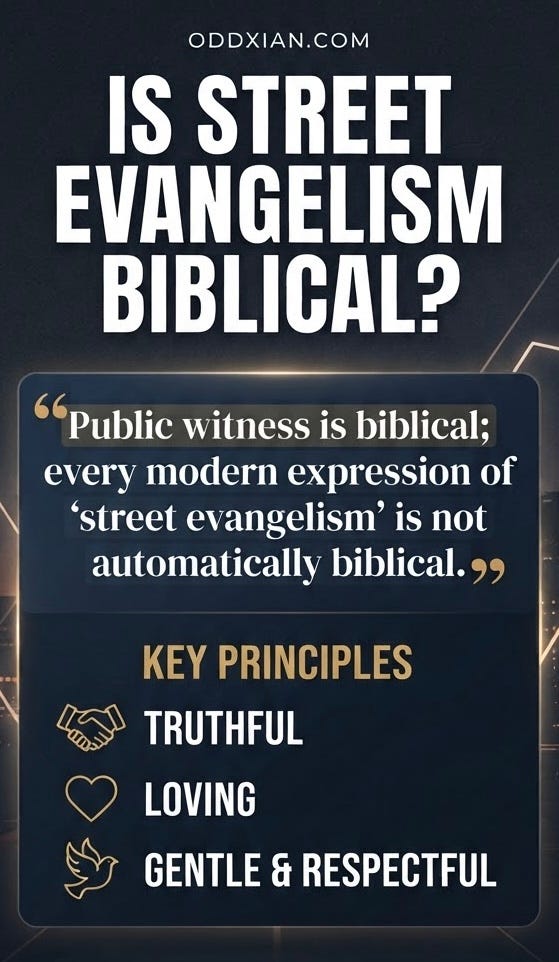
The Bible clearly calls Christians to speak about Jesus beyond the walls of the church. It also gives clear guidance about how we speak: truthfully, humbly, wisely, gently, and with real love for the people in front of us.
The gospel was never meant to stay indoors
Jesus did much of his ministry in public.
He taught in villages, synagogues, homes, on hillsides, by the sea, and in the temple courts. He did not wait for people to find their way into a religious building before speaking to them about the kingdom of God.
The same is true in Acts. After the Holy Spirit came at Pentecost, Peter stood before a crowd in Jerusalem and proclaimed Christ openly. The early Christians taught in the temple courts and in homes. Paul spoke in synagogues, but he also reasoned with people in the marketplace in Athens.
That matters. It shows that Christian witness is not meant to be confined to Sunday services, church programs, or private religious settings.
Jesus’ commission is outward-facing:
“Go therefore and make disciples of all nations…”
Matthew 28:19
Christians are sent people. We are called to bear witness to Jesus in the ordinary places where people live, work, shop, study, and gather.
In that broad sense, there is certainly biblical warrant for sharing the gospel in public.
But public is not the same as faithful
Still, the fact that public evangelism is biblical does not mean every public approach is wise or Christlike.
The New Testament does not command Christians to stand on a street corner with a loudspeaker. It does not say every believer must confront strangers, shout at passersby, or turn every public space into an impromptu sermon venue.
Nor does it teach that a negative reaction proves we have been faithful.
Sometimes people reject the gospel because the gospel confronts us. It tells us that we are sinners, that we need repentance, and that salvation is found in Christ—not in our morality, achievements, or religious effort. That message can be hard to hear.
But Christians should be careful here. There is a difference between people being offended by the truth of Christ and people being offended by our manner.
If someone is upset because we were arrogant, insensitive, combative, careless, or disrespectful, we should not quickly congratulate ourselves for being persecuted. The apostle Peter tells believers to be ready to explain their hope “with gentleness and respect” (1 Peter 3:15).
The goal is not to be loud. The goal is to be faithful.
Paul’s example: public, thoughtful, and engaged
Paul’s ministry in Athens is helpful.
Acts 17 says that Paul reasoned with people in the marketplace. He did not merely announce a message and disappear. He listened, observed, answered questions, and spoke in terms his hearers could understand.
When he addressed the philosophers at the Areopagus, he began with their actual religious environment. He noticed their altar “to an unknown god” and used it as a bridge to explain the God they did not know.
Paul did not compromise the gospel. He still spoke about God as Creator, humanity’s accountability to God, repentance, judgment, and the resurrection of Jesus. But he communicated in a way that was attentive to his audience.
That is an important model for public evangelism today.
Public witness does not have to mean talking at people. It can mean talking with them.
It can involve questions, listening, honest answers, prayer, hospitality, acts of service, and an invitation into real Christian community.
The Bible’s standard for our speech
The New Testament gives us several principles that should shape any kind of evangelism—on the street, at work, online, at a coffee shop, or across the dinner table.
Speak the truth.
The gospel is good news because it is true.
Christian witness should not avoid difficult realities: sin, repentance, the cross, resurrection, judgment, grace, and the lordship of Christ. We should not reduce the gospel to “God wants you to be happy” or “Jesus will improve your life.”
Jesus is not merely an accessory to an already comfortable life. He is Lord, Savior, King, and the One through whom sinners are reconciled to God.
Speak with love.
Truth and love belong together.
Ephesians 4:15 calls Christians to speak “the truth in love.” If our words are correct but our posture is cruel, impatient, or self-righteous, something is badly out of order.
We are not speaking to projects, opponents, or interruptions. We are speaking to people made in God’s image—people with stories, wounds, fears, sins, questions, and eternal significance.
Speak with gentleness and respect.
Peter’s instruction is especially important:
“Always be prepared to make a defense to anyone who asks you for a reason for the hope that is in you; yet do it with gentleness and respect.”
1 Peter 3:15
Gentleness is not cowardice. Respect is not compromise.
A Christian can speak clearly about Christ’s exclusive claims while still treating another person with dignity. We can disagree without mocking. We can answer objections without becoming defensive. We can be bold without being abrasive.
Avoid needless quarrels.
Paul tells Timothy that “the Lord’s servant must not be quarrelsome but kind to everyone” (2 Timothy 2:24).
That does not mean Christians never debate, answer objections, or confront falsehood. Paul certainly did those things. But argument should not become the point. Winning a public exchange is not the same as winning a person.
The aim is repentance, restoration, and faith—not humiliation.
What might faithful street evangelism look like?
Street evangelism can be healthy when it is rooted in love for Christ and love for neighbor.
It may look like offering to pray with someone who is hurting. It may mean asking whether a person would be open to a spiritual conversation. It can mean engaging someone’s real questions about God, suffering, Jesus, or the Bible. It may involve giving out literature without pressure or manipulation.
It can also mean speaking publicly where people have gathered to listen, serving a neighborhood while being ready to explain the hope behind that service, inviting someone into a local church community, or simply having ordinary gospel conversations with people you naturally encounter.
The key is not whether the interaction happened inside or outside.
The key is whether Christ is being faithfully represented.
Making disciples, not just moments
Jesus did not merely command his followers to make converts. He told them to make disciples.
That means evangelism should not end with a quick prayer, a raised hand, or a tract accepted on a sidewalk. Those things may be meaningful, but they are not the whole mission.
Discipleship includes baptism, teaching, fellowship, obedience, prayer, and belonging to the body of Christ. A faithful outreach strategy should ask: If someone responds, where will they be cared for? Who will walk with them? How will they grow?
The local church matters here.
Street conversations can plant seeds. Public preaching can awaken interest. A brief encounter can be used by God in a person’s life. But people need more than a moment of contact. They need the ongoing life of Christian community.
So, is street evangelism biblical?
Yes—if by “street evangelism” we mean taking the gospel into public life and lovingly, courageously sharing Christ with people outside the church.
No—if we mean that every Christian must adopt a particular public-preaching method, or that harshness, disruption, and confrontation are automatically marks of faithfulness.
The Bible calls Christians to go. It calls us to speak. It calls us to bear witness to Jesus.
But it also calls us to do so with wisdom:
“Walk in wisdom toward outsiders… Let your speech always be gracious, seasoned with salt.”
Colossians 4:5–6
The church does not need to choose between boldness and kindness. In Jesus, we are called to both.
The question is not simply, “Are we willing to speak in public?”
A better question is this: Are we representing Christ in a way that is truthful, loving, wise, and aimed at helping people become his disciples?
Soli Deo Gloria