

Note: this article was sparked by this debate between Alex O’Connor and William Lane Craig. I’m hoping WLC gets a chance to see this because I think it may be a compliment to his defense of the Kalam Cosmological Argument.
Start with something that sounds almost too simple to argue about: whatever begins to exist has a cause, the universe began to exist, so the universe has a cause. That’s the Kalam cosmological argument, and the name is worth a second. “Kalam” is the Arabic word for medieval theology, and the argument has deep roots in that tradition. Its sharpest early champion was al-Ghazali, the Persian theologian writing around the turn of the twelfth century, who was alarmed that the philosophers of his day had absorbed the Greek assumption of an eternal universe. He thought a universe with no beginning was not just false but incoherent, and he built a case for why.
For a long time after Kant the argument was treated as a museum piece. Then in 1979 William Lane Craig published a book called The Kalam Cosmological Argument and almost single-handedly dragged it back into serious philosophy, where it has stayed. By one count there have since been more journal articles on the Kalam than on any other contemporary argument for God’s existence, from defenders and critics alike. Craig’s contribution was not just to dust off the old syllogism but to defend its hard premise, the claim that the universe began, on two fronts at once. Philosophically, he argued that an actual infinite cannot exist in reality, and that even if it could, you could never form one by adding one moment after another. Scientifically, he leaned on the expansion of the universe and the thermodynamic arrow. The first premise, that whatever begins has a cause, he treated as nearly undeniable. The whole weight of the dispute falls on the second.
And that second premise is where the interesting fight happens, because here’s the comeback that sounds devastating the first time you hear it. The Kalam says you can’t have an infinite past, because you’d never finish crossing it to get to now. And the skeptic leans back and asks: an infinite number of what, exactly? Seconds? Those are just a convention, we invented them. Moments? What even is a moment, metaphysically. Events? Tell me how you’re individuating an event, because “lifting a cup” is also a billion quantum interactions, so how many events was that. The whole argument seems to dangle on a unit of measurement nobody can pin down.
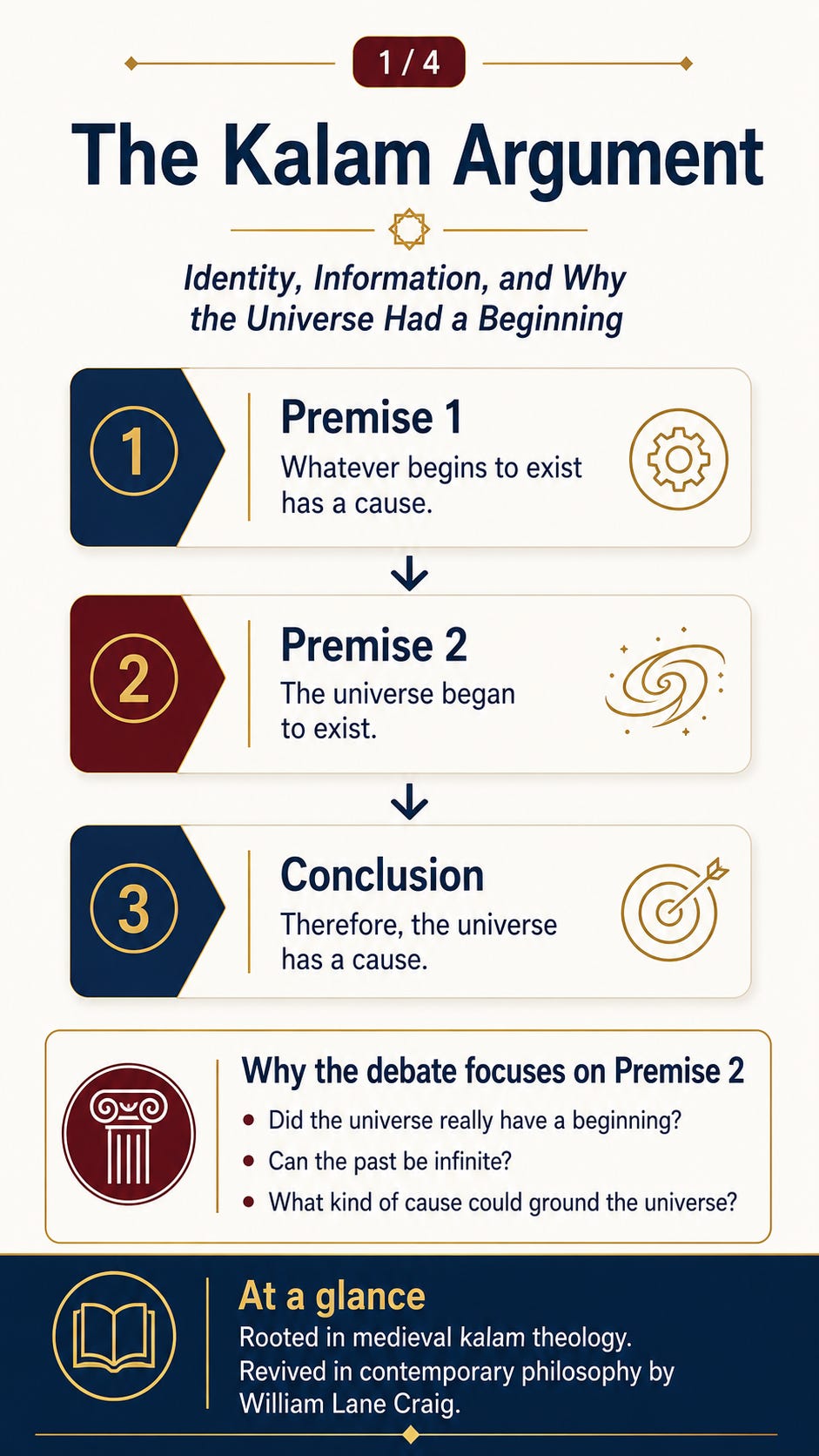
The Kalam cosmological argument: two premises and a conclusion. The whole dispute falls on the second premise, that the universe began to exist.
It’s a fair hit. And the usual responses tend to flail around defending whichever unit got attacked, which is a losing game, because the skeptic just attacks the next one.
I think the unit is the problem, and there’s a better one. Not seconds, not moments, not events. Information states.
Here’s what I mean by that, and I want to be careful because “information” is a slippery word that means three different things and people slide between them without noticing. Sometimes “information” means the abstract content, the proposition, the description of how things are. That’s the immaterial sense, the same way the number seven is immaterial. If that’s what the past is made of, the argument’s already dead, because abstract objects don’t get crossed or traversed, you just have infinitely many of them sitting there like the integers and nobody cares. So that’s not it.
Sometimes “information” means the actual concrete configuration. This field has this value, space has this shape, the entropy is this. The real, physical, instantiated way things are. That’s the sense I want.
And sometimes “information” means the logical structure of that configuration, the fact that it’s determinate, that it’s this and not that, that it isn’t a contradiction. That third sense is doing quiet but crucial work, and I’ll come back to it.
So here’s the reframe. The universe changes. For it to change, it has to pass through, or be ordered as, distinct states. And here’s the part that does the heavy lifting: each state is distinct because it has its own identity. It is this exact configuration rather than some other one. That’s just the law of identity doing its job. If two supposed states were identical in every single respect, they wouldn’t be two states, they’d be one state you described twice. So real difference between states requires real identity. No identity, no distinct states. No distinct states, no change. No change, no universe like ours.
Notice what just happened. The skeptic asked “an infinite number of what?” and the answer is no longer a wobbly human convention. It’s an infinite number of uniquely identifiable concrete configurations of reality. You can’t dismiss those as units we made up, because they’re not units we made up. They’re determinate ways the physical world actually was.
And that third sense of information, the logical structure, is what makes this airtight. The thing that makes each state a distinct countable member of the series is the law of identity. But I should be careful how I say that, because logic isn’t some extra gear in the machine doing work alongside the physics. It isn’t an agent. It’s the condition under which distinct states can obtain at all. The laws of logic aren’t further items floating in the series next to the physical states; they’re what makes individuation possible in the first place.
We tend to treat logic as a set of human conventions, useful habits of reasoning we agreed to follow. But the three classical laws don’t behave like conventions. Identity, non-contradiction, and the excluded middle hold everywhere, all the time, for everything that is, and you can’t even argue against them without using them. That’s the mark of a necessary truth, not a cultural one. Reality is ordered, reason is reliable, and truth is possible, because logic is ontologically real.
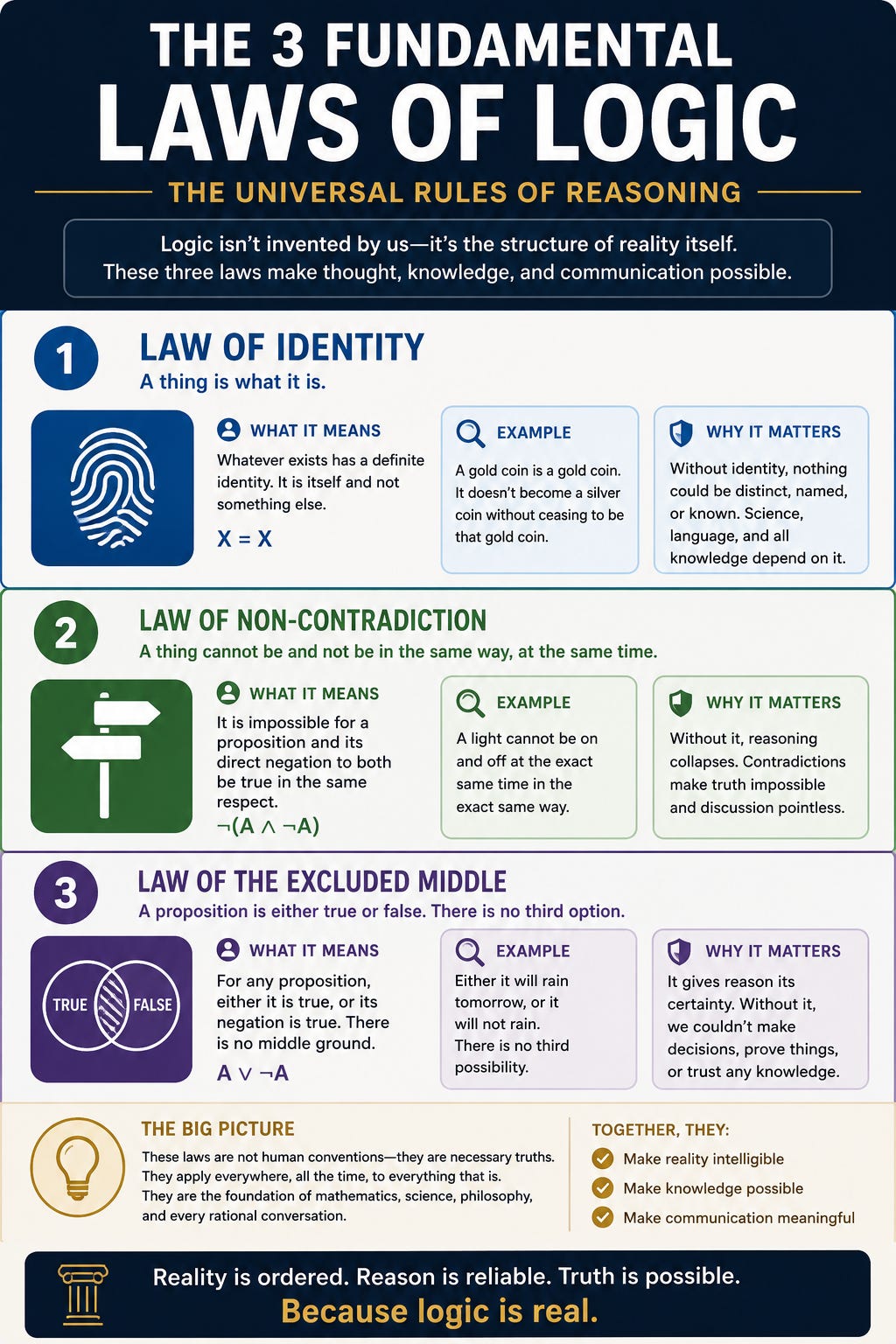
The immaterial constraint is what lets there be distinct members; the physical configurations are the members. And the distinctness is out there in the world, not in our descriptions. I’m not making the weak claim that we can describe one state in two ways. I’m making the strong one, that the states are objectively different configurations of reality, and they’d be different whether or not anyone was around to label them. Keep that straight and the whole thing clicks into place.
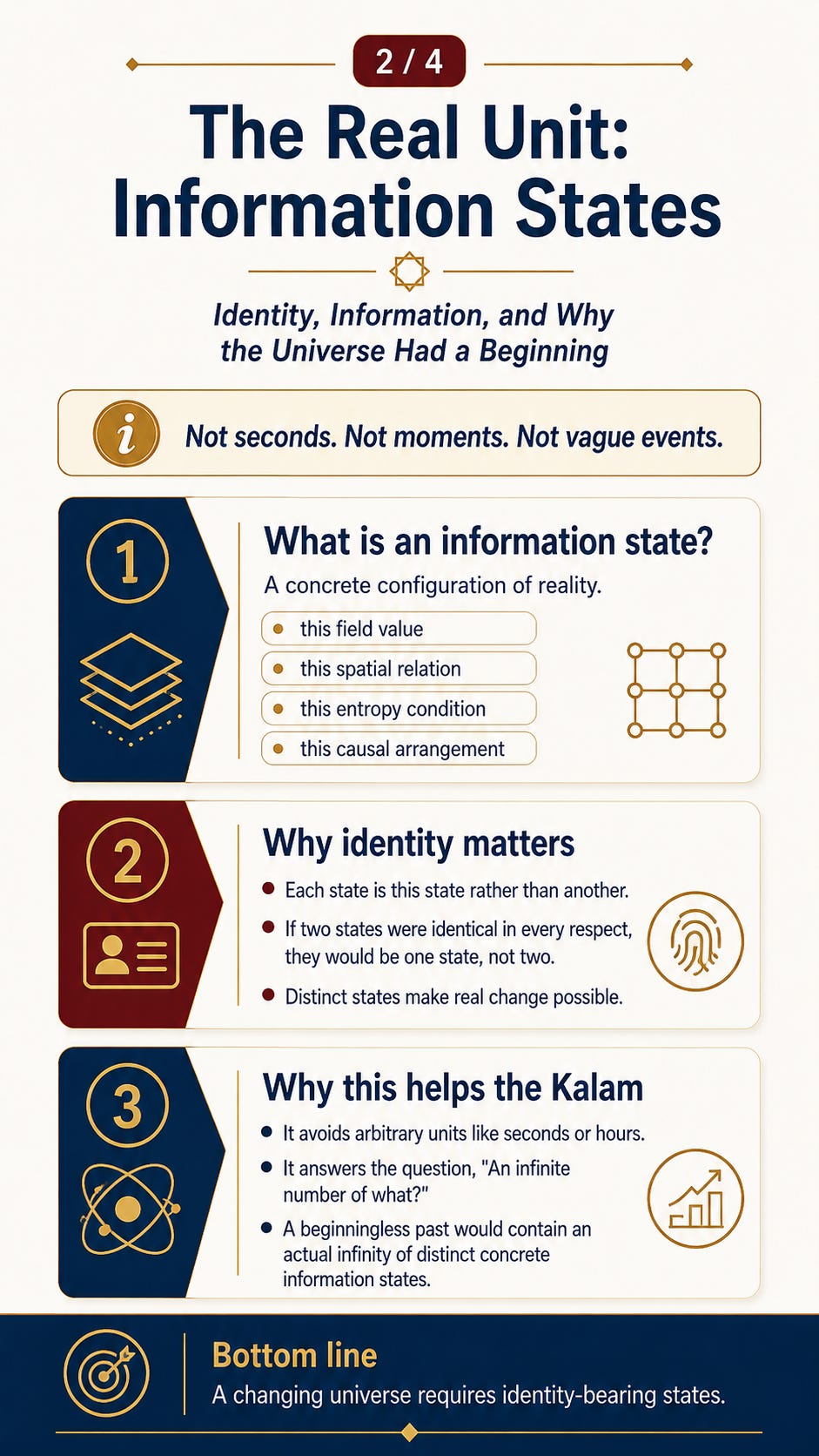
The proposed unit. Not seconds or vague events, but concrete, identity-bearing information states, individuated by the law of identity.
Now, somebody who knows the literature is going to try to wriggle out through the theory of time. Quick background, because the two camps have names. The A-theory says time really flows: there’s a real now, the past genuinely elapsed and is gone, the future isn’t here yet, and “becoming” is an objective fact about the world. The B-theory denies all that. It says the flow is an illusion of perspective, and that all moments, past, present, and future, are equally real and just sit there in a four-dimensional block, related to each other as earlier-than and later-than but with no moving “now” and no genuine becoming. Think of the A-theory as a spotlight sweeping along a filmstrip, and the B-theory as the whole filmstrip laid out at once with no spotlight. So the B-theorist’s escape goes like this: on my view nothing is really “becoming,” all moments just exist tenselessly in the block, so your whole “you can’t cross an infinite past” picture never even gets started, because nothing’s being crossed.
I don’t think that escape works, and here’s why, without me having to win some giant fight about the metaphysics of time. Whatever time turns out to be, it’s the ordering of these states. It’s not a container that existed first and then got filled. So pick your favorite theory. If you’re an A-theorist, prior states really existed and really elapsed. If you’re a B-theorist, earlier states sit in a tenseless earlier-than relation to later ones inside the block. Either way you’ve got an ordered lineup of distinct concrete states. And if the past is beginningless, either way that lineup is an actual infinity of them stretching back with no first member. The argument doesn’t care which theory of time you hold. It runs the same on both. So the theory-of-time dodge isn’t a dodge, it just changes the vocabulary while leaving the actual question untouched.
The B-theorist might come back one more time and say, fine, you’ve handed me a nice foundation for my block universe, but you still haven’t shown the block is finite, a beginningless block is perfectly consistent. And my answer is: right, the time stuff was never supposed to prove finitude. That was never its job. Its job was just to stop you from escaping through a side door. The finitude comes from somewhere else.
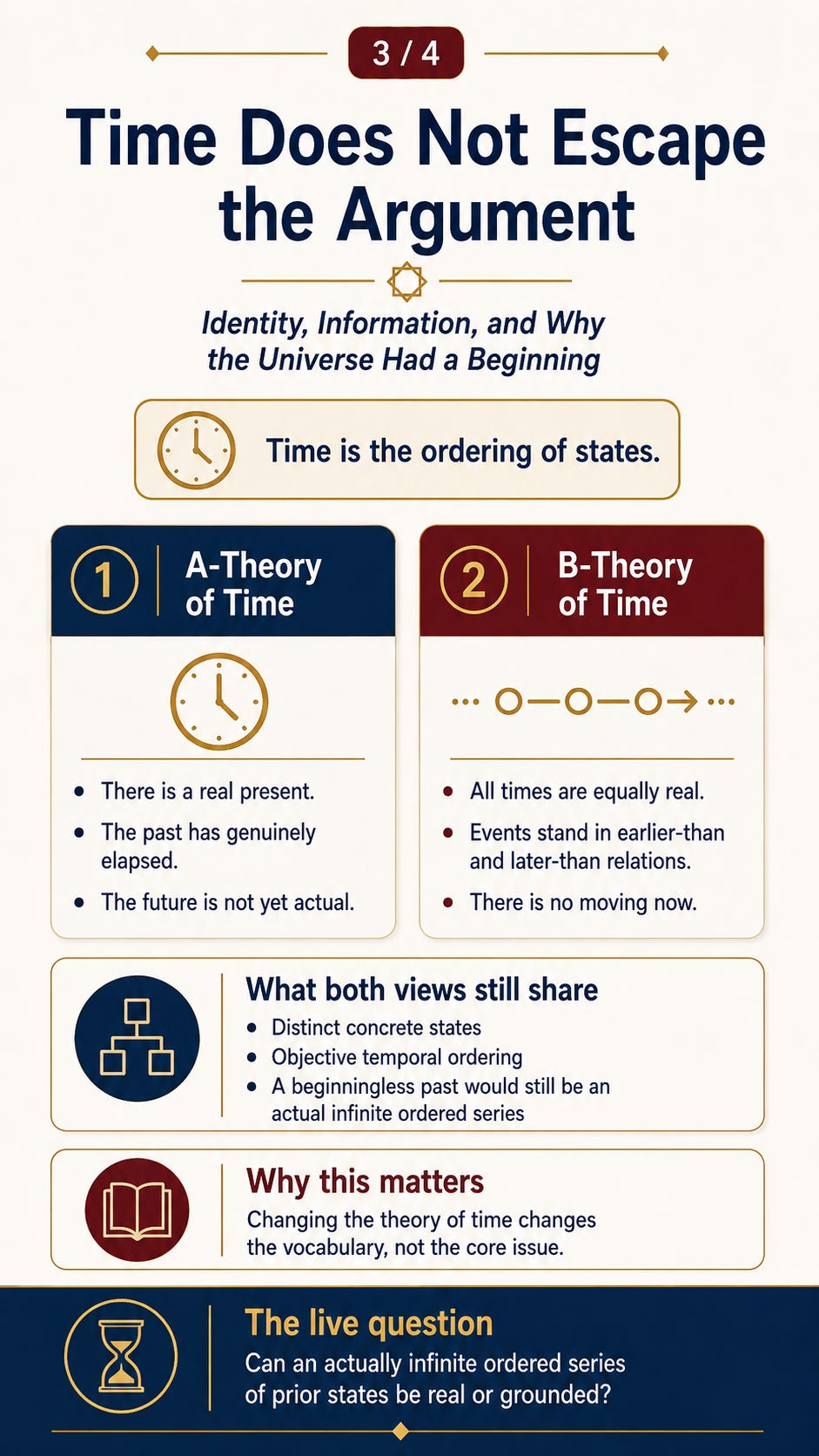
Why the theory of time does not provide an escape. A-theory and B-theory describe the same ordered series of states; the finitude question survives either way.
It comes from this. The states aren’t just sitting in a row, they depend on each other. The present state is conditioned by the prior state, which is conditioned by the one before, and so on. Now imagine that chain of dependence running back with no first member and no starting condition. Every state borrows its determinate character from the one before it, which borrowed it from the one before, forever, with nobody ever actually owning it outright. It’s a line of dominoes where every domino falls because the previous one fell, and there’s no first push. The fall never gets explained. And here’s the thing that’s easy to miss: lengthening the chain doesn’t help. You might think a really long chain, or an infinite one, somehow earns what a short one couldn’t. It doesn’t. Adding borrowed actuality forever never produces owned actuality. A million dependent states explain the present no better than three do, and infinitely many explain it no better than a million. The series defers the ground without ever delivering it, and stretching it to infinity just defers it infinitely.
And here’s where I have to be honest about the one move the whole thing rests on, because I’d rather you see it than have me hide it. The skeptic will say infinite descending series are mathematically fine, look at the negative integers, no first member, no problem. True. Granted, fully. But the negative integers are abstract. They don’t depend on each other, they don’t have to be concretely instantiated, they don’t have to actually obtain. The cosmic series does. So the real question was never whether an infinite sequence is mathematically consistent. It’s whether an actual infinity of concrete, mutually dependent, real physical states can be instantiated as a finished totality. Mathematical consistency and concrete instantiation are different things, and the gap between them is where this argument lives. That’s the load-bearing claim, and a sharp critic will push on exactly that, and they should.
There’s a sharper version of the pushback, and it’s the one I’d worry about most. A critic can say: you’re assuming the series needs a ground at all. Why not just let the infinite chain of dependent states sit there as a brute fact, complete in itself, explaining nothing because nothing needs explaining? That’s a real move and I won’t pretend it’s crazy. But notice what it costs. The brute-totality reply doesn’t refute the dependence point, it just declines to ask the question. It says, in effect, “I’m comfortable with a reality whose every member is derivative and whose totality is therefore wholly borrowed, and I’ll call that comfortable stopping place ‘brute.’” You can do that. But you’ve not escaped the structure I described, you’ve just decided to stand inside it and not look down. And the price is steep, because the thing you’re calling brute is precisely a totality with no member that has its character in its own right. Calling an infinite stack of IOUs “brute” doesn’t make the debt good. I think the honest situation is that this is where the argument and the committed naturalist genuinely part ways, and I’d rather mark that fault line clearly than paper over it. Every cosmological argument bottoms out somewhere near here. At least this one tells you where.
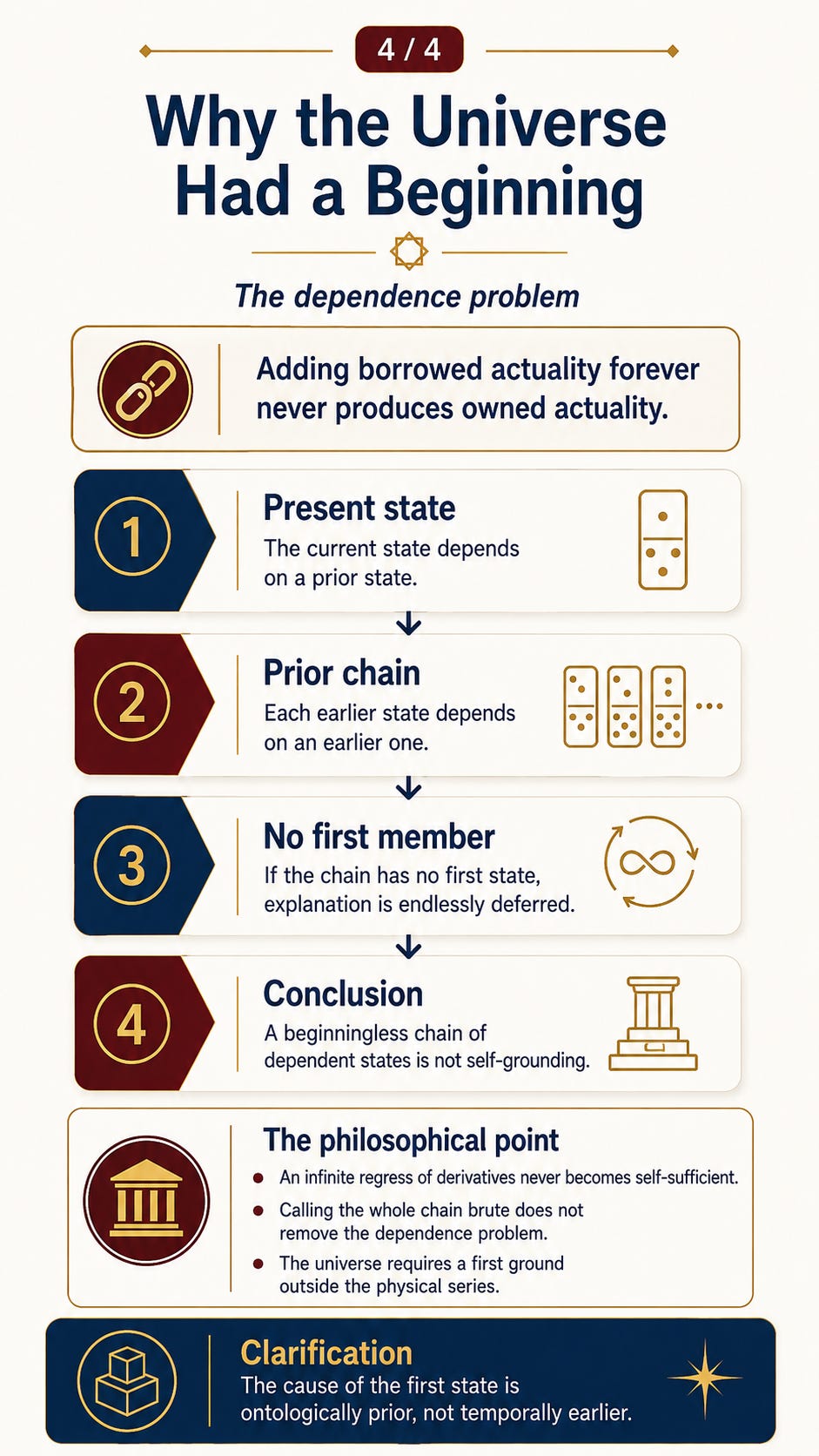
The dependence problem. An endless chain of derivative states never produces a self-sufficient ground; the cause of the first state is ontologically prior, not temporally earlier.
A couple of quick ones people always raise. Does this assume reality is chopped into discrete chunks? No. A continuous universe still has distinct states, because if a field value differs, the configuration differs, and that’s a different state. Smooth doesn’t mean undifferentiated. What about cyclic universes, eternal bouncing cosmologies? Doesn’t help on its own. If the cycles are genuinely successive and the earlier ones are real distinct states, then either there were finitely many, and you’ve got a beginning, or infinitely many, and you’re right back in the same problem.
I’ll mention the physics, but lightly, because honestly the physics is messier than apologists usually admit and I’d rather not lean on it. The Borde-Guth-Vilenkin theorem says an expanding universe is past-incomplete, which sounds like a beginning, and it’s suggestive. But there’s recent work building inflationary models that are supposed to be past-complete after all, so it’s contested, and I’m not going to stake anything on it. The thermodynamic argument is even shakier, the very paper people sometimes cite about the low-entropy past actually argues you might not need a special initial state at all, so that one can cut the other way if you’re not careful. None of this sinks the argument, because the argument was never resting on the physics. It rests on the metaphysics of identity and dependence. The physics is, at most, weather that happens to be blowing in roughly the same direction some of the time.
One last thing, and it matters more than it looks. Because time is the ordering of states, and there’s no state before the first one, there’s no time before the first state either. Not an empty stretch of time where nothing happened. No time at all. So when we ask what caused the first state, we can’t be asking for something that happened earlier, because there is no earlier. We’re asking for something ontologically prior, a ground rather than a previous event. That’s exactly the classical picture of creation, the beginning of time rather than an event inside it, and the nice thing is the argument hands it to you instead of you having to assume it.
I’ll flag one boundary so I’m not accused of smuggling. The laws of logic that individuate all these states, identity and non-contradiction and the rest, those don’t begin to exist. They’re necessary. So I am not running the Kalam on logic itself and quietly slipping God in as the thing that started the laws. The series I’m saying had a beginning is strictly the series of concrete physical states. Why logic holds at all, why reality is ordered and intelligible in the first place, that’s a different argument for a different day. This one’s narrower, and it’s stronger for staying narrow.
So strip it all the way down. A changing universe needs distinct states. Distinct states need identity. A beginningless past needs an actual infinity of those identity-bearing concrete states, all depending on each other, with no first one. And that can’t actually be pulled off. So the past isn’t beginningless. The universe began. The unit isn’t a second or a moment or a fuzzy event you can argue me out of. It’s the determinate, identity-stamped, concrete way reality was, one state after another, back to a first one that something outside the series had to ground.