

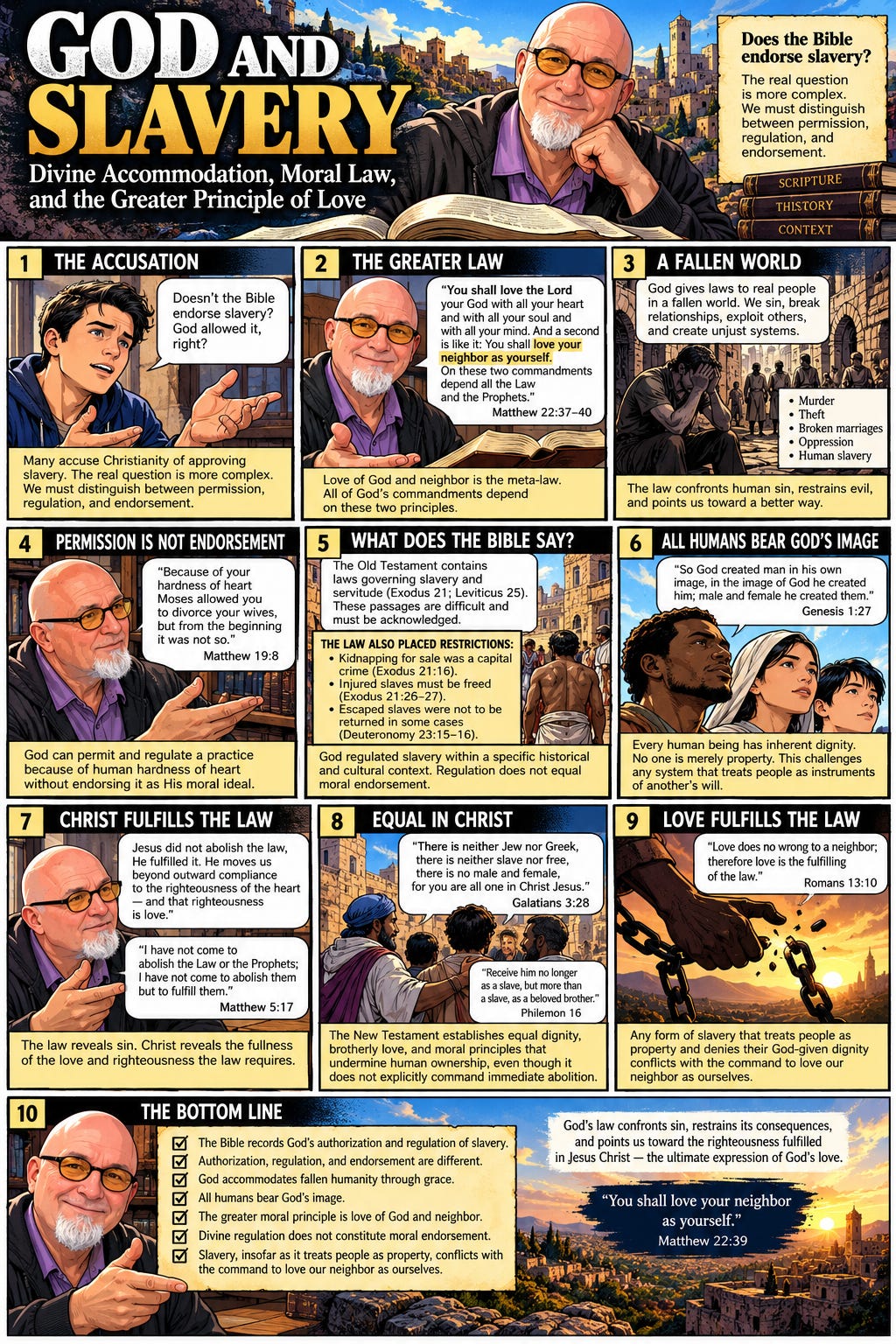
One of the most common accusations against Christianity is that the Bible endorses slavery. The argument usually follows a simple line of reasoning: God permitted slavery, established regulations governing it, and therefore approved of slavery as a morally acceptable institution.
But that conclusion rests upon a fundamental confusion between permission, regulation, and moral endorsement.
These are distinct concepts. And failing to distinguish them produces a serious misunderstanding of the nature and purpose of God’s law.
To understand the biblical treatment of slavery, we must first understand why God gives laws to fallen humanity, what those laws are intended to accomplish, and the greater moral principles upon which they depend.
The Law Beneath the Law
When Jesus was asked which commandment was greatest, His answer was remarkably comprehensive:
“You shall love the Lord your God with all your heart and with all your soul and with all your mind. This is the great and first commandment. And a second is like it: You shall love your neighbor as yourself. On these two commandments depend all the Law and the Prophets.” (Matthew 22:37–40, ESV)
Notice the final statement. All the Law and the Prophets depend upon these two commandments.
The Greek verb translated “depend,” krematai (κρέμαται), conveys the idea of hanging or being suspended from something.
Jesus identifies love of God and neighbor as the governing moral principles upon which the entire biblical legal framework rests.
We might reasonably call this the meta-law of biblical morality.
A meta-law is a higher-order principle that governs the purpose, interpretation, and application of subordinate laws.
The Ten Commandments illustrate this relationship. The prohibitions against murder, adultery, theft, and false witness establish boundaries around human conduct. Each protects something that neighbor-love ought to preserve.
But love goes further than merely observing boundaries.
A person can refrain from stealing from his neighbor while remaining indifferent to his suffering. He can avoid murder while harboring hatred. He can obey the outward requirements of the law while failing to fulfill its deeper moral purpose.
Paul makes the connection explicit:
“Love does no wrong to a neighbor; therefore love is the fulfilling of the law.” (Romans 13:10, ESV)
God’s commandments reveal what righteousness requires. Love expresses the moral character toward which those commandments direct us.
This distinction is essential to understanding slavery.
The Law Was Given to Fallen Humanity
Consider a simple question.
Why does God prohibit murder?
Because human beings murder.
Why does He prohibit theft?
Because human beings steal.
Why does He regulate divorce?
Because marriages are broken by human sin.
God’s laws are given to human beings who already inhabit a fallen world. They address actual human conduct, institutions, conflicts, and failures.
The existence of a divine regulation does not establish that the regulated behavior is morally desirable.
Indeed, many laws exist precisely because human behavior is morally defective.
Jesus provides an explicit example when discussing divorce:
“Because of your hardness of heart Moses allowed you to divorce your wives, but from the beginning it was not so.” (Matthew 19:8, ESV)
This statement establishes a crucial theological principle.
God may permit and regulate a practice because of human hardness of heart without endorsing that practice as His original moral intention.
Mosaic permission concerning divorce was a concession to fallen human conditions. Jesus appealed beyond that concession to God’s creational design.
This does not automatically prove that every Mosaic permission concerning slavery served precisely the same purpose. Each passage must be examined on its own terms.
It does, however, establish that divine permission and divine moral endorsement are categorically distinct.
That distinction cannot be dismissed when examining slavery.
Accommodation Is an Expression of Grace
We must go deeper.
Why would a perfectly holy God accommodate fallen human behavior at all?
Because if God immediately executed the full judgment deserved by every human transgression, fallen humanity could not stand before Him.
The psalmist understood this:
“If you, O LORD, should mark iniquities, O Lord, who could stand?” (Psalm 130:3, ESV)
The answer follows immediately:
“But with you there is forgiveness, that you may be feared.” (Psalm 130:4, ESV)
God’s continued governance of a sinful world is itself an expression of divine patience.
Within Reformed theology, we recognize a distinction between common grace and saving grace.
Common grace describes God’s benevolent preservation of the created order, His restraint of evil, and His provision of temporal blessings to humanity.
Saving grace concerns God’s redemption of sinners through Jesus Christ.
Divine accommodation can reasonably be understood as a limited expression of common grace.
God permits fallen human societies to continue functioning while imposing boundaries upon their conduct. Those boundaries can restrain injustice, protect the vulnerable, and preserve social order.
Accommodation is grace expressed through restraint within a fallen world.
It does not make the accommodated conduct righteous.
Consider the distinction carefully.
A government might regulate a harmful practice to limit its consequences. Such regulation does not necessarily establish the government’s moral approval of the practice.
Similarly, divine regulation can serve a restraining function without constituting an endorsement of the institution being regulated.
Of course, human governments and divine governance are not equivalent in authority or knowledge. The analogy concerns the logical distinction between regulation and endorsement.
And that distinction is decisive.
What Does the Bible Actually Say About Slavery?
We must acknowledge the difficult passages directly.
Exodus 21 contains laws governing slavery and servitude. Leviticus 25:44–46 permits Israelites to acquire slaves from surrounding nations and describes foreign slaves as inheritable property.
These passages cannot simply be redefined as modern employment contracts or voluntary indentured servitude.
The biblical world included multiple forms of slavery and servitude, some involving coercion, permanent ownership, and unequal legal status.
Leviticus 25 is particularly challenging because it distinguishes between the treatment of fellow Israelites and foreign slaves.
Any serious Christian response must acknowledge that distinction.
The Bible also establishes restrictions on slaveholding practices.
Exodus 21:16 condemns kidnapping and selling a human being. Exodus 21:26–27 requires freedom for slaves who suffer certain permanent injuries at their master’s hands. Deuteronomy 23:15–16 prohibits returning an escaped slave to his master, although the precise historical scope of that provision is debated.
These restrictions demonstrate that the Mosaic legal system imposed obligations and limitations upon masters.
They do not erase the existence of slave ownership, nor do they eliminate every moral difficulty in the legislation.
The central interpretive question remains:
Does God’s regulation of an existing institution establish His moral endorsement of that institution?
No.
Regulation alone cannot establish endorsement. Nor does regulation alone establish condemnation.
We must evaluate the institution against the broader moral framework of Scripture.
Human Beings Are Made in God’s Image
The biblical understanding of human dignity begins before the Mosaic law.
Genesis 1:27 declares:
“So God created man in his own image, in the image of God he created him; male and female he created them.” (ESV)
Human dignity originates in God’s creative act.
It does not depend upon nationality, ethnicity, wealth, social position, or political power.
Every human being bears the image of God.
This creates a profound moral problem for any institution that treats human beings as mere instruments of another person’s will.
A slaveholder and an enslaved person possess the same fundamental dignity before their Creator.
Neither possesses a superior claim to humanity.
The moral implications become particularly significant when we apply Christ’s second great commandment:
Love your neighbor as yourself.
Would I desire to be forcibly taken from my family, sold, inherited as property, subjected to another person’s coercive authority, and denied the freedom I claim for myself?
If the answer is no, how could I justify imposing those conditions upon another image-bearer as an expression of neighbor-love?
This is a moral question that slavery cannot evade.
It does not require pretending that ancient servitude and modern race-based chattel slavery were identical. Their historical and legal differences matter.
But those differences do not remove the underlying obligation to love another human being as oneself.
The greater moral principle remains.
Christ Reveals the Fulfillment of the Law
Jesus did not come merely to introduce another collection of legal restrictions.
He came to fulfill the law.
“Do not think that I have come to abolish the Law or the Prophets; I have not come to abolish them but to fulfill them.” (Matthew 5:17, ESV)
In the Sermon on the Mount, Jesus repeatedly moves from outward compliance toward the deeper moral obligations of the heart.
The commandment against murder addresses unlawful killing. Jesus also addresses anger and reconciliation.
The commandment against adultery prohibits a particular act. Jesus also addresses lust.
Christ exposes the inadequacy of merely external righteousness.
The law identifies transgression. Christ reveals the fullness of the righteousness that the law requires.
And that righteousness is inseparable from love.
This principle also informs the New Testament’s treatment of slavery.
Paul writes that in Christ there is neither slave nor free with respect to standing in Him (Galatians 3:28).
In his letter to Philemon, Paul appeals for Onesimus to be received as more than a bondservant, as a beloved brother (Philemon 16).
Neither passage constitutes an explicit universal command abolishing slavery. The New Testament also contains instructions to enslaved people and masters within existing social structures.
We should acknowledge those facts.
Nevertheless, the recognition of equal standing in Christ, the obligation of brotherly love, and the moral equality of image-bearers establish principles that profoundly challenge the justification of coercive human ownership.
The question becomes increasingly difficult to avoid:
How can one claim to love another as oneself while claiming ownership over that person’s life?
The Law Cannot Save Us. Love Does.
There is a deeper theological connection.
The law reveals righteousness, exposes sin, and establishes accountability.
But the law cannot save the sinner.
“For by works of the law no human being will be justified in his sight, since through the law comes knowledge of sin.” (Romans 3:20, ESV)
The law reveals our guilt. It cannot remove that guilt.
God’s love provides the remedy through Jesus Christ.
“In this is love, not that we have loved God but that he loved us and sent his Son to be the propitiation for our sins.” (1 John 4:10, ESV)
Strictly speaking, we are saved by grace through faith in Christ, whose saving work proceeds from God’s love (Ephesians 2:8–9; John 3:16).
That distinction matters because our own imperfect love cannot earn salvation.
But God’s love accomplishes what the law cannot.
And through the regenerating work of the Holy Spirit, the redeemed begin to express the love toward which God’s commandments have always directed them.
Jeremiah 31:33 anticipates this transformation when God promises to write His law upon the hearts of His people.
The external command becomes an inwardly embraced obligation.
The Christian’s obedience increasingly flows from love rather than mere fear of punishment.
This reveals the greater purpose of divine moral instruction.
God’s law teaches us righteousness. His grace redeems us from unrighteousness. His Spirit transforms our hearts toward love.
Does God Endorse Slavery?
We can now answer the original accusation with greater precision.
The Bible records divine authorization and regulation of forms of slavery within ancient Israel.
That is a textual fact.
But authorization, regulation, and moral endorsement are different propositions.
Jesus Himself establishes that a practice permitted under Mosaic law can fall short of God’s original intention.
God’s accommodation of fallen human society is consistent with His patience and common grace.
His moral character remains unchanged.
His supreme commandments remain love of God and love of neighbor.
And His creation of humanity in His own image establishes a dignity that no human institution can legitimately erase.
Consequently, the claim that God’s regulation of slavery necessarily demonstrates His moral endorsement of slavery commits a logical error.
The conclusion does not follow from the premise.
A stronger Christian argument goes further: insofar as slavery entails coercive ownership, exploitation, and the denial of another image-bearer’s dignity, it stands in moral conflict with the biblical command to love one’s neighbor as oneself.
The difficult question of why God permitted particular forms of slavery in ancient Israel remains a legitimate exegetical and theological question. Divine accommodation offers a coherent interpretive explanation, although the biblical text does not explicitly apply Jesus’ explanation concerning divorce to every slavery law.
That limitation should be acknowledged.
But the moral distinction remains intact.
God can govern a fallen institution without approving of its moral character.
Conclusion: The Greater Law of Love
The mistake is to treat every divine regulation as a declaration of moral approval.
God’s law operates within a fallen world. It confronts human sin, restrains destructive behavior, governs imperfect societies, and teaches the principles of righteousness.
But the moral standard underlying those laws is grounded in God’s immutable character.
And Christ identifies the supreme commandments upon which the Law and the Prophets depend.
Love God.
Love your neighbor.
Everything else must be understood in relation to those commandments.
Divine accommodation demonstrates God’s patience with fallen humanity. Divine restraint limits the consequences of human sin. Divine redemption reveals the extraordinary depth of His love.
Slavery, like every human institution, must ultimately be evaluated against that moral standard.
The Christian need not deny that God permitted and regulated slavery in ancient Israel. Nor should the Christian pretend that every difficult passage has an effortless explanation.
But permission does not establish moral endorsement.
And regulation does not establish moral approval.
God’s accommodation of human fallenness is an expression of grace. His commandments teach the obligations of righteousness. And His supreme moral standard remains love.
The law was never intended to make human domination righteous.
It was given within God’s unfolding dealings with fallen humanity, ultimately pointing us toward the righteousness fulfilled in Jesus Christ.
For the Christian, the final moral question is therefore not merely whether an ancient law permitted a particular practice.
It is whether that practice can be reconciled with the character of God and the command of Christ:
“You shall love your neighbor as yourself.”
That is the standard against which every claim of divine moral endorsement must be tested.
Scriptural References
Genesis 1:26–27; Exodus 21:16, 20–21, 26–27; Leviticus 25:39–46; Deuteronomy 23:15–16; Psalm 130:3–4; Jeremiah 31:33; Matthew 5:17–28; Matthew 19:3–9; Matthew 22:37–40; John 3:16; John 14:15; Romans 2:4; Romans 3:20–26; Romans 8:4; Romans 13:8–10; Galatians 3:24–28; Galatians 5:14; Ephesians 2:8–10; Philemon 8–21; 1 Timothy 1:8–11; 1 John 4:7–11.
Biblical quotations from the English Standard Version (ESV).