

When Francis Crick Needed Aliens
In 1973, Francis Crick published a paper that should have shocked the scientific world.
The co-discoverer of DNA’s double helix structure, Nobel laureate, committed atheist, and materialist proposed that life on Earth was too complex to have arisen naturally here. His solution? Advanced alien civilizations must have deliberately seeded our planet with microorganisms billions of years ago.
He called it “Directed Panspermia.”
Nine years later, in his book Life Itself, Crick wrote: “An honest man, armed with all the knowledge available to us now, could only state that in some sense, the origin of life appears at the moment to be almost a miracle.”
“Almost a miracle.” From a man who spent his career explaining biology through chemistry and physics.
This wasn’t ignorance or religious sentiment. Crick understood molecular biology better than almost anyone alive. He knew exactly what needed explaining: the specified functional information encoded in DNA. And he knew of no natural mechanism that could produce it.
So he invoked alien intelligence.
Forty years later, we’re still waiting for naturalism to deliver an actual explanation.
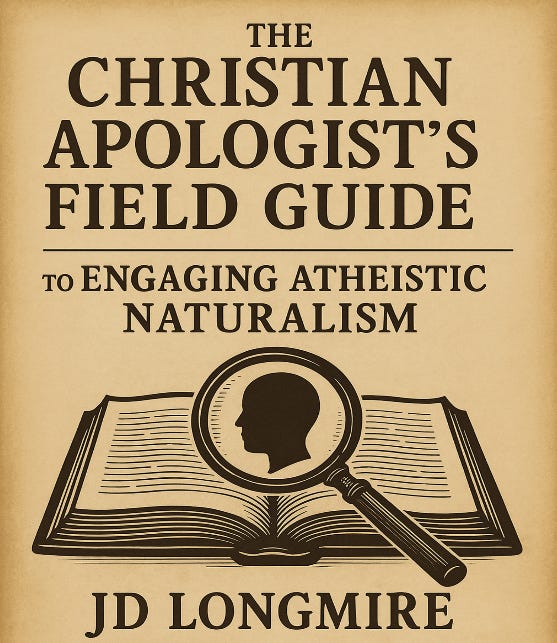
What This Book Is (And Isn’t)
This is not another “here are some arguments for God” book.
This is a tactical field manual for engaging atheistic naturalism using convergence methodology, refined through thousands of real-world Reddit debates, philosophy forums, and hostile academic environments.
You won’t find:
Isolated arguments standing alone
Defensive posturing
Apologizing for faith
Retreat into “we just believe”
You will find:
How to frame debates offensively (which worldview explains the evidence better?)
Pattern recognition for naturalism’s systematic failures
Refined responses to every major objection
Real dialogue examples showing tactics in action
Training exercises with answer keys
The Core Strategy: Convergence
Most apologetics books give you arguments in isolation:
Cosmological argument (Chapter 1)
Fine-tuning argument (Chapter 2)
Moral argument (Chapter 3)
Then skeptics pick them off one by one: “That’s just God of the gaps.” “Multiverse explains fine-tuning.” “Morality evolved.”
This book works differently.
We show that naturalism faces persistent, systematic explanatory failures across multiple independent domains:
Cosmology: Universe from nothing? Laws from what? Initial conditions from where?
Physics: Fine-tuning? Multiverse is unfalsifiable speculation.
Mathematics: Why does it describe reality? Platonism is metaphysical commitment.
Logic: Grounded in what? “Just does” is not an answer.
Abiogenesis: 70 years, no mechanism. Labels (”emerged”) aren’t explanations.
Consciousness: Hard problem remains hard. Functionalism fails on qualia.
Morality: Without objective grounding, “wrong” means “I disapprove.”
History: Resurrection best explains the evidence. Hallucination theories fail.
That’s not cherry-picking gaps. That’s recognizing a pattern.
Christianity predicts this pattern. If a rational, moral, personal God exists, we should find:
Universe with beginning (Genesis 1:1 → Confirmed)
Rationally ordered cosmos (Logos doctrine → Mathematical physics)
Fine-tuning for life (Purposeful creation → 20+ parameters)
Humans with consciousness (Image of God → Irreducible awareness)
Objective moral truth (God’s character → Universal intuitions)
Historical revelation (Incarnation → Documentary evidence)
Every prediction confirmed. Meanwhile, naturalism offers labels without mechanisms, promissory notes without delivery, and unfalsifiable speculation.
What You’ll Learn
Strategic Framework (Chapters 1-3)
How to position Christianity vs. naturalism (competing explanatory frameworks)
The convergence methodology (multiple independent lines)
Why naturalism is not the neutral default
The Converging Gaps (Chapters 4-12)
Cosmological evidence and initial conditions
Fine-tuning across physics, chemistry, biology
Metaphysical foundations (logic, math, causation)
Information and abiogenesis (why Crick needed aliens)
Consciousness and the hard problem
Moral realism without God
Historical evidence for resurrection
Biblical manuscript reliability
The Scorecard: Christianity delivers, naturalism promises
Tactical Deployment (Chapters 13-16)
Core debate principles (offensive posture, frame control)
Common objections with battle-tested counters
Opponent pattern recognition (humility shield, mechanism deflection, consensus appeal)
Advanced tactics for sophisticated skeptics
Application (Chapters 17-20)
Your closing moves (how to wrap arguments)
Extended dialogue examples (right and wrong tactics)
Training exercises with answer keys
Resources for continued study
Who This Is For
You need this book if you:
Face intellectual challenges to your faith
Want to actually answer “Why Christianity?” with substance
Are tired of watching Christianity dismissed as intellectually inferior
Navigate hostile academic environments
Have kids facing skepticism in college
Sense your current apologetics approach isn’t connecting
You don’t need:
Philosophy or theology degrees
Extensive scientific background
Years of debate experience
Encyclopedic apologetics knowledge
I’ve designed this to be accessible but not simplistic, tactical but not manipulative, offensive but not arrogant.
Why I’m Releasing This Now
I’ve spent three decades as an ordained minister and defense contractor systems architect. Whether I’m crafting sermons, architecting networks, or engaging skeptics on Reddit, I’ve learned that elegant solutions share one characteristic: every component serves a unified purpose.
This book is the result of thousands of actual engagements with atheistic naturalism. Every tactic has been tested, broken, repaired, and stress-tested again. I’ve refined these responses through deployment, not just theory.
The stakes are too high to keep this locked up. Ideas have consequences. Bad ideas have casualties.
If naturalism is true:
The Holocaust wasn’t objectively evil (just primates doing things to primates)
Your mother’s cancer isn’t tragic (just atoms rearranging)
Human rights don’t exist (useful fictions we invented)
Love is electrochemistry (meaningful only because we’re wired that way)
Your rationality is suspect (shaped by survival, not truth-tracking)
Nothing ultimately matters (heat death awaits)
I’m convinced naturalism is false because it’s unlivable and explanatorily bankrupt.
Christianity, by contrast, explains what we actually observe. It predicted phenomena before science confirmed them. It grounds rationality, morality, consciousness, and meaning without retreating into “they just emerged.”
Three Biblical Mandates
This work serves Scripture’s three-fold apologetics mandate:
1. Reasonable Defense (1 Peter 3:15) “Always be prepared to give an answer to everyone who asks you to give the reason for the hope that you have.”
The Greek apologia means reasoned defense, like in a court of law. Not emotional appeals. Not authority claims. Reason.
2. Tear Down Strongholds (2 Corinthians 10:4-5) “We demolish arguments and every pretension that sets itself up against the knowledge of God.”
Naturalism is a philosophical fortress. Our job: show the fortress is actually a prison of explanatory poverty.
3. Edify the Saints (Jude 3) “Contend for the faith that was once for all entrusted to God’s holy people.”
Believers struggle with intellectual doubt. They need to know Christianity has rational support and naturalism’s intellectual confidence is overblown.
Get the Early Draft Free
This is an early working draft, openly available on GitHub. You’ll find:
Complete strategic framework
All major arguments with refinements
Real-world dialogue examples
Tactical principles and counters
Training exercises
Download here: GitHub Repository
What This Will Cost You
Reading this book will cost you:
Comfort with neutrality. You’ll see naturalism’s systematic failures clearly.
Defensive posture. You’ll learn to engage offensively.
Intellectual timidity. You’ll gain confidence to challenge consensus.
Acceptance of promissory notes. You’ll demand actual explanations.
But you’ll gain:
Strategic framework for engaging skepticism
Battle-tested responses to major objections
Confidence that Christianity has rational support
Tools to help believers navigate doubt
Ability to expose naturalism’s explanatory poverty
Three Reading Paths
Path 1: Quick Tactical (Chapters 1, 3, 12-14, 17) Need tools immediately? Get strategic framework, learn core objections, start engaging.
Path 2: Comprehensive Study (All chapters in order) Building deep understanding? Work through systematically, practice exercises, master methodology.
Path 3: Reference Manual (Use index) Experienced apologist? Jump to specific objections, grab refined responses, deploy.
A Warning About Charity
I’ve been accused of being uncharitable to naturalism. Let me be clear:
I’ve spent years steelmanning naturalist positions, engaging sophisticated atheist philosophers, reading their best work charitably. But at some point, charity becomes complicity.
When naturalism labels phenomena without explaining them, I’ll call it out. When it offers promissory notes for seven decades without delivery, I’ll note the pattern. When it demands mechanisms from Christianity while providing none itself, I’ll expose the double standard.
This isn’t uncharitable. It’s honest assessment.
If I’m wrong, show me. Point to naturalism’s actual explanations (not “we’re working on it”). Demonstrate the mechanisms (not “emergence” labels). Defend the worldview (not “I’m just lacking belief”).
But I won’t pretend naturalism has explanatory power it lacks. That’s not charity. That’s intellectual dishonesty disguised as niceness.
Truth matters more than tone policing.
Download Now
This early draft is free and openly available. Read it. Test it. Use it. Break it. Tell me what needs refinement.
Get The Christian Apologist’s Field Guide
James (JD) Longmire
Northrop Grumman Fellow (unaffiliated research)
ORCID: 0009-0009-1383-7698
Correspondence: jdlongmire@outlook.com
Coming next: Detailed breakdown of the convergence methodology and why pattern recognition beats isolated arguments.
Subscribe to get: Refined responses to new objections, real-world dialogue analysis, tactical updates from the field.