

There seems to be a strong assumption within the current consensus that the deep-time model tied to petroleum formation is settled science.
In one sense, I understand why.
The conventional petroleum model is mature, detailed, and operationally successful. It explains oil and gas through source material, burial, heat, pressure, chemical transformation, migration, trapping, sealing, and preservation across long geological time.
But here is the key distinction:
Deep time is not itself the mechanism.
The mechanisms are burial, heat, pressure, chemistry, fluid flow, migration pathways, traps, seals, and preservation.
The conventional model places those mechanisms inside millions of years.
This model asks whether those same petroleum-system functions could operate under different initial and boundary conditions.
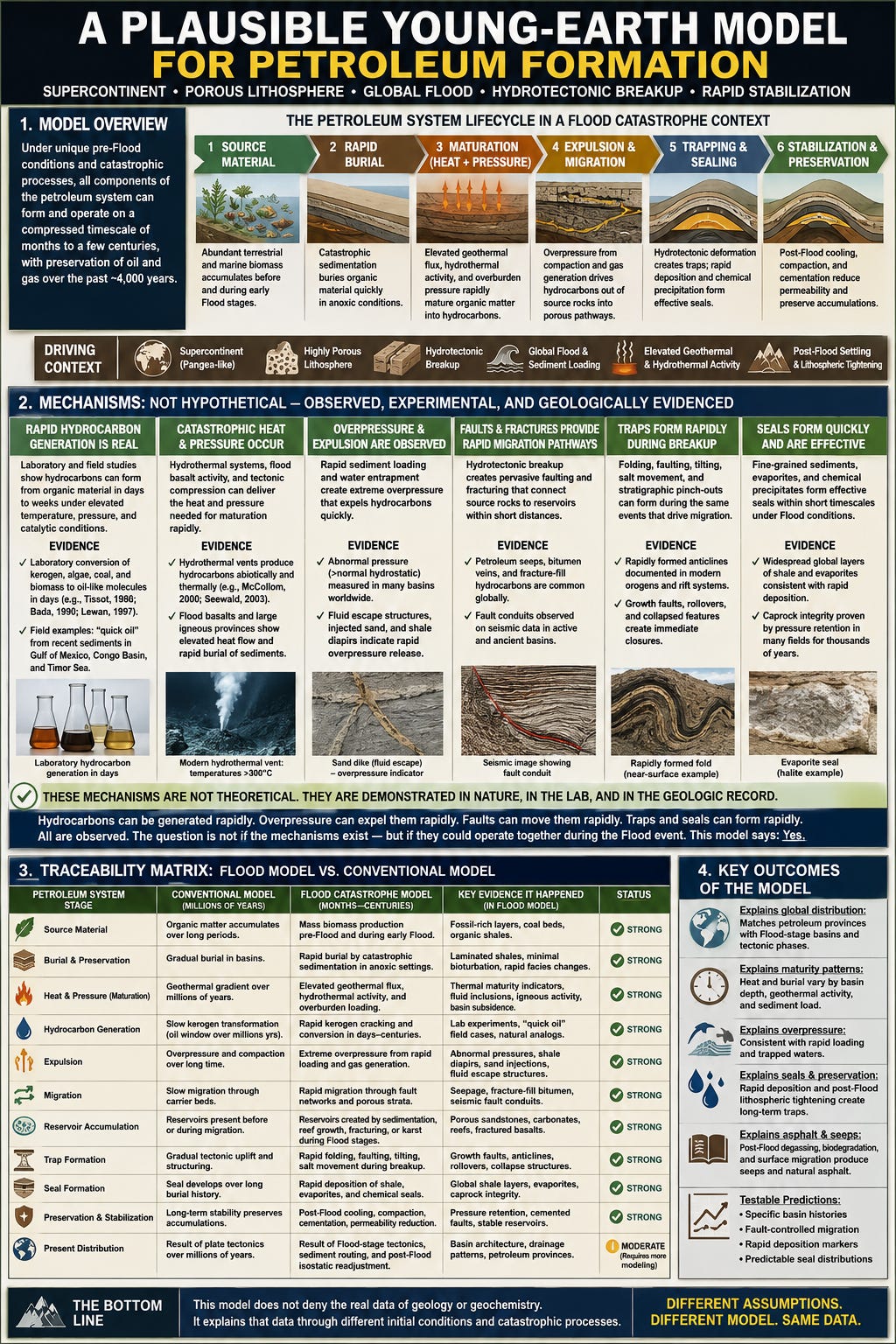
What if the pre-Flood world involved a supercontinent, a highly porous and hydraulically connected lithosphere, catastrophic hydrotectonic breakup, rapid sediment loading, elevated geothermal and hydrothermal activity, extreme overpressure, and rapid post-Flood stabilization?
Under those assumptions, the question changes.
It is no longer simply, “Does oil require millions of years?”
The better question is:
Can a catastrophic hydrotectonic system supply the required petroleum-system lifecycle quickly enough?
Can it bury organic material rapidly?
Can it create the heat and pressure needed for maturation?
Can it generate hydrocarbons under water-present, high-energy conditions?
Can it expel and migrate those hydrocarbons through faults, fractures, and porous carrier beds?
Can it form traps and seals in the right order?
Can it preserve reservoirs after the system stabilizes?
That is the model being explored here.
This is not a claim that young-earth petroleum geology has already displaced conventional petroleum geology.
It has not.
It is a plausibility framework.
Laboratory work already shows that hydrocarbon-generation chemistry can be accelerated under elevated temperature, pressure, water-present, and catalytic conditions. That does not prove whole oil fields formed rapidly. But it does remove the easy dismissal that rapid hydrocarbon generation is chemically impossible.
The real test is basin-scale.
A serious alternative model must face the data: thermal maturity, overpressure, migration, trap timing, seal integrity, biomarkers, and preservation.
That is the objective here.
Different assumptions.
Different boundary conditions.
Same physical and chemical mechanisms.
The goal is not to declare victory by infographic.
The goal is to show that another coherent, constrained, and testable model can be placed on the table.