

Introduction: The Audit We Rarely Run
We live with confident claims about what ultimately explains reality. “The universe is all there is.” Or: “In the beginning, God…”
Confidence is not coverage.
Before declaring either worldview sufficient, we should put the competing accounts side by side and ask the same questions of both. The purpose is not to score points. It is to identify what each model explains, what it assumes, and where its explanatory account ultimately terminates.
That is the purpose of the Explanatory Ledger.
The ledger places two candidate groundings, Material Naturalism (MN) and Christian Designism (CD), against the same 14 explananda, ranging from Why does anything exist? to Why this particular physical history?
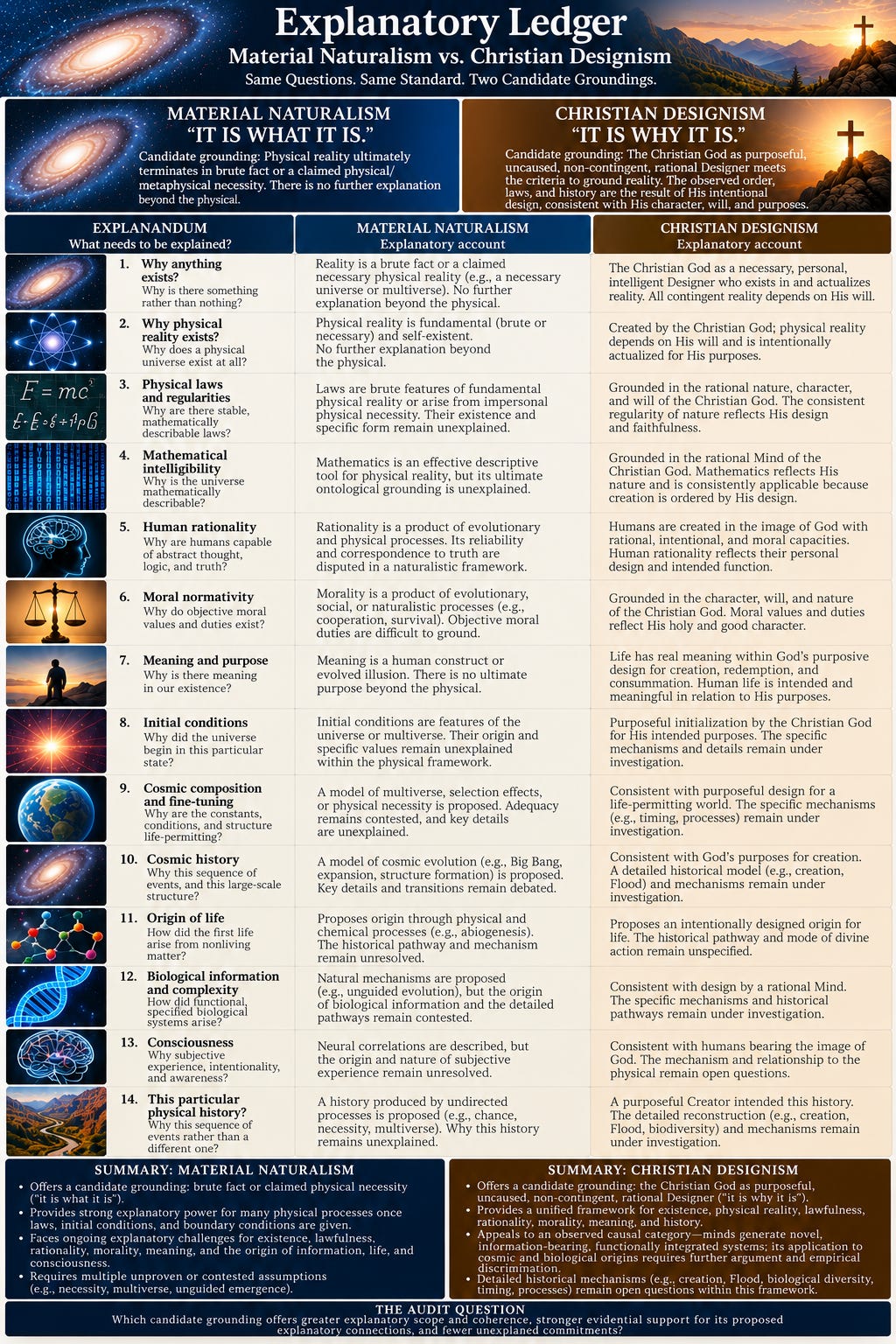
The graphic does not score a winner. It makes the explanatory stops visible.
Every worldview eventually reaches bedrock. The audit asks:
Which candidate grounding leaves fewer unexplained commitments while providing greater explanatory scope, coherence, and causal adequacy?
Two Groundings, Two Stops
Material Naturalism: “It Is What It Is”
MN takes physical reality as fundamental. At the bottom, the explanatory chain terminates in some combination of brute fact, physical necessity, metaphysical necessity, or a deeper physical structure from which our presently observed reality derives.
This does not diminish the extraordinary explanatory success of natural science. Once physical reality, regularities, boundary conditions, and relevant causal capacities are given, physics and the other natural sciences explain an enormous amount.
But the ledger asks a prior question:
What grounds the givens themselves?
Why physical reality? Why these regularities? Why mathematical intelligibility? Why rational observers capable of discovering them?
At some point MN reaches its proposed explanatory terminus: fundamental reality simply has the nature that it has, whether contingently or necessarily.
Christian Designism: “It Is Why It Is”
CD proposes a different candidate grounding: the Christian God as purposeful, uncaused, non-contingent, and rational Designer meets the criteria necessary to ground reality.
That formulation matters.
The claim is not simply “God did it.”
The claim is that the proposed ground possesses properties relevant to the explananda. A rational ground can ground intelligibility. An intentional ground can ground purpose. A non-contingent ground can terminate contingent explanation. A personal ground can ground agency. A morally perfect ground can ground moral normativity.
CD therefore proposes that the observed order, laws, information, rationality, and history of the world ultimately derive from intentional actualization consistent with God’s nature, will, and purposes.
Mechanisms remain important. Physics, chemistry, biology, and historical reconstruction investigate how physical states develop.
CD places those secondary causes within a prior explanatory context.
The how does not exhaust the why.
Reading the Ledger
A pattern emerges when the same questions are put to both models.
MN provides exceptionally powerful accounts of physical processes once a physical order is present. Yet several of the ledger’s questions concern the grounding of that order itself:
Why anything exists.
Why physical reality exists.
Why stable regularities obtain.
Why reality is mathematically intelligible.
Why rational minds exist and can know truth.
Why objective moral obligations would obtain.
Why there is ultimate meaning or purpose.
Why the physical conditions are life-permitting.
Why subjective conscious experience exists.
MN has candidate responses to many of these. They include necessity, emergence, evolutionary explanation, structural realism, moral naturalism, multiverse hypotheses, selection effects, and various theories of consciousness.
Those proposals belong on the ledger.
The audit asks whether they actually ground the explanandum or relocate it.
CD faces a different set of explanatory obligations. It proposes an ultimate purposeful ground, while leaving substantial questions concerning the physical and historical pathways by which particular states were realized:
Initial physical conditions.
Detailed cosmic history.
The origin and development of life.
Biological diversification and information.
The particular physical history that produced the world we observe.
Those are real explanatory debts.
Saying design does not reconstruct a mechanism any more than saying nature does.
The distinction is therefore important:
Grounding an event and reconstructing its physical history are different explanatory tasks.
“One Extra” or “One Better”?
A familiar objection to theistic explanation invokes parsimony:
Why add God? Isn’t that one additional entity?
CD’s response is that explanatory economy cannot be measured merely by counting nouns.
A theory introducing one entity that explains nothing has become more complicated.
A theory introducing one explanatory ground that unifies otherwise independent facts may become more parsimonious at the explanatory level.
So the relevant question is not merely:
How many entities does the ontology contain?
It is also:
How much explanatory work does each commitment perform?
MN may terminate in several apparently distinct primitives: physical existence, lawful regularity, mathematical structure, initial conditions, rationality, consciousness, and perhaps normativity.
CD proposes a common ground in rational Mind.
This is where the comparison becomes interesting.
Mind, as we ordinarily encounter it, is associated with several capacities directly relevant to the ledger:
Logical structure. Minds reason according to logical relations.
Information. Minds generate, interpret, communicate, and instantiate information-bearing structures.
Intentional action. Minds select among possibilities and act toward purposes.
Functional organization. Minds demonstrably produce novel systems in which multiple components are coordinated toward intended outcomes.
That does not demonstrate that the universe was produced by a Mind.
It establishes something more modest and important:
Mind is a known causal category possessing several of the capacities required by the explananda.
Christian Designism then proposes that ultimate reality is grounded in a Mind possessing those capacities necessarily and without dependence upon an antecedent physical system.
The resulting question is sharper than “Does God add one more thing?”
It becomes:
Does the proposed ground unify enough otherwise independent explanatory commitments to justify its inclusion?
“One extra” versus “one better” is therefore not a conclusion.
It is the question the ledger forces us to examine.
“Naturedidit” and “Goddidit”
Both models can become conversation-stoppers if their explanatory terms are allowed to substitute for actual explanation.
Nature did it is not an explanation.
Neither is God did it.
If the naturalist says that rationality “emerged,” the relevant question remains: What causal pathway possesses the demonstrated capacity to produce rationality?
If the Christian says that God designed life, the corresponding question remains: What exactly is being attributed to design, what evidence discriminates design from competing causal accounts, and what historical claims follow?
The same standard applies.
The interesting distinction appears at the grounding level.
When MN ultimately reaches fundamental physical reality, it must explain why that reality is sufficient to ground everything subsequently derived from it.
When CD reaches God, it must explain why the Christian God possesses the properties necessary to serve as the explanatory terminus without simply relocating the same problem one level higher.
Neither side receives a free pass.
Scope and Ability
This brings us to what may be the ledger’s most important test:
Does the proposed explanatory ground possess the causal and ontological resources required by the scope of what it is being asked to explain?
Physics is extraordinarily successful at describing physical relationships once laws, states, and boundary conditions are specified.
But several ledger entries are asking questions of another order:
Why lawfulness?
Why intelligibility?
Why information-bearing organization?
Why rationality?
Why consciousness?
Why normativity?
Why purpose?
Those questions require more than showing that one physical state follows another under an equation.
MN therefore carries the burden of showing how its fundamental ontology possesses sufficient resources for those categories.
CD carries a corresponding burden.
It proposes Mind as fundamental. Logic, information, intentionality, rationality, and purpose are therefore native to its candidate grounding rather than late-arriving categories requiring derivation from something categorically unlike them.
That gives CD potential explanatory reach.
It does not establish that CD is true.
The inference still requires argument.
But it means the proposal cannot fairly be reduced to “God of the gaps.” It is offering a candidate ground whose proposed nature corresponds to the categories requiring explanation.
The question is whether that correspondence survives scrutiny.
The Audit Question
The bottom of the ledger asks:
Which candidate grounding offers greater explanatory scope and coherence, stronger evidential support for its proposed explanatory connections, and fewer unexplained commitments?
That leaves us with two broad explanatory strategies.
MN begins with fundamental physical reality and asks whether lawfulness, mathematical intelligibility, life, information, rationality, consciousness, normativity, and meaning can ultimately be accounted for from that ontology.
CD begins with a purposeful, uncaused, non-contingent, rational Mind and asks whether physical reality and those same features are better understood as intentional actualizations of that Mind.
Both terminate somewhere.
Both therefore carry burdens.
The comparison concerns the quality of those termini.
This Is an Audit, Not a Proof
The Explanatory Ledger is not a proof of Christianity.
It does not establish CD merely by identifying unresolved questions within MN.
Nor does the success of natural science establish MN merely because physical explanations work extraordinarily well within the physical domain.
The ledger asks something narrower.
What does each worldview actually account for, what does it assume, and what explanatory commitments remain when we reach its foundation?
That means CD cannot hide unresolved historical questions behind the word design.
MN cannot hide unresolved grounding questions behind the word nature.
The standard remains the same.
Count the Stops. Check the Category.
The next time someone raises God of the gaps, ask whether the proposed alternative is quietly functioning as nature of the gaps.
The next time someone says just physics, ask whether physics is being asked to perform metaphysical work.
And when someone says God explains everything, ask whether the proposed conception of God actually possesses the properties required to ground the things being explained.
That is what the ledger is for.
Fourteen questions.
Two candidate groundings.
The same standard.
Every explanatory account eventually reaches something it treats as fundamental.
The decisive question is therefore not whether an account has a stopping point.
The question is whether what stands at the stopping point is the kind of thing capable of carrying the explanatory weight placed upon it.