

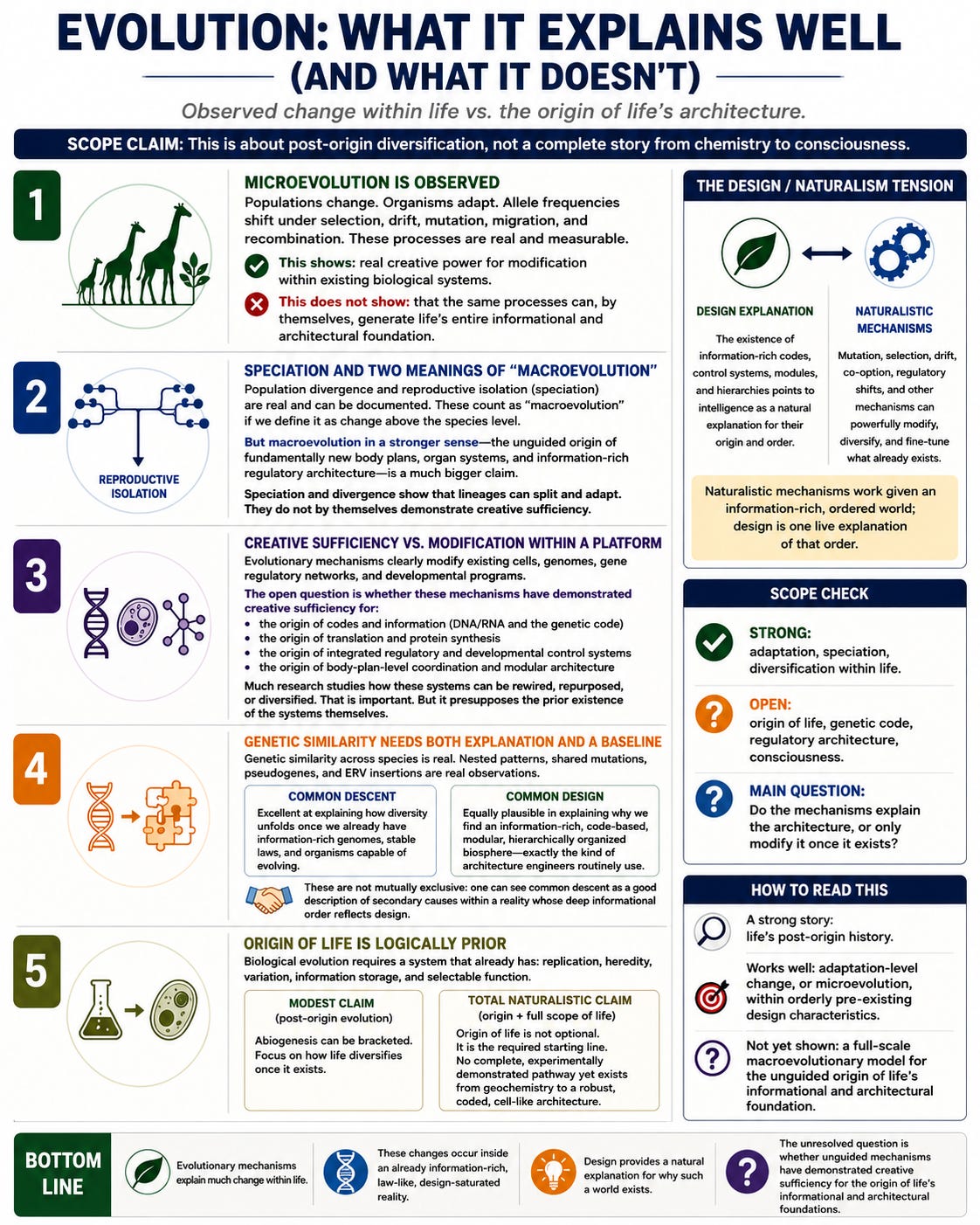
This infographic is not denying biological change. It is clarifying the scope of what evolutionary biology explains well and where the larger naturalistic claim goes beyond what has been demonstrated.
The first box begins with the strongest point of agreement: microevolution is observed. Populations change. Organisms adapt. Allele frequencies shift under selection, drift, mutation, migration, and recombination. These processes are real and measurable. The caution is about extrapolation. Observed adaptation shows real power for modification within existing biological systems. It does not, by itself, demonstrate that unguided mechanisms can generate the entire informational and architectural foundation of life.
The second box separates speciation from the stronger macroevolutionary claim. Population divergence and reproductive isolation can occur. If “macroevolution” simply means change above the species level, then speciation may count. But that definition can obscure the deeper issue. Macroevolution in the stronger sense refers to the unguided origin of fundamentally new body plans, organ systems, developmental control, and information-rich regulatory architecture. Speciation shows that lineages can split and adapt. It does not, by itself, demonstrate creative sufficiency for the full architecture of life.
The third box names the central question: creative sufficiency. Evolutionary mechanisms can modify existing cells, genomes, gene regulatory networks, developmental programs, and selectable populations. That is not the disputed point. The open question is whether those mechanisms can account for the origin of the platform itself: genetic codes, biological information, translation, protein synthesis, integrated regulation, developmental control, body-plan coordination, and modular architecture. Much evolutionary research studies how existing systems are rewired, repurposed, or diversified. That work matters. But it presupposes the prior existence of the systems being modified.
The fourth box addresses genetic similarity. Similarities across species are real. Nested patterns, shared mutations, pseudogenes, and ERV insertions are real observations. Common descent explains these as inherited ancestry through branching descent. Common design explains similarity as shared architecture, shared function, rational reuse, and informational order. The point is not that the data are irrelevant. The point is that data are interpreted within a framework. Common descent is strong at modeling lineage relationships within a naturalistic framework. Common design is strong at explaining why biology is code-based, modular, hierarchical, and functionally coordinated in the first place.
The fifth box is crucial: origin of life is logically prior. Biological evolution requires a system that already has replication, heredity, variation, information storage, and selectable function. If the claim is modest, that evolution explains much of life’s post-origin diversification, then abiogenesis can be bracketed for that discussion. But if the claim is total, that unguided natural mechanisms explain the origin and full scope of life, then origin of life cannot be bracketed. It is the required starting line. There is currently no complete, experimentally demonstrated pathway from geochemistry to robust, coded, cell-like architecture.
The side panels explain how to read the whole argument. Evolutionary biology is a well-framed story for life’s post-origin history. It works especially well for adaptation-level change, or microevolution, within a given biological platform. But that platform already includes orderly design characteristics: stable laws, information storage, functional codes, molecular machinery, regulatory systems, modularity, and developmental coordination.
That leads to the deeper insight: given design, naturalism works. Naturalistic mechanisms can operate powerfully inside an ordered, information-rich, law-governed world. Mutation, selection, drift, co-option, and regulatory shifts can modify, diversify, and fine-tune what already exists. But their success within that order does not prove that unguided mechanisms produced the order itself.
This is the design/naturalism tension. In applied science, biology is treated as an engineering library. We study biological systems for adhesives, flight, materials, computation, energy systems, information storage, and nanotechnology because living systems exhibit functional architecture. In origins science, however, those same systems are often required by method to be explained without design. That methodological rule may guide research, but it should not be mistaken for a metaphysical verdict.
The bottom line is simple. Evolutionary mechanisms explain much change within life. These changes occur inside an already information-rich, law-like, design-saturated reality. Design provides a natural explanation for why such a world exists. Evolutionary mechanisms can then describe how biological systems change over time. The unresolved question is whether unguided mechanisms have demonstrated creative sufficiency for the origin of life’s deep informational and architectural foundations. That burden has not been met.