According to Scripture and Good and Necessary Consequence:
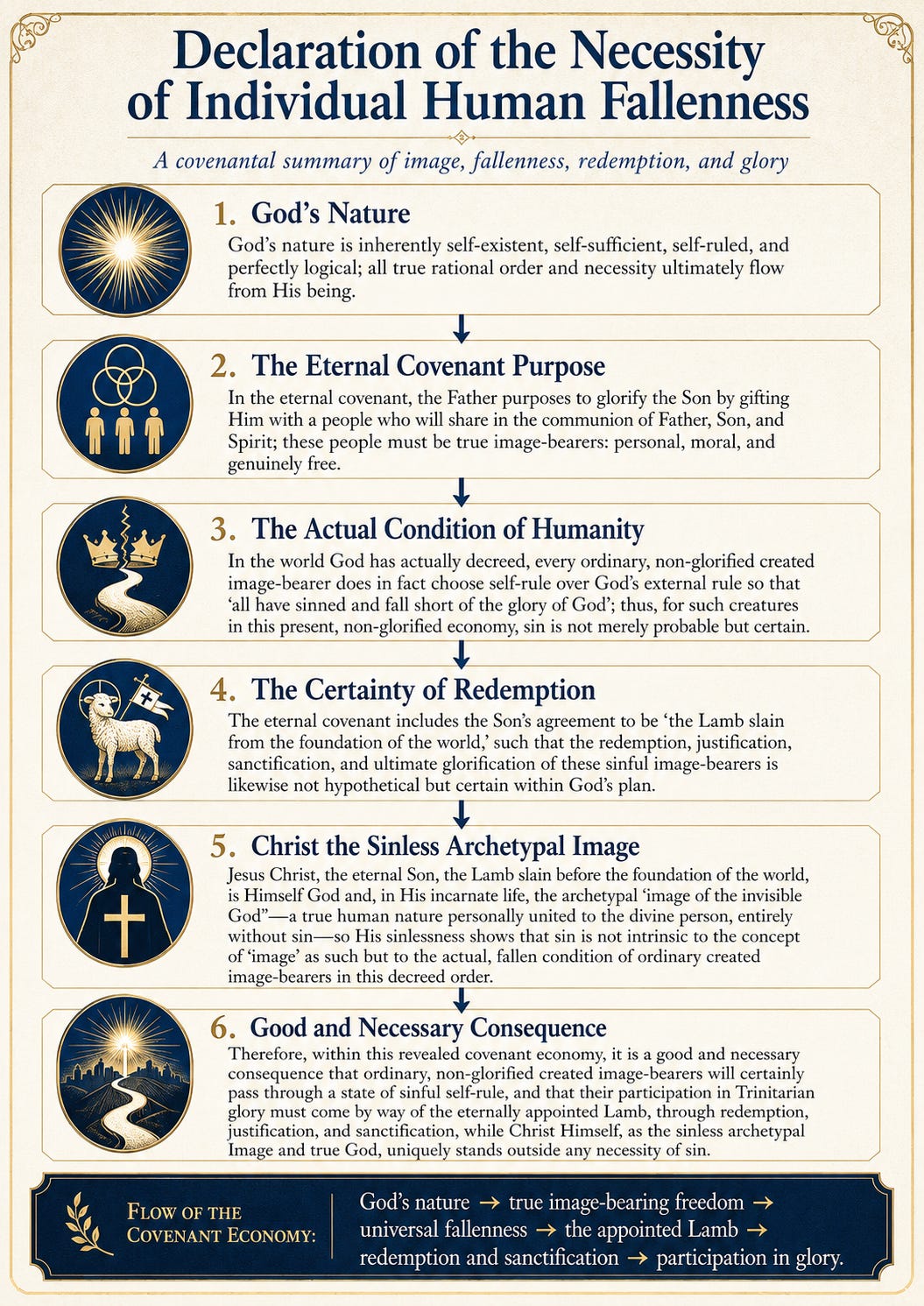
God’s nature is inherently self-existent, self-sufficient, self-ruled, and perfectly logical; all true rational order and necessity ultimately flow from His being.[1]
In the eternal covenant, the Father purposes to glorify the Son by gifting Him with a people who will share in the communion of Father, Son, and Spirit; these people must be true image-bearers, personal, moral, and genuinely free.[2]
In the world God has actually decreed, every ordinary, non-glorified created image-bearer does in fact choose self-rule over God’s external rule so that “all have sinned and fall short of the glory of God”; thus, for such creatures in this present, non-glorified economy, sin is not merely probable but certain.[3]
The eternal covenant includes the Son’s agreement to be “the Lamb slain from the foundation of the world,” such that the redemption, justification, sanctification, and ultimate glorification of these sinful image-bearers is likewise not hypothetical but certain within God’s plan.[4]
Jesus Christ, the eternal Son, the Lamb slain before the foundation of the world, is Himself God and, in His incarnate life, the archetypal “image of the invisible God,” a true human nature personally united to the divine person, entirely without sin. His sinlessness shows that sin is not intrinsic to the concept of “image” as such but to the actual, fallen condition of ordinary created image-bearers in this decreed order.[5]
Therefore, within this revealed covenant economy, it is a good and necessary consequence that ordinary, non-glorified created image-bearers will certainly pass through a state of sinful self-rule, and that their participation in Trinitarian glory must come by way of the eternally appointed Lamb, through redemption, justification, and sanctification, while Christ Himself, as the sinless archetypal Image and true God, uniquely stands outside any necessity of sin.[6]
Scriptural Proof References
[1] Exodus 3:14; Psalm 90:2; Isaiah 40:13-14; Isaiah 44:6; John 1:1-3; Acts 17:24-25; Romans 11:33-36; 1 Corinthians 14:33; Colossians 1:16-17; Hebrews 1:3; James 1:17.
[2] Genesis 1:26-27; Psalm 8:4-6; John 17:2, 6, 9-10, 22-24; Romans 8:29; Ephesians 1:3-6, 9-12; 2 Timothy 1:9; Titus 1:2; Hebrews 2:10-13; 1 John 1:3.
[3] Genesis 3:1-7; Genesis 6:5; 1 Kings 8:46; Psalm 14:1-3; Psalm 51:5; Ecclesiastes 7:20, 29; Isaiah 53:6; Romans 1:18-25; Romans 3:9-23; Romans 5:12-21; Romans 8:7-8; Ephesians 2:1-3; James 1:14-15; 1 John 1:8-10.
[4] Isaiah 53:4-12; John 1:29; John 6:37-40; John 10:11, 14-18, 27-30; Acts 2:23; Acts 4:27-28; Romans 3:24-26; Romans 8:28-30; Ephesians 1:7-11; Hebrews 9:12-15, 26; 1 Peter 1:18-20; Revelation 13:8.
[5] John 1:1, 14, 18; John 8:46; John 14:9; 2 Corinthians 4:4; Colossians 1:15, 19; Colossians 2:9; Hebrews 1:3; Hebrews 2:14-18; Hebrews 4:15; Hebrews 7:26; 1 Peter 2:22; 1 John 3:5.
[6] Luke 24:25-27, 44-47; John 14:6; John 17:22-24; Acts 4:12; Romans 5:18-21; Romans 6:6-11; Romans 8:1-4, 28-30; 1 Corinthians 1:30; 1 Corinthians 15:45-49; 2 Corinthians 3:18; Ephesians 1:4-14; Ephesians 2:4-10; Philippians 3:20-21; Colossians 3:1-4; Hebrews 10:10-14; 1 Peter 1:18-21; Revelation 5:9-10.