

July 5, 2026
Abstract
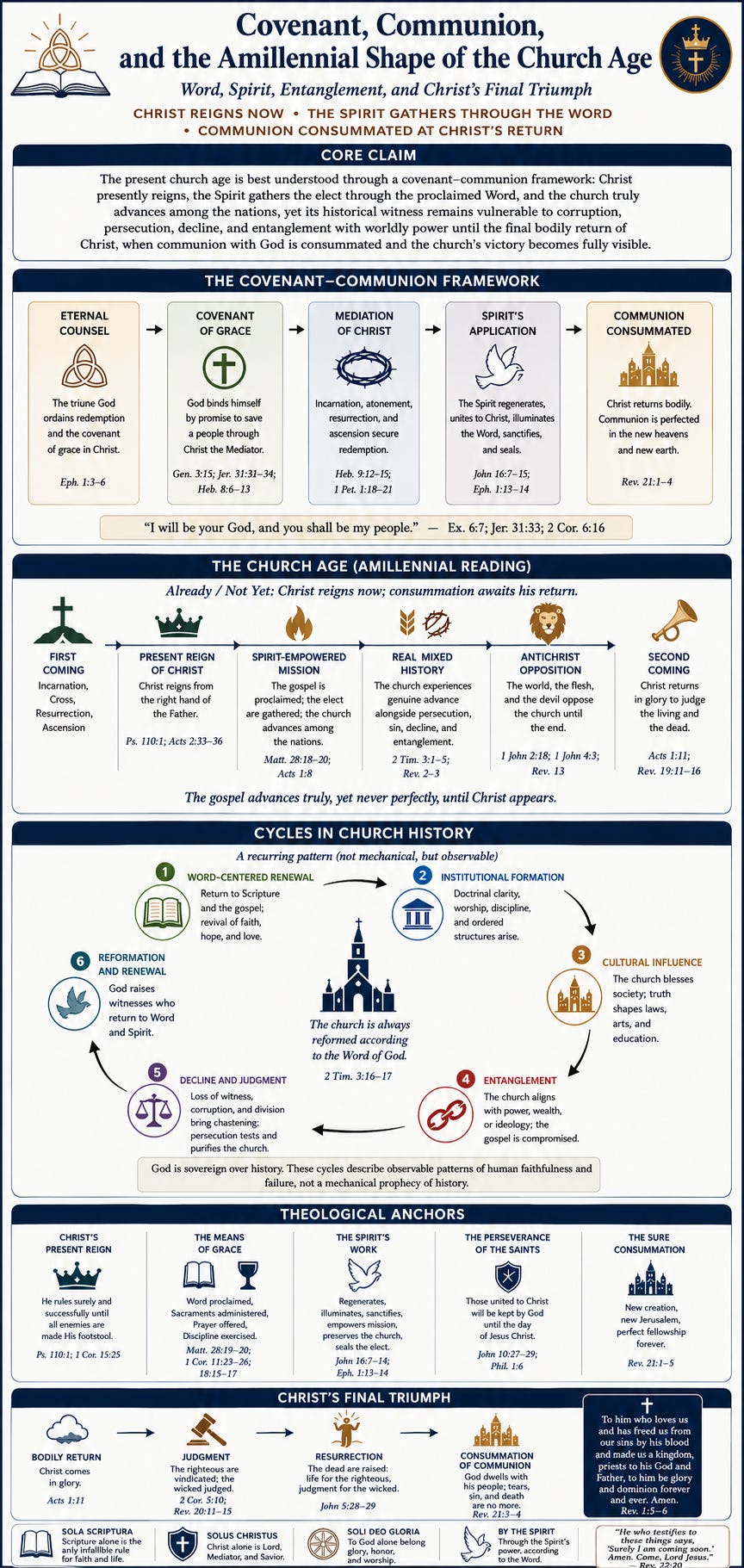
This paper argues that the present church age is best understood through a covenant-communion framework: Christ presently reigns, the Spirit gathers the elect through the proclaimed Word, and the church truly advances among the nations, yet its historical witness remains vulnerable to corruption, persecution, decline, and entanglement with worldly power until the final bodily return of Christ, when communion with God is consummated and the church’s victory becomes fully visible. Covenant is defined as the divinely ordered bond by which God establishes, restores, and secures relation with his people. Communion is the living fellowship with God toward which covenant is ordered. The argument proceeds from the eternal counsel of the triune God, through the historical administration of the covenant of grace, to the amillennial reading of the church age as a period of real gospel advance and real historical mixture. The paper further argues that church history displays recurring cycles of Word-centered renewal, institutional formation, cultural influence, entanglement, decline, and reformation. The church’s final triumph is therefore not the result of earthly power wielded by the church, but the gift of Christ’s return, judgment, resurrection, and consummation.
Keywords: covenant, communion, amillennialism, Word and Spirit, covenant of redemption, church history, entanglement, Revelation 20
Introduction
Christian theology begins and ends with communion. Creation is not an accident of divine need, but the free act of the triune God who gives creaturely life and orders it toward fellowship with himself. Sin ruptures that communion, producing alienation, exile, death, hostility, and darkness. Redemption restores communion through covenantal mediation, sacrifice, promise, incarnation, atonement, resurrection, and the Spirit’s application of Christ’s finished work. The final state consummates communion in the dwelling of God with man (Rev. 21:3).
The theological grammar of this restoration is covenant. Covenant is not a bare contract, nor merely a legal device appended to religion. Covenant is the divinely ordered bond within which communion is restored, maintained, and consummated.[1] The repeated covenantal formula, “I will be your God, and you shall be my people,” gives legal, relational, liturgical, and eschatological shape to the whole drama of redemption.
This paper argues that the present church age is best understood through a covenant-communion framework: Christ presently reigns, the Spirit gathers the elect through the proclaimed Word, and the church truly advances among the nations, yet its historical witness remains vulnerable to corruption, persecution, decline, and entanglement with worldly power until the final bodily return of Christ, when communion with God is consummated and the church’s victory becomes fully visible.
Definitions and Method
The material sources of truth for this inquiry are Scripture in the ESV and the biblical original languages. Historical theology and church history are used as ministerial aids, not as final authorities. The argument is therefore biblical-theological first, historical second, and doctrinally constructive only under the authority of the Word.
Several terms require definition. Covenant translates the Hebrew berit and the Greek diatheke; in this paper it means the divinely established bond that orders God’s relation to his people by promise, command, mediation, and sanction. Communion corresponds to biblical fellowship, especially koinonia; it names the living fellowship with God and his people that covenant secures. Word refers first to Christ as the incarnate logos, and secondarily to the inscripturated and proclaimed Word that bears witness to him. Spirit refers to the Holy Spirit, the pneuma of God, who gives life, illumines truth, applies redemption, sanctifies, and seals the elect (sphragizo). As Steward of Truth, the Spirit inspires, preserves, and providentially orders the church’s recognition and reception of the written witness to Christ through fallen human agents. Church age denotes the inter-advent period between Christ’s first coming and his bodily return. Triumph refers not to the church’s earthly domination, but to Christ’s public vindication of his people at the end. Entanglement names the corruption that occurs when the visible church’s witness is fused with state power, ethnic identity, party interest, empire, money, or cultural prestige.
Truth also requires careful definition. Truth is grounded personally in the Logos before it is expressed propositionally in creaturely language. This preserves both dimensions: truth is not an abstraction above Christ, yet neither is it reduced to experience or relation without propositional content. Christ is the Truth (John 14:6), and Scripture truthfully bears witness to him.[2]
Eternal Covenant and Triune Communion
The covenant-communion pattern is not merely a feature of created history. In Reformed theology, the covenant of redemption, often called the pactum salutis, names the eternal counsel of the triune God concerning the redemption of the elect. This language must be used carefully. The Father, Son, and Spirit are not three competing agents negotiating an agreement as creatures do. God has one divine will. Yet Scripture reveals distinct personal missions: the Father elects and gives a people to the Son; the Son undertakes their redemption as incarnate mediator; the Spirit applies that redemption and seals the elect for inheritance.[3]
The covenant of redemption should be distinguished from, but not separated from, the covenant of grace. The covenant of redemption names the eternal triune counsel by which the Father appoints redemption, the Son undertakes mediation, and the Spirit applies the Son’s accomplished work. The covenant of grace names the historical administration of that saving purpose to fallen sinners through promise, type, fulfillment, proclamation, sacrament, discipline, and perseverance. The former grounds the latter; the latter reveals and applies the former in history. This distinction keeps covenant from becoming either an abstract eternal decree without historical administration or a merely historical arrangement without triune depth.[4]
John’s Gospel is especially important. The Son repeatedly speaks of those given to him by the Father (John 6:37-40; 17:2, 6, 9, 24). He comes not to perform an autonomous project, but to do the will of the one who sent him. The Spirit, in turn, is sent as the Spirit of truth who glorifies the Son by taking what is Christ’s and declaring it to his people (John 14:26; 15:26; 16:13-14). Paul summarizes the same triune economy in Ephesians 1: the Father elects, the Son redeems, and the Spirit seals, all “to the praise of his glory.”
This eternal counsel may be described as a unified covenant of mutual glorification, provided that “mutual” does not imply deficiency, dependence, or divided wills within God. The Father is glorified as the loving and just Sovereign who elects and gives a people to the Son. The Son is glorified as the incarnate Word, Redeemer, and Judge who purchases and vindicates his people. The Spirit is glorified as the Lord and giver of life, the Spirit of truth, who illumines, applies, sanctifies, and seals. The end is not abstract salvation, but redeemed communion with the triune God.
Christ as Truth, Word, Redeemer, and Judge
Truth is personally and finally manifested in the Son. John 1 identifies the Son as the logos, the Word who was with God and was God, and who became flesh. John 14:6 presents Christ himself as the way, the truth, and the life. Hebrews 1:3 identifies the Son as the radiance of God’s glory and the exact imprint of his nature. Revelation 19:13 names him the Word of God.
The Spirit’s ministry as Spirit of truth is therefore Christological and canonical. He bears divine witness to the Son by inspiring, preserving, and providentially ordering the church’s recognition and reception of the written Word. As Steward of Truth, the Spirit curates the truthful canonical witness to Christ through fallen human authors, communities, transmission, and recognition, without surrendering that witness to merely human fallibility.[5]
The manifestation of Christ as truth is two-edged. To the elect, the truth of Jesus is salvation. To the unbelieving, that same truth is exposure, hardening, and condemnation. The gospel is not neutral information awaiting autonomous human evaluation. It is the aroma of Christ, life to life for some and death to death for others (2 Cor. 2:15-16). Christ is precious to believers, yet a stone of stumbling and rock of offense to those who disobey (1 Pet. 2:6-8). His sheep hear his voice because they are his sheep (John 10:26-28). The divergence of response to the same Word evidences divine mercy and judicial condemnation.
Word and Spirit as the Means of Restored Communion
The ordinary outward means by which sinners are restored to communion is the proclamation of the Word. The inward efficient cause is the Holy Spirit’s effectual work. Romans 10:14-17 gives the missionary logic: people call on the Lord through believing, they believe through hearing, and hearing comes through the word of Christ. James 1:18 and 1 Peter 1:23-25 connect new birth to the word of truth and the living and abiding Word of God. Acts 16:14 gives the inward side: the Lord opened Lydia’s heart to pay attention to Paul’s message.
This pattern explains why unreached peoples respond when the gospel is preached. The missionary does not produce spiritual life by technique, spectacle, or cultural pressure. Christ has sheep among the nations. The church proclaims the Word. The Spirit effectually calls. The elect hear Christ’s voice and are drawn into communion with him.[6]
Discipleship is then the ordinary outward means by which restored communion is maintained, cultivated, ordered, and matured in the visible church. This must be stated instrumentally, not ultimately. Christ preserves his sheep. Yet he preserves them through means: the Word read and preached, prayer, baptism and the Lord’s Supper, church discipline, fellowship, suffering, catechesis, and obedience. Proclamation restores communion outwardly; discipleship cultivates that communion; the Spirit gives life and sanctifies; Christ gathers and keeps.
Satan’s Binding and the Amillennial Church Age
Revelation 20 describes Satan being bound for a thousand years, then loosed for a little while before final judgment. An amillennial reading interprets the thousand years symbolically, not as a literal earthly millennium following Christ’s bodily return. This reading rests on genre, immediate context, and the larger New Testament account of Christ’s present reign.
First, Revelation is apocalyptic prophecy. Its numbers often function symbolically, and “thousand” can communicate fullness or vastness rather than strict arithmetic. Scripture itself uses “thousand” in non-arithmetical ways, as in the cattle on a thousand hills (Ps. 50:10), a day better than a thousand elsewhere (Ps. 84:10), and a thousand years as yesterday before God (Ps. 90:4; 2 Pet. 3:8). This does not prove every thousand is symbolic, but it removes the assumption that the number must be literal in an apocalyptic vision.[7]
Second, the binding is defined by the text’s stated purpose: Satan is bound “so that he might not deceive the nations any longer” until the appointed period is completed (Rev. 20:3). The restriction is therefore not absolute inactivity. It is a restraint upon Satan’s ability to hold the nations in comprehensive deception against the gospel mission. This coheres with Christ’s first-coming victory: the strong man is bound (Matt. 12:29), the ruler of this world is cast out (John 12:31), and the risen Christ sends the church to disciple the nations (Matt. 28:18-20).
Third, Revelation 20 can be read as recapitulation rather than strict chronological sequence after Revelation 19. Revelation repeatedly returns to the same inter-advent conflict from different angles. On that reading, Revelation 20 gives a symbolic depiction of the present age in which the martyrs reign with Christ, Satan is restrained from preventing the mission to the nations, and the church awaits the final assault and judgment.[8]
The loosing of Satan in Revelation 20:3 and 20:7 indicates a final climactic season of deception and opposition. This final assault is not ordinary decline or routine persecution, though it may gather those patterns into their most intense expression. It is a brief, divinely bounded rebellion that lasts until Christ returns in final triumph and judgment.
This reading also clarifies what the paper rejects. It rejects a postmillennial identification of progressive historical Christianization with the church’s pre-consummation triumph. The gospel truly advances and cultures may be meaningfully affected, but no historical order becomes the New Jerusalem before Christ appears. It also rejects a premillennial sequencing in which Revelation 20 describes a post-return earthly millennium after Revelation 19. On the reading defended here, Revelation 20 recapitulates the present church age and therefore locates the church’s final triumph at Christ’s bodily return, not in either pre-consummation cultural ascendancy or a distinct earthly millennium after that return.[9]
Historical Cycles: Revival, Decline, and Entanglement
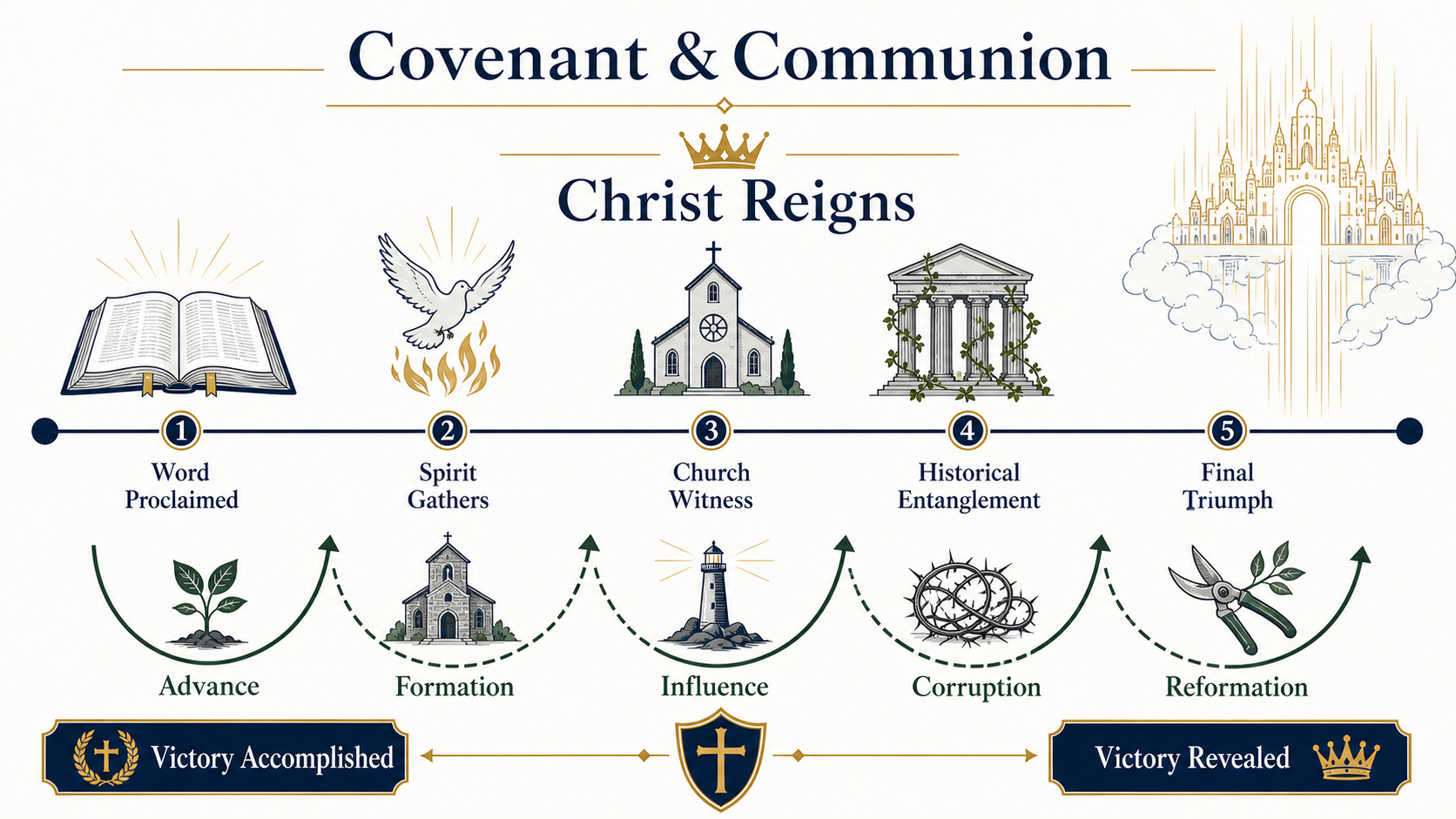
Church history after the resurrection displays recurring cycles rather than a smooth upward ascent. The church age is neither a straight triumphalist climb nor an unrelieved collapse. It is the arena in which Christ reigns, the Word runs, the Spirit gathers the elect, and the visible church remains historically mixed.
The apostolic age shows explosive proclamation, conversion, church formation, persecution, martyrdom, and doctrinal conflict. The early post-apostolic church grows under pressure, and then, with legalization and imperial favor, faces the opposite danger: cultural prestige, political usefulness, and nominal Christianity. Gonzalez’s narrative of the early church and Pelikan’s account of doctrinal development both show that expansion, doctrinal clarification, and institutional consolidation were intertwined rather than cleanly separable.[10] Augustine’s distinction between the City of God and the earthly city helps explain why visible Christianization cannot be equated with the final kingdom, even where Christianity has real public effects.[11]
Medieval Christendom demonstrates both real Christian formation and serious entanglement of church, empire, ethnicity, and coercive power. The Reformation recovers the authority of the Word, justification by faith, and vernacular Scripture, yet it too unfolds amid political alliance, conflict, and fragmentation. MacCulloch’s account of the Reformation is useful precisely because it refuses to treat doctrinal renewal as historically disembodied; the Reformation was theological, ecclesial, political, and cultural at once.[12] Later awakenings display renewed preaching, conversion, holiness, and mission, but also excess, instability, and institutional decline. Noll’s turning-point approach usefully captures how renewal movements can alter the visible church’s mission and self-understanding without dissolving the mixed character of history.[13]
The recurring pattern can be stated as follows:
1. The Word advances.
2. The Spirit gathers and revives.
3. Churches form, teach, discipline, and send.
4. Culture and institutions are affected.
5. Power attaches itself to Christian forms.
6. Entanglement corrupts witness.
7. Persecution, decline, or judgment exposes the corruption.
8. Reformation or revival restores Word-centered communion.
Entanglement is therefore a major historical danger. Christian influence on government and culture is not itself evil. Rulers are accountable to God, and the moral claims of the Word inevitably press upon public life. Yet the church’s witness is corrupted when it becomes fused with state power, party identity, ethnic pride, civilizational vanity, coercive machinery, or cultural prestige. At that point, Christian language can become a tool by which worldly power sanctifies itself.
This historical pattern strengthens the amillennial argument. The church may affirm real gospel influence without identifying any historical order with the kingdom in its consummated form. The kingdom is already present because Christ reigns. It is not yet consummated because sin, death, persecution, and deception remain until his return.
Pentecostalism, Revival, and Doctrinal Discernment
Modern global Christian expansion must be evaluated carefully. Pentecostal and charismatic movements have played a large role in twentieth- and twenty-first-century religious growth, especially in the Global South. Yet growth is not identical with revival, and religious intensity is not identical with doctrinal renewal.
The relevant phenomena must be distinguished. Classical Pentecostal denominations, prosperity-gospel movements, independent charismatic networks, apostolic-prophetic movements, and confessional continuationists are not the same thing. A disciplined critique must therefore avoid treating all continuationist or charismatic Christians as though they shared the same ecclesiology, sacramental theology, doctrine of revelation, or view of apostolic authority.
From a Word-centered Protestant and cessationist or cautious continuationist posture, the most serious concerns arise where Spirit baptism is separated from conversion, tongues are treated as normative evidence of Spirit baptism, revelatory gifts function as a practical second channel of authority beside Scripture, apostolic signs are universalized as ordinary church experience, or resurrection-age power is over-realized in the present age. Gaffin’s critique is especially relevant here because it locates Pentecost within the once-for-all history of Christ’s death, resurrection, ascension, and gift of the Spirit, rather than treating Acts as a timeless template for every believer’s experience.[14]
Therefore, Pentecostal and charismatic expansion may be described as a mixed historical phenomenon. It may include genuine conversions, prayer, missions, and moral renewal. It may also include doctrinal instability, prosperity theology, weak ecclesiology, false prophecy, and displacement of the ordinary means of grace. It should not be equated without qualification with biblical reformation or confessional revival.
The healthier criterion for revival is Word and Spirit. Where the Word of God runs freely, Christ is proclaimed, sinners are converted, doctrine is recovered, worship is purified, holiness is deepened, and churches are ordered in faithful discipleship, there one may speak more confidently of revival. Where spectacle, novel revelation, prosperity, personality, or emotional intensity replaces the ordinary means of grace, the language of revival should be used cautiously. Pentecostal and charismatic expansion is therefore relevant to this paper because it illustrates the broader amillennial pattern: real gospel spread may coexist with doctrinal instability, institutional weakness, and confusion over the relation between present blessing and final consummation.
Final Triumph
There is only one moment when the church becomes ultimately triumphant, and it is not by the strength of power the church wields. The church’s final triumph is eschatological, not institutional. It is received, not constructed. The holy city comes down from God; it is not built upward by ecclesial dominance.
This does not make the present church passive. The church preaches, baptizes, teaches, disciplines, prays, suffers, serves, and witnesses. Its weapons are not carnal. Its victory is cruciform. Revelation 12:11 describes the saints overcoming by the blood of the Lamb, the word of their testimony, and faithfulness unto death. Revelation 19-20 presents Christ as the warrior-judge whose appearing defeats his enemies. Revelation 21 presents the final communion: the dwelling place of God with man.
Amillennialism guards this distinction. It affirms Christ’s present reign and the real advance of the gospel while denying that history culminates in a church-wielded earthly triumph before the bodily return of Christ. The church is already victorious in union with the victorious Christ. That victory becomes finally visible when Christ returns, raises the dead, judges all mankind, vindicates his people, and consummates the new creation.[15]
Conclusion
From beginning to end, redemption is about communion. Covenant is the ordered bond by which God restores and secures that communion. The eternal counsel of the triune God is manifested in history through Christ’s redeeming work and the Spirit’s application of truth. The Son, the Living Word, is truth manifest; the Spirit of truth illumines and seals that truth in the elect. The proclamation of the Word is the outward means by which sinners are restored to communion, and discipleship is the ordinary means by which that communion is cultivated within the church.
History confirms the mixed character of the present age. The gospel advances, revivals occur, peoples are reached, and cultures are affected. Yet corruption, entanglement, persecution, and apostasy recur. Satan is bound from preventing the worldwide mission of Christ, but he is not absent; at the end he is loosed for a final season of deception and assault. The church’s ultimate hope, therefore, is not the power it can wield in history. Its hope is the returning Christ, who alone brings final triumph, judgment, resurrection, and everlasting communion with God. The church therefore lives between victory accomplished and victory revealed: gathered by the Word, kept by the Spirit, chastened by history, and finally vindicated only by the appearing of the King whose city descends from God.
Infographic Companion
Acknowledgments and Source Note
This is a human-curated, AI-enabled theological paper. The argument, doctrinal direction, evaluative judgments, and revision priorities are human-guided; AI assistance was used to draft, organize, revise, and format the material. Because the paper synthesizes biblical exegesis, theological loci, and broad historical claims across multiple editions and formats, some references are necessarily given by work, book, chapter, confession section, or doctrinal locus rather than by definitive page number. Page-specific citations should be added if this paper is later conformed to a particular print edition, journal style sheet, or publisher requirement.
Confessional Standards
Westminster Assembly. The Westminster Confession of Faith; The Larger and Shorter Catechisms. Glasgow: Free Presbyterian Publications, 1994.
Bibliography
Augustine. The City of God. Translated by Henry Bettenson. London: Penguin Classics, 2004.
Bavinck, Herman. Reformed Dogmatics. Edited by John Bolt. Translated by John Vriend. Grand Rapids: Baker Academic, 2003-2008.
Beale, G. K. The Book of Revelation: A Commentary on the Greek Text. New International Greek Testament Commentary. Grand Rapids: Eerdmans, 1999.
Calvin, John. Institutes of the Christian Religion. Edited by John T. McNeill. Translated by Ford Lewis Battles. Louisville: Westminster John Knox, 1960.
Gaffin, Richard B. Perspectives on Pentecost: New Testament Teaching on the Gifts of the Holy Spirit. Phillipsburg, NJ: P&R, 1979.
Gentry, Kenneth L., Jr. He Shall Have Dominion: A Postmillennial Eschatology. 3rd ed. Chesapeake, VA: Victorious Hope Publishing, 2021.
Gonzalez, Justo L. The Story of Christianity, Volume 1: The Early Church to the Dawn of the Reformation. 2nd ed. New York: HarperOne, 2010.
Horton, Michael. Introducing Covenant Theology. Grand Rapids: Baker Books, 2006.
MacCulloch, Diarmaid. The Reformation: A History. New York: Viking, 2004.
Noll, Mark A. Turning Points: Decisive Moments in the History of Christianity. 4th ed. Grand Rapids: Baker Academic, 2022.
Pelikan, Jaroslav. The Christian Tradition: A History of the Development of Doctrine, Volume 1: The Emergence of the Catholic Tradition (100-600). Chicago: University of Chicago Press, 1971.
Riddlebarger, Kim. A Case for Amillennialism: Understanding the End Times. Grand Rapids: Baker Books, 2003.
Thomas, Robert L. Revelation 8-22: An Exegetical Commentary. Chicago: Moody Press, 1995.
Vos, Geerhardus. Biblical Theology: Old and New Testaments. Edinburgh: Banner of Truth, 1975.
[1] On covenant as the structure of God’s redemptive relation to his people, see Westminster Confession of Faith 7; Herman Bavinck, Reformed Dogmatics, vol. 3, Sin and Salvation in Christ; and Michael Horton, Introducing Covenant Theology.
[2] This formulation guards both the personal and propositional dimensions of truth. Compare John 1:1-18; John 14:6; John 17:17; Colossians 1:15-20; and Hebrews 1:1-4.
[3] For Reformed dogmatic treatment of the covenant of redemption and the unified divine counsel, see Bavinck, Reformed Dogmatics, vol. 3; Calvin, Institutes, 2.12-17; and Westminster Confession of Faith 8.
[4] On the covenant of redemption as the eternal ground of the covenant of grace, see Westminster Confession of Faith 7-8; Bavinck, Reformed Dogmatics, vol. 3; and Horton, Introducing Covenant Theology.
[5] See John 14:26; John 15:26; John 16:13-14; 2 Peter 1:20-21; and 2 Timothy 3:16-17. “Steward of Truth” summarizes the Spirit’s canonical and providential work under the biblical title “Spirit of truth.”
[6] See Romans 10:14-17; Acts 13:48; Acts 16:14; John 6:37-44; John 10:16, 26-28; and 1 Corinthians 3:6-7.
[7] For amillennial readings of Revelation 20 that emphasize apocalyptic symbolism and the missional scope of Satan’s binding, see Beale, The Book of Revelation; Riddlebarger, A Case for Amillennialism; and Augustine, City of God, 20.
[8] Beale argues extensively for recapitulation in Revelation and reads Revelation 20 within that literary-theological pattern. See Beale, The Book of Revelation.
[9] For a representative Reformed postmillennial contrast, see Kenneth L. Gentry Jr., He Shall Have Dominion. For a representative premillennial sequential reading of Revelation 20, see Robert L. Thomas, Revelation 8-22. Riddlebarger frames amillennialism against both alternatives in A Case for Amillennialism.
[10] See Justo L. Gonzalez, The Story of Christianity, vol. 1, on early expansion, persecution, Constantine, and the conciliar era; and Jaroslav Pelikan, The Christian Tradition, vol. 1, on doctrinal development from 100-600.
[11] Augustine’s two-cities framework is not identical with later amillennialism in every respect, but it supplies an important anti-triumphalist account of the church’s pilgrim existence in history. See Augustine, City of God, especially books 19-20.
[12] See Diarmaid MacCulloch, The Reformation: A History, for the interwoven theological, political, and cultural character of the Reformation.
[13] See Mark A. Noll, Turning Points, especially the chapters on monastic renewal, the Reformation, evangelical awakenings, and modern missionary movements.
[14] See Richard B. Gaffin, Perspectives on Pentecost. Gaffin’s argument is not merely anti-experiential; it is redemptive-historical, locating Pentecost in the once-for-all accomplishment and exaltation of Christ.
[15] On the church’s final hope and the non-carnal character of its present warfare, see John 18:36; 2 Corinthians 10:4; Revelation 12:11; Revelation 19-21; and Westminster Confession of Faith 25 and 33.