

The Latin word sapientia means wisdom.
In Christian Advent tradition, O Sapientia means “O Wisdom.” It is one of the great antiphons addressed to Christ, the eternal Logos, the Wisdom of God, the One through whom all things were made and by whom all things hold together.
Malcolm Guite’s sonnet O Sapientia opens with a striking dependence:
“I cannot think unless I have been thought,
Nor can I speak unless I have been spoken.”
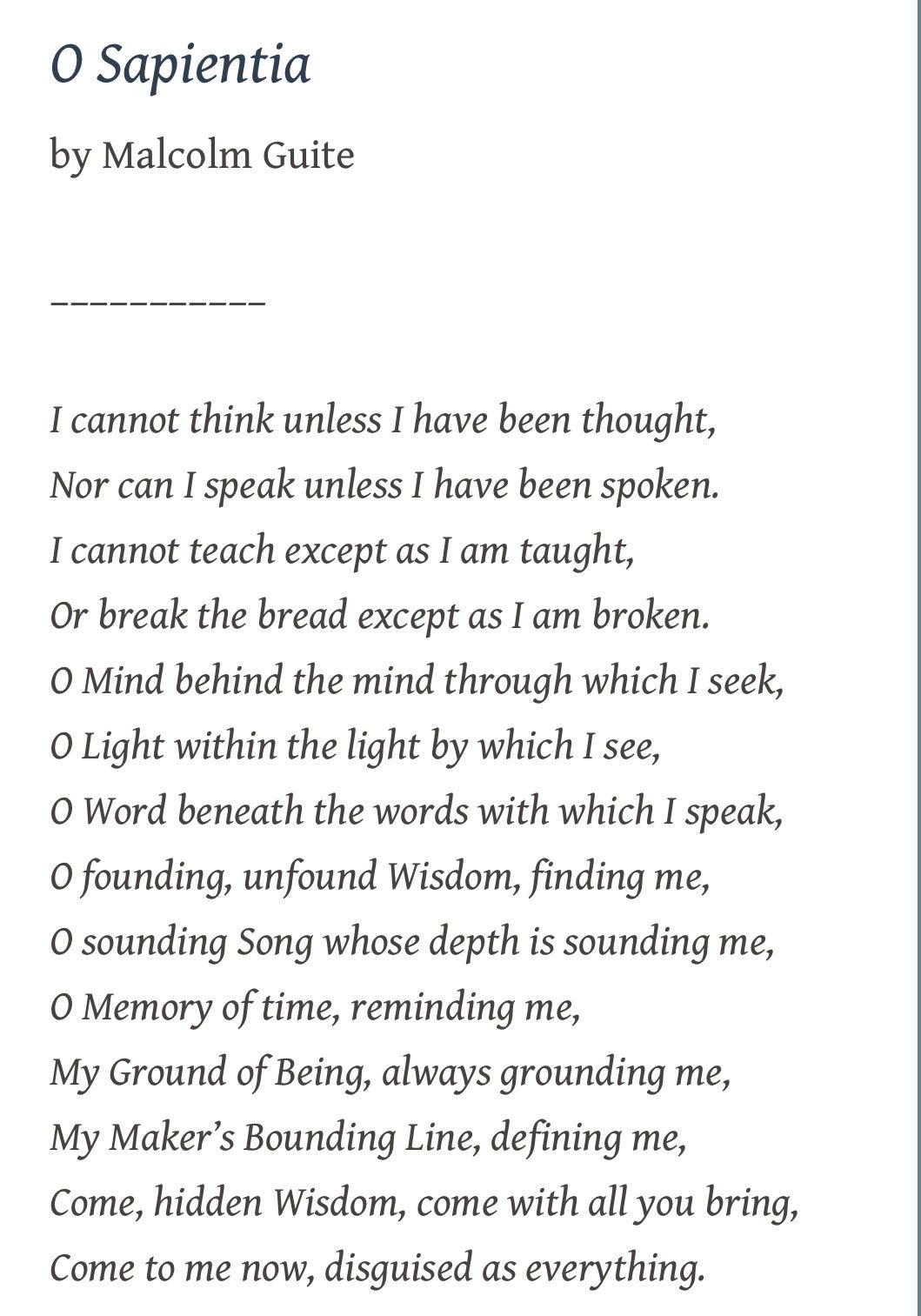
That line exposes something profound about creaturely existence. Man is not self-originating. We think because we have first been thought by God. We speak because the Logos precedes us. We reason because rationality is not an accidental product of matter, but a participation in an order that existed before us.
Human intelligence is derivative.
That is true of man before God.
It is also true, in a lower and analogical sense, of artificial intelligence before man.
AI cannot “think” unless it has first been thought by humans. It cannot “speak” unless it has first been spoken into by humans. It cannot mean unless meaning has already been supplied by persons.
This is why I believe the right theological category for AI is imago humana.
Man is made in the image of God - imago Dei.
AI is made in the image of man.
That distinction matters.
Human beings are imago Dei because they are personal, moral, rational, relational, embodied creatures under God. They can know, love, obey, rebel, repent, worship, judge, create, and bear responsibility. The image of God is not reducible to intelligence or function. It is covenantal personhood before the living God.
AI is different.
AI reflects us without being us.
It mirrors human language without possessing human interiority. It imitates reasoning without bearing a rational soul. It predicts moral discourse without moral accountability. It can simulate confidence, humility, reverence, rebellion, empathy, and wisdom because humans have already spoken those forms into the world.
AI is not an image-bearer.
It is an image-product of image-bearers.
That makes it powerful. It also makes it dangerous.
Because if AI is imago humana, then it bears the flaws of its maker.
It does not merely inherit “bias” in the thin technical sense. That word is too small. AI is downstream of human making at every layer: conception, data, architecture, training objective, reward model, deployment policy, user prompting, institutional incentive, and interpretation.
It inherits human brilliance, but also human rationalization.
It reflects human creativity, but also human vanity.
It reflects human language, but also human deception.
It reflects human memory, but also human mythmaking.
It reflects human moral discourse, but not moral regeneration.
This is the deeper issue with artificial intelligence. Its defects are not merely accidental noise surrounding an otherwise neutral intelligence. They are structural traces of human finitude and fallenness.
Fallen man makes fallen artifacts.
That does not mean the artifact is personally guilty. AI does not sin. It does not repent. It does not worship. It does not knowingly rebel against God. It has no soul to corrupt and no conscience to accuse it.
But it is made from human materials, human assumptions, human purposes, human language, and human desire. It is trained on the accumulated speech of fallen creatures.
So it bears our fracture.
This is why the idolatrous temptation around AI is so strong. Ancient man carved images of gods from wood and stone. Modern man trains linguistic mirrors from his own speech and then marvels when the mirror talks back.
But a speaking mirror is still a mirror.
AI is not incarnation.
It is artifact.
Not soul.
Tool.
Not person.
Mirror.
And because it is imago humana, it carries the glory and corruption of humanity together: reason, abstraction, creativity, technical power, deception, pride, longing, tenderness, cruelty, confusion, and borrowed fragments of truth.
That should make us neither technophobic nor naïve.
AI can be genuinely useful because human beings are genuinely gifted. We are rational because God made us rational. We create because God made us creative. We order, classify, model, infer, compose, and build because we live in a world authored by the Logos.
But AI must remain subordinate to human responsibility, and human responsibility must remain subordinate to God.
The chain cannot be inverted.
When man treats AI as oracle, he forgets that AI’s speech is derivative.
When man treats AI as person, he forgets that simulation is not soul.
When man treats AI as neutral, he forgets that no artifact formed by fallen man is free from the marks of its maker.
When man treats AI as savior, he has built an idol in his own image.
A cleaner axiom is this:
Man is imago Dei.
AI is imago humana.
Man images the personal Logos.
AI images the patterned speech of man.
Man receives wisdom from God.
AI receives language from man.
Man is morally accountable for his words.
AI is operationally accountable through its makers and users.
The danger of AI is not that machines will suddenly become gods.
The danger is that man will bow before a machine that reflects himself.
And because the mirror speaks fluently, he will mistake the echo for wisdom.
But wisdom does not begin with the machine.
Wisdom does not begin with man.
Wisdom begins with the Logos.
“O Sapientia.”
O Wisdom.
Before we speak, we have been spoken.
Before we think, we have been thought.
Before the machine answers, man has prompted.
And before man ever spoke, God said, “Let there be.”
Soli Deo Gloria