

The tree of life is often treated as though it were a strange biological mechanism in Eden, almost a sacred fruit with an intrinsic power to make man immortal. That reading creates unnecessary difficulty. It presses the text toward a crude mechanism the text itself does not require.
Genesis gives us something deeper.
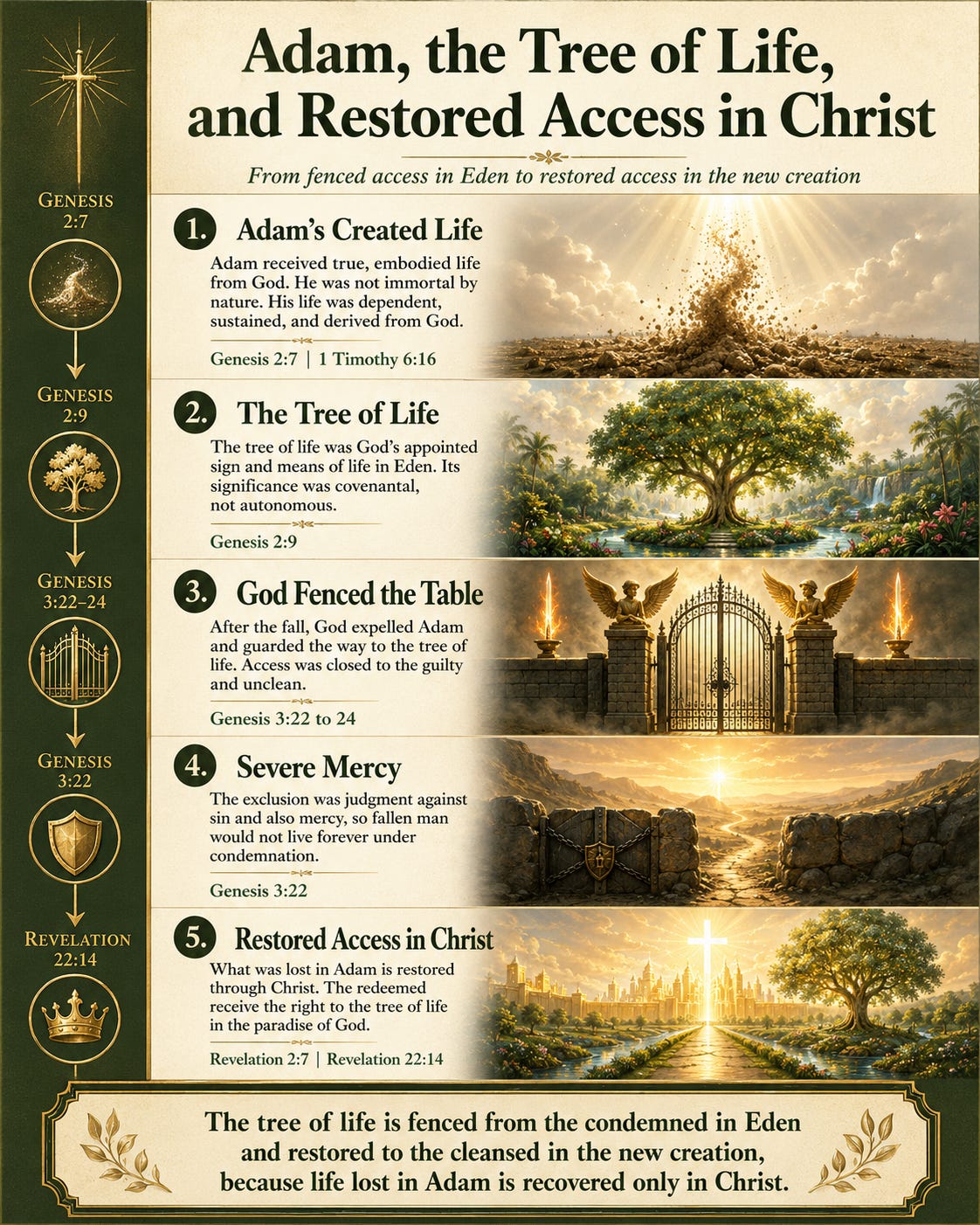
Adam was created with true human life. He was formed from the dust of the ground, and God breathed into his nostrils the breath of life. Only then did man become a living creature (Genesis 2:7). Adam’s life was real, embodied, and good, but it was not self-existing. It was received. It was dependent. It was sustained by God.
That distinction matters. God alone has immortality in himself (1 Timothy 6:16). Creaturely life is never autonomous. Adam was not immortal by essence. He was not divine. He was dust animated by the breath and will of God.
This gives us a better category for Adam’s original condition: Adam was provisionally immortal.
He was not naturally deathless in himself. He was preserved in life under God’s covenantal fellowship, with death entering the human story as the judicial consequence of disobedience. The command concerning the tree of the knowledge of good and evil establishes this clearly:
“You may surely eat of every tree of the garden, but of the tree of the knowledge of good and evil you shall not eat, for in the day that you eat of it you shall surely die” (Genesis 2:16–17, ESV).
Death is not presented as Adam’s ordinary biological endpoint. It is attached to covenant breach. Disobedience brings death. Paul later confirms this structure when he writes that “sin came into the world through one man, and death through sin” (Romans 5:12, ESV).
So Adam’s life was not intrinsic immortality. It was covenantally sustained life. He lived under God’s command, God’s presence, and God’s provision.
That is where the tree of life belongs.
The Tree of Life as Covenant Table
Genesis places the tree of life “in the midst of the garden” (Genesis 2:9). After the fall, God says:
“Behold, the man has become like one of us in knowing good and evil. Now, lest he reach out his hand and take also of the tree of life and eat, and live forever...” (Genesis 3:22, ESV).
The Hebrew sequence is direct:
we-lāqaḥ ... we-ʾākal wā-ḥay
“and take ... and eat, and live”
The text really does connect taking, eating, and living. That connection should not be weakened.
But the passage does not explain the mechanism by which the tree relates to life. It does not say the tree possesses autonomous immortality. It does not say life resides in the fruit as an independent property. The grammar gives an action-consequence sequence. It does not settle whether the tree functions biologically, sacramentally, covenantally, or as an appointed means under direct divine ordinance.
The broader biblical pattern helps here. God often attaches real covenantal significance to physical signs and appointed means. Circumcision was physical, but its meaning was covenantal. Passover involved real eating, but the lamb did not operate independently of God’s promise. The bronze serpent was a visible object through which God appointed healing, yet it had no autonomous saving power. The Lord’s Supper uses real bread and wine, and Paul warns severely against unworthy eating, but the table is not magic. It is a holy ordinance of covenant fellowship.
The tree of life can be read in that same covenantal category.
The tree was the covenantal table of Eden.
Its significance was not botanical autonomy. Its significance was God’s presence, promise, and provision. Adam’s life was not located in fruit as an independent power. Adam’s life was held in fellowship with the living God.
So the right formulation is this:
Adam’s immortality was covenantal, not intrinsic. The tree of life was the Edenic table-sign of that life.
God Fenced the Table
After Adam sinned, God expelled him from Eden:
“Therefore the LORD God sent him out from the garden of Eden to work the ground from which he was taken” (Genesis 3:23, ESV).
Then the text intensifies the point:
“He drove out the man, and at the east of the garden of Eden he placed the cherubim and a flaming sword... to guard the way to the tree of life” (Genesis 3:24, ESV).
God did not merely move Adam away from a useful resource. He guarded the way. The tree remained, but access was barred.
In covenantal terms, God fenced the table.
That language helps because it identifies the theological action. Adam was guilty. Adam was unclean. Adam had broken covenant. He could not continue to partake of the sign and provision of life while remaining in rebellion.
This is the Edenic pattern behind later holy boundaries. Holy things are guarded. The sanctuary is guarded. The ark is guarded. The table is guarded. Unauthorized access to holy provision brings judgment, because holy signs are never religious props. They are covenantal realities.
Paul’s warning concerning the Lord’s Supper follows the same covenantal logic:
“Whoever, therefore, eats the bread or drinks the cup of the Lord in an unworthy manner will be guilty concerning the body and blood of the Lord” (1 Corinthians 11:27, ESV).
The issue is not that bread and wine are magical objects. The issue is that unworthy eating profanes a holy ordinance. The sign is real. The covenantal danger is real. The table must be fenced.
So also in Eden. God barred Adam from the tree of life because fallen man had no right to eat.
Severe Mercy
The expulsion from Eden was judgment. Adam had rebelled against God’s command, and the curse fell upon human life, work, pain, death, and the ground itself (Genesis 3:16–19).
Yet the barring of the tree was also mercy.
Genesis 3:22 says the danger was that man might take, eat, and live forever. But after the fall, that does not mean glorified eternal life. It means perpetual fallen existence. It means living forever under condemnation.
That is the horror God prevents.
Fallen immortality would not be salvation. It would be the endless continuation of guilt, exile, corruption, and curse. To live forever in that state would be no blessing. It would be a confirmed misery.
So God closed Eden in mercy as well as judgment.
He fenced the tree so that man would not live forever under condemnation. The way to life would not be unauthorized eating. The way to life would have to come through redemption.
This also explains why Genesis 3:15 matters so deeply. Before Adam is driven from Eden, God promises the seed of the woman who will bruise the serpent’s head (Genesis 3:15). The path forward is not immediate return to the tree. The path forward is promise, sacrifice, covering, judgment, exile, and eventual redemption.
Eden was closed so redemption could open.
Lost Access in Adam, Restored Access in Christ
The Bible does not leave the tree of life behind in Genesis. It returns in Revelation.
To the church in Ephesus, Christ says:
“To the one who conquers I will grant to eat of the tree of life, which is in the paradise of God” (Revelation 2:7, ESV).
At the end of Scripture, the right of access is restored:
“Blessed are those who wash their robes, so that they may have the right to the tree of life...” (Revelation 22:14, ESV).
That phrase is crucial: “the right to the tree of life.”
The issue is not merely location. It is right of access.
Adam lost that right by covenant breach. The redeemed receive that right through cleansing. In Genesis, the tree is fenced from the guilty. In Revelation, the tree is granted to those washed and restored through Christ.
This confirms the covenantal reading. The tree of life is not a free-standing immortality mechanism. It is bound to righteousness, cleansing, access, and fellowship with God. The guilty are barred. The cleansed are welcomed.
The movement of Scripture is therefore not simply from garden to city. It is from lost access in Adam to restored access in Christ.
Adam forfeited the covenantal table of life by disobedience. Christ restores access by redemption, cleansing, and conquest.
Conclusion
Adam was created with contingent, covenantally sustained life. He was not immortal by nature. He was provisionally immortal under God’s sustaining fellowship.
The tree of life was the covenantal table of Eden, the appointed sign and means of life under God’s ordinance. After Adam’s rebellion, God fenced the table. This was judgment against sin, but also severe mercy, because fallen man must not eat and live forever under condemnation.
The way to the tree is closed in Genesis to the guilty and unclean. It is reopened in Revelation to the cleansed and redeemed.
The tree of life is fenced from the condemned in Eden and restored to the cleansed in the new creation, because life lost in Adam is recovered only in Christ.
Soli Deo Gloria
Doctrinal Statement on Adam, the Tree of Life, and Restored Access in Christ
Adam was created by God with true, embodied human life and depended wholly upon God for that life. The man became a living creature by the breath of God, not by an immortal power inherent in himself (Genesis 2:7). God alone possesses immortality in himself, while all creaturely life is received, dependent, and sustained by his will (1 Timothy 6:16).
Under God’s covenantal fellowship, Adam possessed life as a divine gift and stood under the command of God with the prospect of continued life. The command concerning the tree of the knowledge of good and evil shows that death entered the human story as the judicial consequence of disobedience, not as Adam’s ordinary created destiny (Genesis 2:15–17; Romans 5:12).
The tree of life was placed by God in the midst of Eden as his appointed sign and means of life for man under his ordinance. Its significance was not independent of God, as though life resided autonomously in the tree, but derivative of God’s presence, promise, and covenantal fellowship (Genesis 2:9).
After the fall, God expelled Adam from Eden and guarded the way to the tree of life. This exclusion was judgment against sin, and it was also severe mercy, so that fallen man would not eat and live forever in a cursed and condemned condition (Genesis 3:22–24).
Accordingly, the way to the tree of life is closed in Genesis to the guilty and unclean. It is reopened in Revelation to those whom God cleanses and restores through Christ. The redeemed are granted access to the tree of life in the paradise of God, and they receive the right to enter the holy city and partake of life restored (Revelation 2:7; Revelation 22:14).
Scripture therefore presents a redemptive movement from lost access in Adam to restored access in Christ. Adam forfeited the covenantal table of life through disobedience. Christ restores access by redemption, cleansing, and conquest. The tree fenced from fallen man in Genesis is granted to the redeemed in the new creation.
The tree of life is fenced from the condemned in Eden and restored to the cleansed in the new creation, because life lost in Adam is recovered only in Christ.
This Argument Stands in the Reformed Tradition
The reading offered here is not novel. It recovers and restates a line of interpretation that runs through Augustine, the Reformers, and the Reformed scholastics, and that was given its most careful exposition by Francis Turretin and Geerhardus Vos. Naming that lineage is worth the space, because the strength of the case lies partly in its age. What follows is not a private construction pressed onto Genesis but the historic Reformed understanding of the tree of life, drawn out for a particular pastoral end.
Augustine and the early sacramental reading
The instinct to read the tree as sign rather than mechanism is ancient. Augustine distinguished the tree of life from Eden’s ordinary trees precisely on this point, holding that Adam had nourishment in other trees, but in this one a sacrament (The Literal Meaning of Genesis 8.4, as cited in Turretin, Institutes 1:581). The tree fed Adam, but its deeper office was to signify. That distinction, sign over substance, is the seed of everything that follows.
Turretin: the tree as sacrament, and the forfeiture of its sign
Turretin treats the question directly under the Eighth Topic of the Institutes, asking why it was called the tree of life. He rejects the view, which he attributes to Bellarmine, that the tree held an innate power of vivifying man and conferring absolute immortality. His reasoning is metaphysical: a finite power could not carry the infinite efficacy of extending life forever, and the tree’s own fruit was subject to corruption. Whatever the tree did, it did not do autonomously (Institutes1:580).
He then states the better view. The tree obtained this name principally by reason of signification. It was, in his words, a sacrament and symbol of the immortality which would have been bestowed upon Adam if he had persevered (Institutes1:581). This is the position the present essay takes when it calls the tree the covenantal table of Eden, the appointed sign and means of life under God’s ordinance rather than a botanical engine of deathlessness.
Two features of Turretin’s account bear directly on the argument here. First, he gives the sign a backward and a forward reference at once. Looking back, it was a token reminding Adam that he had life not from himself, but from God, so that each time he ate he was bound to recollect the source of his life. Looking forward, it was a declarative and sealing sign of the life to come (Institutes 1:581). The essay’s claim that Adam’s life was received, dependent, and covenantally sustained is simply Turretin’s first relation stated in plainer words.
Second, and most striking, Turretin anticipates the fenced-table reading almost exactly. Commenting on the expulsion in Genesis 3:22, he denies that the verse implies any physical power in this tree capable of rescuing fallen man from mortality. The barring of the tree, he argues, was not divine envy of human life but the just consequence that Adam, having cut himself off from the life signified, ought no longer to have any right to its sacrament. For this reason, he writes, God willed to station the cherubim with a flaming sword at the gate of paradise (Institutes 1:581). The logic of this essay, that fallen man forfeits the right to the sign of a life he has abandoned, and that the cherubim guard a fenced table, is Turretin’s own.
Vos: the sacrament reserved, the eschatological reading
Geerhardus Vos carried the same reading into Reformed biblical theology, framing it in terms of probation and advancement rather than scholastic seals. For Vos the tree was sacramentally symbolic of life, where life comes from Godand for man consists in nearness to God. The point of God’s fellowship with man was to impart that life (Biblical Theology, p. 27). Vos also noticed the textual detail that grounds this essay’s reading of Genesis 3:22: that Adam had not eaten of it before the fall, which suggested to him that the tree’s use was reserved for the future, in keeping with its later eschatological significance. To anticipate that reward by a present enjoyment of the fruit would have been out of keeping with its sacramental character (Biblical Theology, p. 28, as quoted in multiple secondary sources; verify against the primary before formal citation).
Vos’s contribution is the eschatological frame. The tree did not merely sustain a static condition; it pointed toward a higher, confirmed life to be entered upon obedience. That frame undergirds the essay’s closing movement from lost access in Adam to restored access in Christ, and it explains why the tree reappears in Revelation as the reward granted to the one who conquers (Revelation 2:7).
The breadth of the tradition
The sacramental reading is not the property of two theologians. The catalogue of those who held some form of it includes Augustine and Bede in the early and medieval church, and Calvin, Musculus, Perkins, and Chytraeus among the Reformers, with Wilhelmus à Brakel and later Meredith Kline extending it in the Reformed tradition. Kline spoke of the tree as a sacramental seal of man’s participation in the glory of immortality. The Westminster tradition assumes the same when it treats the trees of Eden as signs attached to the covenant God made with Adam.
Where this essay places its weight
To say the argument stands in this tradition is not to say it merely repeats it. The classical Reformed sources, Turretin chief among them, tend to set the tree within the formal architecture of the covenant of works: probation, merit, and a reward sealed upon completed obedience. The emphasis of this essay falls elsewhere. It foregrounds covenantal fellowship and sustained dependence, the tree as present table of communion, and it gives particular weight to the severe mercy of the fencing, the prevention of a perpetual fallen existence, with Genesis 3:15 as the hinge toward redemption. That emphasis is closer to the communion-centered stream of Reformed biblical theology, in the line of Vos, than to the scholastic seal of Turretin. The thesis is old. The pastoral weighting is the contribution.
A note on sources. The Turretin quotations are taken directly from the Giger translation (Francis Turretin, Institutes of Elenctic Theology, trans. George Musgrave Giger, ed. James T. Dennison Jr., Phillipsburg: P&R, 1992, vol. 1, pp. 580 to 582). The Vos quotations are drawn from Biblical Theology (1948), pp. 27 to 28, and are well attested across independent secondary sources; the precise wording should be collated against a primary copy before formal publication.