

The organization of the local church should emerge from its theology. Scripture provides the foundational principles by which we understand human dignity, spiritual equality, differentiated roles, ecclesiastical authority, and ministerial responsibility.
Modern organizational practices can serve the church well when subordinated to those principles. Problems arise when organizational conventions obscure or displace biblical distinctions.
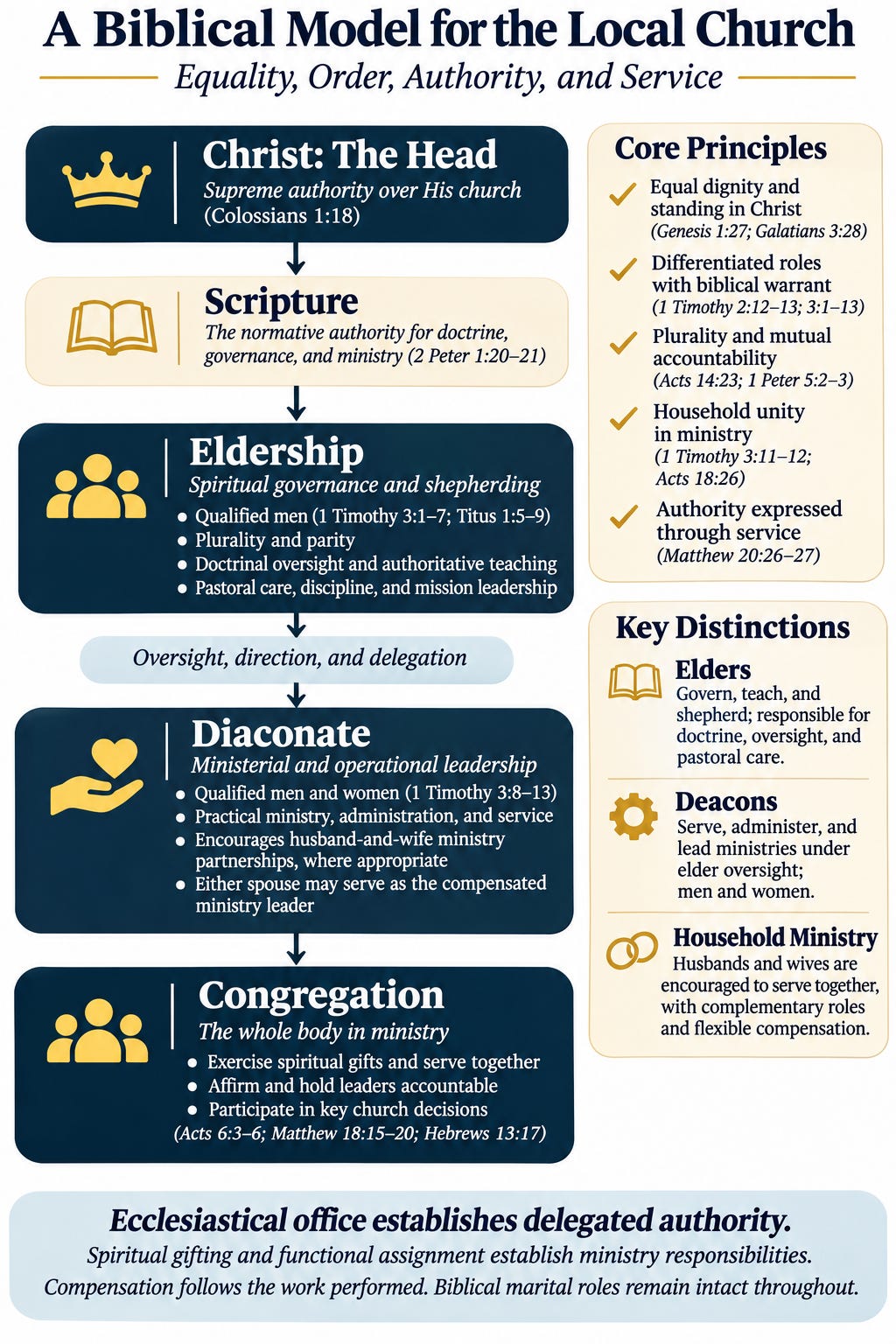
I propose a model of the local church that is Christ-centered, Scripture-governed, elder-led, deacon-served, and congregationally accountable.
This model integrates contemporary church staff into biblical governance, recognizes the distinct responsibilities and contributions of men and women, and encourages the integration of marriage and household life into the ministry of the church.
Equal Dignity, Distinct Roles
God created both male and female in His image (Genesis 1:27). Both possess equal inherent dignity and moral accountability before God.
Paul reinforces our equal standing in Christ:
There is neither Jew nor Greek, there is neither slave nor free, there is no male and female, for you are all one in Christ Jesus. (Galatians 3:28, ESV)
The immediate context concerns justification through faith, adoption as children of God, and inheritance according to the promise (Galatians 3:23–29).
Ethnicity, social standing, and sex confer no preferential standing in salvation. All who belong to Christ are equally heirs of the promise.
This spiritual equality does not abolish physical distinctions or divinely ordained responsibilities. Paul himself establishes differentiated marital and ecclesiastical roles elsewhere in his writings.
Peter reinforces the compatibility of equality and differentiation in his instructions to husbands:
Likewise, husbands, live with your wives in an understanding way, showing honor to the woman as the weaker vessel, since they are heirs with you of the grace of life, so that your prayers may not be hindered. (1 Peter 3:7, ESV)
I understand the reference to the weaker vessel as primarily concerning relative physical constitution. Peter explicitly affirms spiritual equality by identifying husbands and wives as fellow heirs of grace.
Physical differentiation carries corresponding responsibilities, particularly for husbands in their treatment of their wives.
Scripture also establishes differentiated roles within marriage, including the husband’s headship, his obligation to love his wife sacrificially, and the wife’s submission to her husband as to the Lord (Ephesians 5:22–33).
These roles have independent scriptural warrant and remain applicable regardless of the relative physical, intellectual, or organizational capabilities of particular individuals.
Equality of being is entirely compatible with differentiation of function.
Prescription, Practice, and Principle
A sound biblical model requires careful distinctions between explicit scriptural commands, contextual instructions, apostolic judgments, and personal practices.
Paul himself makes such distinctions in 1 Corinthians 7. His preference for singleness, for example, does not establish a universal obligation to remain unmarried. Likewise, his practice of supporting himself through manual labor does not establish a prohibition against compensated ministry (1 Corinthians 9:4–18).
All Scripture is authoritative. Its individual passages, however, have differing prescriptive scopes according to their intended meaning.
Where Paul grounds an instruction in the creation order, as he does in 1 Timothy 2:12–13, there is substantial warrant for understanding that instruction as transcending its immediate cultural circumstances.
We should exercise equal care against imposing restrictions beyond those Scripture establishes.
This hermeneutical distinction is particularly important when developing a biblical model of church leadership. We must distinguish what Scripture commands, what it permits, what it illustrates, and what it leaves to our prudential judgment.
Church traditions and organizational conventions remain subject to this same examination.
Christ Is the Head of the Church
Every ecclesiastical office derives its legitimacy and authority from Christ.
And he is the head of the body, the church. (Colossians 1:18, ESV)
Church leaders exercise delegated authority. They remain accountable to Christ, subject to His Word, and responsible for the welfare of those entrusted to their care.
Scripture is our specially revealed material source of truth and the normative authority by which church doctrine, governance, and practice must be evaluated.
The Holy Spirit, as the divine Author of Scripture, equips the church for ministry and distributes gifts throughout the body according to His will (1 Corinthians 12:4–11; 2 Peter 1:20–21).
The biblical model recognizes two distinct offices within the ordinary governance and ministry of the local church: elders and deacons (Philippians 1:1; 1 Timothy 3).
Their responsibilities are complementary.
The Eldership
The terms elder, overseer, and shepherd describe closely related aspects of pastoral leadership, as demonstrated in Acts 20:17–28 and 1 Peter 5:1–4.
The eldership bears collective responsibility for:
Spiritual governance.
Doctrinal integrity.
Authoritative teaching.
Pastoral care and shepherding.
Ecclesiastical discipline.
Equipping the congregation for ministry.
Oversight of the church’s mission and ministries.
I understand Scripture to reserve this office for qualified men, based on Paul’s instructions in 1 Timothy 2–3 and Titus 1.
Paul explicitly grounds his instruction concerning teaching and authority in the creation order:
I do not permit a woman to teach or to exercise authority over a man; rather, she is to remain quiet. For Adam was formed first, then Eve. (1 Timothy 2:12–13, ESV)
This instruction must be understood alongside Paul’s affirmation of spiritual equality in Galatians 3:28 and his recognition of women as fellow laborers in ministry.
The rationale for male eldership is independent of relative physical strength, intellectual ability, or organizational competence. Its warrant rests upon the scriptural prescription and its grounding in creation.
Being male alone establishes no entitlement to ecclesiastical authority. An elder must demonstrate the character, maturity, doctrinal fidelity, and teaching competence required by Scripture.
Peter further instructs elders to exercise oversight willingly and eagerly, without domineering over those entrusted to them (1 Peter 5:2–3).
Eldership is a weighty responsibility.
Plurality and Parity Within the Eldership
The New Testament repeatedly identifies a plurality of elders within local churches (Acts 14:23; Acts 20:17; Titus 1:5; James 5:14).
This pattern provides substantial warrant for collective spiritual governance and mutual accountability.
Within that plurality, elders may exercise different responsibilities according to their gifts, experience, and ministry assignments.
Paul recognizes such differentiation:
Let the elders who rule well be considered worthy of double honor, especially those who labor in preaching and teaching. (1 Timothy 5:17, ESV)
A senior pastor may therefore serve as the principal preaching elder and coordinate the work of the eldership. Such an arrangement can provide organizational clarity, continuity, and effective leadership.
I would characterize this role as primus inter pares, or first among equals.
The proposed model rests upon five principles:
Parity of office. Every elder holds the same ecclesiastical office and remains subject to its qualifications.
Differentiation of assignment. Elders may specialize in preaching, teaching, pastoral care, discipleship, or other responsibilities.
Delegated coordination. A senior pastor or presiding elder may coordinate the work of the eldership.
Collective accountability. Every elder remains accountable to his fellow elders and subject to appropriate congregational accountability.
Compensation neutrality. Compensated and uncompensated elders possess the same standing within the office.
Equal voting rights among elders would be a reasonable organizational expression of parity, although Scripture does not prescribe a particular voting mechanism.
The senior pastor should exercise his coordinating responsibilities within the collective governance of the eldership. His employment status, public visibility, or preaching responsibilities confer no independent governing authority beyond that properly entrusted to him.
This arrangement provides safeguards against the concentration of ecclesiastical authority in a single individual.
The Diaconate
The diaconate provides an organized means of ministerial service under the spiritual oversight of the eldership.
Its responsibilities may include administration, benevolence, stewardship, facilities, ministry coordination, and the practical execution of the church’s mission.
Acts 6:1–7 illustrates the functional distinction between the ministry of the Word and the administration of practical needs, although the passage does not explicitly identify the seven appointed men as holders of the formal diaconal office.
The qualifications in 1 Timothy 3:8–13 establish that diaconal service also requires spiritual maturity, integrity, and faithfulness.
Deacons can exercise substantial leadership and delegated operational authority within their respective ministries. Their responsibilities remain distinct from the authoritative teaching and spiritual governance assigned to elders.
This distinction is important because some contemporary churches have effectively assigned the governing responsibilities of elders to their deacon boards.
Such arrangements can obscure the biblical differentiation between the offices.
The diaconate should be recognized as a substantive leadership body with meaningful responsibilities, appropriate delegated authority, and accountability to the eldership.
The Household-Integrated Diaconate
Paul’s instructions concerning the diaconate contain an interesting feature that warrants closer examination.
In the midst of establishing the qualifications for deacons, Paul specifically addresses the qualifications of women or wives:
Their wives likewise must be dignified, not slanderers, but sober-minded, faithful in all things. (1 Timothy 3:11, ESV)
He then continues:
Let deacons each be the husband of one wife, managing their children and their own households well. (1 Timothy 3:12, ESV)
The Greek term gynaikas in verse 11 can refer to women or wives. The Greek text contains no explicit possessive pronoun corresponding to the English word “their.” The ESV acknowledges “Women likewise” as an alternative translation.
The passage has traditionally generated two principal interpretations. Paul is either establishing qualifications for the wives of male deacons or establishing qualifications for women serving in the diaconate.
I believe the structure of the passage also warrants consideration of a practical organizational model that recognizes the diaconal ministry of husbands and wives serving together.
The placement of the qualifications for women alongside those for male deacons, marital fidelity, and household management suggests that the household relationship deserves particular attention in the organization of diaconal ministry.
I propose a household-integrated diaconate, in which qualified husbands and wives are encouraged, where appropriate, to serve together in complementary ministry responsibilities.
Marriage already establishes a covenantal relationship in which husband and wife share responsibilities, resources, commitments, and mutual obligations.
Their participation in the ministry of the church can reflect that unity.
Under this model, a husband and wife might jointly undertake responsibility for a particular area of ministry, with their respective assignments determined by spiritual gifting, competence, availability, and the needs of the congregation.
One spouse may exercise primary operational responsibility while the other contributes through complementary service, coordination, counsel, or practical support.
Either spouse may be the compensated ministry leader.
Both may be compensated where their respective workloads and responsibilities warrant it. Both may serve voluntarily.
The biblical marital relationship remains intact regardless of which spouse possesses greater professional expertise or receives compensation for ministry.
A wife’s appointment as a compensated ministry director does not transfer marital headship to her. Her husband’s marital headship likewise confers no automatic professional or ecclesiastical authority over her assigned ministry.
Their respective responsibilities remain properly ordered within marriage and within the governance of the church.
Biblical Examples of Ministry Partnership
The ministry of Aquila and Priscilla provides a particularly relevant example.
Paul identifies them as fellow workers in Christ Jesus (Romans 16:3). Together, they instructed Apollos more accurately concerning the way of God (Acts 18:26). Their household also provided a gathering place for the church (1 Corinthians 16:19).
Scripture does not explicitly identify Aquila and Priscilla as deacons. Their ministry nevertheless demonstrates the compatibility of biblical marriage, shared ministry, and meaningful contributions from both spouses.
Their example illustrates how a married couple can serve the church through complementary gifts and coordinated responsibilities.
Such partnerships are already present in many congregations. A compensated ministry leader may receive substantial assistance from a spouse whose contributions remain informal or largely unrecognized.
A household-integrated diaconal model provides a means of recognizing and organizing such partnerships where both spouses are willing and qualified to participate.
It also encourages churches to consider the effects of ministry commitments upon marriage and family life.
The household is itself an important sphere of Christian responsibility. Church ministry should strengthen faithfulness within that sphere.
Women in the Diaconate
Scripture provides substantial grounds for recognizing women in diaconal ministry.
Paul identifies Phoebe as a servant of the church:
I commend to you our sister Phoebe, a servant of the church at Cenchreae. (Romans 16:1, ESV)
The Greek term translated as servant is diakonos. The term can describe either a servant generally or a holder of the formal diaconal office.
Taken alongside the qualifications for women in 1 Timothy 3:11, this passage provides what I consider a reasonable biblical basis for recognizing qualified women within the diaconate.
The exegetical question remains contested. The household-integrated model represents a proposed application of these passages rather than a claim that Paul explicitly prescribes paired diaconal appointments.
Phoebe’s marital status is unknown. Scripture therefore provides insufficient warrant for requiring every woman serving in the diaconate to participate through a husband.
Likewise, Paul’s recognition of the benefits of singleness for Christian service (1 Corinthians 7:32–35) cautions against making marriage a universal prerequisite for ministry.
The household-integrated model should therefore accommodate qualified unmarried and widowed believers, as well as married individuals whose spouses are unable or uncalled to participate in the same ministry.
Individual spiritual qualifications, willingness, and accountability remain essential. Marriage alone confers no ecclesiastical office upon either spouse.
The New Testament also recognizes women participating in significant ministry beyond the example of Phoebe. Paul instructs older women to teach what is good and train younger women (Titus 2:3–5). He acknowledges women who labored alongside him in the gospel (Philippians 4:2–3).
The Holy Spirit distributes gifts throughout the body of Christ for its common good.
Women may exercise significant leadership in church ministries, administer resources, manage personnel, coordinate programs, and contribute their gifts to the edification of the congregation.
The restrictions associated with eldership should remain within their scripturally warranted scope.
Authoritative Teaching and Instructional Ministry
The distinction between authoritative teaching and instructional ministry deserves particular attention.
Teaching occurs throughout the life of the church. Parents instruct children. Mature believers disciple younger believers. Congregants encourage and admonish one another. Musicians communicate theological truths through song.
Paul recognizes this broader instructional responsibility:
Let the word of Christ dwell in you richly, teaching and admonishing one another in all wisdom, singing psalms and hymns and spiritual songs. (Colossians 3:16, ESV)
Within the complementarian interpretation advanced here, the restriction in 1 Timothy 2 concerns teaching and authority within the church in a manner associated with its authoritative spiritual leadership.
This must be understood alongside the instructional ministries Scripture expressly recognizes.
The eldership retains responsibility for establishing, maintaining, and defending the church’s doctrinal commitments. Other ministry leaders may exercise instructional responsibilities within biblically appropriate contexts and under elder oversight.
This distinction has practical implications for worship, children’s ministry, discipleship, and other ministries involving significant theological content.
A worship ministry director, for example, may select music, direct musicians, coordinate worship services, and develop the ministry within established theological boundaries.
A husband and wife might serve together in this ministry, with one directing the musicians and the other coordinating administration, scheduling, or other responsibilities according to their respective gifts.
Either could be the compensated director.
The eldership retains responsibility for the doctrinal integrity of corporate worship.
Similarly, a children’s ministry director may develop instructional programs, evaluate curriculum, coordinate teachers, and administer the ministry within an elder-approved doctrinal framework.
A husband and wife might jointly support this ministry, with the wife serving as its compensated director and the husband contributing through administration, facilities, family engagement, or other appropriate responsibilities.
The eldership retains responsibility for the theological integrity of that instruction.
Appropriate mechanisms might include:
Established doctrinal and ministry standards.
Periodic review of curriculum and worship content.
Clear boundaries for delegated decision-making.
Defined processes for addressing theological concerns.
Regular communication between elders and ministry leaders.
These mechanisms should be proportionate to the responsibilities and risks of each ministry.
The objective is doctrinal accountability without operational micromanagement.
Delegation allows ministry leaders to exercise their gifts and responsibilities effectively while preserving the spiritual oversight entrusted to the eldership.
Integrating Church Staff into Biblical Governance
Many contemporary churches maintain organizational structures consisting of an elder board, a deacon board, and a professional staff hierarchy.
This arrangement can produce three competing centers of organizational authority.
The elders may possess formal governing responsibility. The deacons may exercise traditional administrative responsibilities. The professional staff may control much of the church’s actual day-to-day activity.
Such arrangements can create ambiguity concerning authority, accountability, and ministerial responsibility.
I propose integrating church staff into the two biblical functional domains according to their actual responsibilities.
Ecclesiastical office establishes delegated authority. Spiritual gifting and functional assignment establish ministry responsibilities. Compensation follows the work performed. Biblical marital roles remain intact throughout.
Staff serving within the eldership would include:
Senior or lead pastors.
Teaching pastors.
Shepherding pastors.
Other qualified pastoral staff exercising spiritual governance, doctrinal oversight, and authoritative teaching.
Staff serving within the diaconate would include:
Church administrators.
Financial and stewardship directors.
Worship ministry directors.
Children’s ministry directors.
Facilities and technology directors.
Benevolence and outreach directors.
Communications and operational support leaders.
These assignments are illustrative. The actual responsibilities of a position determine its appropriate placement.
A pastor exercising the responsibilities of an elder should be a qualified and recognized member of the eldership.
A ministry director exercising substantive diaconal responsibilities should operate within the diaconal structure. Where those responsibilities warrant formal ecclesiastical office, the individual should satisfy the corresponding biblical qualifications and undergo the appropriate recognition process.
Where appropriate, married diaconal leaders may serve in recognized husband-and-wife ministry partnerships.
Other staff members and volunteers may serve within these functional domains without themselves holding ecclesiastical office.
For example, a compensated musician, administrative assistant, or facilities technician need not become a deacon simply by virtue of employment. Such individuals may serve under the leadership of a recognized deacon or appropriate ministry leader.
The same principle applies to pastoral support personnel.
This model integrates professional staff into the biblical governance structure while preserving the distinctions between employment, ministry assignment, marital responsibility, and ecclesiastical office.
Compensation and Household Ministry
Scripture recognizes the legitimacy of compensated ministry (1 Corinthians 9:4–14; 1 Timothy 5:17–18).
Compensation enables individuals to devote time and effort to ministry responsibilities that might otherwise be difficult to sustain.
Within the household-integrated diaconate, compensation should correspond to the actual work performed by each individual.
A wife may possess the training, experience, and availability necessary to direct a particular ministry. Her husband may contribute through voluntary service while maintaining employment elsewhere.
The reverse arrangement is equally compatible with the proposed model.
In some circumstances, both spouses may perform substantial ministry responsibilities warranting compensation. In others, neither may require compensation.
Employment arrangements should clearly identify each individual’s responsibilities, compensation, reporting relationships, and accountability.
A spouse’s voluntary participation must remain genuinely voluntary. The church should avoid creating implicit expectations of uncompensated labor simply because an individual is married to a compensated ministry leader.
Similarly, marriage should confer no exemption from ordinary standards of financial stewardship, conflict-of-interest management, performance accountability, or appropriate safeguarding.
Where spouses serve together, the eldership should provide independent oversight of their ministry arrangements.
The household partnership is an expression of shared Christian service. Its organizational implementation should respect the integrity of both the marriage and the church.
Congregational Accountability
The congregation is the gathered body of believers and an active participant in the life, ministry, and accountability of the church.
The New Testament provides several relevant principles:
Congregational participation in the selection of ministry leaders (Acts 6:3–6).
Congregational participation in ecclesiastical discipline (Matthew 18:15–20; 1 Corinthians 5:4–5).
Responsibility for discernment concerning doctrinal fidelity (Galatians 1:6–9).
Recognition of and submission to faithful spiritual leadership (Hebrews 13:17).
Mutual instruction, encouragement, and accountability among believers (Colossians 3:16; Hebrews 10:24–25).
These passages establish meaningful congregational responsibilities alongside the governing responsibilities of the eldership.
I would therefore characterize the proposed model as elder-led and congregationally accountable.
The eldership exercises ordinary spiritual governance, provides doctrinal leadership, shepherds the congregation, and oversees the church’s ministries.
The congregation participates in significant ecclesiastical decisions and holds its leadership accountable to Scripture.
As a prudential organizational application, I would reserve certain decisions for congregational affirmation:
Appointment and removal of elders and deacons.
Admission and removal of church members.
Final ecclesiastical disciplinary actions.
Material changes to the church’s doctrinal commitments.
Significant changes to the church’s governing constitution.
Major financial or organizational commitments, as defined by the church’s governing documents.
The eldership would ordinarily lead the processes associated with these decisions, providing biblical guidance, relevant information, and recommendations.
The congregation would exercise its corresponding responsibilities through informed discernment and affirmation.
Where husbands and wives are recognized together in diaconal ministry, their respective qualifications and responsibilities should be clearly established. Each individual remains accountable for his or her own conduct and service.
The precise allocation of decision rights, voting thresholds, and procedural mechanisms requires prudential judgment. Scripture does not prescribe a comprehensive parliamentary constitution.
Congregational participation also remains subject to the authority of Christ and His Word. A majority vote cannot legitimize doctrinal error or disobedience to Scripture.
Likewise, elders cannot appeal to their office to exempt themselves from biblical accountability.
Both the leadership and the congregation remain under the same ultimate authority.
A Proposed Organizational Model
The resulting local church structure is relatively straightforward.
Christ: The Head
Christ is the ultimate Head and authority of the church.
His will is authoritatively communicated through Scripture, which governs the doctrine, organization, leadership, and ministry of the entire body.
Eldership: Spiritual Governance and Shepherding
Qualified male elders, including appropriate pastoral staff and non-staff elders, collectively exercise responsibility for spiritual governance, doctrinal integrity, and shepherding.
The eldership operates according to plurality, parity, differentiated assignments, and mutual accountability.
A senior pastor may exercise delegated coordinating leadership as a fellow elder.
The eldership establishes the church’s doctrinal and ministry direction, delegates appropriate responsibilities to the diaconate, and retains accountability for spiritual oversight.
Diaconate: Ministerial and Operational Leadership
Qualified men and women, including appropriate ministry staff and non-staff deacons, exercise responsibility for ministerial service, administration, and delegated operational leadership under elder oversight.
The diaconate encourages household-integrated ministry through husband-and-wife partnerships where appropriate.
Either spouse may exercise primary operational responsibility and receive compensation according to the work performed.
Qualified individuals may also serve independently according to their circumstances, gifts, and responsibilities.
The diaconate translates the church’s ministry priorities into practical execution, coordinates resources, leads assigned ministries, and enables the congregation to serve effectively.
Diaconal leaders possess meaningful delegated authority within their respective responsibilities.
Congregation: The Body in Ministry
The gathered body of believers exercises spiritual gifts, participates in the life of the church, and contributes to its mission.
The congregation participates in significant ecclesiastical decisions, exercises biblical discernment, and contributes to the accountability of church leadership.
Elders and deacons remain members of this same body.
Church leadership exists to equip the saints for the work of ministry (Ephesians 4:11–16). The ministry of the church belongs to the whole body.
Within this model, professional staff are integrated into biblical governance. Compensation creates no separate tier of ecclesiastical authority.
Practical Implications
The proposed model addresses several persistent organizational problems within contemporary churches.
Concentration of authority. A plurality of accountable elders provides safeguards against the excessive concentration of spiritual and organizational authority in a senior pastor.
Competing leadership structures. Integrating staff into the eldership and diaconate reduces ambiguity between formal ecclesiastical governance and day-to-day ministry leadership.
Underutilization of spiritual gifts. Recognizing qualified women within the diaconate provides opportunities for substantial ministry leadership while maintaining the scriptural distinctions associated with eldership.
Fragmentation of marriage and ministry. Encouraging husband-and-wife ministry partnerships provides opportunities for spouses to serve together while maintaining their biblical marital responsibilities.
Unrecognized spousal contributions. Household-integrated ministry allows churches to recognize the meaningful contributions of spouses who might otherwise serve without appropriate acknowledgment or organizational clarity.
Operational micromanagement. Clear delegation allows elders to concentrate on spiritual governance and doctrinal oversight while equipping diaconal leaders to administer ministries effectively.
Congregational disengagement. Meaningful congregational participation reinforces the responsibilities of the entire body and its role in preserving biblical faithfulness.
Professionalization of ministry. Compensation becomes a practical means of supporting ministry rather than a source of ecclesiastical status or authority.
These are anticipated organizational benefits. Their realization depends upon faithful leadership, clear responsibilities, appropriate safeguards, and the spiritual maturity of those involved.
An organizational model cannot compensate for deficient character or disobedience to Scripture.
Biblical Prescription and Prudential Implementation
An important qualification applies to this entire proposal.
Scripture establishes the foundational principles of ecclesiastical authority, spiritual qualifications, differentiated responsibilities, marital order, servant leadership, and congregational participation.
The particular administrative arrangements proposed here represent reasoned applications of those principles.
The household-integrated diaconate deserves particular consideration because it draws upon the relationship between diaconal qualifications, marital fidelity, household management, and biblical examples of married couples serving together.
I believe this arrangement is worth encouraging. Its implementation should remain sensitive to individual circumstances and the limits of its explicit scriptural warrant.
A small congregation may require relatively little formal administrative structure. A large congregation may require specialized ministries, compensated personnel, extensive facilities, and more developed financial controls.
Both can operate according to the same biblical principles.
The complexity of the organizational implementation should be proportionate to the needs of the congregation.
Church constitutions, bylaws, organizational charts, employment arrangements, and decision-making procedures are instruments of stewardship. Their legitimacy depends upon their consistency with Scripture and their effectiveness in supporting the church’s mission.
We should hold firmly to what God has commanded and exercise humility concerning the organizational arrangements we develop to implement those commands.
Authority Expressed Through Service
The governing ethic of both offices is established by Christ Himself:
But whoever would be great among you must be your servant, and whoever would be first among you must be your slave. (Matthew 20:26–27, ESV)
Every legitimate exercise of authority within the church must reflect this principle.
Elders govern through faithful shepherding.
Deacons lead through faithful service.
Husbands and wives serve together in covenantal unity, according to their respective gifts and responsibilities.
The congregation participates through faithful stewardship of the gifts God has given its members.
Paul’s affirmation of our unity in Christ provides the foundation for these relationships. His instructions concerning ecclesiastical offices provide the framework for their orderly expression.
The church belongs to Christ. Its organizational structure should reflect His authority, its leadership should demonstrate His character, and its ministries should advance His purposes.
Equal dignity.
Equal standing in grace.
Differentiated roles.
Household unity.
Plurality and accountability.
Faithful stewardship.
One body under one Head.
Scripture quotations are from the ESV® Bible (The Holy Bible, English Standard Version®), copyright © 2001 by Crossway, a publishing ministry of Good News Publishers. Used by permission. All rights reserved.